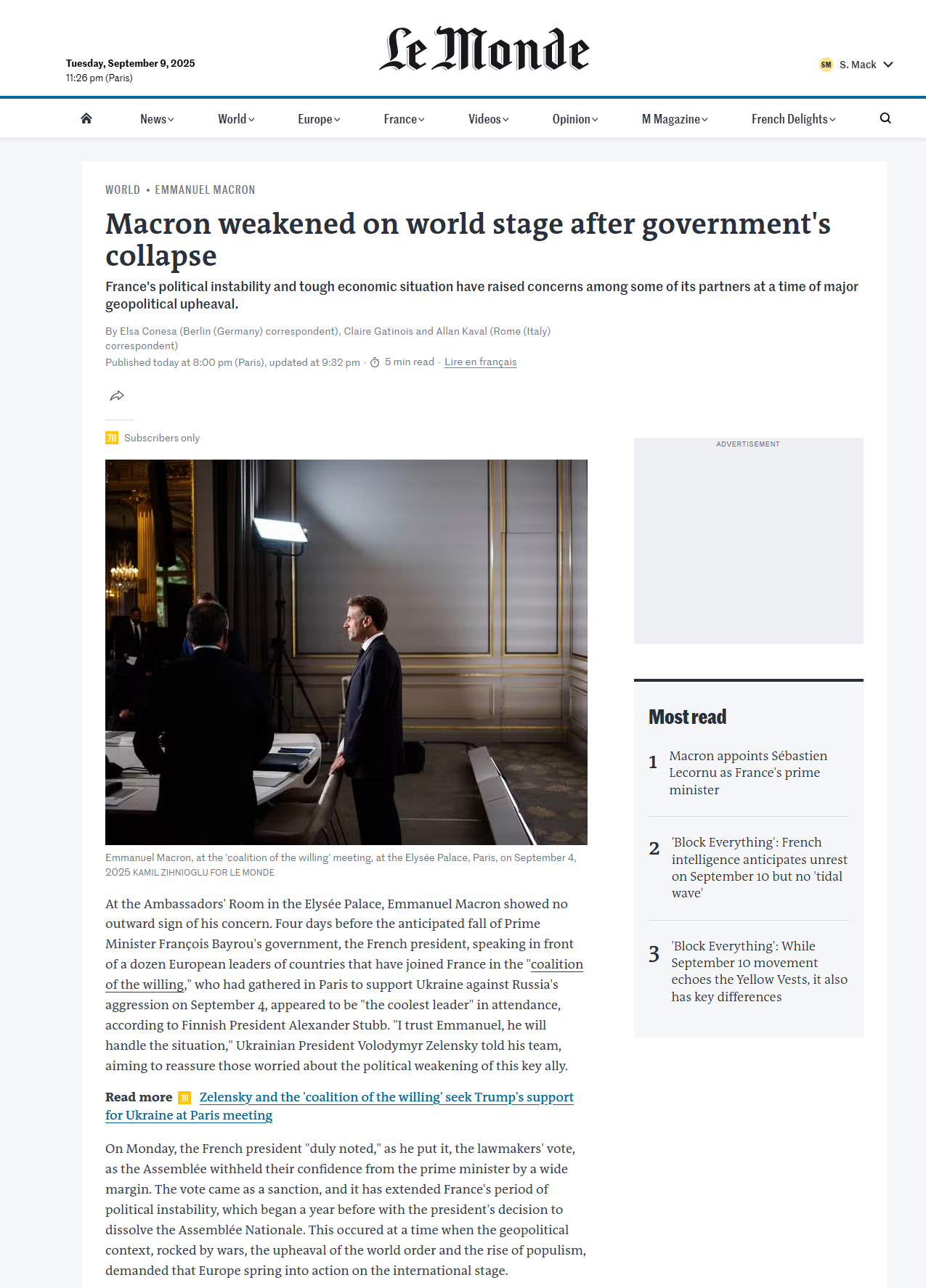
Once a star on the international stage, dubbed the “French Obama” in the US and “Wunderkind” in Germany, Macron is now described as one of the architects of the French decline: a phenomenon seen as a source of concern for some and of schadenfreude for others. The self-proclaimed reformer has “self-destructed,” summarized the magazine Der Spiegel on Friday, mocking the “grotesque discrepancy between words and deeds: So far, Paris has only granted Ukraine a total of €6 billion in military aid, less than countries like Denmark, the Netherlands or Sweden, which would never claim to play a role on the international scene. France is now a great power only in its president’s speeches.”
The incident also comes 15 days before the United Nations General Assembly, held in New York on September 22, at which the French president is due to recognize the State of Palestine. Macron hopes to revive the two-state solution, at a time when Israel is continuing its relentless bombing of the Gaza Strip. Meanwhile, Israeli officials have criticized Macron and seek to undermine his initiative, describing it as being led by a president who “doesn’t matter” anymore.
Investigation: ‘The Two Emmanuel Macrons’ (Part 1/4). The French president’s decision in June to dissolve the Assemblée Nationale provoked a major political crisis in France. Le Monde looks back in a series of articles at the leader’s puzzling evolution.
On November 16, 2016, a couple, she in sunglasses and leather pants, he in a slim-fitting black suit and thin matching tie, slipped incognito under the central gate and archways of the Basilica of Saint-Denis. Just after declaring his candidacy for the presidential election in the nearby Paris suburb of Bobigny, Emmanuel Macron, accompanied by his wife Brigitte, slipped away to secretly visit the tombs of the 43 kings of France. In the winter light filtering through the rose window of the south arm, the future president caressed the white marble of the recumbent sculpted figures.
For all those who take power, there’s an original scene. Saint-Denis is the crucible of France’s royal past, a key place in the national narrative. Other presidential candidates, lovers of history, had preceded Macron in drawing a piece of legitimacy from this magnetic pole of monarchical ambitions: François Mitterrand in the autumn of 1980; Jean-Luc Mélenchon, more quietly, in 2012.
On that day in November 2016, journalists and the embedded writer Philippe Besson, then busy writing his book Un personnage de roman (“A character from a novel”), missed Macron’s escapade. But on the way back, he confided to one of his early admirers, the journalist-blogger Bruno Roger-Petit, the meaning of his visit to Saint-Denis: Amid the “stones that speak,” he found himself “alone in his destiny.”
…
Editor: In the 3,522 words of the first part of their political essay, have Raphaëlle Bacqué, Ariane Chemin and Ivanne Trippenbach decided to rehabilitate Truman Capote’s non-fiction novel? Though their collective prose style seems mannered to an American Reader !
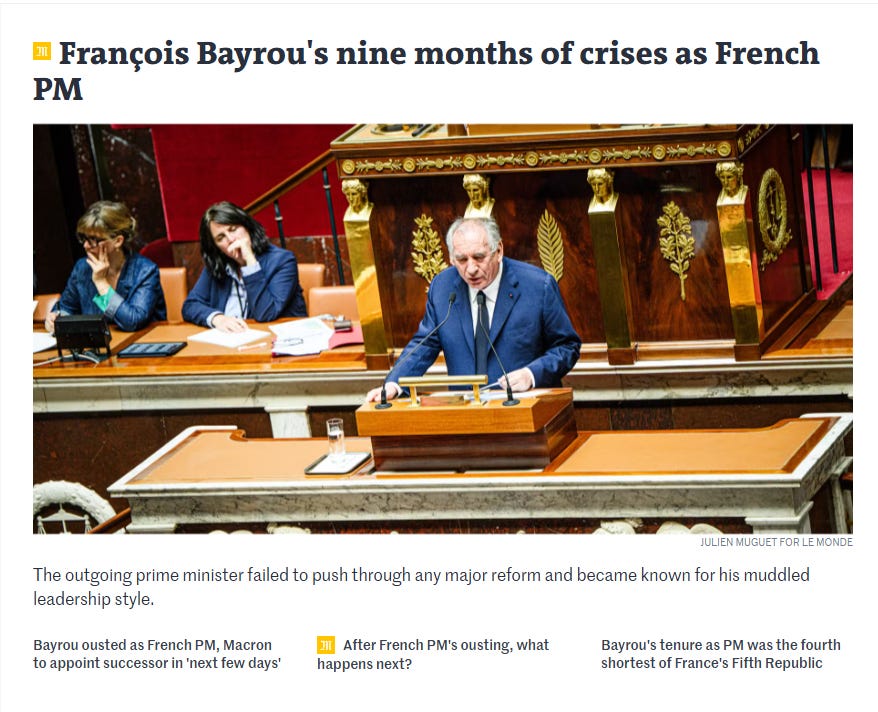
Headline: Bayrou ousted as French PM, Macron to appoint successor in ‘next few days’
Sub-headline: After just nine months in office, François Bayrou will have to hand in his resignation. His fall leaves President Emmanuel Macron searching for his seventh prime minister.
You can share an article by clicking on the share icons at the top right of it. The total or partial reproduction of an article, without the prior written authorization of Le Monde, is strictly forbidden. For more information, see our Terms and Conditions. For all authorization requests, contact syndication@lemonde.fr.
François Bayrou was ousted as prime minister on Monday, September 8, after losing a vote of confidence in the Assemblée Nationale. Bayrou and his government lost the vote by 364 votes to 194, with opposition parties uniting against him. He will submit his resignation to French President Emmanuel Macron early Tuesday, sources close to him told Agence France-Presse. The Elysée Palace said Macron will name a new prime minister “in the next days.”
Bayrou, who was on the job for just nine months, blindsided even his allies by calling a confidence vote to end the lengthy standoff over his austerity budget. He had unveiled his budget plan in July, which sought €44 billion in spending cuts over three years, including reductions in pension and healthcare spending. The proposals had triggered weeks of tense debate in Parliament and strong public criticism.
Bayrou was the sixth prime minister under Macron since the French president was first elected in 2017. Bayrou’s ousting leaves Macron with a new domestic headache at a time when he is leading diplomatic efforts on the Ukraine war.
Before the vote at the Assemblée Nationale, Bayrou defended his decision to call the high-risk confidence vote, telling MPs: “The biggest risk was not to take one, to let things continue without anything changing (…) and have business as usual.”
Describing the debt pile as “life-threatening” for France, Bayrou said his government had put forward a plan so that the country could “in a few years’ time escape the inexorable tide of debt that is submerging it.” “You have the power to overthrow the government,” but not “to erase reality,” said Bayrou.
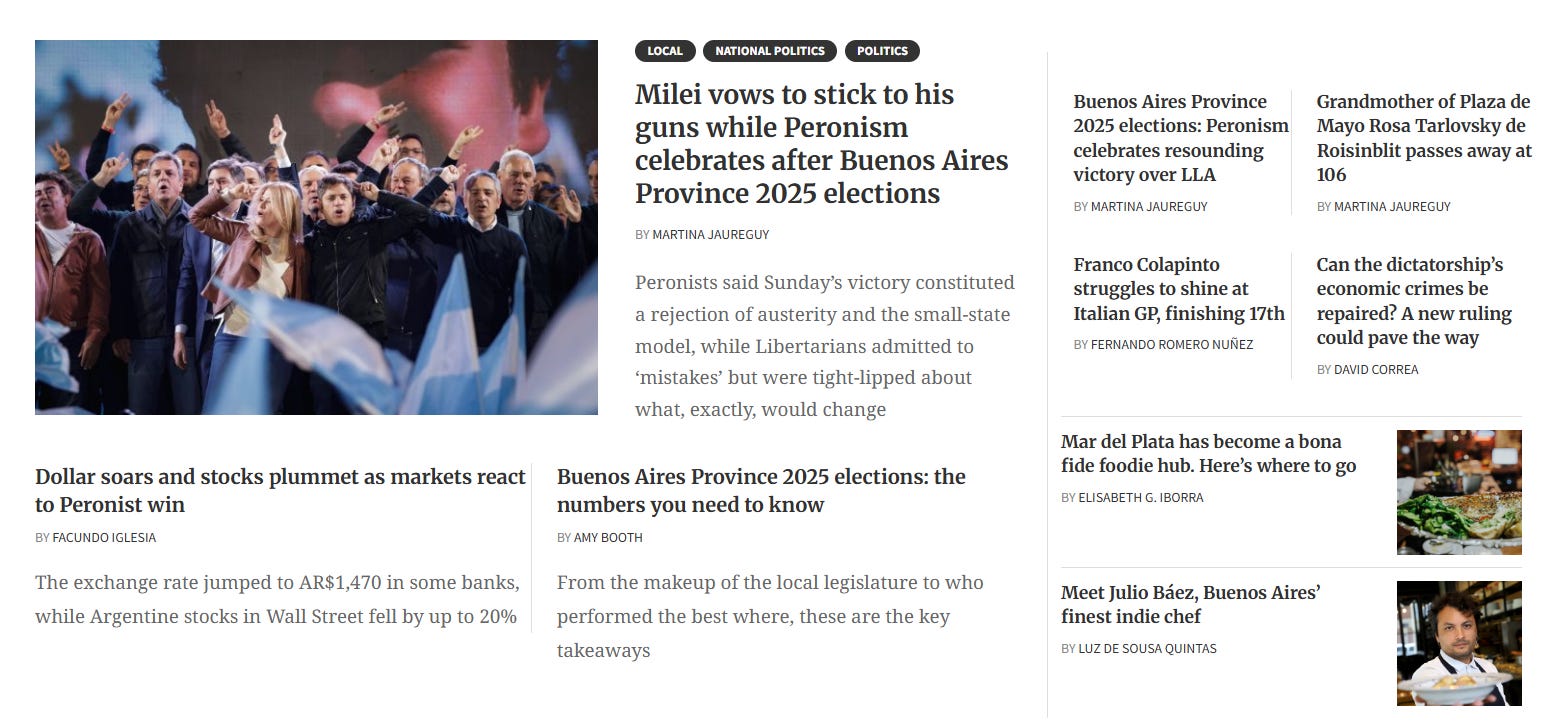
Peronists said Sunday’s victory constituted a rejection of austerity and the small-state model, while Libertarians admitted to ‘mistakes’ but were tight-lipped about what, exactly, would change.
The Supreme Court on Monday lifted a federal judge’s order prohibiting government agents from making indiscriminate immigration-related stops in the Los Angeles area that challengers called “blatant racial profiling.”
The court’s brief order was unsigned and gave no reasons. It is not the last word in the case, which is pending before a federal appeals court and may again reach the justices.
The court’s three liberal members dissented.
In the near term it allows what critics say are roving patrols of masked agents routinely violating the Fourth Amendment and what supporters say is a vigorous but lawful effort to enforce the nation’s immigration laws.
The lower courts had placed significant restrictions on President Trump’s efforts to ramp up immigrant arrests to achieve his pledge of mass deportations. Aggressive enforcement operations in Los Angeles — including encounters captured on video that appeared to be roundups of random Hispanic people by armed agents — have become a flashpoint, setting off protests and clashes in the area.
Civil rights groups and several individuals filed suit, accusing the administration of unconstitutional sweeps in which thousands of people had been arrested. They described the encounters in the suit as “indiscriminate immigration operations” that had swept up thousands of day laborers, carwash workers, farmworkers, caregivers and others.
“Individuals with brown skin are approached or pulled aside by unidentified federal agents, suddenly and with a show of force,” the complaint said, “and made to answer questions about who they are and where they are from,” violating the Fourth Amendment’s prohibition of unreasonable searches and seizures.
One plaintiff, Jason Brian Gavidia, a U.S. citizen born in East Los Angeles, was stopped by a masked agent while he was working on his car outside a tow yard. The encounter was captured on video.
The agent asked whether Mr. Gavidia was American, and he said he was.
The agent then asked what hospital Mr. Gavidia had been born in, and he said he did not know. According to the lawsuit, the agent and a colleague proceeded to slam Mr. Gavidia against a metal gate, twist his arm and seize his phone.
“Fearing for his life, Gavidia offered to show the agents his ID,” the lawsuit said. “The agents took the ID, and about 20 minutes later, returned Gavidia’s phone and set him free. They never returned his ID.”
In response to what she called a “mountain of evidence” of agents “indiscriminately rounding up numerous individuals without reasonable suspicion,” Judge Maame E. Frimpong, of the U.S. District Court for the Central District of California, ordered agents not to rely on several factors, alone or in combination, in deciding whom to stop and question in her judicial district, which includes Los Angeles and surrounding areas.
The factors were race or ethnicity; speaking Spanish or accented English; presence at a particular location, such as a day-laborer or agricultural site; or performing a particular type of work.
A three-judge panel of the U.S. Court of Appeals for the Ninth Circuit refused to pause the order issued by Judge Frimpong, who was appointed by President Joseph R. Biden Jr.
The administration then appealed to the Supreme Court. In an emergency application, D. John Sauer, the solicitor general, wrote that Judge Frimpong’s order had unlawfully hamstrung immigration enforcement in the nation’s most populous judicial district, one he said “harbors some two million illegal aliens out of its total population of nearly 20 million people, making it by far the largest destination for illegal aliens.”
Mr. Sauer added that federal agents used judgment and discretion.
“Needless to say,” Mr. Sauer wrote, “no one thinks that speaking Spanish or working in construction always creates reasonable suspicion. Nor does anyone suggest those are the only factors federal agents ever consider. But in many situations, such factors — alone or in combination — can heighten the likelihood that someone is unlawfully present in the United States, above and beyond the 1-in-10 base line odds in the district.”
The challengers drew a different conclusion from the area’s demographics, one they said “explains the damning record in this case.” The odds, they wrote, suggest that “the government’s roving patrols have routinely stopped U.S. citizens — including some plaintiffs — without an individualized assessment of reasonable suspicion.”
American Dissenter.
…
The American Mythology in the ‘Age of Fracture’ ? Reader forget the final chapter, historian Daniel T. Rodgers lost his nerve!
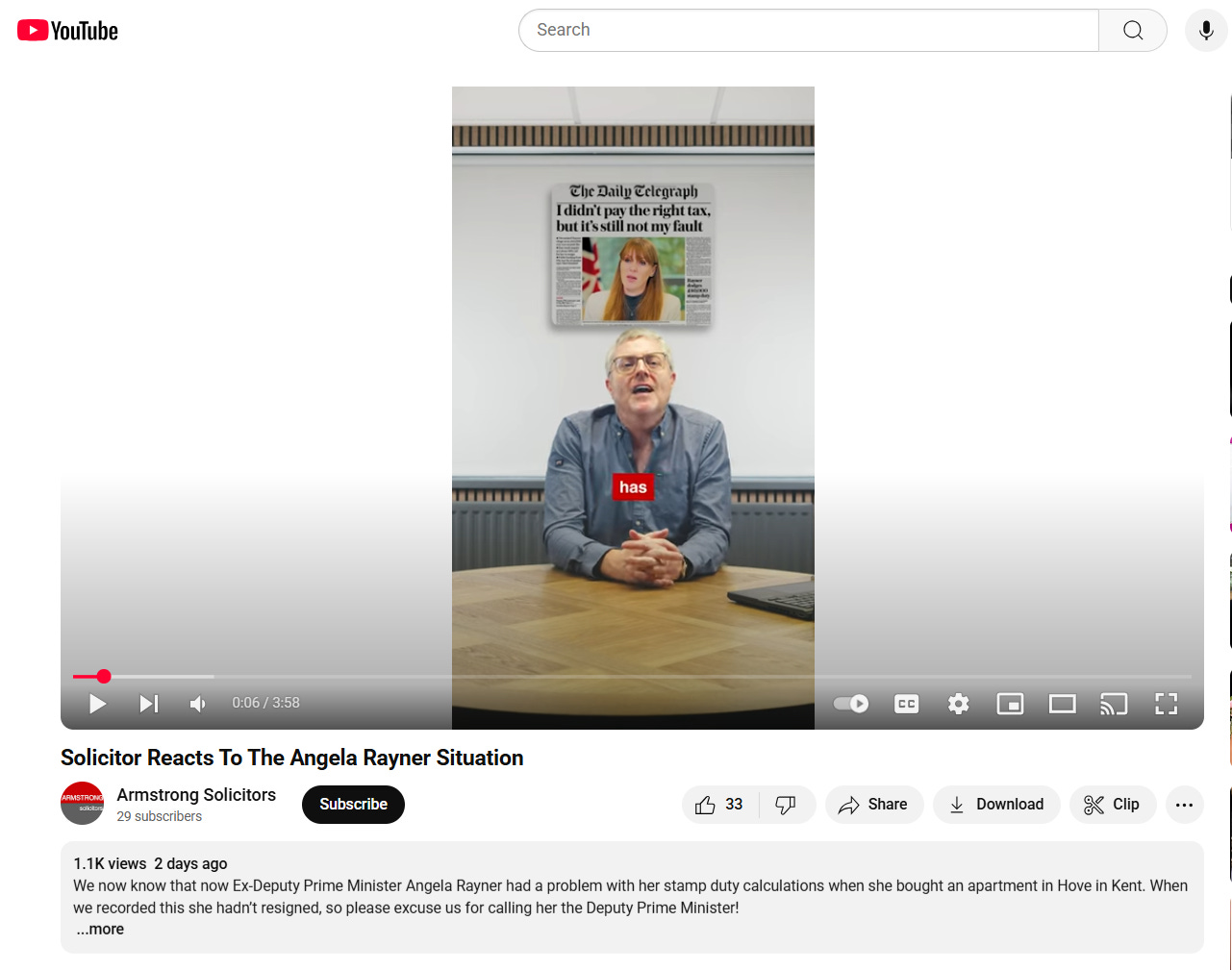
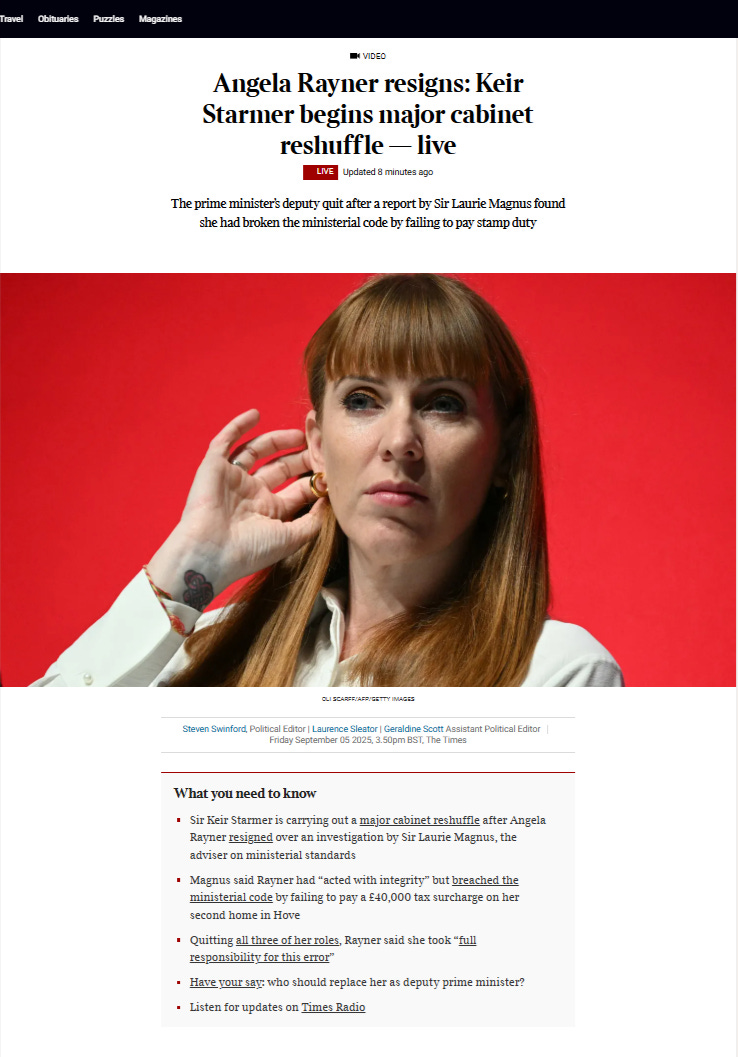
Editor: The Reader has to wonder at Mr. Robert Colvile political address of the Angela Rayner problem that closes his essay.
It not just Reeves that is trouble! In the final paragraphs of his essay Colevile mentions But for all Reform’s focus on migration — indeed, for all the wider farragos and fiascos that have assailed this government, Angela Rayner’s failure to get decent tax advice very much included — it is issues of the economy and cost of living upon which governments live and die. That is why, amid the extraordinary game of musical chairs played over the past week, both within No 10 and around the cabinet table, it is the woman who didn’t move who remains by far the most important to Starmer’s future.
The economy may be able to cling on until the budget. But if Reeves can’t square the circle on the public finances, things for this government — and for the country — will get even worse. No wonder Nigel is smiling quite so broadly.
…
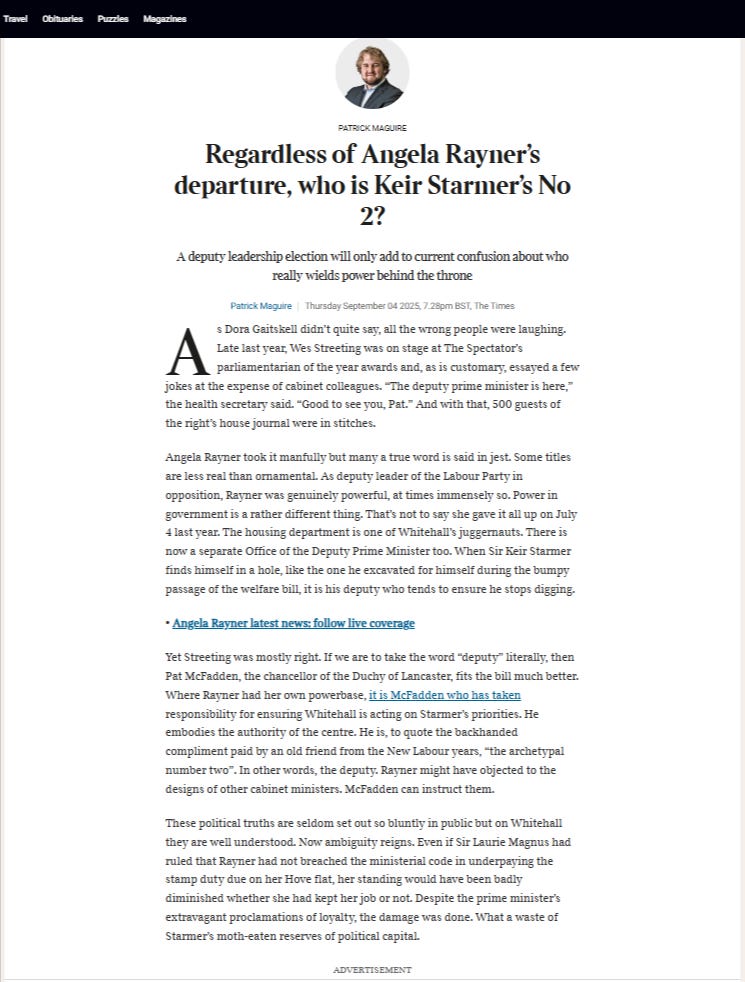
Editor: let me share with the reader just a portion, of the whole of the problems that definee the Starmer leadership! It’s like a political pastiche, in miniature, of David Cameron,Theresa May, Boris Johnson, Liz Truss, Rishi Sunak !
Editor : It’s impossible to find out Kapadia net worth! *Should the American reader wonder at the why of this choise by The Economists? The Reader just needs to fosus on his opening paragraphs and his political persona of ‘Jerry’ !
WE’VE ALL been at a party with a well-meaning but exhausting guest; let’s call him Jerry. Jerry’s stories meander without a clear point. He equivocates, laments past failures, complains about the status quo and offers no solutions for the future. He talks without listening. Everyone feels for Jerry, but no one wants to be around him. The vibes give everyone the ick.
Jerry’s predicament is exactly the bind Democrats find themselves in. They have lost the thread, and it is showing; of the 30 states that track voter registrations by party, the Democrats have lost ground in every single one of them over the past four years, with a negative voter-registration swing of 4.5m.
…
Editor : ‘Jerry’ is an untouchable exspesssed as ‘ick’ , concocted by Kapadia as the would be springboard, for his maladriot political chatter from a man of not just means, but the of wealth, that is a well kept secret! Kapadia and his ilk share in there contempt for this self-serving construct of ‘Jerry’. That is freighted by his political bad judgement: Kapadia who lacks the retorical skill to bring ‘Jerry’ to life except as straw man!
…
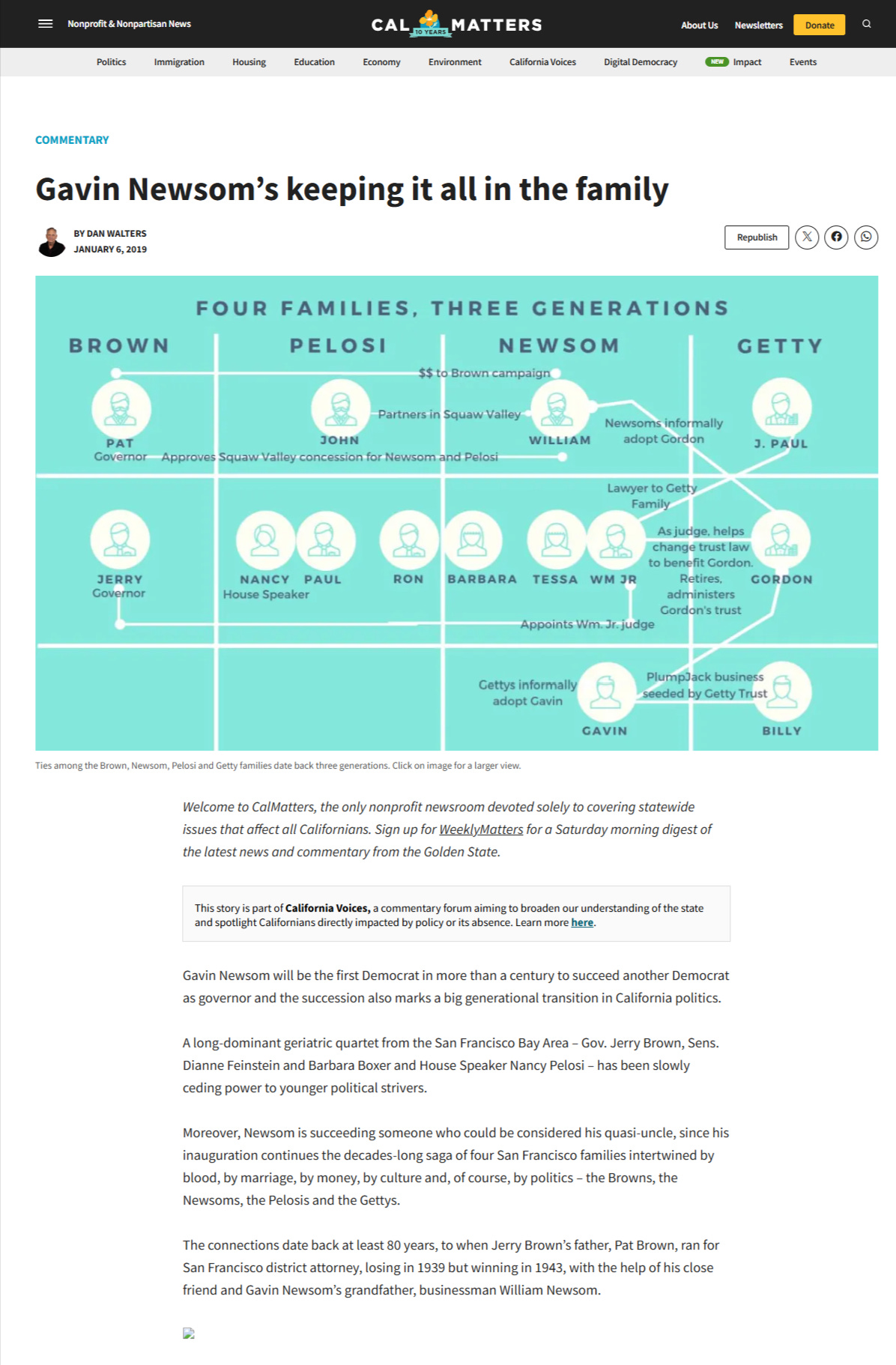
Editor: the next two paragraphs awash in wan political cliches, fails to mention The Clinton’s as corrupt Neo-Liberal actors that distroyed Glass-Stegal, of Obama of ‘lets put this all behind us’ and Simpson-Bowles, and the feckless senile Joe Biden that ushered in the Trump second term!The Clintons made the Democrtic Party Neo-Liberal! Old Money Gavin Newsom, now tears down Homeless Encampments, instead of advocating for the Poor!
The party that once embodied American optimism now sounds perpetually pessimistic. Where Democrats once championed growth and possibility, they now focus on managing decline and redistributing scarcity. They have become the party that explains why things can’t be done rather than the party that gets things done. Worse, they’ve become hopelessly reactive, always responding to whatever Republicans do instead of charting their own course.
To get their aura back, the Democrats need to listen to a fresh crop of leaders. It isn’t that hard; at cocktail parties and in politics people gravitate towards authenticity, optimism and those who listen and show respect for others. People lean away from those who make excuses, complain and patronise them. If the Democrats can harness their dynamic young talent and offer common-sense solutions that help Americans get on top of their most important issues, the vibes will be immaculate.
Editor: That ‘dynamic young talent’ is headed by Gavin Newsom!
Editor: Here is Gaurav Kapadia summation: the reader is almost reminded of Ronald Regans stump speecheds of 1980 ?
Ronald Reagan’s 1980 Neshoba County Fair speech
…
I believe in states’ rights; I believe in people doing as much as they can for themselves at the community level and at the private level. And I believe that we’ve distorted the balance of our government today by giving powers that were never intended in the constitution to that federal establishment. And if I do get the job I’m looking for, I’m going to devote myself to trying to reorder those priorities and to restore to the states and local communities those functions which properly belong there.
Americans want a party that believes the pie can grow bigger, not one that just argues about how to slice it smaller. This means getting stuff done: more homes built faster, more good jobs created, more paths to prosperity opened. Take housing. Young teachers can’t afford to live in the districts where they work. Nurses commute for two hours because homes near hospitals cost a fortune. Small-business owners can’t find workers because their employees can’t find places to live. Accepting the weaponisation of regulation by special interests in building housing and letting constituents fend for themselves has alienated voters. Democrats have let themselves get captured by every constituency except the most important one: people who need somewhere to live.
The same pattern crushes entrepreneurship. Lower-income workers and budding business-owners are being hobbled by conflicting and unreasonable rules and red tape. Hair-braiders in some states need 500 hours of training. New York City’s decade-long waiting lists for food-truck permits have created an illegal secondary market where aspiring vendors pay exorbitant rates to lease permits from existing holders. Democrats claim to champion the American Dream while making it harder to fulfil. When even democratic-socialist mayoral candidates call for slashing small-business regulations, maybe it’s time for the party to listen.
The required getting-things-done mindset extends beyond housing to every challenge Democrats claim to care about. Climate change? Stop blocking nuclear plants and transmission lines. Economic mobility? Cut the licensing requirements that keep people from starting businesses. Infrastructure? Build the roads and bridges instead of spending five years on environmental reviews for projects everyone agrees are needed.
Democrats need to embrace logical policies regardless of their source. If Republicans propose something that works, steal it and make it better. Immigration is a prime example. America’s asylum process is indeed broken; working across the aisle to fix it should be a priority. If business leaders identify regulatory barriers to job creation, fix them. If local mayors figure out how to cut permit times in half, scale their innovations nationally.
There are reasons for optimism. In Ohio, Democrat-led Cincinnati has pushed zoning reforms and set up a trust fund to make it easier for families to find affordable homes. In Maryland, a “Feds to Eds” programme helps ease teacher shortages by fast-tracking teaching licences for laid-off federal workers. Across the country, younger Democratic leaders are showing that efficiency, pragmatism and partnership with business can produce results.
Democrats have a choice: embrace the vanguard of leaders who make things work, or remain the party that excuses away why they don’t. Americans are exhausted by broken systems and frustrated by leaders who seem to ignore or misunderstand their complaints. They want less process and more progress.
The party that figures out how to be both principled and practical, both compassionate and competent, will own the next generation of American politics. The party that doesn’t will find itself exactly where Jerry always ends up: talking to an empty room while everyone else has moved on to better conversations.
Editor: Gaurav Kapadia leaves no political cliche at rest. Yet this Reader finds his essay that could have been recorded by a Dictaphone, and reviewed by his auditeor and finalized by Mr. Kapadia! This Reader finds Mr. Kapadia essay tepid at best!
American Reader.
*According to TipRandks Gaurav Kapadia net worth is $3.12B!
It’s early on a January morning in 1979, I’m 10 years old, and the adventure is about to begin.
My alarm jolts me awake. Snow is falling outside, and my mother tells me that school is canceled. We canceled school every time it snowed in Kentucky, and for me, that was always the best possible news. I grab my winter gear, scarf down some Cheerios, and then I’m off. “Bye, Mom,” I say. “I’m going to Brent’s house,” and that’s the last she sees of me for about 10 hours — until I’m home for family dinner.
The day starts with a pickup hockey game on a frozen pond in our neighborhood and then moves to snow football in Brent’s backyard. We play for hours, and we’re almost ready to go inside for some hot chocolate when we hear the ultimate siren song for a young boy’s brain — go-karts racing in an open field.
We run over and beg to take turns competing on a makeshift dirt track, driving as fast as we can for as long as we can. No one wears helmets. No adults are in sight. And then, with our fingers and toes so cold that we can barely feel them, we hobble back inside — just in time for dinner.
“How was your day?” my mother would ask. “Fun,” I’d respond, and I’d regale my family with tales of my athletic exploits. I’d smooth out the rough edges. I wouldn’t tell them about the minor fistfight over late tackles in the snow football game, or the fact that Jeff drove one of the go-karts into a tree (he was fine; there was only a little blood).
I’d end the day exhausted, happy — and praying fervently that the snow would keep falling. I lost our snow football game, and I needed to get my revenge.
…
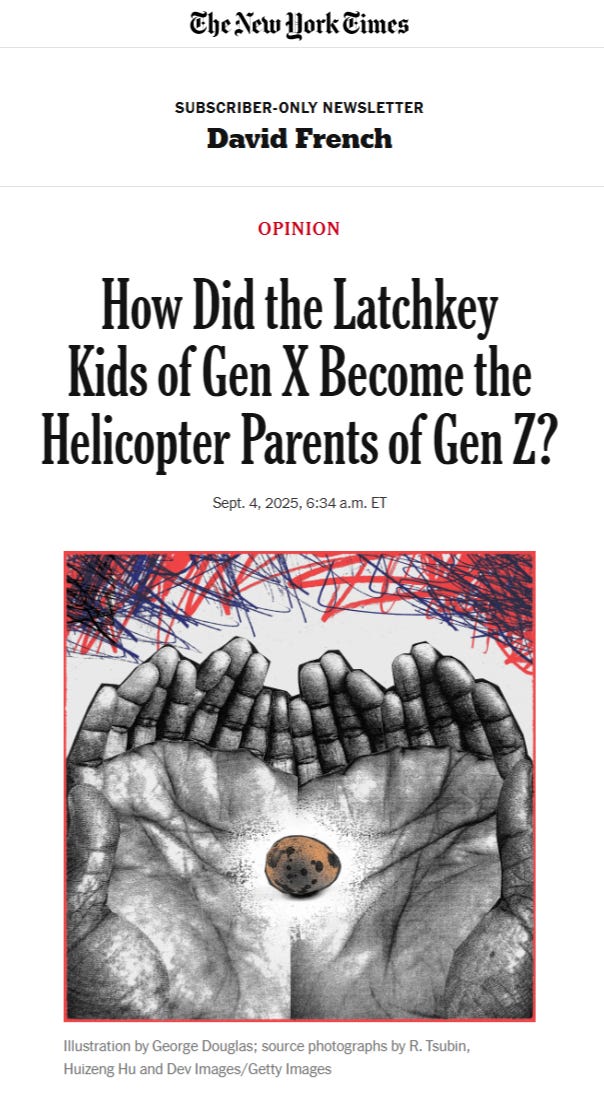
French’s essay blossoms, like a thirty minute black and white television Family Comedy, via an esatz Sociological Study… Reader think of David Brooks ‘The Road to Character’ & ‘The Social Animal’ merde!
…
My memory tracks the story that Gen X likes to tell about itself. We’ve been called the least-parented generation in American history, with some justification. It’s not just that we were free-range kids — given permission to roam our neighborhoods at will. Then, independent childhoods were the norm. But we were also the first peacetime generation that grew up with two working parents as a normal part of life, and we were the first generation to live with the consequences of widespread divorce and single parenting, which at that time meant almost entirely single mothers.
In other words, we weren’t experiencing fantastic adventures as much as many of us were experiencing loneliness and abandonment. All across America, young kids would get off their school buses, unlock their houses and fend for themselves for hour after hour, until Mom or Dad came home from work. We were, in the phrase that launched a thousand newsweekly covers, latchkey kids.
My parents exerted tremendous efforts to make sure that one of them was home when my sister and I came home from school, so my latchkey experience is measured in weeks and months, not years, like it was for many of my friends.
For me, the experience was benign, fun even. I was too much of a rule-following nerd to get into real trouble. So my life during those afternoons after school mainly consisted of challenging my neighbor Rob to chess matches and one-on-one basketball games.
…
Editor : Reader prepare yourself for an avilanch of 1548 words, even Newton’s third law of motion is dragooned! Mr. French’s ‘essay’ is deserving of a stinging retorical brevity!
Political Observer.
Editor: In lieu of actual Sociology, Mr. French engages in a New York Times version, pionered by David Brooks? Not to forget that French trades in the territory of Philip Wylie of another time, place and discusive framing, that puts the blame Generationaly, rather than on ‘Momism’. The Reader might ask is there a propinquity?
The Man Who Hated Moms: Looking Back on Philip Wylie’s “Generation of Vipers”
Wylie’s moms were middle-aged and menopausal Cinderellas, hirsute and devoid of sex appeal.
Generation of Vipers (whose full title is Generation of Vipers: A Survey of Moral Want • A Philosophical Discourse suitable only for the Strong • A Study of American Types and Archetypes • And A Signpost on the two Thoroughfares of Man: the Dolorosa and the Descensus Averno • Together with sundry Preachments, Epithets, Modal Adventures, Political Impertinences, Allegories, Aspirations, Visions and Jokes as well as certain Homely Hints for the care of the Human Soul) sold terrifically when it hit bookstores in January 1943, thanks to the endorsement given it the week before publication by popular columnist Walter Winchell. The first printing of 4,000 copies sold out in a week, and the book just kept selling. Vipers went through 11 printings in 1943 alone and went on to sell 180,000 copies in hardcover by 1954. In 1950, the American Library Association named Generation of Vipers one of the 50 most influential and important books of the last 50 years.
“Mom,” Wylie begins the chapter “Common Women,” “is an American creation. Her elaboration was necessary because she was launched as Cinderella.” Here Wylie refers to an earlier chapter in which he explained how American women were inculcated in a distorted version of the fairy tale that conditioned them to expect material wealth, not because of virtuous activities but merely because they were female. “The idea women have that life is marshmallows which will come as a gift — an idea promulgated by every medium and many an advertisement — has defeated half the husbands in America,” Wylie wrote. “It has made at least half our homes into centers of disillusionment. […] It long ago became associated with the notion that the bearing of children was such an unnatural and hideous ordeal that the mere act entitled women to respite from all other physical and social responsibility.” He went on:
Past generations of men have accorded to their mothers, as a rule, only such honors as they earned by meritorious action in their individual daily lives. Filial duty was recognized by many sorts of civilizations and loyalty to it has been highly regarded among most peoples. But I cannot think, offhand, of any civilization except ours in which an entire division of living men has been used, during wartime, or at any time, to spell out the word “mom” on a drill field, or to perform any equivalent act.
This was an example of the sort of “Megaloid” mom worship that Wylie dubbed “Momism.”












 StephenKMackSD's Blog