The fact that the whole American political class is now the captive of AIPAC and Adelson money are facts! A selective report gathered from Le Monde:
The warning was direct, blunt and left no room for doubt. “We expect all ICC actions against the United States and our ally Israel – that is, all investigations and all arrest warrants – to be terminated,” said Reed Rubinstein, legal adviser at the US State Department, before delegates of the 125 member states of the International Criminal Court (ICC) on Tuesday, July 8, at a meeting at United Nations headquarters in New York from July 7 to 9. If the ICC arrest warrants for crimes against humanity and war crimes issued against Israeli Prime Minister Benjamin Netanyahu and former defense minister Yoav Gallant on November 21, 2024, as well as ongoing investigations into crimes committed in the Gaza Strip and the settlement of Palestinian territory, are not dropped, “all options remain on the table,” he declared.
For three days, member states debated expanding ICC jurisdiction to one day allow the prosecution of “crimes of aggression,” defined as attacking a territory without a UN mandate or without acting in self-defense. The crime, which primarily targets heads of state, was described as a “crime against peace” by the Allies at the Nuremberg Trials of Nazi leaders after World War II. Invited as a non-member, the US used the platform to criticize the ICC and threaten its 125 member states. “We will use all appropriate and effective diplomatic, political and legal instruments to block ICC overreach,” Rubinstein said.
…
On Wednesday, US Secretary of State Marco Rubio announced sanctions against Francesca Albanese, UN special rapporteur on the occupied Palestinian territories, “for her illegitimate and shameful efforts to prompt [ICC] action against US and Israeli officials, companies and executives.” On June 30, the Italian law expert published a report on the “economy of genocide” in Gaza, warning around 60 companies of the risk of becoming “criminally complicit” in Israeli crimes.
…
Editor: Le Monde doesn’t just muddle the Question of Ukraine, but seeks to avoid the question of American , E.U. and other bad actors, Soros, as responsible parties in the maufatured coup, and the resulting war that continues to this day!
Mr. Tomasky’s potted history of the dismal failure ‘Third Party Candiates’ in American Elections, is about the Self-Rescue Project of The New Democrats, still led by the Clinton ménage. Hillary Clinton could not win an election against Trump! Yet Tomasky posits that somehow Musk is different, in a 1457 word potted history of failures, false starts and wishful thinking, that somehow Trump can be deafeated? Musk is a self- infatuated megalomaniac and subject to toxic moods and political retreats aided by reinvetions ?
Editor: Tomasky posits this:
I saw a lot of chortling after Elon Musk’s announcement last week that he intends to start a third party, the America Party. Chortle away if you like. But this effort, at least according to what Musk said his goals are, is completely different from other third-party bids in recent U.S. history, and I’ve been amazed these last couple of days at how few people seem to understand that.
Editor: Tomasky self-presents as above all other political commetators, in his vision of a possible Musk future? The Reader might think/ask in this examinations of Musks grand strategies, via Histories provided by Tomansky, about the victory of Zohran Mamdani, a Muslim Democratic Socialist, won the New York City Democratic mayoral primary on June 24, 2025? The Macro and the Micro meet at what crossing?
…
I saw a lot of chortling after Elon Musk’s announcement last week that he intends to start a third party, the America Party.
…
Third parties in the United States are jokes for one simple reason: They are built around presidential candidacies. That is a ridiculous goal, and it always has been.
…
Let’s look at the most successful third-party presidential candidate in modern American history: Ross Perot in 1992. He struck a nerve among folks who were then referred to collectively as “the radical center.”
…
However: In electoral terms, Perot was a joke. He won zero Electoral College votes. In fact, he didn’t come remotely close to winning a single electoral vote. He finished third in every state.
Editor: Yet the Perot vote gave the edge to Bill Clinton!
…
This is why that overhyped No Labels nonsense from 2024, which got a lot of silly press, was ridiculous (and run by hustlers, picking the pockets of gullible, ill-informed rich people).
…
But the presidency is not Musk’s goal. He posted on July 4 that his goal would be “to laser-focus on just 2 or 3 Senate seats and 8 to 10 House districts.”
Editor: The Musk’s strategy is that of an insergency, not of a Third Party nor of a ‘radical center’.
Editor: Tomasky begins his self-congratulation!
Now that is a different kettle of fish.
…
First, the obstacles. They’re formidable. There’s this thing in political science called Duverger’s law. French political scientist Maurice Duverger studied party systems in the 1950s and found that countries that elect their legislatures in winner-take-all single-member districts (as we do in the United States) tend to narrow down to having two parties.
…
So let’s apply Duverger’s law to Musk’s effort. He’s going to be fielding candidates under his America Party banner in a handful of (presumably) carefully chosen congressional districts. The question is, can an America Party candidate for the House win 34 percent of the vote in a three-way general election?
…
Editor: Here is where Tomasky reaches his political stride, between these two paragraphs?
…
The answer is: It won’t be easy, but it also isn’t impossible. First of all, it has happe;ned. Bernie Sanders and Angus King are independent senators. Both first made it to Washington—King to the Senate in 2012, Sanders to the House back in 1990—by beating Democratic and Republican opponents.
…
Musk’s agenda right now seems to be radical libertarian. That will appeal to his uber-rich tech bro friends, but it won’t peel away enough Republicans to win a House seat. He needs to find a couple MAGA Achilles’ heels and build a platform around them. (Also, if Musk’s platform is essentially libertarian, it raises the question of why he doesn’t plow his resources into the existing Libertarian Party, as it so desires.)
…
Editor: Tomasky revels in the ‘discovery’ of the Musk’s Political Methodology! Yet how can the politics of the political moment be changed permanently ? Does Musk have the political staying power, or the commitment to wage such a battle over time? Or will his interest fade with time, and the new vistas of Space Travel’s challendes present themselves?
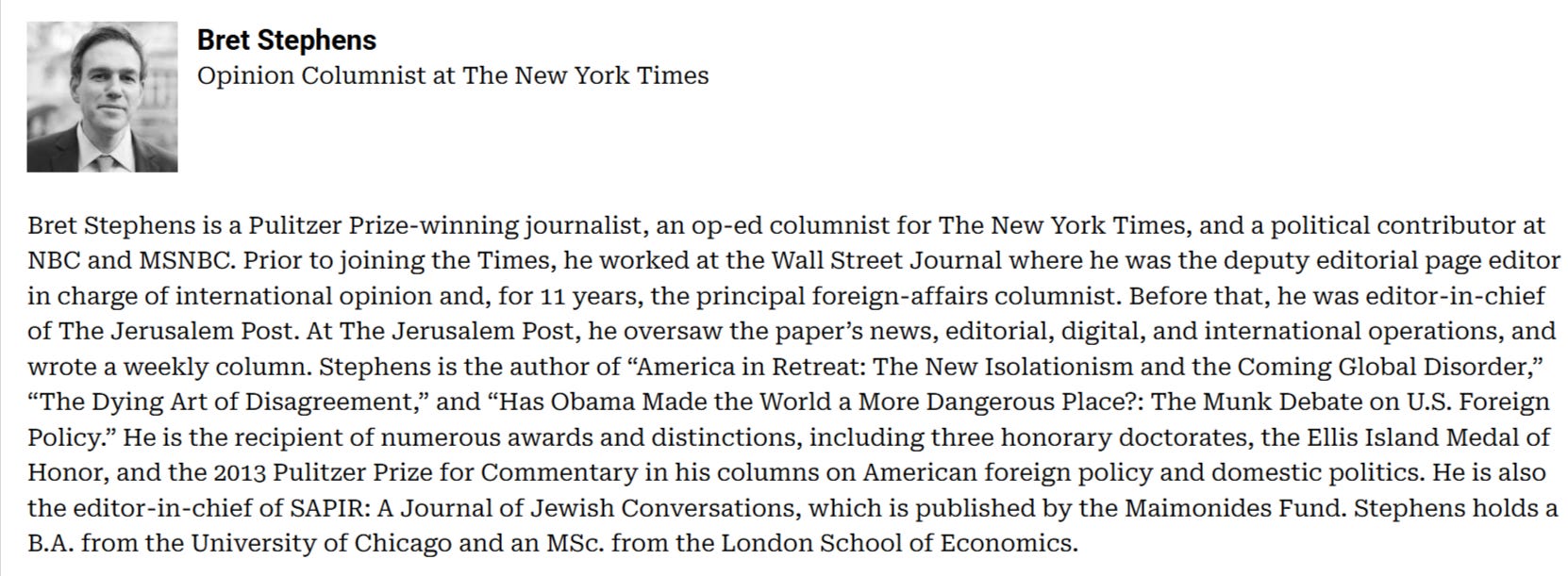
Desides the insults reservered for Greta Thunberg, Zohran Mamdani and Tucker Carlson, Bret Stephens in not a man of wit nor sensibility!
Editor: I’ll begin my comentary at this point in Stephens commentary. It can’t escape its authors singular motive, propganda!
On Israel’s side, diplomatic flexibility has three authors. The first is the Israeli public’s understandable exhaustion with 21 months of fighting. The second is pressure from Trump to reach a deal — and Netanyahu’s eagerness to please him.
But neither factor would have been sufficient if Israel hadn’t achieved its military success over Iran, crowned, from an Israeli point of view, by America’s participation in the campaign.
At a stroke, Israel humiliated its most formidable adversary (and Hamas’s principal patron), demonstrating not only its capacity but also its courage to take on the mullahs directly and survive their reprisals intact. It advertised its capabilities to Saudi Arabia, which may now be more amenable to joining the Abraham Accords — not out of a softhearted desire for peace but out of a hardheaded interest in cementing military, economic and technological ties with the Jewish state. It created at least the possibility that Iran might choose to forgo its nuclear ambitions out of fear of seeing them destroyed again. And its victory gave Netanyahu the upper hand over his far-right coalition partners, allowing him to sign a deal that probably wouldn’t cause his government to collapse.
Critics of Israeli policy have argued that the cost of its military victories lies in its isolation on the world stage or in the contempt in which it is held by people like Zohran Mamdani and Tucker Carlson. There’s also no doubt that hatred of Israel has done much to contribute to growing antisemitism, although it’s equally true that antisemitism lies at the root of much of the hatred of Israel.
Then again, Israel doesn’t exist to placate the feelings of its detractors and defamers. It exists to protect Jewish life and uphold Jewish dignity in a world too intent on destroying both. If diplomacy now has a chance of succeeding, it’s because in geopolitics, as in life, it pays to be a winner.
Editor : The Reader must never forget that in the imagination of Mr. Stephens, Zionism and Juadism are a political and moral singularity! Or that Stephens in a child of hight privelidge: Middlesex School in Concord, Massachusetts, University of Chicago and comparative politics at the London School of Economics. Nor can it escape the attention of the reader that he worked for the The Jerusalem Post, The Wall Street Journal and The New York Times? The reader might ask at what moment does Stephens confront the stark reality of the Gaza Genocide, as historical moral fact?
Headline: Justice Ketanji Brown Jackson Makes Herself Heard, Prompting a Rebuke
Sub-headline: In solo dissents this term, the justice accused the conservative majority of lawless bias. On the term’s last day, Justice Amy Coney Barrett fired back.
Editor: The first paragraphs of Adam Liptak scolding chatter? Steeped in animus toward the newist member of the Court, is unsurprising, this is The New York Times!
Justice Ketanji Brown Jackson wrote just five majority opinions in the Supreme Court term that ended last month, the fewest of any member of the court. But her voice resonated nonetheless, in an unusually large number of concurring and dissenting opinions, more than 20 in all.
Several of them warned that the court was taking lawless shortcuts, placing a judicial thumb on the scale in favor of President Trump and putting American democracy in peril. She called the majority’s opinion in the blockbuster case involving birthright citizenship, issued on the final day of the term, “an existential threat to the rule of law.”
Justice Jackson, 54, is the court’s newest member, having just concluded her third term. Other justices have said it took them years to find their footing, but Justice Jackson, the first Black woman to serve on the court, quickly emerged as a forceful critic of her conservative colleagues and, lately, their approach to the Trump agenda.
Her opinions, sometimes joined by no other justice, have been the subject of scornful criticism from the right and have raised questions about her relationships with her fellow justices, including the other two members of its liberal wing.
Editor: In sum Justice Jackson has overstepped the bounds of deference to the senior members of the Court?
The History of the Neo-Confederate Supreme Court is well Documented, and its holdovers
On Wednesday, the five partisan Republicans on the U.S. Supreme Court showed that they wanted to do their part in devaluing the votes of blacks, Hispanics, Asian-Americans and young urban whites. So the key GOP justices indicated during oral arguments that they are looking for excuses to strike down the heart of the Voting Rights Act.
Right-wing Justice Antonin Scalia shocked the courtroom when he dismissed the Voting Rights Act as a “perpetuation of racial entitlement,” suggesting that the right of blacks to vote was some kind of government handout.
But almost as troubling was the remark from Justice Anthony Kennedy who insisted that the Voting Rights Act, which was first enacted by Congress in 1965 and was renewed overwhelmingly in 2006, was an intrusion on Alabama as an “independent sovereign,” states’ rights language reminiscent of the Old Confederacy.
Indeed, the five Republican justices also including John Roberts, Clarence Thomas and Samuel Alito seem to have absorbed a Neo-Confederate interpretation of the Constitution that is at odds with what the Framers intended.
Editor: Freighted with respectable bourgeois political chatter, here is the would-be ‘Bill of Attainder’ against Justice Jackson, confected by Liptak!
Justice Jackson, who did not respond to a request for comment, has also been a harsh critic of the court’s use of truncated procedures in ruling on emergency applications.
“This fly-by-night approach to the work of the Supreme Court is not only misguided,” she wrote in April, when the court said that Venezuelan men the administration was seeking to deport to El Salvador had sued in the wrong court. “It is also dangerous.”
In a dissent from an emergency ruling in June granting Elon Musk’s Department of Government Efficiency access to sensitive Social Security data, Justice Jackson accused the majority of giving Mr. Trump favored treatment. “What would be an extraordinary request for everyone else,” she wrote, “is nothing more than an ordinary day on the docket for this administration.”
When the court let Mr. Trump lift humanitarian parole protections for more than 500,000 migrants in May, Justice Jackson wrote that the majority had “plainly botched” the analysis, “rendering constraints of law irrelevant and unleashing devastation.”
Justices Jackson and Sotomayor are the only members of the court who have served as trial judges. In the last term, Justice Jackson repeatedly criticized the majority for undermining the authority of their colleagues on the front lines.
In the dissent that prompted Justice Barrett’s rebuke, she decried the majority’s “dismissive treatment of the solemn duties and responsibilities of the lower courts.”
“Officials who use their public positions for private gain threaten the integrity of our most important institutions,” she wrote. “Greed makes governments — at every level — less responsive, less efficient and less trustworthy from the perspective of the communities they serve.”
Editor: How uttery inconveient for a sitting Justice of The Supreme Court , Justice Jackson, to remind the other members of the Court, that she is capable of telling critical evaliations of their corrupt practises?
“Coverage today is based on decades-old data and eradicated practices. The formula captures States by reference to literacy tests and low voter registration and turnout in the 1960s and early 1970s. But such tests have been banned nationwide for over 40 years. §6, 84Stat. 315; §102, 89Stat. 400. And voter registration and turnout numbers in the covered States have risen dramatically in the years since. H. R. Rep. No. 109–478, at 12. Racial disparity in those numbers was compelling evidence justifying the preclearance remedy and the coverage formula. See, e.g., Katzenbach, supra, at 313, 329–330. There is no longer such a disparity.
In 1965, the States could be divided into two groups: those with a recent history of voting tests and low voter registration and turnout, and those without those characteristics. Congress based its coverage formula on that distinction. Today the Nation is no longer divided along those lines, yet the Voting Rights Act continues to treat it as if it were.
B
The Government’s defense of the formula is limited. First, the Government contends that the formula is “reverse-engineered”: Congress identified the jurisdictions to be covered and then came up with criteria to describe them. Brief for Federal Respondent 48–49. Under that reasoning, there need not be any logical relationship be-tween the criteria in the formula and the reason for coverage; all that is necessary is that the formula happen to capture the jurisdictions Congress wanted to single out.
The Government suggests that Katzenbach sanctioned such an approach, but the analysis in Katzenbach was quite different. Katzenbach reasoned that the coverage formula was rational because the “formula . . . was relevant to the problem”: “Tests and devices are relevant to voting discrimination because of their long history as a tool for perpetrating the evil; a low voting rate is pertinent for the obvious reason that widespread disenfranchisement must inevitably affect the number of actual voters.” 383 U. S., at 329, 330.
Here, by contrast, the Government’s reverse- engineering argument does not even attempt to demonstrate the continued relevance of the formula to the problem it targets. And in the context of a decision as significant as this one—subjecting a disfavored subset of States to “extraordinary legislation otherwise unfamiliar to our federal system,” Northwest Austin, supra, at 211—that failure to establish even relevance is fatal.
The Government falls back to the argument that because the formula was relevant in 1965, its continued use is permissible so long as any discrimination remains in the States Congress identified back then—regardless of how that discrimination compares to discrimination in States unburdened by coverage. Brief for Federal Respondent 49–50. This argument does not look to “current political conditions,” Northwest Austin, supra, at 203, but instead relies on a comparison between the States in 1965. That comparison reflected the different histories of the North and South. It was in the South that slavery was upheld by law until uprooted by the Civil War, that the reign of Jim Crow denied African-Americans the most basic freedoms, and that state and local governments worked tirelessly to disenfranchise citizens on the basis of race. The Court invoked that history—rightly so—in sustaining the disparate coverage of the Voting Rights Act in 1966. See Katzenbach, supra, at 308 (“The constitutional propriety of the Voting Rights Act of 1965 must be judged with reference to the historical experience which it reflects.”).
But history did not end in 1965. By the time the Act was reauthorized in 2006, there had been 40 more years of it. In assessing the “current need[ ]” for a preclearance system that treats States differently from one another today, that history cannot be ignored. During that time, largely because of the Voting Rights Act, voting tests were abolished, disparities in voter registration and turnout due to race were erased, and African-Americans attained political office in record numbers. And yet the coverage formula that Congress reauthorized in 2006 ignores these developments, keeping the focus on decades-old data rel-evant to decades-old problems, rather than current data reflecting current needs.”
“The situation Congress faced in 2006, when it took up reauthorization of the coverage formula, was not the same. By then, the formula had been in effect for many years, and all of the jurisdictions covered by it were “familiar to Congress by name.” Id., at 328. The question before Congress: Was there still a sufficient basis to support continued application of the preclearance remedy in each of those already-identified places? There was at that point no chance that the formula might inadvertently sweep in new areas that were not the subject of congressional findings. And Congress could determine from the record whether the jurisdictions captured by the coverage for-mula still belonged under the preclearance regime. If they did, there was no need to alter the formula. That is why the Court, in addressing prior reauthorizations of the VRA, did not question the continuing “relevance” of the formula.
Consider once again the components of the record before Congress in 2006. The coverage provision identified a known list of places with an undisputed history of serious problems with racial discrimination in voting. Recent evidence relating to Alabama and its counties was there for all to see. Multiple Supreme Court decisions had upheld the coverage provision, most recently in 1999. There was extensive evidence that, due to the preclearance mechanism, conditions in the covered jurisdictions had notably improved. And there was evidence that preclearance was still having a substantial real-world effect, having stopped hundreds of discriminatory voting changes in the covered jurisdictions since the last reauthorization. In addition, there was evidence that racial polarization in voting was higher in covered jurisdictions than elsewhere, increasing the vulnerability of minority citizens in those jurisdictions. And countless witnesses, reports, and case studies documented continuing problems with voting dis-crimination in those jurisdictions. In light of this rec- ord, Congress had more than a reasonable basis to conclude that the existing coverage formula was not out of sync with conditions on the ground in covered areas. And certainly Shelby County was no candidate for release through the mechanism Congress provided. See supra, at 22–23, 26–28.
The Court holds §4(b) invalid on the ground that it is “irrational to base coverage on the use of voting tests 40 years ago, when such tests have been illegal since that time.” Ante, at 23. But the Court disregards what Congress set about to do in enacting the VRA. That extraordinary legislation scarcely stopped at the particular tests and devices that happened to exist in 1965. The grand aim of the Act is to secure to all in our polity equal citizenship stature, a voice in our democracy undiluted by race. As the record for the 2006 reauthorization makes abundantly clear, second-generation barriers to minority voting rights have emerged in the covered jurisdictions as attempted substitutes for the first-generation barriers that originally triggered preclearance in those jurisdictions. See supra, at 5–6, 8, 15–17.
The sad irony of today’s decision lies in its utter failure to grasp why the VRA has proven effective. The Court appears to believe that the VRA’s success in eliminating the specific devices extant in 1965 means that preclearance is no longer needed. Ante, at 21–22, 23–24. With that belief, and the argument derived from it, history repeats itself. The same assumption—that the problem could be solved when particular methods of voting discrimination are identified and eliminated—was indulged and proved wrong repeatedly prior to the VRA’s enactment. Unlike prior statutes, which singled out particular tests or devices, the VRA is grounded in Congress’ recognition of the “variety and persistence” of measures designed to impair minority voting rights. Katzenbach, 383 U. S., at 311; supra, at 2. In truth, the evolution of voting discrimination into more subtle second-generation barriers is powerful evidence that a remedy as effective as preclearance remains vital to protect minority voting rights and prevent backsliding.
Beyond question, the VRA is no ordinary legislation. It is extraordinary because Congress embarked on a mission long delayed and of extraordinary importance: to realize the purpose and promise of the Fifteenth Amendment. For a half century, a concerted effort has been made to end racial discrimination in voting. Thanks to the Voting Rights Act, progress once the subject of a dream has been achieved and continues to be made.”
Headline: MPs like Corbyn won’t be prosecuted for Palestine Action support
Sub-headline: The former Labour leader and fellow PA advocates such as Diane Abbott will not be punished for expressing support in the chamber due to parliamentary privilege
MPs will avoid prosecution if they support Palestine Action while speaking in the House of Commons even after the group is proscribed as a terror group.
Parliamentary privilege will protect them from prosecution, the House of Commons confirmed.
It means that left-wing members including the former Labour leader Jeremy Corbyn, John McDonnell, who served as his shadow chancellor, the former Labour MP Zarah Sultana, Carla Denyer, the Green party leader, and others who spoke out against the government’s move to ban Palestine Action will not face prosecution if they incite support for the group.
They were among 26 MPs, including nine from Labour, who voted against the move to proscribe Palestine Action on Wednesday. The Labour members included Diane Abbott, the veteran left-winger.
Barring a last-minute injunction proving successful at the High Court on Friday, Palestine Action will be added to a list of terrorist groups alongside Al Qaeda, Isis and Hamas. That will make it illegal to be a member or to invite support for the organisation, punishable by up to 14 years in jail.
The Commons confirmed that this will not apply to MPs who speak in support of the group in the chamber due to parliamentary privilege, which frees MPs and peers to speak freely in parliament even if doing so otherwise breaches the law.
The High Court will hear an application from Palestine Action to suspend the proscription of the group until a full legal hearing can be heard later this summer. On Thursday it launched a new direct action group named “Yvette Cooper” in an attempt to force the home secretary to proscribe herself. Cooper has said the Home Office would look to ban any new groups set up in an attempt to circumvent the proscription of Palestine Action.
On Thursday four Palestine Action members were behind bars on remand after anti-terror police charged them over a £7 million vandalism attack on two aircraft at RAF Brize Norton. Amy Gardiner-Gibson, 29, and Jony Cink, 24, both of no fixed abode, along with the north London duo of Daniel Jeronymides-Norie, 36, of Barnet, and Lewis Chiaramello, 22, of Cricklewood, appeared at Westminster magistrates’ court.
The Crown Prosecution Service said it submitted “that these offences have a terrorist connection”. The defendants, who held hands and smiled as they entered the dock, spoke only to confirm their names. They also made peace signs, blew kisses and waved at supporters in the public gallery.
They have yet to offer a plea to conspiracy to enter a prohibited place knowingly for a purpose prejudicial to the safety or interests of the United Kingdom and conspiracy to commit criminal damage. Prosecutors said both offences occurred between June 1 and June 21, 2025.
Counter Terrorism Policing South East (CTPSE) said the charges came as part of an investigation into “an incident in which damage was caused to aircraft at RAF Brize Norton, Oxfordshire”.
Richard Link, the prosecutor, told the court on Thursday: “This relates to a serious incidence of criminal damage at RAF Brize Norton on June 20 committed by a group called Palestine Action Group. The allegations against these four are [that] they are members of that group and they are heavily into the methodology and reasons behind why they have attacked the airbase.”
He told the court that as far as the prosecution was aware, they lived “transient lifestyles”.
District Judge Daniel Sternberg remanded all four in custody to reappear at the Old Bailey on July 18. There was applause and chants of “Free Palestine” from the packed public gallery as the defendants were led away.
CTPSE on Wednesday said a 41-year-old woman arrested on suspicion of assisting an offender had been released on bail until September 19. A 23-year-old man was arrested and released without charge, it added.
…
Editor: On the pressing question of Free Speech in Britain:
The British First Amendment
One of the recommendations of the Leveson Inquiry into the British press was that an explicit duty should be placed on the government to protect the freedom of the press.
Hugh Tomlinson QC was involved in drafting such a measure, which some would call “a British First Amendment.” The first three clauses of this are reproduced below.
But the government didn’t like the idea and, because it was part of a package which included independent regulation, neither did the press. As a result, the proposal was never implemented.
1. Protection of media freedom
(1) Public authorities must aim to:
(a) protect the freedom of the media, and (b) support the independence of the media.
(2) In particular, in exercising their functions public authorities must:
(a) have regard to the importance of the freedom and independence of the media, and
(b) recognise the right of the media to receive and impart information without interference by public authorities.
(3) It is unlawful for a public authority to interfere or attempt to interfere with the media unless the interference or attempt is undertaken:
(a) for a legitimate purpose which the public authority considers necessary in a democratic society, and
(b) having full regard to the importance of the freedom and independence of the media.
I purchased ‘The Poetry of Friedrich Nietzsche’ what seemed like decades ago, from a Oxford University Press book sale.
I had read Rudiger Safranski’s Philosophical Biography of Nietzsche, well before reading about Nietzsche’s poetry. Some of his thought’s, positions seemed unhinged.
And some of ‘Philosophy and Truth’ :
As a ‘misfit’ I might have felt a sense of sympathy, or felt a kind of resonance- he inspired both Adorno and Heidegger…
Perhaps my next book should be Alexander Nehamas’ book ? Though it will have to wait.
If Capitalism is represented by an ‘investor’, Peter Thiel, what might that say about the state of Capitalism? The Peddler of the 21st Century, Jeff Bezos, employees thousands in his chain of warehouses, and its fleets of delivery vans. Bezos built it from the ground up, Thiel made some very lucky investments, but has only financed people like Bezos. Mr. Thiel is like Sherman McCoy (lead character in ‘Bonfire of the Vanities’, now utterly forgotten) but ‘he’ is reborn in the political present, although with a taste for political thugs, like Henry Ford. That is why Zuckerberg and his familiar Sandberg have ended their political relationship with Thiel.
The job of reinforcing the imperatives of The American National Security State, in their ‘Metaverse’, is a small price to pay- even though Facebook’s popularity/profitability are sinking! Rumble, Substack, TikTok ,and Joe Rogin are the New Places to Be, the New Internet Toys! Facebook is Old News!
The Reader might just compare Thiel with Henry Luce of the Time/Life Empire, now long forgotten. Although ‘Time’ still has 23 million readers.
Can The New Citizens, like Peter Thiel, associated with Asperger’s syndrome, a form of autism, now present an opportunity to view humanity within another frame? ‘The Straussian Moment’ is now superceded by men who are attached to how their brain functions, as outside ‘the norm’. ?
With House Republicans poised to pass President Trump’s centerpiece legislation, Minority Leader Hakeem Jeffries is making the most of the customary “magic minute” he’s afforded at the end of floor debate. In a marathon speech that has lasted six hours thus far, the New York Democrat is taking to task supporters of the “big, beautiful bill,” which would deliver historic rollbacks in the social safety net.
Beginning just shy of 5 a.m., and ongoing as of this writing, Jeffries began by observing, “This bill represents the largest cut to health care in American history. It’s an all-out assault on the health care of the American people,” which renders hollow Trump’s January promise to “love and cherish Social Security, Medicare, Medicaid.”
Later on, Jeffries addressed House Speaker Mike Johnson, saying, “I feel the obligation, Mr. Speaker, to stand on this House floor, and take my sweet time.” As his Democratic colleagues broke into applause, Jeffries continued, “to tell the stories of the American people” as well as “their health care,” “their Medicaid,” “their nutritional assistance,” “veterans,” “farmers,” “children,” “seniors,” “people with disabilities,” and “small businesses.”
Jeffries’s speech is working through a sizable collection of letters from residents of each U.S. state who are worried about losing health care coverage, or otherwise suffering under the legislation, as well as naming the Republican lawmakers who represent those concerned residents.
Shortly before 8 a.m., Jeffries said, “Budgets are moral documents. And in our view, Mr. Speaker, budgets should be designed to lift people up. This reckless Republican budget that we are debating right now … tears people down … and that is why I stand here on the floor of the House of Representatives with my colleagues in the House Democratic Caucus, to stand up and push back against it with everything we have.”
The longest “magic minute” was an over eight-hour speech delivered in February 2018 by then-Minority Leader Kevin McCarthy. Jeffries, having recently completed his sixth hour of speaking, shows no sign of stopping soon—his effort echoing, to a degree, Senator Cory Booker’s record-breaking 25-hour speech in April lambasting the Trump administration and Elon Musk’s Department of Government Efficiency.
This story was last updated at 11:53 a.m.
This paragraph of Hakeem Jeffries’s six hour speech offers a moral argument. The New Democrats failed by running an addled Joe Biden, as a viable candidate, and then offering a feckless Kamala Harris!
Shortly before 8 a.m., Jeffries said, “Budgets are moral documents. And in our view, Mr. Speaker, budgets should be designed to lift people up. This reckless Republican budget that we are debating right now … tears people down … and that is why I stand here on the floor of the House of Representatives with my colleagues in the House Democratic Caucus, to stand up and push back against it with everything we have.”
Headline: MPs like Corbyn won’t be prosecuted for Palestine Action support
Sub-headline: The former Labour leader and fellow PA advocates such as Diane Abbott will not be punished for expressing support in the chamber due to parliamentary privilege
MPs will avoid prosecution if they support Palestine Action while speaking in the House of Commons even after the group is proscribed as a terror group.
Parliamentary privilege will protect them from prosecution, the House of Commons confirmed.
It means that left-wing members including the former Labour leader Jeremy Corbyn, John McDonnell, who served as his shadow chancellor, the former Labour MP Zarah Sultana, Carla Denyer, the Green party leader, and others who spoke out against the government’s move to ban Palestine Action will not face prosecution if they incite support for the group.
They were among 26 MPs, including nine from Labour, who voted against the move to proscribe Palestine Action on Wednesday. The Labour members included Diane Abbott, the veteran left-winger.
Barring a last-minute injunction proving successful at the High Court on Friday, Palestine Action will be added to a list of terrorist groups alongside Al Qaeda, Isis and Hamas. That will make it illegal to be a member or to invite support for the organisation, punishable by up to 14 years in jail.
The Commons confirmed that this will not apply to MPs who speak in support of the group in the chamber due to parliamentary privilege, which frees MPs and peers to speak freely in parliament even if doing so otherwise breaches the law.
The High Court will hear an application from Palestine Action to suspend the proscription of the group until a full legal hearing can be heard later this summer. On Thursday it launched a new direct action group named “Yvette Cooper” in an attempt to force the home secretary to proscribe herself. Cooper has said the Home Office would look to ban any new groups set up in an attempt to circumvent the proscription of Palestine Action.
On Thursday four Palestine Action members were behind bars on remand after anti-terror police charged them over a £7 million vandalism attack on two aircraft at RAF Brize Norton. Amy Gardiner-Gibson, 29, and Jony Cink, 24, both of no fixed abode, along with the north London duo of Daniel Jeronymides-Norie, 36, of Barnet, and Lewis Chiaramello, 22, of Cricklewood, appeared at Westminster magistrates’ court.
The Crown Prosecution Service said it submitted “that these offences have a terrorist connection”. The defendants, who held hands and smiled as they entered the dock, spoke only to confirm their names. They also made peace signs, blew kisses and waved at supporters in the public gallery.
They have yet to offer a plea to conspiracy to enter a prohibited place knowingly for a purpose prejudicial to the safety or interests of the United Kingdom and conspiracy to commit criminal damage. Prosecutors said both offences occurred between June 1 and June 21, 2025.
Counter Terrorism Policing South East (CTPSE) said the charges came as part of an investigation into “an incident in which damage was caused to aircraft at RAF Brize Norton, Oxfordshire”.
Richard Link, the prosecutor, told the court on Thursday: “This relates to a serious incidence of criminal damage at RAF Brize Norton on June 20 committed by a group called Palestine Action Group. The allegations against these four are [that] they are members of that group and they are heavily into the methodology and reasons behind why they have attacked the airbase.”
He told the court that as far as the prosecution was aware, they lived “transient lifestyles”.
District Judge Daniel Sternberg remanded all four in custody to reappear at the Old Bailey on July 18. There was applause and chants of “Free Palestine” from the packed public gallery as the defendants were led away.
CTPSE on Wednesday said a 41-year-old woman arrested on suspicion of assisting an offender had been released on bail until September 19. A 23-year-old man was arrested and released without charge, it added.
…
Editor: On the pressing question of Free Speech in Britain:
The British First Amendment
One of the recommendations of the Leveson Inquiry into the British press was that an explicit duty should be placed on the government to protect the freedom of the press.
Hugh Tomlinson QC was involved in drafting such a measure, which some would call “a British First Amendment.” The first three clauses of this are reproduced below.
But the government didn’t like the idea and, because it was part of a package which included independent regulation, neither did the press. As a result, the proposal was never implemented.
1. Protection of media freedom
(1) Public authorities must aim to:
(a) protect the freedom of the media, and (b) support the independence of the media.
(2) In particular, in exercising their functions public authorities must:
(a) have regard to the importance of the freedom and independence of the media, and
(b) recognise the right of the media to receive and impart information without interference by public authorities.
(3) It is unlawful for a public authority to interfere or attempt to interfere with the media unless the interference or attempt is undertaken:
(a) for a legitimate purpose which the public authority considers necessary in a democratic society, and
(b) having full regard to the importance of the freedom and independence of the media.