President Javier Milei’s backing of the crypto token $Libra that collapsed in hours is a story that the administration is hastily trying to rewrite amid calls for impeachment and international media attention.
On Friday night, the president took to X announcing the “Viva la Libertad Project” and promoting a token called $Libra, claiming it would bolster Argentina’s economy. The token’s value soared and promptly plummeted within hours in what is known as a “rug pull,” with eight users making away with most of the US$4.5 billion market cap.
The backlash was immediate and multipartisan, with many pointing to the endeavor’s red flags and the fact that it is illegal for elected officials to advertise private ventures. There was initial speculation that the president’s account had been hacked, which was later debunked. After five hours, Milei removed the post, saying he had since “become more familiar” with the scheme and lashed out at political opponents for wanting to ‘take advantage of this situation.”
The story plastered Argentina’s front pages over the weekend, and international media outlets, including the New York Times, Bloomberg, and El País wrote about what’s nationally being coined as the $Libra scandal.
Political firestorm:
Online discussions quickly turned to whether Milei’s actions were illegal and whether he could be held liable for the losses incurred by those who invested in the meme coin. Constitutional lawyer Andrés Gil Dominguez claimed that the president’s incursion into $Libra violated “several criminal laws, Argentina’s Public Ethics Law (based on Article 36 of the Constitution” among others.
“With the post, President Milei induced the purchase of a hitherto non-existent cryptocurrency by linking it to the country’s economic growth. He linked the cryptocurrency’s smart contract (the place where the money should be sent) because, as a new currency, it was not listed anywhere. Without such a publication on X, no one would have invested in $LIBRA the way it happened,” he wrote in an X post on Sunday afternoon.
He highlighted Article 265 of the Penal Code — establishing a maximum six-year prison sentence for public officials who use their position for financial benefit — and the widely-reported meeting between the president and Julian Peh, the co-founder of KIP Protocol, the company which hosted $Libra.
Socialist deputy Esteban Paulón was the first to announce that he would litigate the president’s actions, saying he would demand Chief of Staff Guillermo Francos appear before the Lower House and give explanations. He later added that on Monday, he would file a petition requesting that impeachment proceedings be launched.
It should be noted that the Impeachment Commission does not currently have a presiding deputy and is thus not operational.
“You promoted a private cryptocurrency from your official X account, created by who knows who. You inflated its value taking advantage of your presidential investiture,” said former president and head of the Justicialist Party, Cristina Fernández de Kirchner, in an X post interspersed with capital and lowercase letters. “And, to top it all off, you say that you were ‘unfamiliar’! Weren’t you “the best president in history”? Weren’t you “the genius of the economy”? From self-proclaimed ‘global leader’ to CRYPTO SCAMMER.”
In a bid to address the growing political firestorm, the government announced on X that Argentina’s Anti-Corruption Organization would be audited “to determine whether there was improper conduct on the part of any member of the national government, including the president himself.”
“Milei has to explain to the country and to justice who the swindlers are and who he benefited. It has to be made clear if he and his entourage are among the swindlers,” said Buenos Aires Governor Axel Kicillof. “The president of Argentina was part of a worldwide con. It is a scandal and a disgrace. But, above all, it is a crime.”
Open questions remain as to how markets will react on Monday morning.
The opening paragraphs of JD Vance speech should not surprise! It is the usual Trump strategy of causing intentional disequlibian, in sum putting American Allies on the defensive. It’s the Trump Political Speciality: Greenland, Panama Canal, Canada, the Gulf of America! But note that JD Vance iteration of that strategy, is a more modulated than Trump’s, but still manages to cause upset/consternation in European Officialdom!
JD Vance has said Europe’s “threat from within” is graver than that posed by Russia and China in a confrontational speech that hit out at alleged infringements of democracy and provoked a furious response from the continent’s officials.
In an address to the Munich Security Conference, the US vice-president criticised the cancellation of a recent election in Romania, the prosecution of an anti-abortion protester in the UK and the exclusion of far-right and far-left German politicians from the event itself.
“The threat that I worry the most about vis-à-vis Europe is not Russia, it’s not China, it’s not any other external actor,” Vance said. “And what I worry about is the threat from within, the retreat of Europe from some of its most fundamental values.”
Editor: Does JD Vance manage to convince The Reader that his performance as moderate scold, in lieu of Trump has patency? Or that Vance has suceeeded in any way with his auidence? These quotations will supply possible answer?
European officials were alarmed by what they saw as Vance’s attempts to link US security backing for the continent to his comments about freedom of speech and democracy.
Speaking after Vance in the same forum, Germany’s defence minister Boris Pistorius labelled the criticism as “unacceptable”, adding he had no choice but to respond.
“I had a speech I prepared today,” Pistorius said. “It was supposed to be about security in Europe. But I cannot start in the way I originally intended . . . This democracy was called into question by the US vice-president.”
The German defence minister added: “He compares the condition of Europe with what is happening in autocracies. This is not acceptable.”
Kaja Kallas, the EU’s chief diplomat, said she was surprised by Vance’s “lecturing”. “I think we can deal with our own domestic issues,” Kallas told the FT.
Friedrich Merz, Christian Democrat leader and favourite to be the next German chancellor, accused the Trump administration of “interfering quite openly in an election”.
He told broadcaster Deutsche Welle he was irritated by Vance’s remarks, adding: “It is not the job of the American government to explain to us here in Germany how to protect our democratic institutions.”
As dozens of European leaders, corporate executives and senior diplomats watched on grimly, Vance painted a picture of a continent where democracy was under threat from a disconnected elite.
“If you are running in fear of your own voters, there is nothing America can do for you,” he said.
Editor: Further revelitory Vance Speak:
…the US vice-president said there should be “no room for firewalls” in European politics.
Editor: Vance and AfD:
Though he did not explicitly refer to Alternative for Germany, his comments were hailed by the far-right party, which polls suggest will claim second place in the February 23 election. “Excellent speech!” Alice Weidel, AfD co-leader, wrote on X.
Parts of the AfD have been designated as rightwing extremists by Germany’s domestic intelligence agency and the group has been blacklisted from this week’s Munich conference, as has a populist leftwing party.
Vance met with Weidel on Friday, a big step in normalising a party seen as toxic by mainstream German parties and most of their western allies.
…European leaders were blindsided by the Trump administration’s announcement that it would begin bilateral talks with Russia about ending the war in Ukraine.
Vance said European allies planned to brief him on how they would increase their commitments to the continent’s collective defence. However, he said security would only come through addressing the array of social challenges he described.
“I believe deeply that there is no security if you are afraid of the voices, the opinions and the conscience that guide your very own people.”
European officials in Munich were horrified at what they saw as Vance’s unfair and untrue claims, and his linking of US support to the allegations.
“It was mad, totally mad,” said one senior European diplomat. “And very dangerous.”
Some officials compared the speech with Vladimir Putin’s address at the same event in 2007, where the Russian president warned that Nato expansion risked conflict with Moscow.
“He lectured us, he humiliated us,” said a senior EU diplomat. “The mood in the room was exactly like the Putin 2007 speech . . . it was outrageous.”
A 24-year-old failed Afghan asylum seeker pleaded guilty to carrying out the attack, authorities said on Friday, as they suggested a likely Islamist motive.
Editor: The Vance diatribe continued as reported in The Financial Times:
Vance said: “More and more all over Europe, they are voting for people who promise to put to an end uncontrolled migration.”
He added: “Dismissing their concerns . . . shutting people out of the political process, protects nothing. In fact, it is the most sure-fire way of destroying democracy.”
The US vice-president attacked “EU Commission commissars” for warning “citizens that they intend to shut down social media . . . the moment they spot what they’ve judged to be ‘hateful content’,” and, “perhaps most concerningly . . . our very dear friends, the United Kingdom”.
Vance criticised the UK’s handling of a case in which a man was convicted last year after praying near an abortion clinic. The man was within a buffer zone around such centres in which abortion-related campaigning is banned.
Note that Vance’s literary debut ‘Hillbilly Elegy: A Memoir of a Family and Culture in Crisis’ reviewed here by Nancy Isenberg :
J.D. Vance’s Hillbilly Elegy borrows from the traditional formula of the American Dream, celebrating grit and self-actualization. Looking in the rearview mirror as he moves ahead, Vance—who was raised in a middle- and working-class community in southern Ohio, served in the Marines, went to Yale Law School, and became a venture capitalist—revels in the proven possibility of individual uplift. He simultaneously tells two stories: those of outsider and insider. He is at once a fugitive from his dysfunctional family and the anointed prophet tasked with translating rural Appalachia into words that the American media can process with knowing satisfaction. He is a believer in the “corny” American Dream and feels that he lives in the “greatest country on earth.” (Yeah, he actually writes that.)
Vance writes about a troubled childhood with an abusive mother who is battling alcohol and drug addiction. He endures a long list of stepfathers and a remarried father whose religious extremism he eventually finds empty because it “required so little” of him except hating gays, evolutionary theory, Clintonian liberalism, and extramarital sex. Vance’s childhood trauma centers around one very dramatic event, in which his mother threatens to kill them both in a car crash; but we never really see it from his perspective as a child. He survives the ordeal, and is forced to lie in court so that his mother, who is tried for a domestic violence misdemeanor, can retain custody and avoid jail time. He had made a pact with his grandmother, Mamaw: he could stay with her whenever he wanted, and “if Mom had a problem with the arrangement, she could talk to the barrel of Mamaw’s gun.”
…
Mr. Vance’s ‘Elegy’ was re-written and edited by many hands, as Vance was/is ambitious, and had powerful friends, mentors and other canny self-publicists.
Editor: The Self-Made Man had help on The Way Up, from another Self-Made Man!
Editor: The American Mythology of The Selfmade Man :
27 Facts About J.D. Vance, Trump’s Pick for V.P.
Mr. Vance spilled scores of details about his life in his coming-of-age memoir. We’ve collected the highlights.
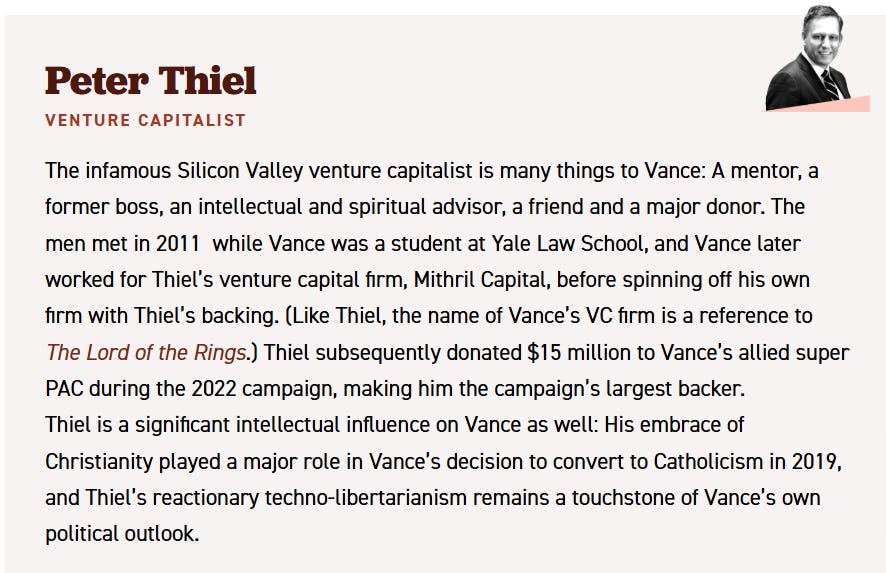
Editor: Consider number 6 and how handily it fits Peter Thiel. ‘A mentor, a former boss, an intellectual and spiritual advisor, a friend and a major donor.’!
6. He was taught to accept gay people. Mr. Vance wrote that he would “never forget the time I convinced myself I was gay.” Not yet old enough to feel attracted to the opposite sex, he worried something was wrong. “You’re not gay,” his mamaw told him, and even if he were, she reassured him, “that would be OK. God would still love you.” As he wrote, “Now that I’m older, I recognize the profundity of her sentiment: Gay people, though unfamiliar, threatened nothing about mamaw’s being. There were more important things for a Christian to worry about.”
I’m trying to imagine the left’s reaction if it emerged that a leading politician had once lavished praise on a century-old book that not only trotted out racist stereotypes about, say, black people and their supposed characteristics, but whose central thesis rested on an ancient, hostile assumption about that group. Would good, progressive folk be rushing to defend that politician by saying the author of the book in question had also written lots of important, non-offensive things, and that other people had quoted that author too, so this was a fuss about nothing – or would they be appalled and even sickened that a contemporary politician could praise such a text without so much as mentioning the racism within it?
It turns out that the answer is: it depends which side the politician is on, and also perhaps which ethnic minority is involved. If the politician is the current leader of the Labour party and the minority involved are Jews, well, then it seems the usual progressive reflexes don’t always kick in.
In today’s Times, the columnist Daniel Finkelstein has dug out a 2011 reissue of JA Hobson’s 1902 work, Imperialism: A Study. The foreword was written by Jeremy Corbyn in 2011. Across eight pages, the then Labour backbencher lavishes praise on the book. His very first sentence describes it as a “great tome”. Among other things, he calls it “very powerful,” “brilliant”, as well as “correct and prescient”. The trouble is, Hobson was not just an accomplished analyst of international politics – for the Manchester Guardian, as it happens – but an egregious anti-Jewish racist.
….
Editor: don’t miss the final paragraph
We all know that it’s painful to admit flaws in those we admire. Corbyn should have done it about Hobson, but did not. Now that task falls to Labour MPs, members, supporters and voters. The Labour leader may tell himself that he is the victim here, a serially unlucky anti-racist who means well, but keeps overlooking racism against Jews even when it’s right in front of him, whether on the platforms he shares or the books he praises. Now the rest of the Labour family have to decide how much longer they are willing to indulge that delusion.
Editor: Don’t forget The Economist contribution to the Defamation of Corbyn ?
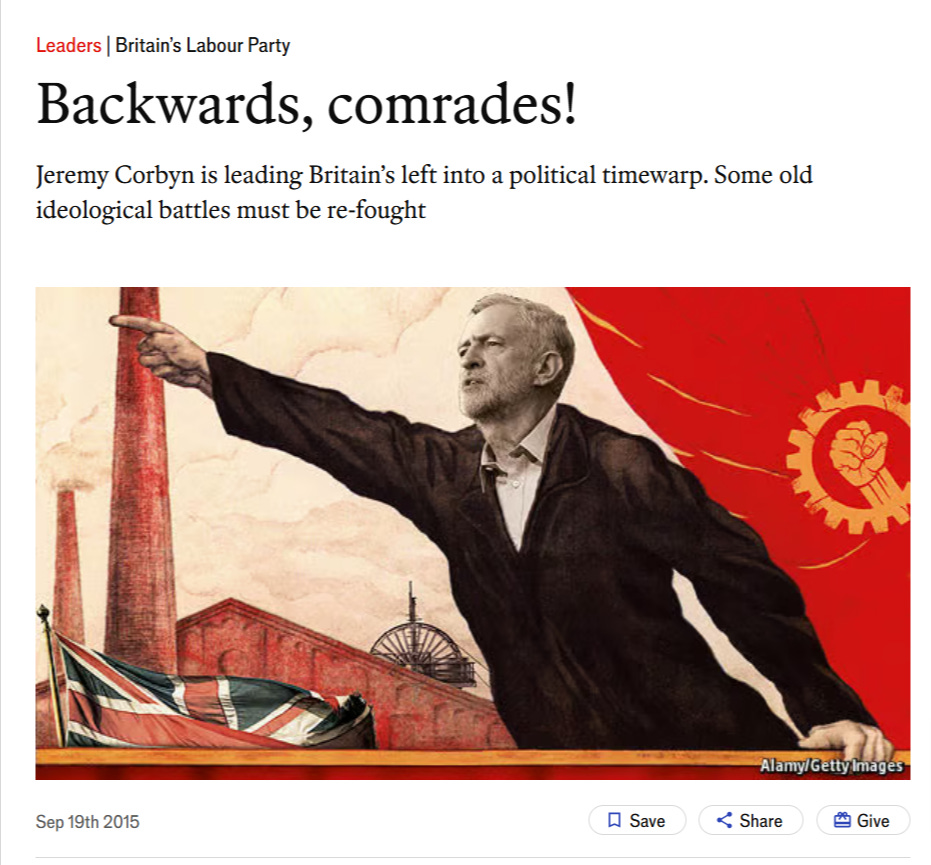
BEFORE he had finished belting out his first celebratory rendition of “The Red Flag”, a hymn to class struggle, some of Jeremy Corbyn’s colleagues in Labour’s shadow cabinet had already handed in their resignations. A 66-year-old socialist, Mr Corbyn has spent 32 years as one of the hardest of hardline left-wingers in the House of Commons and a serial rebel on the Labour backbenches. On September 12th he flattened three moderate rivals (see article) to become leader of Britain’s main opposition party. Labour MPs are stunned—and perhaps none more so than Mr Corbyn himself.
Two views are emerging of Labour’s new leader. The more sympathetic is that, whatever you think of his ideology, Mr Corbyn will at least enrich Britain by injecting fresh ideas into a stale debate. Voters who previously felt uninspired by the say-anything, spin-everything candidates who dominate modern politics have been energised by Mr Corbyn’s willingness to speak his mind and condemn the sterile compromises of the centre left. The other is that Mr Corbyn does not matter because he is unelectable and he cannot last. His significance will be to usher in a second successive Conservative government in the election of 2020—and perhaps a third in 2025.
Both these views are complacent and wrong. Mr Corbyn’s election is bad for the Labour Party and bad for Britain, too.
Cowards flinch and traitors sneer
Start with the ideas. In recent decades the left has had the better of the social arguments—on gay rights, say, or the role of women and the status of the church—but the right has won most of the economic ones. Just as the Tory party has become more socially liberal, so, under Neil Kinnock and then Tony Blair, Labour dropped its old commitment to public ownership and accepted that markets had a role in providing public services. Mr Blair’s government put monetary policy in the hands of an independent Bank of England and embraced the free movement of people and goods within Europe.
The argument today has moved on—to the growing inequality that is a side-effect of new technology and globalisation; to the nature of employment, pensions and benefits in an Uberising labour market of self-employed workers (see article); and to the need for efficient government and welfare systems. Fresh thinking on all this would be welcome—indeed it should be natural territory for the progressive left. But Mr Corbyn is stuck in the past. His “new politics” has nothing to offer but the exhausted, hollow formulas which his predecessors abandoned for the very good reason that they failed.
In his latest political/moral iteration Freedland plumbs the depths of the Zionist Psyche, while avoiding the Genocide, that is the actual Watershed of Theodor Herzl’s European Zionism. Not to willfully forget that Freedland is a Tribalits to his marrow! Reader brace your-self for the turged melodrama!
In Israel, dread and rage haunt the streets. Netanyahu is exploiting that
When I visited Israel this week, it seemed time had stood still since 7 October. I saw pain and grief, but little sign of hope
Journalists cannot enter Gaza, but I was in Israel this week and saw for myself at least the latter half of the equation. When I reported from there a few weeks after the 7 October attacks, I was struck by how time seemed suspended, how frozen the country was in the terror of that day, when at least 1,200 Israelis, mostly civilians, were killed and more than 250 taken hostage. That remains true today. For Israelis, it’s still 7 October.
What has kept so many of them stuck is the wait for the hostages’ return. It might be the Tel Aviv skyscraper lit up with the number of days of captivity – it will be 500 on Monday – and the message “All of us are waiting for you”, or the stickers and posters of their faces plastered on street corners and bus shelters. Either way, anxiety for their plight hangs heavy in the air.
It gained a new urgency after the release last Saturday of three male hostages, each one visibly emaciated. The sight immediately struck a nerve that lies close to the surface of Israeli society: I heard the three referred to as Muselmänner, the name Auschwitz prisoners gave to the walking skeletons among them.
Editor: I will offer a selection of the Melodrama, as narrated by Freedland:
…
That has left the hostage families in the no man’s land between hope and dread: hope that their father or son will come out, dread at the state they’ll be in.
…
“It’s like an open wound that you cannot treat until this is over.” She cannot move on till he is back, and in that she is like much of her country.
But beyond dread, there is rage.
…
What Sharabi did not know, but his captors surely did, was that his wife and daughters were murdered on 7 October.
…
Israeli media rarely show the devastation Israeli bombardment has wreaked on the strip; most Israelis don’t see what the rest of the world sees. They know that thousands have been killed, but they put the blame squarely on Hamas, which surely knew what it was unleashing on 7 October.
…
He wants the war to resume, and for cynical reasons: because if the war continues, his far-right coalition members stay onboard, keeping him in the prime minister’s chair and out of jail. (His trial on corruption charges is ongoing.)
…
…Netanyahu would embark on a “very aggressive”, two-month operation that would, Harel writes, culminate in “the forced expulsion of Palestinians”.
…
This week, I met Yair Golan, the new leader of what was the Israeli Labor party, now rebadged as the Democrats. A former general, Golan is hailed as one of the heroes of 7 October.
…
Equally important is to provide an alternative to Hamas.” Only when “a young Palestinian” can see the path to a better future that does not involve violence will Hamas be truly defeated.
…
And much of the Israeli public struggles to see through the anger, pain and grief that descended on 7 October and which has barely lifted.
Those who want change have to hope that Netanyahu has erred by tying himself to an erratic, if not unstable, US president abroad and to extremist allies at home, and that is too combustible a mixture to last. I badly want that to be right. But I also know there’s a reason why hope has always been the Middle East’s scarcest commodity.
Editor: Max Seddon in Berlin and Christopher Miller in Kyiv write on the Putin Victory that is almost certain?
Vladimir Putin’s initial plan to capture Ukraine in a few days ended in disaster. But after Donald Trump set up direct peace talks with Moscow, bypassing Kyiv and European allies, the Russian president is now closer than ever to getting what he wanted from his three-year-long invasion.
Putin’s main ambition, said people who have spoken to him during the war, is to establish a new security architecture that gives Russia a sphere of influence in Europe — much as the Yalta conference did for the Soviet Union at the end of the second world war.
Now, the US may be open to letting him have it. Defence secretary Pete Hegseth has dismissed Ukraine’s aspirations to join Nato and reclaim its territory from Russia. Putin and Trump discussed “bilateral economic co-operation”, suggesting that the US was prepared to roll back its sanctions against Moscow.
And Trump appears intent on rolling back the US’s commitment to Nato and leaving to European countries the job of sustaining a peace.
“The situation looks much more favourable for Putin than at any point during the entire war over the last three years,” said Alexander Gabuev, director of the Carnegie Russia Eurasia Center in Berlin. “If the US just unilaterally ends its military and diplomatic support, as well as intelligence sharing, then Ukraine will be in a very tough position. And it’ll be hard to get out of it even if the Europeans get more involved.”
In Moscow, there was palpable joy following Wednesday’s call between Trump and Putin.
“A single call can change the course of history — today, the leaders of the US and Russia have possibly opened a door to a future shaped by co-operation, not confrontation,” said Kirill Dmitriev, a Russian sovereign wealth fund chief involved in back-channel talks with the US over prisoner exchanges.
Editor: Note the source in the above paragraph : said Kirill Dmitriev, a Russian sovereign wealth fund chief involved in back-channel talks !The Reader must wonder at the insertion of the photograph of Churchill, Stalin and FDR at Yalta… as a mispaced mood setter, toward what purpose? Reader save yourself from the agony of this propganda and procede to the the final paragraphs of this 1,290 word diatribe!
… Zelenskyy told reporters on Thursday that it was “not very pleasant” to know that Trump spoke to Ukraine’s adversary first. He insisted he “will not accept . . . any bilateral negotiations about Ukraine without us”.
What was imperative, Zelenskyy added, was to “not allow everything to go according to Putin’s plan”.
Kyiv had hoped it could convince Trump to work out a common position on bringing Russia to the table, and had offered access to its reserves of rare earth metals in return for US support.
For now, Kyiv and its European allies are looking on, aghast, from the outside, fearful the US will strike an unfavourable deal with Putin to end the war — and stick them with the bill.
“Trump is proving to be as bad as we feared. He is willing to make a deal with Putin at the expense of Ukraine, and still wants Ukraine to pay him in mineral resources,” said Volodymyr Kulyk, a professor of political science at the Kyiv School of Economics. “The question is what Ukraine and Europe will do.”
Editor: Recall that Victoria Nuland and United States Ambassador Geoffrey R. Pyatt along with NATO, the EU, George Soros , The Foundation for Defense of Democracies, a Neo-Consevetive front group, while Obama remained at a safe distance? On The Foundation for Defense of Democracies, Muhammad Sahimi has written a revelatory essay at Lobe Log:
Behind the Foundation for Defense of Democracies’ Embrace of Authoritarianism
In Stendhal’s The Red and the Black, a book that is never far from me, the colours refer to two careers. The first is the army. The other is the priesthood. The setting is Bourbon Restoration France but it could be almost anywhere in the west, at almost any time until the dawn of industry, such was the importance of these vocations to the national order.
Editor: Ganash swithes registers to current men’s fashions ‘T-shirt and the Gilet’ that is attached to ‘tech & finance’to this assertion ‘London, an ancient financial hub too, is a useful place from which to assess these distinct clans’
In our world, the two ruling careers are no harder to name. It is tech and finance, The T-shirt and the Gilet, that have first refusal on the ablest graduates. It is tech and finance whose executives are interviewed for their musings on politics and life. As the Google office in King’s Cross nears completion, London, an ancient financial hub too, is a useful place from which to assess these distinct clans.
Editor: Ganesh at near full gallop appears!
And to learn to prefer, on average, the company of finance. There is a client-facing side to that business — the dinners, the silver-tongued sales calls — that instils a minimum of suaveness. In much of tech, the “client” is a vast and remote public. So no such practice.
Editor: Ganesh embroidery: ‘the dinners, the silver-tongued sales calls — that instils a minimum of suaveness.’
Note that, while the world’s financial centres are almost all urban, tech often chooses a low-density setting, such as the Santa Clara Valley or the Fens. Even Bengaluru is India’s Garden City. Some of this is historical accident. But it is also the result, and perhaps a cause, of tech’s social diffidence. I needn’t dwell on the sector’s ultra-individualist political turn here. Or the Andrew Huberman-led zeal for health, whose logical endpoint is a scandalised recoil from bodily contact. Even on the warmer side of tech, that of effective altruism and people aching to do good, there is a trace of Beatrice Webb about the approach to humankind, as something to help rather than like. Tech’s real or potential achievements on behalf of us all might dwarf those of finance. But over a drink? Give me the FX sales-trade bod.
Editor: What can this mean: ‘But over a drink? Give me the FX sales-trade bod.’
Editor:Ganesh embroidery makes way for his cast of characters. Ganesh in his earlier self, had a singular talent for the telling aperçu. That talent continues to assert itself , but in more muted retorical tonalities: I will put in italics some of those examples. Yet he manages to provide too many examples of his interpretation of a/the zeitgeist?
Another thing. Finance has more — don’t laugh too hard now — humility. Precisely because banking in particular has a bad name, at least post-Lehman, at least outside America, its practitioners have to tread gingerly these days. People whom the world is disposed to hate tend to learn a sort of pre-emptive charm. (Which is why the biggest snobs in Britain are almost never Etonians.) Tech hasn’t had its 2008 yet, and might never. It is high on itself to a degree that can be easier to respect from a distance than to be around.
“Humble” doesn’t mean interesting, of course. Nor does “suave”. Because I have to come up with ideas for a living, I will put up with a lot for a conversation that throws up a eureka moment. So, which side is more stimulating company? The raw processing power of the tech minds I encounter leaves me standing. But my test — am I still thinking of the discussion on the Tube home? — is met no more often by them than by bankers or hedgies or less gilded professions. One problem is the tech world’s impatience with history, which is inevitable when the grandest companies don’t much predate the millennium. The result is a fixation with transient events and “trends” that someone with a wider lens might recognise as froth.
The other conversational glitch is that undergraduate contrarianism you see all the way up from the local crypto bore to the billionaire class. Your finance bro is hardly immune. (“Putin just wants a warm water port.”) But something about belonging to an establishment profession will tend to take the edge off. The archetypal tech genius — fabulously credentialed, but somehow as overeager to impress as an autodidact — must be peculiar to a young industry.
All ethnographic observations about these two tribes have to be qualified, of course. For one thing, tech and finance can be hard to tell apart. (Where should we file Sam Bankman-Fried?). Still, much the biggest change in the world of work since I entered it is the relative decline of the one against the other as the prestige industry. If all finance retains is the social edge, tech will find it a trivial deficit, next to pay and power, if also much the hardest to overcome.
As usual Janan Ganesh has a lively and insightful conversation with himself -its like a fast moving current in a river of ideas, speculations, and just plain political chatter – some call this free imginative variation, that somehow touches reality , if that seems coherent? The Reader is in ‘Ganesh World’!
Headline: The deceptively negotiable Donald Trump
Sub-headline: The tariff row is further indication that he is quick to quarrel but also quick to settle
The markets were fools on Saturday, and shrewd judges of character on Monday. When Donald Trump announced tariffs against America’s neighbours last weekend, investors who had talked since November of a misunderstood, deceptively pragmatic US president were exposed as naive. For 48 hours. Then he more or less vindicated them. The tariffs have been put off in return for Canadian and Mexican assurances about cross-border drug traffic and other Trump bugbears. Investment banks can postpone the sheepish client calls until March.
The world would be silly to relax, of course. Trump has the potential to shatter the trading system in the coming years, even if he does so in fits and starts. But if nothing else, the past few days have been an education in the art of dealing with him.
Editor: Trump is nothing more than a petulent child who loves to shock and dimay, he is a changeling. Ganesh provides a kind of ‘oppreative diagnosis’?
Because Trump is so quick to quarrel, people tend to miss that he is also quick to settle. He almost never drives as hard a bargain as his belligerent manner seems to promise. In 2020, China bought some peace with a vague and hard-to-enforce pledge to cut the two countries’ trade imbalance. (“The biggest deal anybody has ever seen,” he called it, with telling emphasis on external perception.) Likewise, he didn’t abandon Nafta so much as pass off a revised version of it as a personal coup. Being an egoist, not a fanatic, what he cares about is his reputation as a maker of deals. To keep it going, he needs a regular flow of them. And so their content becomes secondary. We can mock, but the lesson here for countries faced with Trump is an encouraging one: give him something that he can call victory. The concession needn’t be huge, and he will in fact co-operate in talking up its significance.
Editor: A portion of Ganesh’s commentary rings true: I’ve placed those sentences in italics. Some time’s, even Ganesh, manages in his commetaries, to brush by someting of value: An Egoist recogconises his brethren?
Editor: A selection of Ganesh aperues: At this he excelles, wedded to evocative Name Dropping!
…
The concession needn’t be huge, and he will in fact co-operate in talking up its significance.
…
Trump is open to what Henry Kissinger called “linkage”.
…
…the smallness of their concessions (Justin Trudeau is appointing a fentanyl “czar”) or the fact that economics and drug policy are mixed up like this in the first place.
…
In that sense, he might be easier to defang than Joe Biden, who didn’t think Nato was a club of free-riders or the EU a conspiracy against Silicon Valley.
…
Instead, I suspect, he would just rather have the slow-burn pleasure of someone submitting to him over years than the one-time high of destroying them. There is something of Caesar in his belief that the ultimate emasculation of an enemy is to spare them.
…
(For where is the sense of conquest with them?) If so, David Lammy and Peter Mandelson, far from being awkward choices as Britain’s foreign secretary and ambassador to Washington, make perverse sense.
…
If being a Trump stalwart from the beginning were a guarantee of anything, Nigel Farage’s place in the Maga court wouldn’t be so uncertain.
…
The outlandish ugliness of his statements make this hard to see. When a US president wants to “take over” Gaza and develop it into a Levantine Cote d’Azur, throwing him a bone — on trade, on anything — seems pointless.
…
For anyone who recognises that trade and internationalism have raised the lot of humankind, there isn’t good news to be had about the next four years, only least-bad ways of operating in the storm.
Editor: The first two senteses are vintage Wooldridge/Micklethwait Oxbridger dullwitted slur, against a long gone caricature of Left Pariaians, like Sartre?
Can a country still call itself an ally of America if America is threatening to annex part of its territory? Such a question might once have seemed ripe for a Gitane-puffing philosophe to ponder in a Saint-Germain-des-Prés café circa 1968.
Editor: Too bad some of their readerhip will miss that wan little gibe. But the parade of caricatures in the headline continues, they cleaned out the rhetorical closet with ‘Gitane-puffing philosophe’ chatter ? The aways servisable anonimous source appears on cue!‘Channelling his inner Jean-Paul Sartre, a European diplomat quipped: “With allies like Donald Trump, who needs enemies?”
The Economist Actors appear:
The Gaullists: in 145 words.
The Atlanticists: in 209 words
The Gaullists & The Atlanticists tagteam it: in 191 words
Editor: The final paragraph under the rubric of ‘How many divisions does Europe have?
All countries contain bits of the four factions in their political establishment. (Germany, set to get a new chancellor following elections on February 23rd, is hard to place in any camp for now.) Even if Europeans were to agree on an overarching defence plan, the thorny question of how to pay for it would then need to be resolved. Some cash-strapped countries could afford to spend more on defence only if funding came through borrowing the money jointly at EU level, a non-starter for fiscal hawks. That would open up another can of divisions for future summits to ponder.
Editor: After all the evocative word play, and a large cast of characters: Gaullists, Atlanticists, denialists and Putinists topped by : ‘Gitane-puffing philosophe to ponder in a Saint-Germain-des-Prés café circa 1968’ the final paragraph sinks into – the end of that train ride into the office, seems a welcome respite from Ecomomist vacious political chatter!
In an intriguing guest essay in The Times this week, Rutgers University historian Jennifer Mittelstadt made the case that Trump was a “sovereigntist,” a tradition she dated to 1919 and the Republican rejection, led by Henry Cabot Lodge, of U.S. membership in the League of Nations. Sovereigntists, she noted, also looked askance at U.S. membership in NATO, the General Agreement on Tariffs and Trade, the 1965 Immigration and Nationality Act and especially the Carter administration’s decision to relinquish the Panama Canal.
Why Does Trump Threaten America’s Allies? Hint: It Starts in 1919.
Feb. 2, 2025
Editor: The final paragraphs of Jennifer Mittelstadt’s essay is to say the least bleak, that hallowed ‘Post-War Liberal Order’ is at its end?
…
There is little to be won predicting foreign policy in a second Trump administration. The influence of the sovereigntist movement may recede in the face of a president who is changeable and distracted. And some members of Mr. Trump’s coalition do not subscribe to a purely sovereigntist standpoint, including Secretary of State Marco Rubio. But sovereigntists will surely double down. “International organizations and agreements that erode our Constitution, rule of law or popular sovereignty should not be reformed,” Project 2025 explains. “They should be abandoned.”
The most vigorous sovereigntists openly say they will seek withdrawal from the U.N. if necessary. They already oppose many proposed pacts and conventions, including the U.N.’s Pact for the Future, which addresses climate change and inequality. The Trump administration has said it intends to withdraw from the World Health Organization and has taken steps toward a near ban on immigration. It’s likely to weaken the European Union, enfeeble NATO and oppose multicountry trade agreements like the revamped NAFTA. And it will seek to regain a kind of Monroe Doctrine-era control of the Western Hemisphere, no matter what happens with the canal.
Mr. Trump’s embrace of sovereignty politics will only embolden similar regimes around the world. Brexit was a harbinger of other potential E.U. exits. Nearly every right-wing party across Europe would consider one if they came to power.
Look for other countries, buoyed by Mr. Trump’s scorn, to put the brakes on internationalism and instead build new, separate relationships with one another. What we would be left with is an unruly period for international relations, one that is less centralized and less governed by the shared principles and operating modes that lasted from the end of World War II until just a few years ago.



 StephenKMackSD's Blog