American Reader comments on Le Monde’s ‘Political Centrism’ as ‘Neo-Liberal Apologetics’ !
Editor: A brief preamble:
The Reader needs to approach with caution Nathalie Segaunes essay! With the Trump/Vance meeting with Zelensky, that signaled the not quite end of American and NATO hegemony! And the allience of Macron and Starmer, and a cadre of the un-ethusiastic: where might The Reader place Segaunes celebratory praise of Alexis Kohler, at the most impropitious moment of his planned departure? In a brief 1102 words?
The Eurocrats, in the person of Ursula von der Leyen, President of the European Commission, enthuse over the possibility that Europe can rise to the political moment, and save the remanes of the 2014 American coup d’état? The Reader can only imagine Macron of the Jupiterian presidencyand other over-blown political mendcities, with out the help of Tecnocrat Supreme Alexis Kohler: Yet Macron as his attack on the Gilets Jaunes made utterly clear, that even Kohler couldn’t manage Macron’s authoritarianism.
………………………………………………………………
Editor: Give Nathalie Segaunes her due, she embraces the duty of a political cog in the political machinery of this newspaper! Note the “vice president,” …
The end of the reign is in sight. With two years to go before the end of President Emmanuel Macron’s second term in office, Alexis Kohler, his chief of staff since 2017, will step down on April 14, the Elysée Palace announced on Thursday, March 27.
The news did not come as a major suprise. The day after Macron’s re-election in 2022, the “vice president,” as he has sometimes been nicknamed, said he would not stay at the Elysée Palace for the full 10 years. His statement had been met with doubt, as his close relations with the president and his hard work had established him as an essential cog in keeping the state running.
Editor: Some informative quotations follow. This weak melodrama moves this political chatter along:
…
In the fall of 2024, the news quietly spread that Kohler had approached the High Authority for Transparency in Public Life to inquire about possible conflicts of interest should he take up a job in the private sector. Macron’s “twin” was, indeed, looking for a way out.
…
The two men, who had no political experience at the time, together devised the platform that led to Macron’s victory in the 2017 presidential election, and led the country for eight years with a rare close ideological bond.
…
Pragmatic and even-tempered, Kohler, who is older than the president by five years, was also the man who would translate Macron’s sometimes risky “political impulses” into public policy.
…
“He has served our country in an exemplary way these years. I know how much our collective action owes to him, and I know that he will continue his commitment to the nation in other forms,” he added.
…
Deeply affected by this accusation, the senior civil servant believes that the legal proceedings would never have existed if he hadn’t been the president’s chief of staff.
…
Editor : On the pressing Question of who Alexis Kohler is :
February 19. In a press release on Friday morning, the bank Société Générale said Kohler, 52, would become its second-in-command and head its investment banking services, confirming initial reports by Le Monde.
…
Moulin served as chief of staff to Bruno Le Maire at the Finance Ministry (from 2017-2020), and then to Gabriel Attal at the prime minister’s office (January-September 2024).
As expansive and frank as Kohler is secretive and rigid, Moulin is no stranger to crisis management
…
Editor: Under the tired rubric of Inside Information!
Moulin would have preferred to head the French government’s investment arm, the Caisse des Dépôts et Consignations (CDC). The position has been vacant since Eric Lombard joined the government as finance minister on December 23, 2024. However, getting Parliament to approve him promised to be tricky, especially as he was the head of the Treasury at the time when France’s public accounts began to deteriorate, in 2023. He will instead help Macron complete the last stretch of his term in office
Editor: The Reader can’t be surprised by this would-be hagiography of Starmer, by Mr. Marr. Yet the pestioners with out heat, and the claim of 28 Million Buget hole from Rachel Reeves demonstrates what?
Rachel ReevesBritain’s Labour Government Says It Inherited a $28 Billion Budget Hole
Rachel Reeves, the chancellor of the Exchequer, cut some infrastructure funding and pensions benefits, adding that more “difficult decisions” would come later this year.
To put those figure into context, in the Spring Budget it was expected that total public spending this year would be £1,226bn. Either £9.5bn or £22bn would be a small proportion of that.
Spending was much higher than expected due to Covid in 2020 and 2021 and also almost £10bn higher than expected in 2023 because of inflation caused by Russia’s invasion of Ukraine.
Outside those years there have not been overspends close to £9.5bn.
This piece was originally published on 3 September 2024 and has been updated following the OBR report that accompanied the 30 October Budget
Editor : What is The Reader to think ? Yet here is Reeves latest excuse making:
Editor: The Patient Reader finally emerges from the fog of would-be hagiography, to what resembles critical evaluation, of a kind !
…
At this point a hefty dose of scepticism is appropriate. Leaders of right and left have said similar things throughout the past century, while government has grown ever bigger and slower to respond. This week’s new Planning and Infrastructure Bill, read carefully, actually increases regulatory safeguards.
And Starmer, the former public prosecutor, is not ready to confront the problem of judicial review, which makes it harder for ministers to take decisions and has had a chilling effect across Whitehall. He will get there, but not yet. He believes that he has the tenacity others have lacked; that when he gets his teeth into something he tends not to let go. We will see.
But meanwhile, his argument deserves a hearing. We live in a political culture which thinks of politics as fundamentally about visions and values whereas he sees it as about levers and pulleys – what people say vs how to build a more effective machine.
Toolmaking, his late father’s trade, is not simply a working-class job. It is a highly skilled and difficult art – turning out precisely crafted implements for the real, material world. Perhaps it isn’t so hard to see where the Prime Minister’s obsession with “what actually works” and his contempt for the easier answers of populism, comes from.
At any rate, here is Starmerism. And if, grinding remorselessly through Whitehall, it can yet produce a more effective state – a big “if” – it may turn out to be what demoralised, divided Britain needs.
Editor : Final consideration: Starmer was the polical product of the the purge of Jeremy Corbyn from the New Labour of Tony Blair, and the Toxic Political Mythologist like @Freedland at The Guardian!
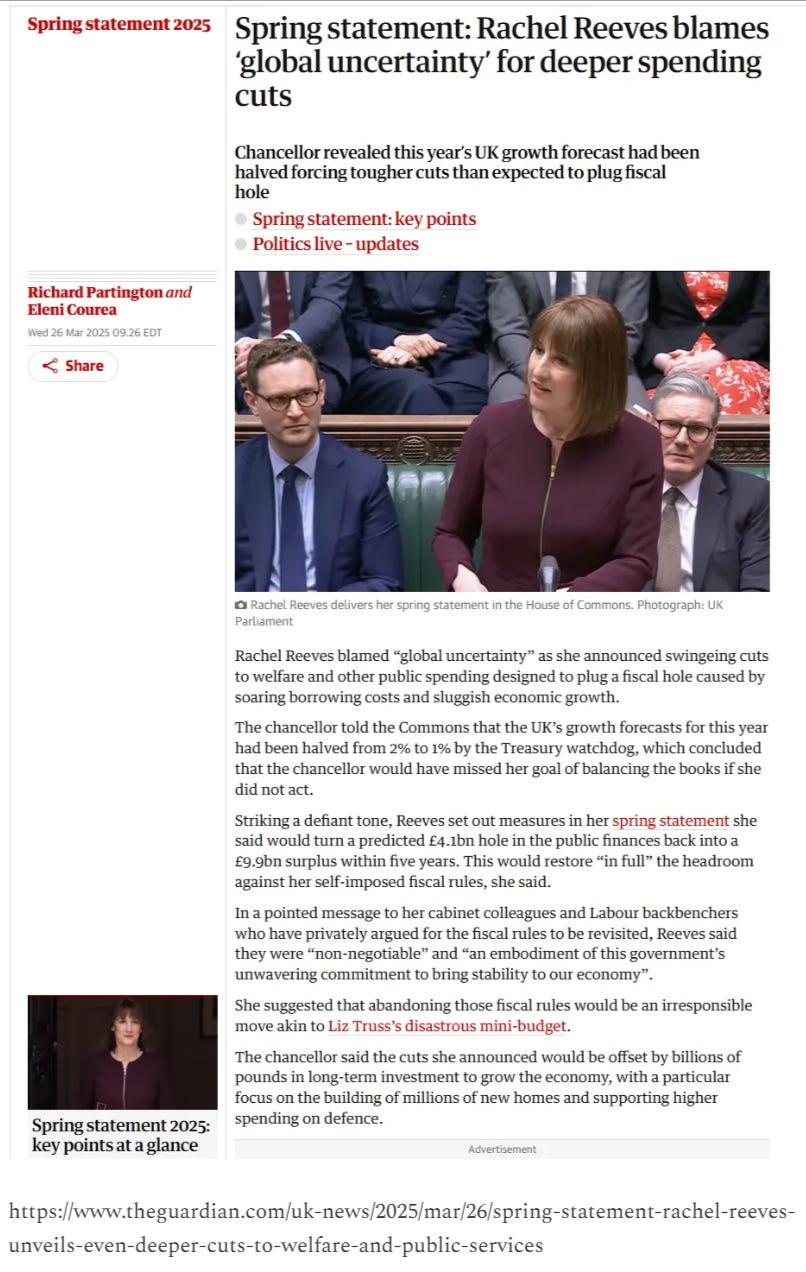
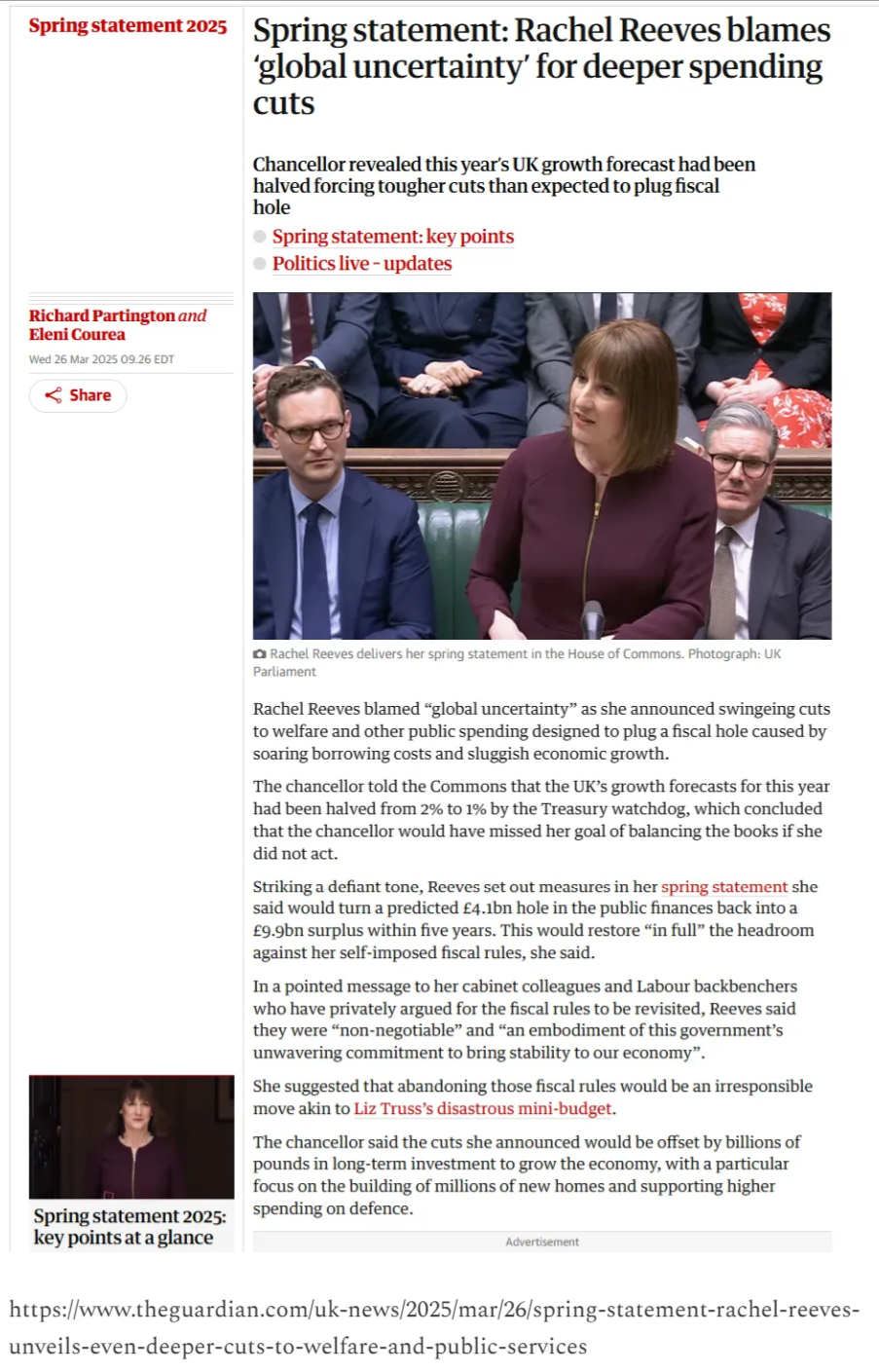
Pensioners without heat are not the only problem that Kier Starmer and Rachel Reeves face, besides that utterky anemic 1% growth rate! And the argued 22 billion over-spend that is left beind, and in its place is ‘global uncertainty’. ?
To put those figure into context, in the Spring Budget it was expected that total public spending this year would be £1,226bn. Either £9.5bn or £22bn would be a small proportion of that.
Spending was much higher than expected due to Covid in 2020 and 2021 and also almost £10bn higher than expected in 2023 because of inflation caused by Russia’s invasion of Ukraine.
Outside those years there have not been overspends close to £9.5bn.
This piece was originally published on 3 September 2024 and has been updated following the OBR report that accompanied the 30 October Budget
Headline: Michael Lind: Trump represents a nationalist tradition that goes back to Nixon’
Sub-headline: Despite his inconsistencies, the American president has always criticized free trade and the American military umbrella. For four decades, he has described the United States’ allies as parasites, highlights the Texan writer and academic.
The Nixon-Connally strain of American economic nationalism was carried on in the 1990s by Connally’s fellow Texan Perot, like Trump a billionaire businessman who ran for the presidency twice, in 1992 and 1996. Perot denounced the North American Free Trade Agreement for allowing US automobile companies to transfer production from well-paid, unionized workers in the US to low-wage labor in Mexico. Perot complained that the Japanese and other allies had “picked our pockets” and declared that as president he would charge both Japan and Germany $50 billion [$114 billion in today’s dollars] to repay the US for the cost of defending them
In the 1992 presidential campaign, Perot received nearly 20% of the popular vote – more than any third-party party since former Republican president Theodore Roosevelt ran as the Progressive candidate in 1912. Nevertheless, following Perot’s defeats in 1992 and again in 1996, the US foreign policy establishment treated neo-Nixonian economic nationalism as a discredited doctrine favored only by marginal figures on the far right like the pundit and failed presidential candidate Patrick J. Buchanan – who had been a Nixon aide.
….
Editor: As an Amrican I’m familier with Michael Lind ‘He is a fellow of the center-left think tank New America’ ! And its CEO Anne-Marie Slaughter a Clinton Fellow Traveler. Here is Lily Geismer on the evolution of The Neo-Liberal Democrats, while not a complete History, it offers enough valuable insights, that renders the Clinton Betrayel of the New Deal Tradition about politcal opportunism!
Democrats and Neoliberalism
Lily Geismer
The fallout from the 2016 election has created many surreal moments for historians of American politics and parties, but surely one of the oddest has been the introduction of the term neoliberal44 into the popular discourse. Even stranger still is that it has become a pejorative largely lobbed by the left less at Republicans and more at Democrats.45 As neoliberal has come to describe a wide range of figures, from Bill and Hillary Clinton46 to Ezra Klein47 and Ta-Nehisi Coates,48 its meaning has become stretched thin and caused fuzziness and disagreement. This muddle of meanings creates an opportunity to seek a more precise understanding of what I call “Democratic neoliberalism.”
It is actually not the first time Democrats have been called neoliberal. In the early 1980s, the term emerged to describe a group of figures also called the Watergate Babies, Atari Democrats, and New Democrats, many of whom eventually became affiliated with the Democratic Leadership Council(DLC). In this iteration, the term neoliberal was embraced not as opprobrium. Rather, it used a form of self-description and differentiation to imply that they were “new Democrats.” In 1982, Washington Monthly Editor Charles Peters published “A Neo-Liberal’s Manifesto,”49 which aimed to lay out the core principles of this group; two years later, journalist Randall Rothenberg wrote a book called The Neoliberals50 that sought to codify and celebrate this cohort’s ascendency.
…
In The Neoliberals, Rothenberg observed that “neoliberals are trying to change the ideas that underlie Democratic politics.” Taking his claim seriously provides a means to think about how this group of figures achieved that goal and came to permanently transform the agenda and ideas of the Democratic Party.
…
The group of policymakers and politicians that circulated around the DLC suggests that the roots of many aspects of neoliberalism emerged less from free market conservatism than from the ideology, institutions, and social commitments of liberalism. This group updated and extended many of the core tenets of post-New Deal liberalism, especially the emphasis on technocratic expertise, individualist solutions to structural problems, growth over redistribution, and development of strong partnerships between public and private sectors, particularly nonprofits, businesses, and foundations. The efforts to portray the DLC as indicative of the rightward shift of the party, therefore, fail to acknowledge the ways in which they advocated retaining key aspects of liberalism.
…
Figures like Michael Dukakis, Paul Tsongas, Bill Bradley, Tim Wirth, and Al Gore abided by the maxim “the solutions of the thirties will not solve the problems of the eighties.”
…
This group was heavily influenced by the work of figures like Lester Thurow, whose 1980 book The Zero-Sum Society53 essentially became something of a guidebook. Thurow argued that the solution to the multifaceted problems of the 1970s lay in “accelerating the growth of productivity,” which he believed could happen by investing public and private resources in sunrise rather than sunset industries.
…
David Osborne, an early fellow at PPI, was especially influential in helping achieve and shape this mission. Osborne’s research centered largely on the rise of public-private partnerships and “third sector institutions”58 such as nonprofits and other community organizations, which he argued offered a more effective means of providing social services and economic development than traditional government bureaucracies. Osborne reduced the argument of his 1988 book, Laboratories of Democracies, to a slogan: “if the thesis was government as solution and the antithesis was government as problem, the synthesis is government as partner.”
&
Along with co-author Ted Gaebler, Osborne expanded on this argument in Reinventing Government: How the Entrepreneurial Spirit Is Reinventing the Public Sector,59 published in 1992. The book’s model of “entrepreneurial government” advocated both efficiency techniques to make government more results-oriented and less costly as well as ways to decentralize authority and to shift more responsibility and control onto the community. It also suggested that the government should serve not as a service provider but as a “catalyst” in connecting the public and private sectors. Clinton, who served as the head of the DLC in the early 1990s, emerged as the most influential advocate of the ideas in Reinventing Government, praising it as a “blueprint” to “revitalize government.
Editor: The reader is here watching the birth of The Neo-Liberal New Democrats Bill And Hillery Clinton, and their Thatcherite Vision :
Crime Bill Signed Enacted the Clinton-Gore Administration’s tough and smart crime fighting strategy. The Bill contained tougher penalties, including “three strikes and you’re out” legislation, helped states build more prisons and increased prevention and victims rights. As a result, the overall crime rate has dropped for 8 years in a row — the longest continuous drop on record — and is now at a 26 year low. (PL 103-322, signed 9/13/94)
Welfare Reform Enacted President Clinton kept his promise to end welfare as we know it by requiring welfare recipients to work, limiting the time they can stay on welfare, and providing child care and health care to help them make the move from welfare to work. The landmark bipartisan welfare reform law signed by the President also enacted tough new child support enforcement measures proposed by the President. Since January 1993, the number of people on welfare has fallen by nearly 60 percent, from 14.1 million to 5.8 million, the smallest welfare rolls in 32 years, and millions of parents have joined the workforce. (PL 104-193, signed 8/22/96)
Created the Welfare to Work Partnership The Welfare to Work Partnership was launched at the President’s urging to lead the national business effort to hire people from the welfare rolls. Now 20,000 businesses strong, the Partnership has helped an estimated 1.1 million welfare recipients move to employment. Under Vice President Gore’s leadership, the Administration has also done its fair share, hiring 50,000 welfare recipients, and has fostered partnerships between employers and community and faith-based organizations that help families move from welfare to work.
Welfare-to-Work Grants Due to President Clinton’s leadership, the Balanced Budget Act included $3 billion over two years for Welfare-to-Work grants to help states and local communities move long-term welfare recipients and certain non-custodial parent in lasting, unsubsidized jobs. This funding, used for job creation, placement and retention efforts, has helped the hardest-to-serve welfare recipients and promotes parental responsibility among non-custodial parents who need to find work to honor their responsibilities to their children.
Achieving Victory in Kosovo President Clinton led the NATO Alliance in a 79-day air war that expelled Serb forces from Kosovo and restored self-government to the province, ending a decade of repression and reversing Slobodan Milosevic’s brutal campaign of ethnic cleansing. In the face of Allied unity, American military superiority, and strong Presidential leadership, Milosevic withdrew his troops and permitted international peacekeepers to begin returning refugees. (3/24-6/20/99)
Financial Modernization Legislation Enacted President Clinton signed the Financial Modernization Act into law, finally revamping a banking system that had been in place since the Great Depression. The new law will increase innovation and competition in the financial services industry, including traditional banking, insurance and securities industries, giving consumers greater choice and lower prices. The President insisted that the new regulatory structure permit banking institutions to expand into these newly authorized lines of business only if they satisfactorily serve the credit needs of their communities, and that the law include many of the consumer privacy provisions he proposed. (PL 106-102, signed 11/12/99)
Headline: Abundance is the new buzzword on the US left. Now it’s coming here
Sub-headline : The US left’s focus on redistribution is failing. A new approach, emphasising economic growth, is gaining traction — but faces big hurdles
Editor: Colvive can hardley contain his glee via the use of the US Left in his headline and sub-headline! The Reader need only read Bari Weisse’s column of March 18, 2025 in the The Free Press to find the source of Colevile US Left fixsation.
Headline: Can Ezra Klein and Derek Thompson Save the Left From Itself?
Sub-headline : The Democrats desperately need a new vision. Two prominent liberal journalists are offering one.
Editor: To put it bluntly Bari Weisse is the very bottom of the Neo-Conservative Intellegencia! Neither Ezra Klien nor Dereck Thompson are Liberals:Klien is at The New York Times andDerek at The Atlantic, a Neo Conservative publication. And Bairi Weisse lives in an Imagined World!
Ezra Klein and Derek Thompson are the two most important liberal journalists working in the legacy press today—Ezra at The New York Times, and Derek at The Atlantic.
Although they insist they’ll never go into politics themselves, they are offering Democrats a path back to power.
To get out of the political wilderness, they say the Democrats need a new vision—one that goes beyond resistance to Trump. A vision that can bring back the disaffected Democrats who stayed home or voted red for the first time this past November.
While other progressives are doubling down on zombie ideas, afraid to confront a country that has moved decisively to the right, Ezra and Derek are willing to face reality. They see that blue states are functioning similarly to the DMV—and, as a result, losing people to states like Texas and Florida.
In their new book, Abundance, they offer a blueprint for winning them back—to cities like San Francisco and New York, but also to the Democratic Party.
The thesis is simple: To have the future we want, we need to build and invent more of what we need.
While conservatives and libertarians might say, Yes, exactly, let the free market do its thing, Ezra and Derek insist that the government can play a crucial role—if liberals will let it. They want to rein in the laws, regulations, and bureaucratic thinking that have made it nearly impossible to do anything in this country.
….
Editor: Colvile as a Thatcherite attacking the Left is a civic, political duty!
The US elections were brutal for the Democrats. But here’s the most brutal fact: the places that swung hardest against them were those where they’d been in power for longest — New York, Chicago, Detroit, Los Angeles. And the people there aren’t just voting against left-wing rule but increasingly leaving it behind: one of America’s great demographic trends has been migration from blue states to red.
What’s the problem? In their new book Abundance, Ezra Klein and Derek Thompson make a simple argument: the left has been awful at governing. In particular, it has prioritised keeping its coalition of interest groups happy over getting stuff done — and brought in a raft of rules, not least on environmental protection, that make it too hard to build or invent things that might give those voters a better life, whether that be homes, high-speed railways, solar farms or life-saving medicines.
When this approach has, inevitably, produced a gap between supply and demand, the solution has been to throw subsidies at the problem — for affordable housing or childcare, say — rather than to actually tackle the blockages.
Klein and Thompson’s book is filled with chilling examples: the ghastly failure of cities like New York to build housing; the California high-speed rail project that makes HS2 look like a model of prudent procurement; the steady decline of risk-taking in science. But it is also filled with inspirational stories: the reforms that enabled the construction of cheap housing for the homeless in San Francisco; the Pennsylvania governor who repaired a bridge half melted by a crashed oil tanker in days rather than weeks; the warp-speed development and deployment of Covid vaccines.
Why does this matter? Partly because the authors are pretty influential — celebrated writers at The New York Times and The Atlantic respectively. But mostly because it represents one of the first serious attempts to chart a course for the Democrats that doesn’t involve doubling down on progressivism or shouting about the nasty orange man.
…
Editor: The final paragraph compares Abundence with Foundations written by three of his friends? Or just three of his employees?
But there is one final problem, which is that many voters, particularly on the right, do not want abundance at all. They are the people who decry the desecration of the green belt, who want new power cables buried underground (at billion-pound expense), who complain about tower blocks being built on car parks. And Labour’s planning reforms — which I largely support — will give them more ammunition, in particular via the hugely contentious plans to expand compulsory purchase of private land.
Indeed, the whole reason the Tories did not take up the abundance agenda while in power — despite my and others’ best efforts — was that they had become almost exclusively focused on protecting the privileges of pensioners, including the delightful views from their windows. Because, as I’ve pointed out before, it is OAPs that hold the electoral whip hand.
Abundance is one of those books that matter. Like the UK-focused essay Foundations — written by three of my friends — it explains that the scarcities that afflict our economies are scarcities we have actively chosen. Making it easier to build, making better choices, will enable us to build a better future. But it is a future that needs to be not just argued for, but fought for.
Headline: ‘Europeans are going to have to relearn to be angry’
Sub-headline: In an interview with ‘Le Monde,’ Pierre Wunsch, Governor of the National Bank of Belgium, believes that Europe, built on the single market and open trade, is ill-adapted to the fragmentation of the world.
Editor: I will attempt to provide The Reader- this reads almost like an Official Document, or even like the self-congratulatory tone of The Financial Times?
Pierre Wunsch, Governor of the National Bank of Belgium, has a 25-year-old son who recently asked him if World War III was on the horizon. “I thought it was excellent news that he asked me,” he said to Le Monde. Not that the central banker welcomes the possibility of war returning, obviously, but because he sees it as a sign that public opinion is really worried. “[Russian president Vladimir] Putin, represents a real threat and we absolutely must invest in our defense. But my big fear is that people won’t accept that, that they’ll say we should spend on something else,” he said. For him, procrastinating on European rearmament would represent a far greater risk: “If we’re not strong enough against Putin, that’s when there could be a risk of global escalation. Europeans are going to have to relearn to be afraid, relearn pride and, from time to time, relearn to be angry.”
Wunsch is not a military expert but a central banker (at the National Bank of Belgium since 2011, governor since 2019). Previously, he worked for nearly a decade at the Suez Group and served in right-wing ministerial cabinets. When he speaks out on tensions with Russia, it is through the prism of economics. The Russian threat and the potential abandonment of American protection will require heavy budget spending in Europe. “But there’s no such thing as free money falling from the sky,” he said. He therefore believes that very difficult budgetary choices are looming just about everywhere in Europe and that people need to be prepared for them: “We’ll either have to cut spending, or raise taxes.”
Editor: Its not as if this sentence is of no interest : ‘Pierre Wunsch, Governor of the National Bank of Belgium, has a 25-year-old son who recently asked him if World War III was on the horizon’ as a kind of bridge, yet what follows reads like a confession of impotence, tinctured in the despondency of a banker!
Similarly, rewriting European rules to cope with this law of the strongest is proving tricky. “The single market operates with clear, predictable rules… Now we’re entering a more complex equilibrium, with industrial policy in certain areas, strategic autonomy issues… The question then becomes: who decides?” Should these powers be transferred to Brussels, at the risk of a democratic deficit? Or leave them to the member states, risking a cacophony of ideas? Wunsch warns that we need to face reality head-on: “We’re going to have to relearn how to do ‘power politics,’ to be transactional, to show… that we’re also becoming a political power.”
Despite this worrying diagnosis, he refuses to turn the European Central Bank (ECB) – of which he is one of the 26 members of the Governing Council – into the armed wing of the “power politics” he is calling for. He warns that the monetary institution will not support the financing of governments.
Editor: Pierre Wunsch engages in what Americans used to call ‘letting off steam’ although of a very high order! Enter stage-right Christine Lagarde:
Christine Lagarde, the ECB’s president, has already said that “participating in the financing effort is not the ECB’s raison d’être.” Wunsch pointed out that the ECB has the “exorbitant privilege” of being independent of the political powers. In the name of respect for democracy, to avoid entering the political arena, he believes it is essential to respect to the letter its mandate, defined in the European treaties: to ensure price stability.
Editor: The Wunsch’s final telling comment, refracted through Eric Albert:
Wunsch will not comment and remains open to the idea of pausing the interest rate cut at the next meeting on April 17. “We’ll see what the economic data are like between now and then,” he said. Under these conditions, governments’ budgetary choices are likely to be even more difficult.
Reader consider that Ezra Kline writes for The New York Times, whose support for Netnayahu’s Gaza Genocide and Zelensky’s Ukraine War is reaching its many murderious denouments. Or that Thomas Friedman, David Brooks & Bret Stephens are all rabid Zionists! Or that Derek Thompson writes for a News Magazine whose editor is a former Israeli prison guard, who tortured Palestinians.
Editor: Bari Weisse rewrites History and Facts at her self-serving whim. She never surprises because she invents at will! Neo-Cons and ‘The Noble Lie’ are constant companions!
Ezra Klein and Derek Thompson are the two most important liberal journalists working in the legacy press today—Ezra at The New York Times, and Derek atThe Atlantic.
Editor: the above sentence makes no sence except to The Straussian
Although they insist they’ll never go into politics themselves, they are offering Democrats a path back to power.
Editor: AboveBari Weisse imagines what Klein and Thompson cannot.
Editor : Reader you will need to pay a fee for the remaining portions of the essay!
To get out of the political wilderness, they say the Democrats need a new vision—one that goes beyond resistance to Trump. A vision that can bring back the disaffected Democrats who stayed home or voted red for the first time this past November.
While other progressives are doubling down on zombie ideas, afraid to confront a country that has moved decisively to the right, Ezra and Derek are willing to face reality. They see that blue states are functioning similarly to the DMV—and, as a result, losing people to states like Texas and Florida.
In their new book, Abundance, they offer a blueprint for winning them back—to cities like San Francisco and New York, but also to the Democratic Party.
The thesis is simple: To have the future we want, we need to build and invent more of what we need.
While conservatives and libertarians might say, Yes, exactly, let the free market do its thing, Ezra and Derek insist that the government can play a crucial role—if liberals will let it. They want to rein in the laws, regulations, and bureaucratic thinking that have made it nearly impossible to do anything in this country.
How do we build a government that’s less like the DMV and more like the Apple Store? How can it actually deliver for Americans and solve our most pressing problems—in housing, energy, transportation, and healthcare? And, how do we reverse government’s long march into total incompetence?
Ezra and Derek have a lot of ideas on how we can get there. Today on Honestly, we hear them. This was an excellent conversation and I’m eager for you to watch or listen.
Editor: Simon Hankinson is a Neo-Con, in fact, a defacto Straussian. What does that mean? Leo Strauss re-wrote the History Of Philosphy, that just didn’t advocate The Noble Lie, but inshrined it as an execise of Elite Power : a methodolody of the control of the lesser beings, by that self-appointed Elite! Reader Peter Thiel offers his ‘The Straussian Moment’!
Socrates’ introduction of the Republic‘s notorious “noble lie” comes near the end of Book 3 (414b-c). “We want one single, grand lie,” he says, “which will be believed by everybody – including the rulers, ideally, but failing that the rest of the city.” Grand lie? Noble lie? G. R. F. Ferrari has a good note on the issue: “The lie is grand or noble (gennaios) by virtue of its civic purpose, but the Greek word can also be used colloquially, giving the meaning ‘a true-blue lie,’ i.e. a massive, no-doubt-about-it lie (compare the term ‘grand larceny’).” This is not the only point on which there might be argument about the translation. Some prefer to “lie” the more neutral “falsehood” (which need not imply deliberate deception), others “fiction ” (perhaps trying to prescind from questions of truth and falsehood altogether). Cornford had “bold flight of invention.” I think “lie” is exactly right. But the argument for that will emerge later, in section II.
The noble lie is to serve as charter myth for Plato’s good city: a myth of national or civic identity – or rather, two related myths, one grounding that identity in the natural brotherhood of the entire indigenous population (they are all autochthonous, literally born from the earth), the other making the city’s differentiated class structure a matter of divine dispensation (the god who molds them puts different metals in their souls). If people can be made to believe it, they will be strongly motivated to care for the city and for each other.
Editor: M.F. Burnyeat offers isights on the Straussian Methodology:
Strauss, of course, wants his “gentlemen” readers to form the opposite conviction, about the Republic and about politics in general. What persuasions can he muster? There is the frail comparison with Shakespeare. There is the consideration that Socrates is a master of irony and “irony is a kind of dissimulation, or of untruthfulness.”
But to show in detail that Plato means the opposite of what Socrates says, Strauss resorts to a peculiar mode of paraphrase which he evidently learned from the tenth-century Islamic philosopher, Farabi.
The technique is as follows. You paraphrase the text in tedious detail—or so it appears to the uninitiated reader. Occasionally you remark that a certain statement is not clear; you note that the text is silent about a certain matter; you wonder whether such and such can really be the case. With a series of scarcely perceptible nudges you gradually insinuate that the text is insinuating something quite different from what the words say. Strauss’s description of Farabi describes himself: “There is a great divergence between what Farabi explicitly says and what Plato explicitly says; it is frequently impossible to say where Farabi’s alleged report of Plato’s views ends and his own exposition begins.”
The drawback with this mode of commenting on a Platonic dialogue is that it presupposes what it seeks to prove, that the dialogue form is designed to convey different meanings to different kinds of readers.
Ifthere is a secret meaning, one might concede that Maimonides’ instructions show us how to find it and that Farabi’s mode of commentary is the properly cautious way to pass it on to a new generation of initiates. But Strauss has not yet shown that Plato does conceal his opinions, let alone that they are the opposite of what Socrates explicitly says. Hence his use of techniques adapted from Maimonides and Farabi is a vicious circularity.
It would be tedious to follow up all the perversities, both literary and philosophical, of Strauss’s reading of the Republic. I shall pick on one central statement Strauss makes about the Republic: “The philosophers cannot be persuaded, they can only be compelled to rule the cities.”
There’s an old joke among US immigration officers: “the case ain’t over ‘til the alien wins”.
It long reflected the truth: that absurd interpretations of the law and endless appeals made it rare for non-citizens (“aliens”) to ever be deported, even if they had committed fraud or other crimes.
But the United States now has a president committed not only to securing the country’s borders, but to enforcing the law and deporting those ordered to be removed. Trump has said that those “who have engaged in pro-terrorist, anti-Semitic, anti-American activity” will be held to account.
Mahmoud Khalil, a recent graduate of New York City’s Columbia University, is a test case: can the United States remove non-citizens with views that appear to be antithetical to its very existence, or will the courts force us into pathological levels of tolerance?
Khalil was arrested on March 8 by immigration agents. He is reportedly of Palestinian heritage and from Syria, arrived on a student visa, and then, apparently based on marriage to an American citizen, obtained lawful permanent residence status, aka a “green card”.
There is much evidence that Khalil has been at the centre of anti-Israel protests on campus – perhaps even organising them. He has been described as belonging to Columbia University Apartheid Divest (CUAD) and reportedly led students from its campus Gaza Solidarity Encampment in negotiations with administrators.
Under leaders who are at best feckless and at worst sympathetic to the protesters, Columbia has endured two years of disgraceful events, including assaults on Jewish students, sequestering staff, occupying buildings, pro-Hamas propaganda, blocking classes, and vandalism.
…
Editor: Mr. Hankinson last paragraph offers Trump as the final arbiter. What Hankinson offers the reader is incomplete: The Executive, The Legislative and The Judicial share the powers as civic equals! Though the vexing question remaines how far will Trump go?
In Europe, defiant, possibly unassimilable immigrants seem to have the upper hand. In the US, the Trump administration has not only declared them unwelcome, but taken action to send them packing.
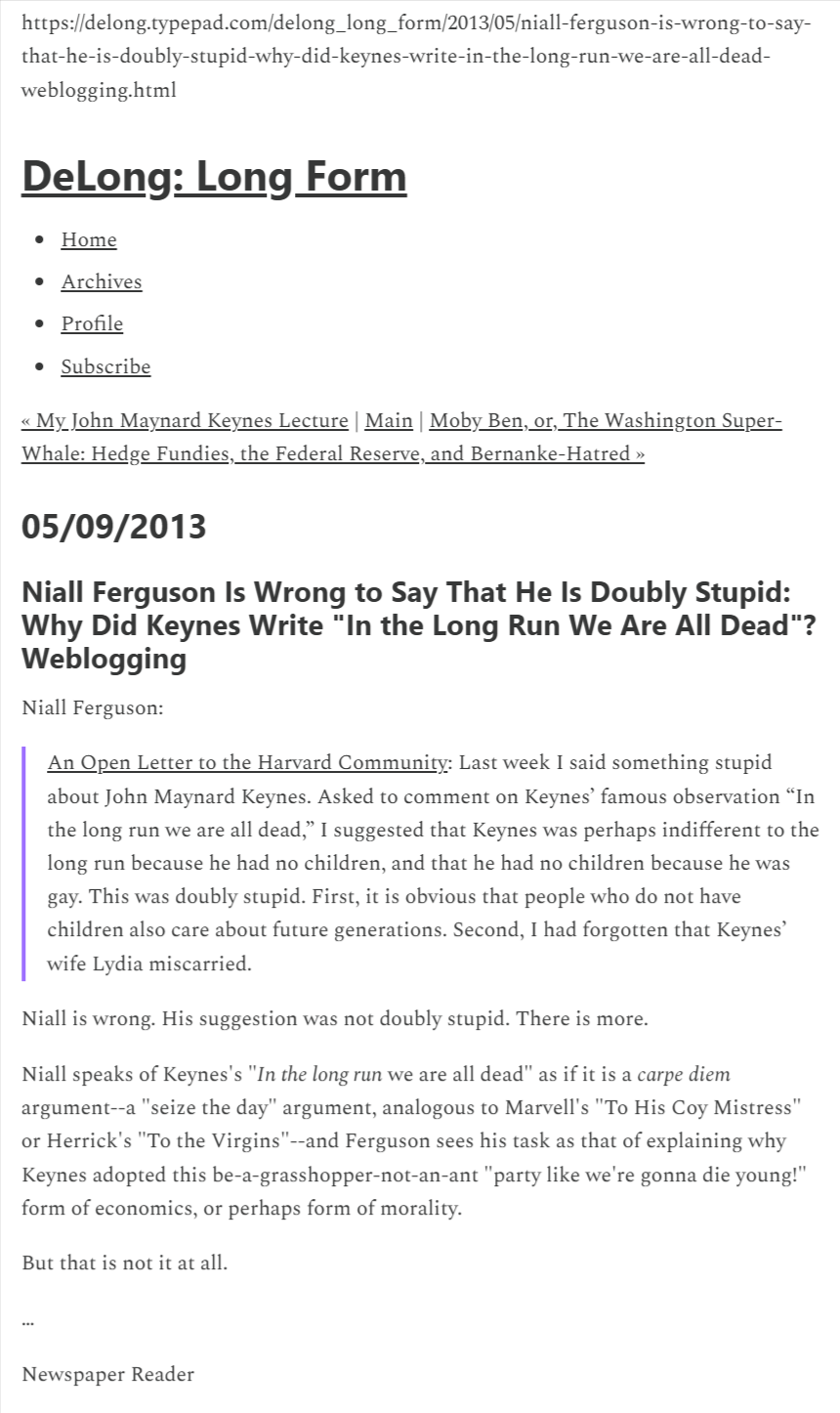
The historian Niall Ferguson has denied being an “gay-basher”, claiming that his friendship with the prominent homosexual blogger Andrew Sullivan showed that he could not be homophobic.
Following days of criticism about his comments on the sexuality of economist John Maynard Keynes, the Harvard professor sought to clear his name with an open letter to The Harvard Crimson, the university’s college newspaper.
The British academic had already apologised for claiming that Keynes did not care about the future because he was gay and had no children, but said he owed it to his students to “make it unambiguously clear” that he was not homophobic.
In the letter, Ferguson, 49, said: “In my writing and teaching, I have laboured long and hard to expose precisely what was wrong about the theories that condemned homosexuals, Jews and others to discrimination and death.” As evidence that he was not a “gay-basher as some headline writers so crassly suggested” he pointed out that Sullivan , a US-based political commentator, gave a reading at his wedding and is a godfather to one of his sons.
Explaining his remarks last Thursday which sparked the row, he said: “Not for one moment did I mean to suggest that Keynesian economics as a body of thought was simply a function of Keynes’ sexuality.” But he added it could not be true that the economist’s sexuality “is totally irrelevant to our historical understanding of the man”.
Ferguson also used the letter to condemn “vituperative online critics” for their knee-jerk response to his original comments – adding that for the “self-appointed inquisitors of internet, it is always easier to accuse than seriously to inquire”.
But judging by the online comments, many students remain unimpressed, with several questioning his “some of my best friends are gay” defence, and others questioning his role as the Laurence A Tisch professor of history at Harvard.
Editor: The Reader has to give Mr. Colevile some credit for his first paragraphs.
Keir Starmer is the last person you can imagine going on Stars in Their Eyes. But in his big speech on Thursday he did a pretty convincing impression of Elon Musk. The prime minister complained that Whitehall was harbouring a “cottage industry of checkers and blockers”; that it’s too hard “for the most enterprising people in the country to just get on with the job”. But no more! Under Labour, compliance costs for business will fall by a quarter. Yes, a full 25 per cent.
It’s an admirable ambition. Every poll of businesses, large and small, finds that compliance and admin are an ever-growing burden. In the City, for example, the ratio of regulators to workers has roughly quadrupled since 2011 — having already risen almost 40-fold since 1980. And God knows our economy needs an injection of dynamism: the latest GDP figures have us shrinking once more, after year on year of stagnant growth.
Editor: what follows is an etiolated diagnosis framed by ‘But there are a few small problems.’The Reader just needs to focus on Colevile as the head of a Think Tank, that employs a cadre of technoctats, yes small t, who can and will supply the boss with the most pertenent idiological information. These two pargagraphs are alive with the hard work of his underlings. Not forgetting that Starmer is the a low-rent version of Tony Blair! The Reader might look at the Prime Misterships of David Cameron, Theresa May, Boris Johnson, Liz Truss and Rishi Sunak as a collection of mendacious political incompetents.
The Reader now finds herself in a position of confronting the remaining 998 words of Colvile’s political argument. I’ll supply a selection of his political chatter.
…
Musk and Donald Trump are targeting whole categories of compliance — DEI, ESG, AML, KYC. Hell, Trump has even said it’s OK to bribe foreigners again.
…
The second is that, as Dominic Lawson points out, Starmer is simultaneously increasing the regulatory burden, via Angela Rayner’s Employment Rights Bill — a package of pro-union, anti-business measures so detested by the private sector that the government cannot name a single small firm that supports it
…
Only one department, Defra, has a full list of the regulations it has imposed. Even when the government was deciding which European rules to keep after Brexit, there were no costs attached.
…
But that system is utterly unfit for purpose.
…
Editor: under the manner of Self-Congratulation
Last year I co-authored a report for the Centre for Policy Studies think tank examining the impact assessments attached to every piece of legislation from the 2010s. We showed that the Tories’ promises to lower the burden of regulation were bunkum — in fact, the official estimates demonstrated that costs rose by £6 billion a year.
….
Editor: ‘by the most junior people’ in sum not worthy of attention/consideration. Not to speak of ‘Class Bias’!
It was clear from the assessments, and from conversations within Whitehall, that the estimates were too often done at the last minute, by the most junior people in the office, to justify decisions that had already been made.
…
Editor: to the Grenfell matter, see the italics of the second sentence!
Or what about the second staircase rules brought in after Grenfell to make evacuation easier? A noble and necessary measure, you might think.
Except that the Grenfell inquiry did not actually recommend second staircases. And the impact assessment could not find evidence of a single life, anywhere, that would have been saved — not least because fire brigade practices in buildings under 50m tall “are effective to the point that mass evacuation via the stairwell is an extremely rare occurrence”. Yet the Tories not only introduced the requirement but unilaterally lowered the height limit for second staircases from 30m to 18m.
But this, too, isn’t the end of the story. Because the impact assessment included the cost of building the additional staircases. But not of the floor space, and flats, that would be lost to make room. It glibly claimed the towers could be made wider or taller. Which is not, to say the least, how our planning system works.
In truth, once you ran the numbers properly, the estimated annual cost of £268 million was closer to £2 billion. But there was no way for builders to challenge the figures. The result has been fewer new homes, an effective ban on the construction of traditional mansion blocks over that 18m threshold — and long months of frozen construction, across England, as the consultation dragged on.
…
Editor: Colevile self-congratulation is the perpetual ! An expression of ‘Progressive Thatcherism’ ?
That means, as our report set out, a complete transformation of how Whitehall thinks about regulation — putting the costs front and centre, getting independent estimates rather than letting departments mark their own homework, and much more. It means eliminating scams like the plastic bag trick, in which civil servants rebadged the obligation for customers to save the planet by paying for their shopping bags as a deregulatory measure — think of the savings for the supermarkets! — and magically met their targets for slashing red tape as a result.
Above all, it means changing how ministers think — and what they are rewarded for. Because the problem is not just over-mighty regulators, but politicians whose positive headlines — and cabinet careers — depend on being seen as legislative dynamos, constantly responding to the latest clamour that something (anything!) must be done about the problem of the day, whatever the cost.
…
Editor: The Eternal Mirage of Growth as expressed by both Starmer and Colevile. Note the Colevile tag line in italics!
Starmer is absolutely right that Britain’s addiction to regulation is a drag on growth. But his government has done nothing but increase the burden on the private sector — with disastrous economic consequences.
As for making a speech promising to cut compliance costs on the same day that his party blithely votes through a massive hike in them without even pausing to get an accurate estimate? There’s a word for that. But not one I can use in print.




 StephenKMackSD's Blog