In the beginning there was agony. Under the empires of old, the strong did what they willed and the weak suffered what they must.
But over the centuries, people built the sinews of civilization: Constitutions to restrain power, international alliances to promote peace, legal systems to peacefully settle disputes, scientific institutions to cure disease, news outlets to advance public understanding, charitable organizations to ease suffering, businesses to build wealth and spread prosperity, and universities to preserve, transmit and advance the glories of our way of life. These institutions make our lives sweet, loving and creative, rather than nasty, brutish and short.
…
Editor: collecting ready-made cliche’s is Mr. Brooke strong suit ‘The Collapse’ being his entance into ‘New York Times World’. But The Reader confronts in this 1124 word essay is these political actors:
NATO, Perkins Coie, Harvard, Columbia, Big Ten,Bernie Sanders and Alexandria Ocasio-Cortez, Erica Chenoweth and Maria J. Stephan, (Think of the civil rights movement at Selma.), “Upheaval,” Jared Diamond.
But note Mr. Brook’s self-descritpion in his final paragraph, that reeks of placing himself above and or beyond the frey, that somehow retains political credibility, in Brooks’ self-conception?
I’m really not a movement guy. I don’t naturally march in demonstrations or attend rallies that I’m not covering as a journalist. But this is what America needs right now. Trump is shackling the greatest institutions in American life. We have nothing to lose but our chains.
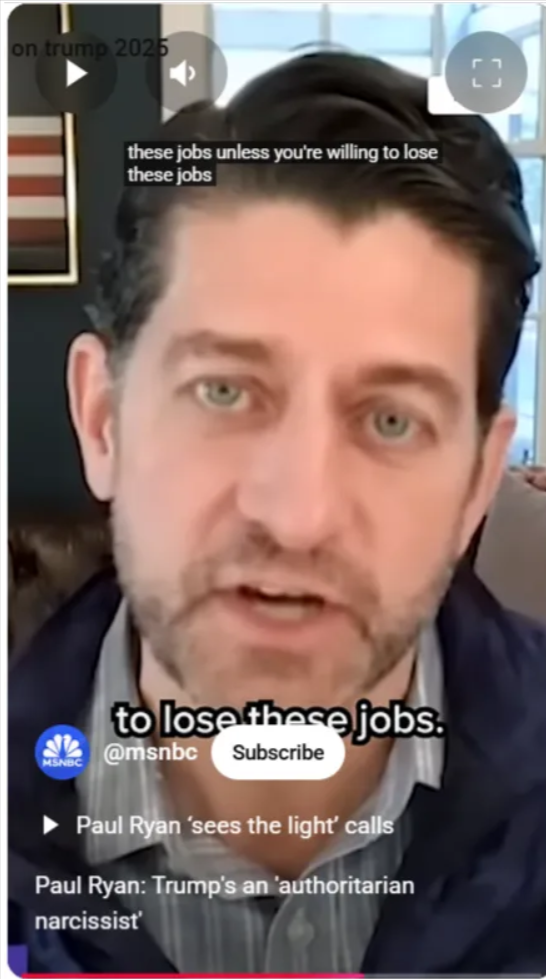
Paul D. Ryan and his self-proclaimed “young guns” in the House Republican leadership traversed the country in 2010 harnessing the energy of the Tea Party movement that would sweep them to power that November. But in failing to confront the most divisive forces of the movement, they may have set their party up for its current crisis.
Some of those insurgent winners from that year would eventually turn on the leaders one by one, setting in motion the downfall of Rep. Eric Cantor — just as Republicans were attempting to cobble together a modest immigration measure — then blocking the ascent of Rep. Kevin McCarthy after they had deposed John A. Boehner as the speaker of the House.
Now the Tea Party’s ultimate creation, Donald J. Trump, may be coming for the last young gun unscathed, Ryan.
“Paul Ryan, I don’t know him well, but I’m sure I’m going to get along great with him,” Trump said as he stormed through Super Tuesday and sealed his front-runner status. “And if I don’t, he’s going to have to pay a big price.”
Weeks before that, Trump blamed Ryan in part for Republicans losing the White House in 2012.
Facing forces he inadvertently helped unleash, Ryan finds himself confronting a potentially agonizing choice — both moral and intellectual — between the values he has spent his career promoting and the man who stands ready to repudiate them.
“If a person wants to be the nominee of the Republican Party,” Ryan said this week, directing rare fire at Trump, though not by name, “there can be no evasion and no games. They must reject any group or cause that is built on bigotry.”
On Wednesday, Ryan’s office was contacted by Trump’s campaign, but the two men did not speak, said Brendan Buck, a spokesman for Ryan. “We expect the speaker to be in touch with all the remaining candidates soon to discuss our efforts to build a bold conservative policy agenda for 2017,” he said.
To Democrats, and some Republicans, Ryan and the Republican leadership have a quandary of their own making. Republican lawmakers and candidates often averted their gaze when questions were raised about President Barack Obama’s birth certificate and religion. They tolerated breaches of decorum, such as Rep. Joe Wilson’s cry of “You lie” during a presidential address, and even made light of the man who brought many of those alleged conspiracies to the fore: Trump.
“The party repeatedly made myopic decisions, tolerating the intolerable views of a segment of the party unwilling to accept that problem-solving is complicated,” said Tony Fratto, a Republican consultant who served in the George W. Bush administration. “The short game was winning some midterms. The cost was creating an incoherent and unsustainable coalition.”
Democrats are now seizing on this trajectory, and trying to tie all Republican incumbents, even Ryan, to the legacy.
“Donald Trump is appealing to some of the darkest forces in America,” Sen. Harry Reid of Nevada, the Democratic leader, said on the Senate floor Wednesday. “It’s time for Republicans to stop the Frankenstein they created.”
Many Republicans reject that analysis, especially when it comes to Ryan. His aides answer questions of Obama’s birth and presidential eligibility with a form letter that includes a copy of the president’s birth certificate. “I certainly understand the importance of this issue,” the letter says, “and I hope you find the information useful.”
Instead, they pin Trump’s rise on their own failures to deliver on campaign promises, like the repeal of the Affordable Care Act, the defunding of Planned Parenthood, and the broad shrinking of government. That helped spawn the anger propelling Trump.
“People were not totally upfront in saying as long as President Obama is in the White House, we need to be realistic about our goals,” said Brian Walsh, a former official at the National Republican Senatorial Committee. “I think that contributed to the anger and disenchantment with leadership.”
While Ryan politely rejected the birth inquiries, others did not.
Asked in 2011 on the NBC program “Meet the Press” about the birth certificate conspiracy, and House members still promoting it, Boehner responded, “It really is not our job to tell the American people what to believe and what to think.” Asked on the same program about such “crazy talk,” Cantor replied, “I don’t think it’s, it’s nice to call anyone crazy, OK?”
“In Trump’s America, the Guessing Game Never Ends”
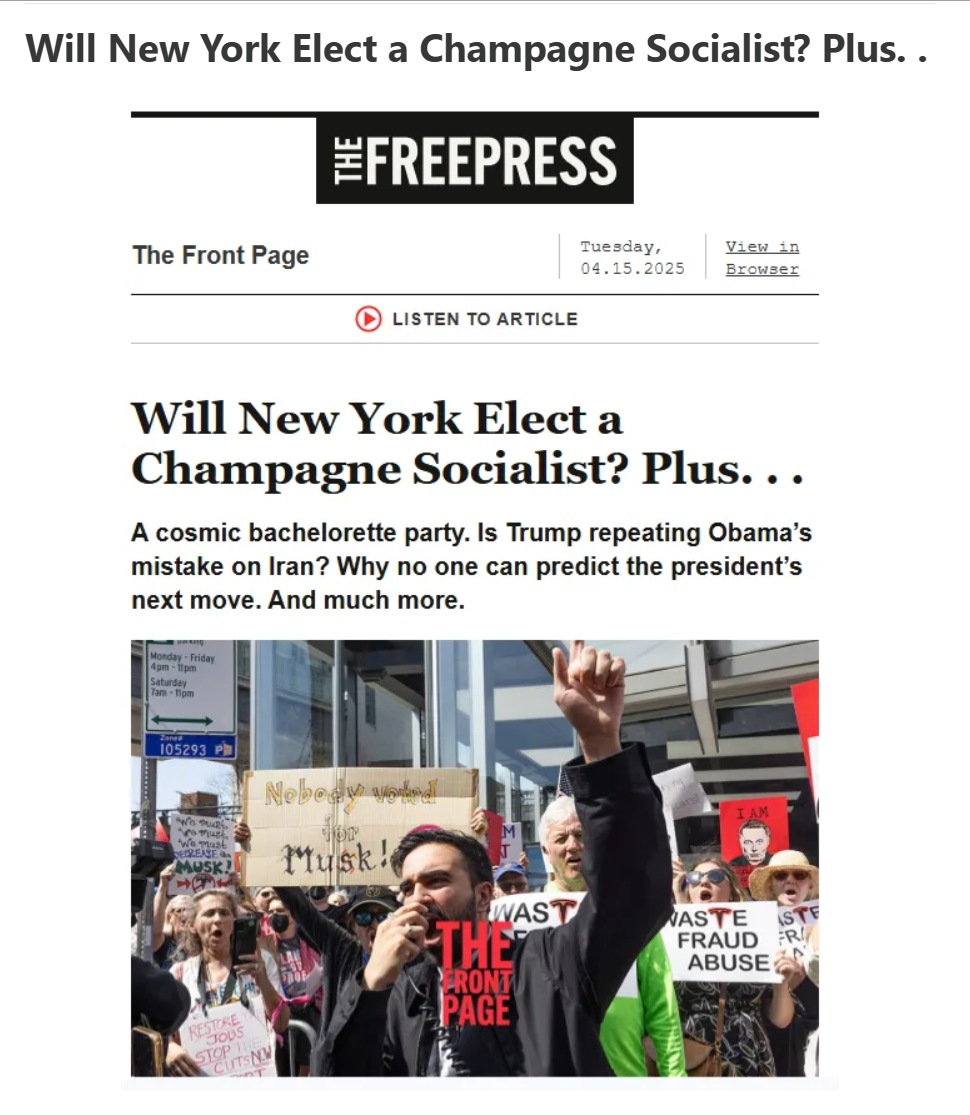
What is our policy toward Iran? Are the tariffs on or off? If they’re on—what countries are they on? And are they permanent? What’s actually going on? As a newsletter writer, it is my job to know these things, and yet when I walked to work this morning I saw a little French Bulldog peeing on the sidewalk, and I looked in his bulging bug eyes and figured he could predict the Trump administration’s next moves as well as I could.
And maybe he could. Today in our pages, Matthew Continetti says that I—like a lot of people—am thinking about the Trump administration the wrong way. Why? Because, according to Matt, we’re “looking for conceptual frameworks and policy Svengalis. None exist. In Trump’s White House, strategy documents are suggestions. Personnel is not policy. Trump is the policy.”
Editor : Its been a while since I’ve seen the name Matthew Continetti in any context, but his association with the American Enterprise Institute (AEI) is no surprise!
Why Does Trump’s Iran Policy Look Like Obama’s?
Over the weekend, just before Middle East special envoy Steve Witkoff met with Iranian leaders in Oman, he told The Wall Street Journal that the goal was to dismantle Iran’s nuclear program, but that the “red line” is that the country can’t have nuclear weapons.
That may sound unremarkable enough. But as Eli Lake argues today, it represents a sea change in Trump’s Iran policy. And he thinks it’s an ominous sign when it comes to the kind of deal we might be about to strike with Tehran.
Editor : The Reader only need confront the first paragraph, and the use of the term ‘Activist Judges’… to follow next is the Ronald Reagan favorite ‘Welfare Queens’ ? to confront Mr. Colvile’s not so latent xenophobia!
Week after week, the reports fill the papers. “Migrant avoids deportation because he lost his phone.” “Pakistani paedophile allowed to stay in UK because he is an alcoholic.” “Rapist’s criminal record is so bad he can’t be deported.” “Criminal’s deportation case halted over son’s dislike for chicken nuggets.” “Afghan woman can’t be deported because she has back pain.”
Even allowing for a certain level of journalistic exaggeration, we clearly find it harder than we should to kick out those who shouldn’t be here. So what’s gone wrong?
…
Editor: The Reader might wonder about the British Empire and how it strip-mined its Colonial Possesions over centuries: that is carefully elided from the Mr. Covle’s rant, about the undeservig grifters on the dole. It could be argued that those on the dole are the watershed of that Empire, and its criminal eterprise refracted though time? Mr. Colevile is a Thaterite of a certain political class, in sum an Oxbridger whose veration of The Iron Lady is toxic! Should The Reader pay due attention to Mr. Colvile’s arguments?
Well, Robert Jenrick, the shadow justice secretary, thinks much of the blame lies with lawyers like Greg Ó Ceallaigh. Ó Ceallaigh is a crusading KC, who supports the abolition of the Illegal Migration Act, has called Tory politicians “terrible crooks” and tweeted in 2012 that the party “need to be dealt with as you would deal with the Nazis, cancer or lava”. But he also moonlights as a migration judge.
I’m not suggesting Ó Ceallaigh’s judicial verdicts are driven by his politics, though he has certainly contributed to the catalogue above. (“Covid made me commit crime, claims drug dealer spared deportation”.) But it is definitely true that the people who become migration judges tend to be migration lawyers — and that such lawyers generally got into the field to protect migrants’ rights, not borders.
Indeed, asylum and migration is widely accepted to be one of the most left-wing parts of an increasingly left-wing profession. In surveys by The Lawyer, the magazine’s readers voted overwhelmingly for the Lib Dems in 2019, and even more overwhelmingly for Labour in 2024.
Editor : Mr. Colevile presents Greg Ó Ceallaigh in a Dickensian shadow, in his utter mendacity and ‘left-wing politics’. But reader notice how the cast of characters grows into a 885 word tyrade, against a set of bad political actors in the Colvile Political Imagination! A sampler of the miscreants exhaustes the readers patience , so let me be parsimonious in my selection!
1) A few months ago, every living lord chief justice co-authored a report on prisons policy, urging more leniency and lamenting the fact that idiot politicians, egged on by the media, kept pushing for tougher sentencing.
2) The nutrient neutrality scandal has seen tens of thousands of houses blocked by a disastrously strict interpretation of habitat regulations. And the government has yet to explain why we are legally obliged to give up the Chagos islands, let alone hand billions to Mauritius for the privilege.
3) When the row over “two-tier justice” broke out, the chairman of the Sentencing Council sent the justice secretary an astonishingly high-handed letter, warning that the judiciary accepted sentencing guidelines only because they were written by the judiciary, and that for “sentencing guidelines of whatever kind …
4) Similarly, when Kemi Badenoch and Sir Keir Starmer agreed it was utterly wrong for a Gazan family to be granted asylum under a scheme reserved for Ukrainians, the lady chief justice said the lack of respect for judicial independence left her “deeply troubled”.
5)As are many of his closest friends — including Philippe Sands, who has driven the Chagos case, and the attorney-general, Lord Hermer.
6)That might seem like a commendable blow for equality. But the more you dig into the equal pay rules, the less that argument convinces.
7)The clothing firm Next, for example, was punished for paying warehouse workers more than retail staff because those jobs were male and female-coded — even though it did not pay a single woman less than a man for doing the same job, and almost half of its warehouse workers were female.
8)The same legal constraints have seen the NHS grade all staff according to an impossibly complicated formula that creates arbitrary equivalence between completely different roles.
9)For example, the evidence in the Next case was very clear that there is more demand for warehouse workers than retail staff, that pay for such roles is higher, and that the firm had begged staff in its stores to shift over.
10)Rather than reflecting reality, the equal pay regime has become a charter for trade unions to milk employers. And I’ve explained it at such length because Labour is hugely expanding its scope.
11)It gives unions the right to enter workplaces where they aren’t recognised, and forces firms to give union “equality representatives” time off to attend to those duties.
12)Ministers will also activate the long-dormant “socioeconomic duty” within the Equality Act, which means every single decision made by the state must be evaluated according to its impact on disadvantage. And all of this will be policed by legal case after legal case.
13)During the Tory leadership contest, Tom Tugendhat argued that Britain is increasingly subject not to the rule of law but the rule of lawyers. That’s been great for the legal profession — but not so much for the rest of us. And sadly, the lawyers around the cabinet table are set to make things very much worse.
Editor: Though my attempt at parsimony, may have been limited by Mr. Colvile’s Thatcherite Historical Sweep, the reader is given key passages from which to reach the essentials, if that is what they be?
& Wong Kim Ark is not just an artifact that history has long passed by. The modern Supreme Court, in dicta, has reaffirmed it. In Plyler v. Doe (1982), a 5-4 majority observed that the Fourteenth Amendment’s Equal Protection Clause forbade states from excluding the children of illegal aliens from public schools. The Justices unanimously agreed, however, that “no plausible distinction for the 14th Amendment’s ‘jurisdiction’ can be drawn between resident aliens whose entry into the United States was lawful and resident aliens whose entry was unlawful.” Critics of birthright citizenship today can certainly argue that the Court erred in Plyler, just as they can argue that the Court erred in Wong Kim Ark. But they must show that the weight of historical evidence of the original understanding of the Fourteenth Amendment justifies reversing 140 years of unbroken judicial interpretation. They cannot because the traditional sources of legal meaning run exactly the other way.
The Fourteenth Amendment recognized the traditional American norm of birthright citizenship. No Supreme Court, Congress, or President has acted to the contrary. As head of the executive branch, Trump has the authority to order the agencies to pursue a different interpretation. He can use his discretion to prompt a test case that will swiftly reach the Supreme Court, which will almost certainly affirm Wong Kim Ark. It is hard to see a conservative, originalist Supreme Court rejectingthe traditional American understanding of citizenship held from the time of the Founding, through Reconstruction, to today. But while destabilizing settled constitutional meaning, Trump may suffer severe political costs without doing anything to solve the problems of immigration and the southern border.
John Yoo: The Man Who Would Make the President King
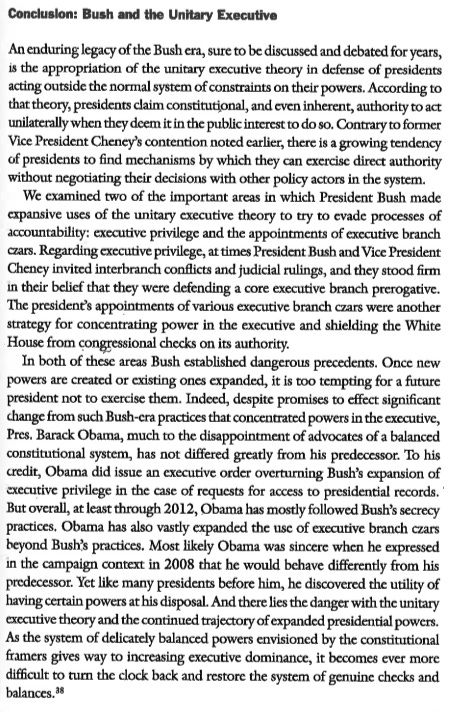
The Trump presidency has been a stress test for maximalist theories of presidential power.
The Trump presidency has been a stress test for maximalist theories of presidential power. Even the narrower versions of unitary executive theory, which hold that the president has an indefeasible right to direct and remove executive branch officers, present vast opportunities for mischief. With those powers, a crooked president can cover up corruption by barking “You’re fired!” to inspectors general who might expose it, or direct federal prosecutors to protect his cronies and screw his enemies. Trump’s efforts in this direction so far have been unsubtle, to say the least, but they reveal how much rests on a bed of unenforceable “norms.” Alexander Hamilton’s argument for “energy in the executive” in Federalist 70 took as a given that we’d have a president vulnerable to “the restraints of public opinion,” not one for whom, as has been said of Trump, “shamelessness is a superpower.”
Yoo’s hardly blind to Trump’s character flaws. He admits his hero Hamilton erred badly in predicting that the office would be filled by “characters preeminent for ability and virtue.” Instead, the 20th century drift toward “quasi-plebiscitary” selection favors the sort of figures Hamilton feared: men with “talents for low intrigue and the little arts of popularity”—a description, Yoo concedes, that “could not have anticipated Donald Trump’s public life in more accurate terms.” But if we’re increasingly likely to get people we can’t trust, might it have been unwise to concentrate so much power in the presidency in the first place?
Hamilton also argued that energy in the executive would provide “steady administration of the laws.” This is, perhaps, another area where the $10 Founding Father could’ve been a lot smarter. The last three presidents have assumed an extraordinary amount of unilateral power to make the laws, as with Trump’s recent decision to conjure up $400 a week in supplemental employment benefits with the stroke of a pen.
Under Yoo’s tutelage, Trump appears poised to take pen-and-phone governance still further. The president is “privately considering a controversial strategy to act without legal authority to enact new federal policies,” Axios reported in July, in a scheme “heavily influenced by John Yoo, the lawyer who wrote the Bush administration’s justification for waterboarding after 9/11.”
The gambit centers on the Supreme Court’s recent decision, in DHS v. Regents of the University of California, blocking Trump’s reversal of Obama’s Deferred Action for Childhood Arrivals (DACA) program, itself an arguably illegal use of executive power. The ruling, Yoo lamented in National Review, “makes it easy for presidents to violate the law”—and hard for their successors to undo those violations. In a matter of days, though, Yoo decided Regents was really a blueprint for action and began urging Trump to “weaponize the DACA decision” to enact his own agenda.
One problem with forging new weapons is that you can’t keep them out of the hands of future presidents, some of whom are sure to combine Trump’s shamelessness with actual competence.
Oh, well: The upside is that Yoo’s new theory of executive empowerment scored him an audience with the president. After his Oval Office visit in July, Yoo reported that Trump is “really on top of things,” and, despite what you hear, not all “Nixonian in the bunker and paranoid and dark.” So we’ve got that going for us.
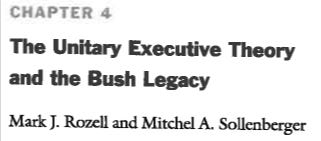
Political Observer ( With apologies to Mark J. Rozell & Mitchel A. Sollenberger !)
Trumpian chicanery renders any attempt at finding motive and reasons, for self-serving political and economic manipultion, are moot? Exploitable Chaos is The Trumpian métier !
Editor: The Financial Times reports on the Trumpian Chaos, and the massive sighes of relief, and the fears of an uncertain future, that cannot be assuaged!
Donald Trump stunned global investors on Wednesday when he announced a 90-day pause in additional tariffs on countries that were willing to negotiate with the US, sending stocks surging as the president backed down from a full-blown trade war.
Wall Street equities surged immediately after Trump’s announcement, with the blue-chip S&P 500 closing up 9.5 per cent and the Nasdaq Composite surging more than 12 per cent. It was the best day for the S&P 500 since 2008 and the strongest for the Nasdaq since 2001.
The massive rally in stocks added about $4.3tn to the market value of the S&P 500, according to Financial Times calculations based on FactSet data. The gains reversed some of the heavy losses for US stocks since Trump announced his wide-ranging tariffs a week ago.
However, the president also singled out China for further tariffs, increasing his additional levies on the world’s second-largest economy to 125 per cent, deepening his trade stand-off with the Asian nation.
Trump said in a Truth Social post: “Based on the fact that more than 75 Countries have called . . . to negotiate a solution . . . and that these Countries have not, at my strong suggestion, retaliated in any way, shape, or form against the United States, I have authorized a 90 day PAUSE, and a substantially lowered Reciprocal Tariff during this period, of 10%, also effective immediately.”
But China had showed a “lack of respect” by retaliating against US tariffs, Trump added. “I am hereby raising the Tariff charged to China by the United States of America to 125%, effective immediately.”
The stunning climbdown from the US leader came after a week of turmoil in global markets, with trillions of dollars shed in equity prices around the world, a sharp sell-off in US bonds, and a plunge in oil prices to levels last seen during the coronavirus pandemic.
“This is Trump’s capitulation to markets,” said Andy Brenner at NatAlliance Securities. “He has saved face by keeping tariffs on China.”
A heavy sell-off in US government debt, a bedrock of the global financial system, eased following Trump’s U-turn and a Treasury auction that signalled robust international demand. The 10-year yield, which had been up as much as 0.24 percentage points on Wednesday, ended the New York day up 0.08 percentage points at 4.35 per cent.
Companies that had been beaten down in recent days also posted huge gains on Wednesday. Apple, Nvidia, Microsoft, Amazon, Meta and Tesla all jumped at least 10 per cent following Trump’s announcement.
Commerce secretary Howard Lutnick said the “world is ready” to work with Trump to “fix global trade” but dismissed China as having “chosen the opposite direction”.
Lutnick added on X that he and Treasury secretary Scott Bessent “sat with the President while he wrote one of the most extraordinary Truth posts of his Presidency”.
Later on Wednesday, Trump appeared to acknowledge some of the fear in the markets sparked by his trade war.
“Well, I thought that people were jumping a little bit out of line. They were getting yippie, you know, they were getting . . . a little bit afraid,” he told reporters.
Headline: There’s Nothing Real About Trump’s ‘Real America’
…
I’ve been thinking about this case as an emblem of everything that makes Donald Trump’s presidency so vile and destructive, even when I’ve bentoverbackward to give him the benefit of the doubt, and even when I’ve agreed with him on this or that pointofpolicy.
…
I have, to borrow a line from Peggy Noonan, a “certain idea of America.” He ain’t it.
…
It’s Sojourner Truth asking the suffragists at the 1851 Woman’s Rights Convention in Akron, Ohio, “Ain’t I a woman?
…
It’s Lou Gehrig, stricken with A.L.S. in his 30s, calling himself “the luckiest man on the face of the earth.”
…
It’s Gail Halvorsen, the candy bomber of the Berlin Airlift, parachuting chocolates and gum to the hungry children of the besieged city.
…
It’s John McCain refusing an offer to be released before other American P.O.W.s in North Vietnamese captivity — and, 40 years later, publicly rebuking a supporter for calling Barack Obama, his opponent in the 2008 presidential race, “an Arab.”
…
It’s Robert F. Kennedy after Martin Luther King Jr.’s assassination: “What we need in the United States is not division; what we need in the United States is not hatred; what we need in the United States is not violence and lawlessness; but is love and wisdom, and compassion toward one another.”
Democratic nobility is also found on a page I keep in my desk drawer, a passenger manifest of the ship that brought my 10-year-old mother to the United States, thanks to the Displaced Persons Act of 1948. Right below my mother’s name and nationality — “Stateless” — there is Jamil Issa Hasan, 26, Jordanian; Bruna Klar, 27, Italian; Martha Kohlhaupt, 41, German; and Gerda Nesselroth, 45, also stateless.
Soon to be Americans all.
…
understatement and confidence, decency and expectation, the America of Huck and Jim, Bogart and Hepburn, Shepard and Glenn.
…
But I struggle to understand what’s real in JD Vance’s shape-shifting political beliefs or Trump’s meme coins.
…
Editor: this selective collection of quotations, in sum these lifeless tableau vivant , are the sighposts of a decorus chatter, that is an attempt to mitigate, excuse the Genocide being perptrated against the Palestinian’s, by the Zionist Faschist State. Onley in high dudgeon can Mr Stephens manage to command, what almost resembles the moral/political high ground!
The United States is a vast and diverse country and an old and resilient democracy that won’t quickly fold into authoritarianism and illiberalism the way Russia or Hungary did. The habits of freedom, 250 years old, still run deep in our bones — deeper than anything this president can ruin over the next few years. But that certain idea of America that once typified us, and for which we were once so admired, is evaporating.
A fresh, research-driven playbook for how successful leaders can maximize the potential of others
When we think of leaders, we often imagine lone, inspirational figures lauded for their behaviors, attributes, and personal decisions—a perception that is reinforced by many leadership books. However, this approach ignores the expectations of modern work cultures centered on equity and inclusion, where a leader’s true mission is to empower others. Applying decades of behavioral science research, Don A. Moore and Max H. Bazerman offer a passionate corrective to this view, casting today’s organizations as decision factories in which effective leaders are decision architects, enabling those around them to make wise, ethical choices consistent with their own interests and the organization’s highest values. As a result, a leader’s impact grows because it ripples out instead of relying on one individual to play the part of heroic figure.
Filled with real-life stories and examples of the structures, incentives, and systems that successful leaders have used, this playbook equips each of us to facilitate wise decisions.
yup.email.news@yale.edu
Editor: Recall ‘The Man in the Gray Flannel Suit’ in the 1955 novel by Sloan Wilson and the Movie of 1956 ?
Political Observer
I recall reading ‘The Man in the Gray Flannel Suit’ sometime in the 1990’s. I had to stop reading this book – I felt a growing sence of creeping claustrophobia, as Wilson’s book described the ethos of that time and place in post-war America. In the near political present ‘Mad Men’ captured, although awash in retograde nostalgia, and in evocative color resolution, what that time was like…
Anderson is too intelligent and honest to deny the intellectual and political triumph of the right in the past decade, and yet he has never formally renounced his revolutionary convictions. They have just sunk quietly into the background, becoming a kind of coda to what is now his main occupation – the exposition of other people’s ideas. In this he is masterly. Yet intellect and political loyalties still occasionally conflict, producing confusion. A good example of this is his essay on Francis Fukayama’s The End of History. Fukayama’s grand narrative of historical progress – even though it culminates in the triumph of bourgeois liberal democracy – is of precisely the kind to win Anderson’s admiration. Anderson defends it against its detractors, claiming, on impeccably Marxist grounds, that their various refutations of Fukayama’s hypothesis amount to nothing more than local difficulties, and do not constitute a genuine contradiction. But then – as if suddenly realising what he has admitted – he amasses a whole set of difficulties of his own, ranging from environmental problems to feminism. But these are no more a fundamental contradiction than the difficulties he has previously dismissed. All are manageable within the confines of the present world-system. Fukayama has beaten Anderson at his own game.
Editor: Reader consider these portions of Commentary – Endgame by Joseph McCarney: Radical Philosophy 62, Autumn 1992
…
In sharp contrast Perry Anderson hails it in A Zone of Engagement as a work of ‘conviction and elegance’ ,of’ graceful fluency’ and’ original argument’ , a ‘remarkable feat of composition’ in which ‘for the first time, the philosophical discourse of the end of history has found a commanding political expression’. ‘It is safe to say,’ he adds, ‘that no one has ever attempted a comparable synthesis – at once so deep in ontological premise and so close to the surface of global politics.’ These generous words may also be taken as illustrating a larger tendency. Clearly, the reception of Fukuyama ‘s book offers a rich field of inquiry.
…
Perry Anderson gives the principle of them in remarking that the Right’s charge of ‘inverted Marxism’ is grounds for tribute on the Left. His own tribute is delivered in A Zone of Engagement with an intellectual force and authority that risks incongruously overshadowing its subject.
…
Fred Halliday’s report in New Left Review 193 on ‘An Encounter with Fukuyama’ is the product of one of those unsatisfactory confrontations. This was a television discussion which was, as Halliday says, ‘somewhat deviated by the interventions of a bibulous Labour dignitary’ . Hence, it did not even begin to get the measure of Fukuyama’ s ideas and Halliday now seeks to make amends on his own account. He does this by graphically outlining some of the ‘many questions of interest and challenge to historical materialism’ raised by Fukuyama’s work. For present purposes, however, it may be enough to note his conclusion in which, echoing the ‘inverted Marxism’ theme, he suggests thatthe ‘problem with Fukuyama’s theory’ might be solved by doing to him ‘what Feuerbach did to Hegel, namely turn him on his head’. Halliday takes it to be a measure of Fukuyama’s breadth of reading and tolerance of his critics that he did not seem ‘too perturbed’ by the suggestion. Such equanimity deserves to be probed further. But first one should take account of the record of a meeting with a representative of historical materialism that is even warmer in tone and undeviated in its significance. This is Andrew Chitty’S interview in the second issue of Analysis, by far the most revealing document for Fukuyama’s thinking to have emerged from his British visit. In it Chitty refers to the vitriolic tone of much right-wing and establishment comment on the book, contrasting it with his own view as a Marxist that it is ‘one of the most developed expressions’ of bourgeois thought in the last twenty or thirty years. For the most striking vignette of Fukuyama’ s encounter with the British Left one has, however, to look to the occasion of his debate with Terry Eagleton. It came at question time when a speaker from the floor asked whether Fukuyama realised that the only friends he had in the world were orthodox Marxists like himself. Once again Fukuyama did not seem too perturbed. He seemed rather to endorse the suggestion in a complex reaction which united insight, resignation and humour. In the interview with Chitty he had declared himself proud to be an exemplar of bourgeois thought. Yet the responses to Halliday and to his anonymous questioner hint at levels of self-consciousness not adequately captured in that description, at a sensibility less flatly bourgeois than he likes to profess to the world.
…
Indeed Fukuyama’s book can plausibly be read as the record of a struggle for his soul between Kojeve and Strauss. This unacknowledged and unresolved drama may go some way to account for the impression of generalised ambiguity the work has made on many readers
…
This is so because the esoteric message of Fukuyama’s book is not at all personally congenial to him as a patriotic American liberal. His problem is that he lacks the theoretical resources to put up any serious resistance to it. Yet such resources are available in the tradition from which he claims indirect descent. For Hegel history is emphatically not to be characterised as essentially a struggle for recognition. It is rather ‘the progress of the consciousness of freedom’. A proper articulation of this view would surely enable one to see why the end of history is not, in principle, on offer from any kind of collectivist authoritarianism. That this is not clear to Fukuyama should be put down to the fact that, as various commentators have noted, the idea of freedom has no significant role in his theoretical scheme. The occasional references to it are the merest lip-service without any sense of intellectual or normative pressure behind them. This is perhaps not too surprising in view of the immediate provenance of his work, as outlined here. A living concern with freedom is scarcely to be acquired from a· conservative elitist such as Strauss. On the other hand, an interest in it as an ideal is, notoriously, not to be found in Kojeve either, ‘un Stalinien de stricte observance’, as he described himself. Nothing could better illustrate Fukuyama’s own distinctive brand of irony than his deadpan attempt to explain the problems in seeing Kojeve ‘as a liberal’. For Fukuyama to escape from his dilemma here he would need direct access to Hegel, unmediated by such an interpreter. An important lesson of his book is that his critics and admirers on the Left need this access too, now more than ever. As Kojeve’ s pupil, Lacan, remarked, it is just when we think we may be moving further away from Hegel that he may be sneaking up behind us. His understanding of how individual freedom may be concretely realised in a rationally-ordered community is still an indispensable starting point, indeed an as yet untranscended horizon of thought. The case for a welcome for Fukuyama from the Left rests on the assumption that his project and some of his methodology can be adapted in the service of quite other conclusions. From this standpoint it appears that the Right shows a sound instinct in being suspicious of him. The philosophy of history is our subject, and, now that Fukuyama has helped to put it back on the agenda, we have to take it over and revivify it. Our entire intellectual tradition rests on the belief that the truth of Hegel’s dialectic is socialism. This truth urgently needs to be demonstrated once again in the accents of our time.
Defeated on the political plane, Anderson has at last succumbed to the “siren voices of idealism”. His latest essay, The Origins of Postmodernity, is a work of cultural criticism in the classic tradition of Benjamin and Adorno. It is essentially a defence and an elaboration of Frederic Jameson’s thesis that postmodernism constitutes “the cultural logic of late capitalism”.
Postmodernism is a natural target of attack for a Marxist. What it signifies is the final disappearance of any critical perspective on the capitalist order. The Soviet Union, for all its imperfections, provided such a perspective, and its existence sustained the avant-garde throughout Europe and America. Now there is nothing but capitalism. Any revolt is immediately assimilated and commodified. Art, realising this, has abandoned its haughty intransigence and entered into alliance with the market. The tone of the essay is one of sorrowful resignation. Anderson can diagnose the malady, but he has no cure.
There is something strangely conservative about Anderson’s denunciation of a world in which, to quote Jameson, “we are henceforth so far removed from the realities of production and work that we inhabit a dream world of artificial stimuli and televised experience”. All that remains of Marxism, now that the political illusions have been shattered, is nostalgia for a lost seriousness. It can hardly be a coincidence that the fiercest critics of postmodernism, the most intransigent defenders of the eternal verities, have all been Marxists: Alex Callinicos, David Harvey and Terry Eagleton. At first glance this appears an ironic reversal, but on reflection it could hardly have been otherwise. Marxism cannot be other than conservative, because the one truly revolutionary ideology of the modern world – under whose sign “everything solid melts into air” – is capitalism.
The core of Gould’s essay is a close reading of PI par. 112-138, elucidating an oft-quoted bit: “A picture held us captive. And we could not get outside it, for it lay in our language and language seemed to repeat it to us inexorably” (par. 115). Oversimplifying, Gould’s point is that the vatic, aphoristic quality of the line tempts readers into an ‘isolationist’ reading, when what is needed is an understanding of therapeutic function in context. That Wittgenstein is attempting ‘therapy’ is of course the least original of theses, but Gould is painstaking and plausible in his tracing of a narrative of restless oscillation — but it must be! but it can’t be! — leading to fixation on linguistic forms, which turn out to be delusive rudders, leading to attention to ordinary use. To get the details, read Gould. But the complex irony he is exploring can be appreciated in the abstract. A typical effect of par. 115 is almost a parody of its purpose. ‘A picture of pictures as things in language held us captive. And we could not get outside it, for it lay in Wittgenstein’s language and his language seemed to repeat it to us inexorably.’ Here we get some hint as to why Gould thinks Wittgenstein’s compulsion to show what he is saying is problematic — when it seems it ought to be helpfully reinforcing. At the very moment he wants to send us ‘back to the rough ground’, he gives us some artfully epigrammatic frame — which we then trace around and around until its contours seem necessarily isomorphic with wisdom. By exemplifying the target pathology too potently, Wittgenstein’s rhetoric infects rather than inoculates.
But I have not explained how Gould makes the connection between his close reading and Wittgenstein’s allegedly fraught post-Romanticism. Eldridge helps here. Let me first quote one bit without context, because the subject could be almost any page of The Literary Wittgenstein:
“But now the worry arises that such a working through and dramatic display could not be philosophically significant. No theses seem to be quite established. Arguments appear at best as moves within an ongoing self-interrogation, not as routes to definite results. It seems too ‘optional’ whether anyone responds to the protagonist’s worries and to the drama of the text. Is philosophy here, within this reading, being vaporized into bad literature, as some of my colleagues sometimes ask?” (p. 212).
A drop of philosophy vaporized into a cloud of grammar. Indeed, all the contributions to The Literary Wittgenstein risk accumulating into a nebulous reversal of Wittgenstein’s therapeutic intentions; especially when half orbit around an inevitable few — tantalizing, ambiguous, vague — drops from Culture and Value, e.g. “I think I summed up my position on philosophy when I said: philosophy ought really to be written only as a form of poetry” (CV 24). This sentence appears as a blurb on the back of the book.




 StephenKMackSD's Blog