Robert Colvile on ‘Reformageddon’?

The Critic, after Sheridan.

stephenkmacksd.com/'s avatar

stephenkmacksd.com/

May 04, 2025

Headline: Reformageddon suggests Tories and Nigel Farage could help each other

Sub-headline: Any party that can win both Kent and Durham needs to be taken very seriously indeed.

https://www.thetimes.com/comment/columnists/article/reform-tories-nigel-farage-d396ql080

Mr. Colevile is attched to catch-phrases as manuctured place holders, like his latest ‘Reformageddon’, that hints at an imagined ‘something’ about to occure in the political now, or politicak moment! Think of ‘The Red Shoes’ and that wayword advertisement that is animated as partner, to the enchanted dancer? Too highpalutin? 1167 words makes the Critics role mired in speculatons, refracted though more speculations!


Nigel Farage has had some good days in politics. But it’s hard to imagine anything as purely satisfying as standing on stage in Durham to proclaim “a truly historic landmark” — a set of local elections that marked, among a string of other Reform successes, “the beginning of the end of the Conservative Party”, which was being “wiped out in the shires of England”.


For Keir Starmer, the news was … less good. Losing the by-election in Runcorn & Helsby, one of the safest seats in the country, will hardly calm the jitters in his party about its dire poll ratings. On the other flank, we also saw the Greens and Islamic independents continue to eat into Labour’s vote share.


Editor: Its hard to imagine two more mis-begotten candiates, yet view their percursors: David Cameron, Theresa May, Boris Johnson, Liz Truss, and Mr Sunak!


Editor: some very selective quotation, mined from this well of chatter:

There, even though the combined vote share for Conservatives and Reform massively outweighed Labour, a divided right helped Labour come through the middle.

Now, he argued, it is supporting Kemi Badenoch that is a wasted vote: “If you vote Conservative, you stop our chances of winning. If you vote Conservative, you get Labour.”

But there’s also a case — even if only a tentative and provisional one — that the divisions on the centre right may not be as damaging, for either party, as the consensus has it.

Let’s start with the results from Thursday. It is clear that Farage has forged a remarkable coalition. Any party that can win both Kent and Durham needs to be taken very seriously indeed.

In fact, Reform did not just win votes where the Tories won in 2019 and 2021, but also where they could never dream of doing so — in particular, some of the working-class Labour strongholds where even Boris Johnson, in his post-Brexit pomp, could not triumph.

Editor: Reader delay your bout of ennui, and read the last three paragraphs of this essay!

Of course, the parallels aren’t exact — not least because of the difference between a referendum and a five-way first-past-the-post grudge match. And trying to carve out an electoral foothold in an environment transformed by Reform may be a historic comedown for a Conservative Party that has long had a comfortable monopoly on the centre-right vote. But that’s what you get when you screw up as badly as the Tories have in recent years.

As for Farage, he has long dreamt of supplanting the Tories as the country’s second party. That dream is closer than ever to being fulfilled. Yet even if Reform eclipses the Conservatives, it is still hard to see either having the strength to win on its own.

A single right-wing ticket, in whatever form, would prevent Labour from coming through the middle. But it could also taint both Tories and Reform with the negatives of the other. Better for each movement to focus ruthlessly on the voters it is best placed to attract. Buttressed by voters’ impeccable ability to self-sort, such an approach might just mean, as in 2016, that a divided right ends up being more than the sum of its parts.

The Critic, after Sheridan.
Posted in Uncategorized | Leave a comment

From June 29, 2024: On Jonathan Freedland as Truth Teller!

Political Observer.

stephenkmacksd.com/'s avatar

stephenkmacksd.com/

May 04, 2025

Jonathan Freedland never disappoints, except in the matter truth, facts or valid argument! It’s his habit of being!

Political Observer engages in some Political Archaeology.

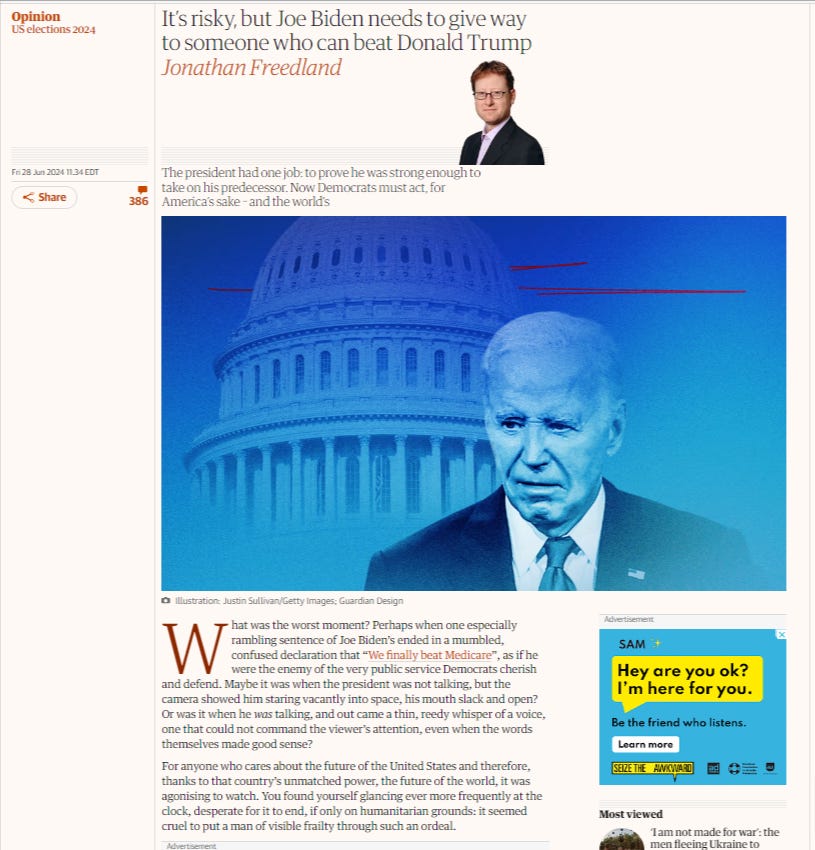
Headline: It’s risky, but Joe Biden needs to give way to someone who can beat Donald Trump

Sub-headline: The president had one job: to prove he was strong enough to take on his predecessor. Now Democrats must act, for America’s sake – and the world’s

https://www.theguardian.com/commentisfree/article/2024/jun/28/joe-biden-democrats-donald-trump

Mr. Freedland almost makes political noises reminiscent of ‘Morning Joe’ on the burning ‘Biden Question’ : beginning with 3:50 is the maudlin chatter about Joe’s ‘love of Biden, Jill and his family’: Norman Rockwell was better at producing American Kitsch! But this is also about the utter failure of American Broadcast News, as America abandons ‘Morning Joe’ for ‘Joe Rogan’ !

Freeland’s approach is the bloated ‘World Historical’ , as expressed the ‘The Fate of West’ in the sub-headline. But nothing quite matches Freedland’ s particular brand of panic steeped in hysterics:

What was the worst moment? Perhaps when one especially rambling sentence of Joe Biden’s ended in a mumbled, confused declaration that “

Is this Freedland’s Gethsemane moment?

Editor: The Reader is left with 963 words of ‘analysis’ I’ll engage in ‘sampling’ from this bloated text:

Expectations were rock bottom:

For one thing, Trump’s entire framing of this race is strong v weak: he offers himself as a strongman, against an opponent too feeble to lead and protect the US in an increasingly dangerous world.

But, no less important, Biden’s inability to deliver clear, intelligible statements meant Donald Trump’s lies went unchallenged.

There were dozens more in that vein, an unceasing firehose of lies.

As the former Obama administration official Van Jones put it after the debate, this is a contest of “an old man against a conman” – but the weakness of the former is allowing the latter to prevail.

Editor: on Trump:

He is a failed coup leader, nationalist-populist menace and racist who would suck up to the world’s autocrats and throw Ukraine to Vladimir Putin’s wolves: he should be allowed nowhere near power.

Editor: on ‘expectations’:

Indeed, that is why the White House opted to have the debate so unusually early: to allay fears about the president’s age and to reframe the race not as a referendum on Biden, but as a choice.

Editor: On Biden as a ‘proud and stubborn man’:

Some imagine the likes of Hillary Clinton and Barack Obama having a quiet word, but Biden is a proud and stubborn man who feels he was passed over too long, including by those two.

Editor: Jill Biden provides a kind of solace as antidote to the glaring reality:

Some say the only person who could ever persuade him to do that is his wife, Jill. But after the debate, she loudly congratulated her husband, albeit in a manner that reinforced the sense of a man well past his prime. “Joe, you did such a great job!” she said. “You answered every question! You knew all the facts!”

Editor: on the possibility of a Biden replacement:

The party could throw it open to a contest fought out at its convention in August among the deep bench of next-generation Democratic talent – the Michigan governor, Gretchen Whitmer, her California counterpart, Gavin Newsom, and others – but that could be messy, bitter and rushed.

Editor: Freedland in his final paragraph repeats the current political wisdom of the Biden as ‘a good and decent man’ : ‘Morning Joe’s maudlin chatter seems to have infected , emboldened other apologists? Yet this reader recalls the Joe Biden of another political time:

CNN —

Joe Biden in a 1993 speech warned of “predators on our streets” who were “beyond the pale” and said they must be cordoned off from the rest of society because the justice system did not know how to rehabilitate them.

Biden, then chair of the Senate Judiciary Committee, made the comments on the Senate floor a day before a vote was scheduled on the Senate’s version of the Violent Crime Control and Law Enforcement Act.

His central role in shaping and shepherding the tough-on-crime bill will likely face scrutiny in a Democratic primary should he run for president in 2020. His 1993 comments, which were in line with the broad political consensus to tackling crime at the time, are at odds with a new bipartisan coalition of activists and lawmakers who are trying to undo what they say is a legacy of mass incarceration fostered by that era.

Biden’s word choice could also pose a problem with a new generation of Democrats who view the rhetoric at the time as perpetuating harmful myths about the black community.

CNN’s KFile came across the 1993 speech during a review of the former vice president’s record.

President Bill Clinton in 1994 signed the crime bill into law with broad bipartisan support as violent crime rates peaked in the US in the early 1990s. Included in the law was the federal “three strikes” provision, mandating life sentences for criminals convicted of a violent felony after two or more prior convictions, including drug crimes.

“We have predators on our streets that society has in fact, in part because of its neglect, created,” said Biden, then a fourth-term senator from Delaware so committed to the bill that he has referred to it over the years as “the Biden bill.”

“They are beyond the pale many of those people, beyond the pale,” Biden continued. “And it’s a sad commentary on society. We have no choice but to take them out of society.”

In the speech, Biden described a “cadre of young people, tens of thousands of them, born out of wedlock, without parents, without supervision, without any structure, without any conscience developing because they literally … because they literally have not been socialized, they literally have not had an opportunity.” He said, “we should focus on them now” because “if we don’t, they will, or a portion of them, will become the predators 15 years from now.”

https://www.cnn.com/2019/03/07/politics/biden-1993-speech-predators/index.html

Political Observer.

Posted in Uncategorized | Leave a comment

Jonathan Freedland on Trump : ‘One hundred days in, Donald Trump faces a problem: he can rage, but he can’t govern’

Political Observer traces the poitical evolution of Freedland from Corbyn defamer, to Trump would be diagnostician !

stephenkmacksd.com/'s avatar

stephenkmacksd.com/

May 02, 2025

One of Mr. Freedland’s talents is to self-present as a political chameleon, who changes political hues at conveient political moments:

Fri 13 Dec 2019 11.41 EST

Headline: This is a repudiation of Corbynism. Labour needs to ditch the politics of the sect

Sub-headline: A 1970s hard-left clique led the party into a dead end – and it’s the poor and vulnerable who will pay the price

https://www.theguardian.com/commentisfree/2019/dec/13/corbynism-labour-left-party

Labour knew it and Corbyn knew it. Those appalling numbers were not state secrets. His admirers always describe him as a selfless, almost saintly man, devoid of ego. So why didn’t he take one look at his own ratings and say, “I am clearly a drag on this party’s prospects. Those who need a Labour government have a better chance of getting one if I step aside.” Not a chance.

Corbyn’s own vanity was too great for him even to consider such an act of self-sacrifice. Instead he was encouraged by his own devoted legions of supporters, for whom the idea of a change of leader was heresy. In their mind, it was better to lose under Corbyn than to have a shot at winning with someone – anyone – else.

Of course, this relates not just to Corbyn but Corbynism. For the last four years, Labour has been in thrall to the notion that it’s better to have a manifesto you can feel proud of, a programme that calls itself radical, than to devise one that might have a chance of winning. Some even argued that, “win or lose”, Corbyn achieved much simply by offering a genuinely socialist plan – in contrast with Labour’s 1997 offer, which was so boringly modest and incremental.

Well, guess what. Labour’s “radical” manifesto of 2019 achieved precisely nothing. Not one proposal in it will be implemented, not one pound in it will be spent. It is worthless. And if judged not by the academic standard of “expanding the discourse”, but by the hard, practical measure of improving actual people’s actual lives, those hate figures of Corbynism – Tony Blair and Gordon Brown – achieved more in four hours than Corbyn achieved in four years. Why? Because they did what it took to win power.

Editor: Mr. Freedland provides a severable diganosis of the Corbyn political mentality ?


Wed 5 Sep 2018 08.53 EDT

Headline : Jewish concern over Corbyn is not all about Israel. It’s about antisemitism

Sub-headline: The IHRA row focused on the Middle East conflict. But that’s not the heart of the matter

….

The IHRA controversy has also distorted and obscured what the tension over Labour and antisemitism is really about. Because of the focus on the four IHRA examples that Labour dropped back in July, it’s often looked as if the disagreement is entirely about Israel/Palestine – as if, when you get right down to it, the Jewish community cannot tolerate criticism of Israel and that its problem with Corbyn is that he is just too passionate a campaigner for Palestinian rights.

Of course that might be true for some. But for many Jews, especially within Labour, the picture is very different. Witness Sunday’s conference in London of the Jewish Labour Movement, many of whose members have been most vocal in criticising Labour over antisemitism. A curious thing happened when Gordon Brown addressed the conference. At one point, he called for the establishment of a Palestinian state, the sharing of Jerusalem and the withdrawal of settlements – going on to denounce Donald Trump for cutting off funding of Palestinian refugees. He was interrupted by loud applause.

Later Margaret Hodge, the same Margaret Hodge who called Corbyn an antisemitic racist to his face, condemned Benjamin Netanyahu’s recent nation state law as “despicable and abhorrent”. The room erupted in a thunderous ovation. To state the obvious: these are not the reactions of people who cannot stomach criticism of Israel.

Where, then, lies the grievance with Corbyn? At that meeting on Sunday, Jewish Labourites were not opposing the party leader for championing the Palestinians. They were opposing him for, to take one example, his 2013 attack on a group of “Zionists” he’d encountered, where he tackled them not on their arguments but on ethnic grounds, noting that despite “having lived in this country for a very long time, they don’t understand English irony”.

The implication of that remark is clear – and it has nothing to do with defending Palestinians. It’s that Corbyn sees Jews as fundamentally alien, foreigners who might live here a long time, might even be born here, but are still essentially other. People who will never be truly English.

Editor: Friedland offers Corbyn in the guise of : ‘Corbyn sees Jews as fundamentally alien, foreigners…’ This viewed from the political present of the ongoing Gaza Genocide, renders Mr. Freedland’s ‘fundamentally alien’ claim, refracted in the lens of the political present, of unabated Zionist Mass Murder reads like prescience of a very high order?

………………………………………………………………………………

Fri 2 May 2025 11.39 EDT

Headline: One hundred days in, Donald Trump faces a problem: he can rage, but he can’t govern

Sub-headline: Americans are beginning to worry about their future amid a shrinking economy, warnings of empty shelves – and the president’s failed promises

https://www.theguardian.com/commentisfree/2025/may/02/donald-trump-first-100-days-tariffs-us-economy

Mr. Friedland’s commentary is awash in ‘Liberal Distaine’ of Trump and Trumpism: yet the Political History of Britain, is marked by notorious political incompetence: David Cameron, Theresa May, Boris Johnson, Liz Truss, Rishi Sunak , Keir Starmer!

Editor : The final paragraphs of Freedland’s diatribe offers…..

So it’s fair to say the 100 days have not gone as Trump would have wished. And thanks to those serial failures, you can see the first, small signs that his power to terrify is fading. Witness the handful of senate Republicans who voted with Democrats against his tariff policy. And note how the reliably rightwing editorial page of the Wall Street Journal is now a fierce critic, slamming Trump as a “bully” and denouncing tariffs as “the biggest economic policy mistake in decades”. For a few short hours, even Jeff Bezos seemed ready to take a stand, amid reports that Amazon was about to itemise the cost of tariffs to US customers, before the company backed down.

Of course, none of this should be a surprise. Trump’s conman promises and delusional dreams of turning the clock back were always bound to fail. This is the nature of nationalist populism, whether it wears a red cap in Michigan or a turquoise rosette in Runcorn. It is expert at turning grievance, division and nostalgia into votes. But when it comes to governing, it will always fail. It offers an outlet for complaint – and has no answers at all.

Political Observer.

Posted in Uncategorized | Leave a comment

David Brook’s ‘The Collapse of the Dream Palaces’ sets the tone, when he attempts to locate ‘paganism’ as the root of Trumpism!

Political Observer on the bumptious Mr. Brooks!

stephenkmacksd.com/'s avatar

stephenkmacksd.com/

May 01, 2025

Reader here is a link to my commentary on Brooks’ notorious defence of the War On Terror.

Reading ‘The Collapse of the Dream Palaces’ in July 2019: American Writer’s selective commentary

Posted on July 10, 2019 by stephenkmacksd

Editor : Mr. Brooks has become a more adroit propagandist since the ‘The Collapse’ but not by much!

I had forgotten how exhausting it is to live in Donald Trump’s world. He’s not only a political figure. He creates a psychological and social atmosphere that suffuses the whole culture — the airwaves, our conversations, our moods.

If there is one word to define Trump’s atmosphere, it is “pagan.” The pagan values of ancient Rome celebrated power, manliness, conquest, ego, fame, competitiveness and prowess, and it is those values that have always been at the core of Trump’s being — from his real estate grandiosity to his love of pro wrestling to his king-of-the-jungle version of American greatness.

The pagan ethos has always appealed to grandiose male narcissists because it gives them permission to grab whatever they want. This ethos encourages egotists to puff themselves up and boast in a way they find urgently satisfying; self-love is the only form of love they know.

The pagan culture is seductive because it lures you with images of heroism, might and glory. Think of Achilles slaughtering his enemies before the walls of Troy. For a certain sort of perpetual boy, what could be cooler than that? But there is little compassion in this worldview, no concept that humility might be a virtue. There is a callous tolerance of cruelty.

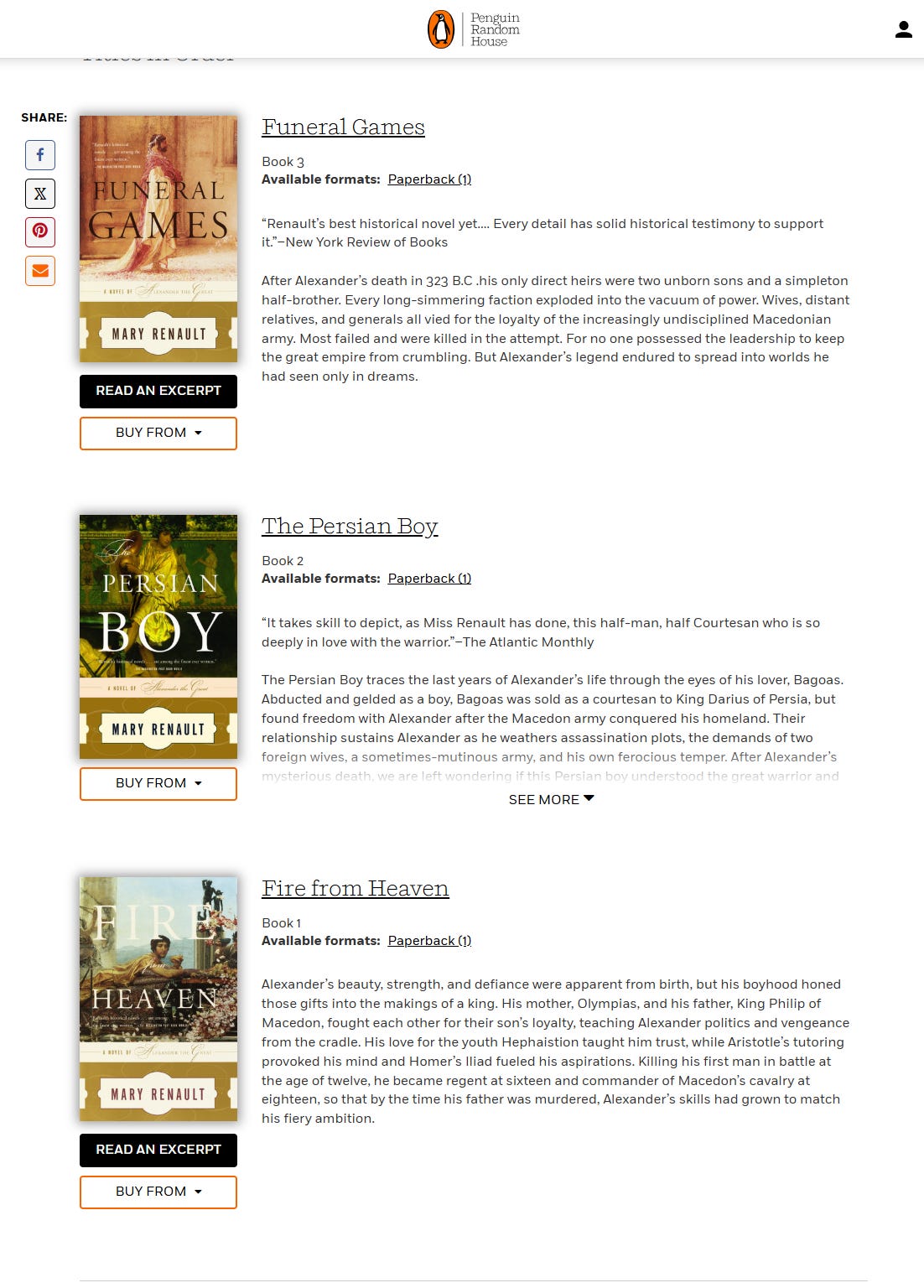
Editor : If the discussion of ‘paganism’ is just to be ‘imagined’ by Brooks in the most self-serving way: what can a series of novels offer, to the reader, who might consider Mary Renault’s Trilogy?

Editor: Mr. Brooks offers his reader:

Tom Holland is a historian who wrote several fine books of classical history, like “Persian Fire.” Gradually he became more and more appalled by many of those ancient pagans — those Caesars who could slaughter innocent human beings by the hundreds of thousands while everyone thought this was totally fine.

“This is a really terrifyingly alien world, and the more you look at it, the more you realize that it is built on systematic exploitation,” Holland told the writer Justin Brierley. “In almost every way, this is a world that is unspeakably cruel to our way of thinking. And this worried me more and more.”

….

The callous tolerance of cruelty is a river that runs through human history. It was dammed up, somewhat, only by millenniums of hard civilizational work. The pagan ethos — ancient or modern — always threatens to unleash brutality once again. The pagan ethos does not believe that every human was made in the image of God, does not believe in human equality, is not concerned about preserving the dignity of the poor. It does not care much about the universal feelings of benevolence, empathy and faithfulness toward one another, which, it turns out, are absolutely required for a democracy to function.

If paganism is a grand but dehumanizing value system, I’ve found it necessary, in this increasingly pagan age, to root myself in anything that feels rehumanizing, whether it’s art or literature or learning. I’ve found it incredibly replenishing to be spending time around selfless, humble people who are still doing the work of serving the homeless, mentoring a lost kid who’s joined a gang. These days I need these moral antidotes to feel healthy, resilient and inspired.

If paganism is a grand but dehumanizing value system, I’ve found it necessary, in this increasingly pagan age, to root myself in anything that feels rehumanizing, whether it’s art or literature or learning. I’ve found it incredibly replenishing to be spending time around selfless, humble people who are still doing the work of serving the homeless, mentoring a lost kid who’s joined a gang. These days I need these moral antidotes to feel healthy, resilient and inspired.

Judaism and Christianity confront paganism with rival visions of the good. The contrast could not be starker. Paganism says: Make yourself the center of the universe. Serve yourself and force others to serve you. The biblical metaphysic says: Serve others, and you will find joy. Serve God, and you will delight in his love.


Editor: Where might The Reader look to explaine/rationalize the Genocide in Gaza, perpitrated by Israel, with munitions supplied by its allies in The West? That Brooks so malidriotely elides, from his self-serving politcal moralizing = New York Times merde!

Political Observer

Posted in Uncategorized | Leave a comment

The Rule is anything written by @rcolvile: Approach With Caution !

Political Observer, with the help of Jean-Louis Missika & Dominique Wolton and James and Marie McIntosh.

stephenkmacksd.com/'s avatar

stephenkmacksd.com/

Apr 27, 2025

Editor: Mr. Colevile’s voice is very distinctive: The Reader cannot compare him in any way to @JohnJCrace of The Guardian, as political satirist and commentator. Mr. Colevile cannot match his talent in either of these fields: of commentary and political satire, with a welcome bite! Also consider Colevil’e political propinquity with arch conservative, and the utterly notorious @Jacob_Rees_Mogg! This just a quick sketch of ‘The Worlds’ that Colevile inhabits, touches, and attemps to explaine to The Reader.

………………………………………………………………………

Headline: The prize on Thursday: who do voters hate the least?

Sub-headline: In these anxious times, all our politicians are more or less equally unpopular, all at once

https://www.thetimes.com/comment/columnists/article/local-elections-labour-reform-robert-colvile-wbrjcf68v

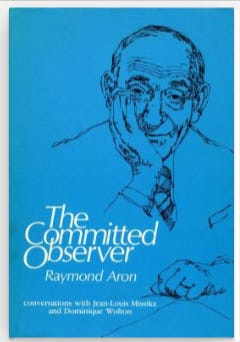
Editor: It can’t be a surprise, that Colevile political essay is a brief 1095 words? The question might occour, as to how The Reader might approach this bloated political itinerary? Reader consider the possibilities of naming all the political actors? Or might The Reader opt for the naming of the political operatives, that marked the 14 years of Tory Rule :David Cameron, Theresa May, Boris Johnson, Liz Truss, Rishi Sunak? Colevile’s strategy is to place himself outside the political action. Which in a way is servisable, that reminds me or just echos the book of The Committed Observer that I read in 1983.

The Committed Observer

Interviews With Jean-Louis Missika and Dominique Wolton = Le Spectateur Engage

By Raymond AronJean-Louis MissikaDominique Wolton · 1983

Political Observer.

Posted in Uncategorized | Leave a comment

@FT & miranda.green@ft.com ask the probing ? : ‘What makes ‘Reform-curious’ Labour voters so hard to woo back’

Political Cynic comments.

stephenkmacksd.com/

Apr 27, 2025

stephenkmacksd.com/'s avatar

Editor: The headline of Miranda Green’s would-be commentary is exhausted in a marriage of the headline & sub-headline, that trades on the well worn political place holders , wedded to current jargon.

Opinion UK politics

Headline: What makes ‘Reform-curious’ Labour voters so hard to woo back

Sub-headline ; Downing Street fears Starmer will lose support to Farage but imitating him will alienate other groups it needs on side

Miranda Green

https://www.ft.com/content/deb23c48-aa90-4af2-8124-a86fce88c53f

Editor: The first paragraph sets ‘the tone’ Green’s exploration of ‘Reform-curious’ in its various hues.

First we had the “red wall”, then the “blue wall” and now the “turquoise wall” — the one Nigel Farage promises to erect for his Reform UK party across traditional Labour areas. Electoral turbulence in Britain is marked by analysts repainting the political map. But these broad brush descriptions conceal complexity — and the challenge for Labour attempting to woo voters who are willing to switch allegiance. It also throws up intriguing policy dilemmas.

Editor: Green offers a textbook analysis of the emotions of the potential voters in the next two paragraphs. Could just a veiled mention of Freud added balast to this chatter?

Local elections this Thursday could increase already high jitters. So many of the voters who backed Labour in July’s general election have cooled towards the party that vast energies are being spent pondering how to tempt them back — especially those targeted by Reform UK.

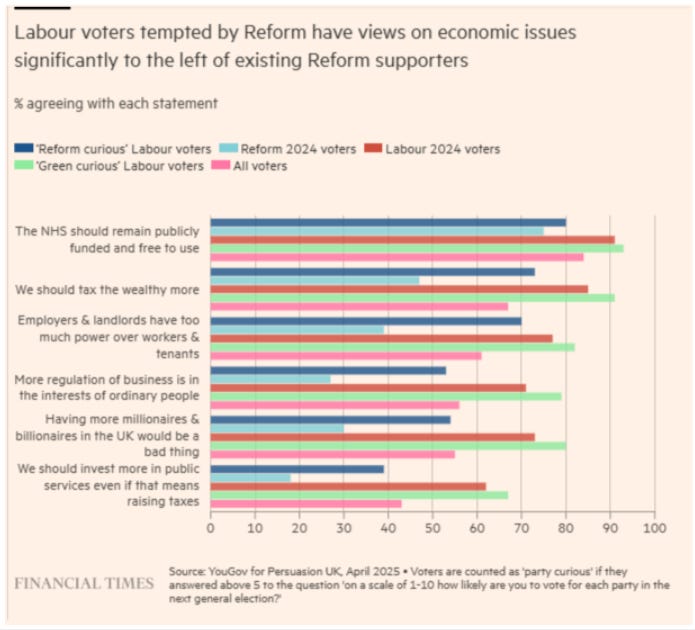
These “Reform-curious” voters might be hard to retain without repelling others, however. And it’s even more of a challenge than some of the cruder stereotypes suggest. A purely “Faragist” agenda is not to their taste — according to Steve Akehurst at research initiative Persuasion UK, who commissioned polls and focus groups to find out what makes them tick.

Editor: The veiled apperance of “Faragist”to the final labored paragraph, heightens the political tension?

Concern about immigration is the main issue prioritised by both Farage’s core supporters and wavering or actively switching former Labour voters — particularly small boats and asylum hotels. But while this confirms Downing Street is right to be worried about Reform attacks on the agenda, Akehurst’s research reveals significant differences on other topics.

Editor: with the appearnce of Farage and his consern for ‘small boats and asylum hotels’ renders moot any possible discussion of British toxic Imperialism, over centuries. Miranda Green and her empolyers The Financial Times, would find that more than inconvenient, and really irelevevent, to the carefully managed political chatter of this newspaper!

……………………………………………………………………………………………………………………

Editor: A selection of the remaining sentences and paragraphs of this would be political anlysis

With a risk of even more support peeling off to the left of Labour’s winning 2024 coalition, Akehurst argues it’s a “free hit” to maintain momentum on the green energy agenda, keeping both sets of waverers on side.

The research picked up unease among these voters on other aspects of Reform. They like Farage but dislike his friendship with US President Donald Trump and his stance on Ukraine, and they wonder if his party is fully respectable.

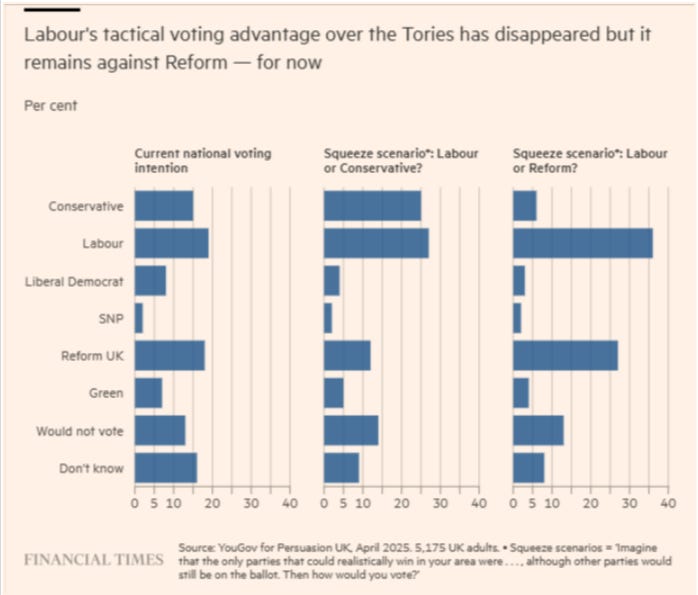
Offering more hope to Labour MPs, there are also signs in Persuasion’s data (see chart) that anti-Farage tactical voting might buoy up support for their party: enough voters in red wall areas could decide to back the incumbent explicitly to keep Reform out — even Conservatives seem willing to do so.

The party’s left flank is seething with discontent but gets less attention at Westminster as MPs and apparatchiks obsess over Farage. Keeping these disgruntled voters happy while appealing to the Reform-curious is possible but it will require a careful policy mix.

Unfortunately for a government whose spending options are so constrained, there’s one more thing that Labour’s left flank and those tempted by Reform have in common: they are repelled by anything that resembles austerity. And that’s Labour’s real dilemma.

………………………………………………………………………………

Editor. Provided by Financial Times:

1)

2)

Political Cynic.

Posted in Uncategorized | Leave a comment

In attempting to read ‘Ross Douthat’ ‘Condition of America’ Interviewed by Nick Burns, in New Left Review …..

In the guise of Political Observer, my attempt to satirized Mr. Douthat: I missed the actual thinker/writer of his books, rather that his opinion columns in The New York Times?

stephenkmacksd.com/'s avatar

stephenkmacksd.com/

Apr 26, 2025

Editor:

For the occasional reader of Mr. Douthat’s New York Times columns, what Nick Burns, in his interview, is the political/intelletual sophistication of Douthat’s books, as related to his columns, which execises a kind of political blandness! A selections of examples is instructive:

Editor: Mr. Burns first question:

Your first book, Privilege, is at once a devastating take-down of Harvard, as a bastion of a self-satisfied elite careerism, and a rueful love letter to it. Since those days, you’ve always unmistakeably been an adversary of American liberalism, yet in some ways continue to be a beneficiary of it. Where would you locate yourself—politically, then intellectually—on the map of the contemporary American scene? What is it in liberalism, beyond obvious hypocrisies, that you dislike?

Editor: Mr. Douthat’s reply:

Ishare the fairly conventional conservative view that the strongest case for liberalism is as an effective technology for managing social peace in a complex society—but one that depends upon sources of meaning and purpose deeper than itself, which it struggles to generate on its own.

Editor: Mr. Burns : Liberalism as feeding off non-renewable moral resources?

Douthat:

Those resources can be self-regenerative. I don’t fully buy the argument that, with the advent of Locke, there is an automatic decline into hyper-individualism. American history provides plenty of evidence that a liberal superstructure doesn’t necessarily prevent great awakenings. To the extent that it does so, it is under particular technological conditions. The vindication of the older conservative critique of liberalism as atomization—which looks more potent today than it did when I was at Harvard in the early 2000s; and looked more potent then than it did in, say, 1955—is technologically mediated. There have been technologies that accelerate individualism, ranging from things we take for granted, like the interstate highway system and the birth-control pill, through to the internet, a particular accelerant. As a metaphor, you can think of individualism’s tending towards atomization and despair as a gene within the liberal order, which gets expressed under particular environmental conditions, but doesn’t necessarily emerge if those conditions are not present. In recent years, the internet in particular has helped that gene be expressed more fully than it was.

An alternative theory of liberalism is that it is an ambitious way of life in its own right. That would be the argument of my friend Samuel Moyn, with whom I’ve taught classes on this. He would essentially agree with the conservative critique, but argue that this means you need a liberalism that is not just managerial but ambitious, Promethean, committed to self-creation and exploration. And that form of liberalism, in my view, is subject to strong and dangerous temptations. Sometimes they’re necessary temptations—a culture may need a little Prometheanism—but they can quickly lead it badly astray. The liberalism I described in Privilege tended towards a spiritually arid form of hyper-ambition; not Whitman and Emerson communing with the glories of creation, but: how do I get a job at McKinsey? Under conditions of prosperity, liberalism as a world-view had been transmuted into a purely instrumental, self-interested meritocracy.

Liberals themselves subsequently decided this was true. A whole spate of books came out after Privilege, from Harry Lewis’s Excellence Without a Soul—he was dean of Harvard when I was there; he wrote it as soon as he retired—to William Deresiewicz’s Excellent Sheep, Daniel Markovits’s Meritocracy Trap, Michael Sandel’s Tyranny of Merit. So in a sense, I was early to a critique of meritocratic liberalism that many liberals came to think was probably correct. Of course, I was already stealing things from Christopher Lasch.

Political Observer : call this revelatory of what Mr. Douthat is capable of thinking/writing/considering ! More time is needed to fully grasp this interview in its entirety

https://newleftreview.org/issues/ii152/articles/ross-douthat-condition-of-america

Posted in Uncategorized | Leave a comment

The last paragraphs of Bret Stephens April 22, 2025 diatribe promps Political Observer to wonder: At what point will or can Stephens confront the Genocidal Netanyahu?

Political Observer.

stephenkmacksd.com/'s avatar

stephenkmacksd.com/

Apr 23, 2025

……………………………………………………………………………………………………….

Editor: There can be no doubt that Stephens self-presents as a political moralist via Harold Macmillan, and that the birth of a diatribe has begun. Stephens as a Neo-Con and student of Leo Strauss, political fabulism is home territory, that synchs naturally with the party line of Trump as beyond the pale, the outlier in this political melodrama! Strauss and Trump are not just sympatico, but are fellow travelers, which renders Stephens commentary inert, yet he clings to it as sevisable in the political moment. The final paragraphs of Mr. Stephens comentary is a crowd scene, from that 21 inch screen black & white world of yester-year.

……………………………………………………………………………………………………………………

Trump is Trump. Let’s think of him on his own terms.

When the president completed his extraordinary political comeback in November, he was at the summit of his political power. He has eroded it every day since. With Matt Gaetz as his first choice for attorney general. With the needlessly bruising confirmation fights over the absurd choices of Hegseth, Robert Kennedy Jr., Kash Patel and Tulsi Gabbard. With making an enemy of Canada. With JD Vance’s grotesque outreach to the German far right. With the Oval Office abuse of Volodymyr Zelensky. With the helter-skelter tariff regime. With threats of conquest that antagonize historic allies for no plausible benefit. With dubious arrests and lawless deportations that can make heroes of unsympathetic individuals. And now with threats to the basic economic order that sent gold soaring to a record high of $3,500 an ounce and the Dow on track to its worst April since the late Hoover administration.

Democrats wondering how to oppose Trump most effectively might consider the following. Drop the dictator comparisons. Rehearse the above facts. Promise normality and offer plans to regain it. And remember that no matter how malignant he may be, there’s no better opponent than a face-plant president stumbling over his untied laces.


Editor: It’s more like a incompetent pastish of Harold Lloyd !

Political Observer.

Posted in Uncategorized | Leave a comment

Is there nothing more tedious than @DouthatNYT examinations of the pressing question of ‘Ultramontanism’ vs. ‘Gallicanism’?

Has Political Observer strayed into the most pressing question of the Historical Moment? Also, does Huntington’s ‘Who Are We’ offer an echo of Douthat in another key?

stephenkmacksd.com/'s avatar

stephenkmacksd.com/

Apr 20, 2025

Editor: For an exploration of this ‘Catholic Duality’, if that is the correct descriptor:

A Defense of Ultramontanism Contra Gallicanism

by Taylor Patrick O’Neill, October 12, 2018

https://churchlifejournal.nd.edu/articles/a-defense-of-ultramontanism-contra-gallicanism/

Editor: Mr. Douthat explores the perifery of this vexing question in two essay:


Headline: An Age of Extinction Is Coming. Here’s How to Survive.

April 19, 2025

Every great technological change has a destructive shadow, whose depths swallow ways of life the new order renders obsolete. But the age of digital revolution — the time of the internet and the smartphone and the incipient era of artificial intelligence — threatens an especially comprehensive cull. It’s forcing the human race into what evolutionary biologists call a “bottleneck” — a period of rapid pressure that threatens cultures, customs and peoples with extinction.

When college students struggle to read passages longer than a phone-size paragraph and Hollywood struggles to compete with YouTube and TikTok, that’s the bottleneck putting the squeeze on traditional artistic forms like novels and movies.

When daily newspapers and mainline Protestant denominations and Elks Lodges fade into irrelevance, when sit-down restaurants and shopping malls and colleges begin to trace the same descending arc, that’s the bottleneck tightening around the old forms of suburban middle-class existence.

When moderates and centrists look around and wonder why the world isn’t going their way, why the future seems to belong to weird bespoke radicalisms, to Luigi Mangione admirers and World War II revisionists, that’s the bottleneck crushing the old forms of consensus politics, the low-key ways of relating to political debates.

When young people don’t date or marry or start families, that’s the bottleneck coming for the most basic human institutions of all.

And when, because people don’t pair off and reproduce, nations age and diminish and die away, when depopulation sweeps East Asia and Latin America and Europe, as it will — that’s the last squeeze, the tightest part of the bottleneck, the literal die-off.

The idea that the internet carries a scythe is familiar — think of Blockbuster Video, the pay phone and other early victims of the digital transition. But the scale of the potential extinction still isn’t adequately appreciated.


Headline: More Babies, Please

Dec. 1, 2012

IN the eternally recurring debates about whether some rival great power will knock the United States off its global perch, there has always been one excellent reason to bet on a second American century: We have more babies than the competition.

It’s a near-universal law that modernity reduces fertility. But compared with the swiftly aging nations of East Asia and Western Europe, the American birthrate has proved consistently resilient, hovering around the level required to keep a population stable or growing over the long run.

America’s demographic edge has a variety of sources: our famous religiosity, our vast interior and wide-open spaces (and the four-bedroom detached houses they make possible), our willingness to welcome immigrants (who tend to have higher birthrates than the native-born).

And it clearly is an edge. Today’s babies are tomorrow’s taxpayers and workers and entrepreneurs, and relatively youthful populations speed economic growth and keep spending commitments affordable. Thanks to our relative demographic dynamism, the America of 50 years hence may not only have more workers per retiree than countries like Japan and Germany, but also have more than emerging powers like China and Brazil.

If, that is, our dynamism persists. But that’s no longer a sure thing. American fertility plunged with the stock market in 2008, and it hasn’t recovered. Last week, the Pew Research Center reported that U.S. birthrates hit the lowest rate ever recorded in 2011, with just 63 births per 1,000 women of childbearing age. (The rate was 71 per 1,000 in 1990.) For the first time in recent memory, Americans are having fewer babies than the French or British.

The plunge might be temporary. American fertility plummeted during the Great Depression, and more recent downturns have produced modest dips as well. This time, the birthrate has fallen fastest among foreign-born Americans, and particularly among Hispanics, who saw huge amounts of wealth evaporate with the housing bust. Many people may simply be postponing childbearing until better times return, and a few years of swift growth could produce a miniature baby boom.

Editor: Does Mr. Douthat’s essays express a kind of cultural/political propinquity to Samuel P. Huntington’s ‘Who Are We?: The Challenges to America’s National Identity’ of December 5, 2005 ?

Political Observer.

Posted in Uncategorized | Leave a comment

Peter Thiel: Insights from“The Straussian Moment“

Political Observer on Peter Thiel and the Gordian knot?

stephenkmacksd.com/'s avatar

stephenkmacksd.com/

Apr 19, 2025

1. The Enlightenment’s mistake.

“You can distinguish the intellect and the will. The medievals believed in the weakness of the will but the power of the intellect. Modern people tend to believe in the power of the will and the weakness of the intellect.”

According to Thiel, the worst mistake made by Enlightenment was sweeping crucial questions under the carpet. To forget about the turbulent years of religious wars and social unrest, the “Age of Reason“ abandoned the important question of human nature or the power of faith.

Thiel, in “The Straussian Moment“ highlighted the ineffable trait of the Enlightenment of not being brave enough to ask hard questions, bringing up the figures of crucial philosophers, for example, John Locke.

“In the place of human nature, Locke leaves us with an unknowable “X.” This awareness of ignorance provides the low but solid ground on which the American Founding takes place. The human “X” may have certain wants and preferences, but nobody is in an authoritative position from which to challenge those desires.’

John Locke is one of the most influential philosophers and a key figure of the Enlightenment. His modern “liberal“ thoughts deeply influenced the Founding Fathers of the USA and gave fresh air, spreading the grasp of optimism around Europe. Locke pioneered the ideas of natural law or social contract.

Locke, among other Enlightenment philosophers, developed a concept of the social contract. According to their concept, the government was created through the consent of the people to be ruled by the majority. Social contract theory provides a rationale justification for the notion that legitimate state power should be derived from the consent of the majority of society.

And by Thiel’s explanation, the concept of the social contract is the central lie of the Enlightenment that allows avoiding asking hard questions about human nature, white-washing problematic and often violent character of human beings. Peter Thiel considers social contract as the main myth:

“The enlightenment always white-washes violence. There are many things we can’t think about under enlightenment reasoning, and one of them is violence itself. If you go to the anthropological myth of the enlightenment, it’s the myth of the social contract. So what happens when everybody is at everybody else’s throat? The enlightenment says that everybody in the middle of the crisis sits down, has a nice legal chat, and draws up a social contract. And maybe that’s the founding myth — the central lie — of the Enlightenment. Girard says something very different must have happened. When everybody is at everybody’s throat, the violence doesn’t just resolve itself, and maybe it gets channeled against a single scapegoat where the war of all against all became a war of all against one and somehow gets resolved in a very violent way. “

According to Thiel, the end of humanity would be marked by the definitive abandonment of all the hard questions, but there would no longer be any conflict.

https://www.playforthoughts.com/blog/peter-thiel-straussian-moment

Editor: In a mere 488 words Thiel inties that Gordian knot!

Political Observer confronts the Thiel conundrum?

Posted in Uncategorized | Leave a comment