https://www.youtube.com/watch?v=qPv7WMReeL0
Oct 12, 2025
Oct 12, 2025
The Economist and The Left, The Greeks,and Neo-Liberal ‘Reform’: a comment by Almost Marx
Posted on February 16, 2015 by stephenkmacksd
Is it any surprise that this editorial at The Economist begins with Left Wing hysteria mongering? This as the West finds itself covered in the soot of the Neo-Liberal delusion that turned to ash? The failure of Neo-Liberalism demands further Neo-Liberal ‘reforms’, so goes the Party Line of the apologists for that exhausted,demonstrably failed political/economic mirage. See Philip Mirowski’s Never Let A Serious Crisis Go To Waste for the dismal history of the Neo-Liberal Thought Collective’s mendacious ascendency and staying power:
Never Let a Serious Crisis Go to Waste
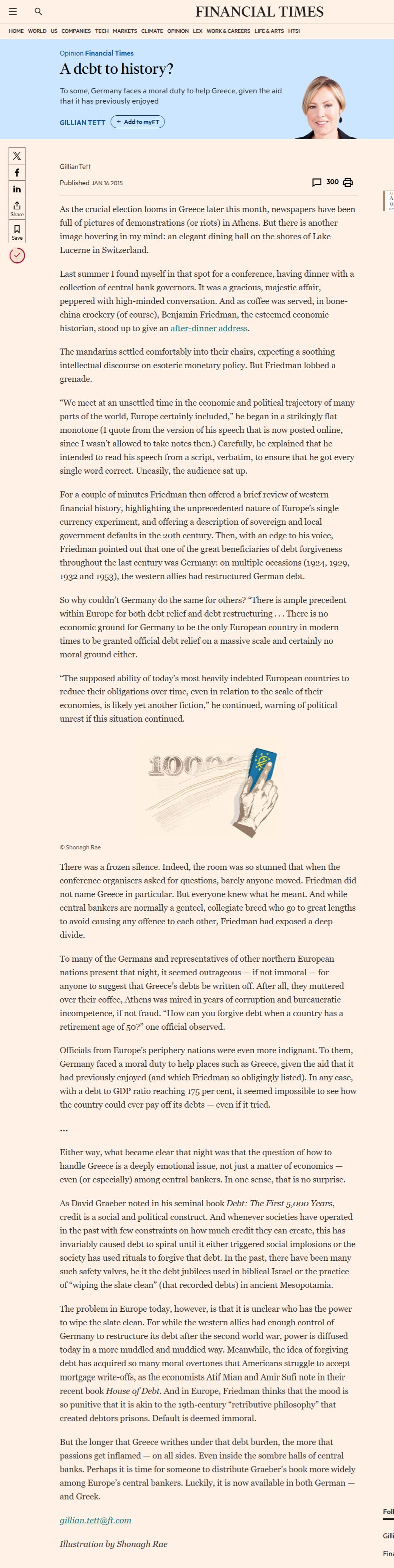
For an alternative view to this Economist editorial see Jillian Tett’s essay at the Financial Times on debt forgiveness and the Germans, from an address by Benjamin Friedman, aptly titled A Predictable Pathology.
A link to Ms. Tett’s essay:
http://www.ft.com/intl/cms/s/0/927efd1e-9c32-11e4-b9f8-00144feabdc0.html?siteedition=intl#axzz3Rqy6UMA0
A link to Mr. Friedman’s essay:
The fact that the Germans were bailed out four times in the 20th Century 1924, 1929, 1932 and 1953. What bearing might that have on the Left Wing hysteria mongering at the Economist, and the issue of the Greeks and debt forgiveness? And/or a range of other options, open to EU technocrats, in alliance with the Greeks, to first and foremost alleviate the suffering of Greek citizens, as the primary issue, not the rescue of the Neo-Liberal delusion in it’s various iterations! But the alleviation of the suffering of the Greeks is utterly antithetical to the whole of the Neo-Liberal Project: civic good is in direct opposition to the argued ‘value’ of Markets and Market Discipline!
Almost Marx
https://www.ft.com/content/927efd1e-9c32-11e4-b9f8-00144feabdc0
Oct 12, 2025
Posted on May 22, 2018 by stephenkmacksd
The death of Mr. Wolfe has produced a great deal of praise for this literary capon in a white suit: a Dandy as imagined by Walt Disney:
Here is an excerpt from Janan Ganesh’s obituary , at The Financial Times, of Tom Wolfe that makes Wolfe look like a harbinger of the Trump Populism, although he clarifies/corrects any assumption the reader might have made, this in the latter part of his essay.
He exposed the credulity of the rich for artistic fads. He made fun of their recreational left-wingery, or, in that unimproveable phrase, their “radical chic”. Among the vanities that went into his bonfire was the idea of America as classless. At the risk of tainting him with politics, there was something Trumpian about his ability to define himself against Manhattan’s grandest burghers while living among them.
…
The mutation of these thoughts into a brute populism in western democracies cannot be pinned on Wolfe, who was civility incarnate. Like a good reporter, he wrote what he saw and left it to the world to interpret. What he saw were people who had wealth, refinement and so much of the wrong stuff.
https://www.ft.com/content/ac14437a-59ca-11e8-bdb7-f6677d2e1ce8
Matt Purple at The American Conservative makes Mr. Ganesh’s essay look like faint praise, except for this bit of literary candor, tinctured by fulsome praise of a literary giant.
That lens may have proven distorted in New York, but position it over present-day America and it suddenly seems less smudged. Wolfe’s understanding of humanity was primarily tribal: people take on the customs and prejudices of the groups they belong to and clash with those they don’t. Hence why his characters are often accused of being universals rather than particulars. Hence, too, why his final (and weakest) novel, Back to Blood, was set in Miami and covered the tensions engendered by mass immigration. Contra Hitchens, what could be more prescient than that? In Back to Blood, the Cuban-American mayor of Miami tells the African-American police chief: “I mean we can’t mix them together, but we can forge a secure place for each nationality, each ethnic group, each race, and make sure they’re on the same level plane.” Is this our destiny, an America of subgroups that never quite melt into the pot? Are we doomed for more conflagration a la Charlottesville? Or is the liberal multicultural dream still possible, even desirable? That we’re even asking these questions suggests Wolfe has been vindicated more than his critics allow.
Ultimately, the only way we’ll get the answers is if we trouble to embark into this America of ours, sneakers laced, notebook paper crinkling in the breeze, lush phrases turning in our minds, determined to confront the weirdness in our backyard and chronicle it in a way that is—saints preserve us!—fun to read. Tom Wolfe’s work is ours now. May he rest in peace.
For another telling bit of information about Mr. Wolfe’s testiness, in regard to criticism of his work, from a writer who had actual contact with the Great Man, Louis Menand ,this short essay published by The New Yorker offers insight. The concluding paragraphs of Mr. Menand’s essay offer some clues as to who that Great Man was.
My brief Tom Wolfe moment—apart from coming across him one day waiting to cross Park Avenue; he was not an easy figure to miss—had to do with a piece I wrote on Maya Lin’s Vietnam Veterans Memorial. I had quoted Wolfe, along with other critics of the design, as calling it “a monument to Jane Fonda.” In due course, I received a fantastically high-handed letter from Wolfe, protesting that he had not been judging the design; he had only been repeating what someone else had said. This seemed to me beyond absurd. Of course Wolfe hated Lin’s memorial. Why would he pretend that that was not his view? I wrote him back to explain that he had, in fact, written those words as his own, and to ask why he was troubling to insist otherwise.
I received a second letter from Wolfe, this one even more fantastically high-handed, in which he deftly filleted every sentence in my letter to him and ended by putting it to me that my reportorial talents were beneath notice. No doubt they were, or are. Still, he had clearly devoted a lot of time to the composition of two longish letters concerning less than a single sentence in my piece. I concluded that he must be suffering from writer’s block on whatever novel he was working on, and did him the kindness of declining to continue the correspondence. However, I saved the letters.
https://www.newyorker.com/culture/culture-desk/tom-wolfe-sage-of-status-anxiety
Christopher Hitchens’ 1983 essay titled ‘A Wolfe in Chic Clothing’ , as recently re-published at Mother Jones site, is, to say the least, Mr. Hitchens at his most biting and insightful on this writer:
Here is Hitchens reviewing ‘A Man in Full’ in the London Review of Books of January 7,1999 (Behind a paywall). He first provides a devastating review of Bonfire of the Vanities and a view of New York of the period and ‘Bonfire’ as the literary paradigm that Wolfe used for his other novels.
Like every writer before him who has ever scored a triumph … Fallow was willing to give no credit to luck. Would he have any trouble repeating his triumph in a city he knew nothing about, in a country he looked upon as a stupendous joke? Well … why should he? His genius had only begun to flower. This was only journalism, after all, a cup of tea on the way to his eventual triumph as a novelist.
The Bonfire of the Vanities (1987)
Take it for all in all, The Bonfire of the Vanities was a blockbuster. It rewrote the whole career description of commercial-cum-literary success. And it got people where they lived, if they lived on or near Park Avenue. These days, New York City is becoming a ramified variant of St Louis, Missouri or Des Moines, Iowa: a great big ‘thank you for not smoking’ town, with ‘buckle up’ messages played on automatic tapes in the yellow cabs, and the cheery, kitsch sovereignty of Walt Disney exerted over what was once Times Square and 42nd Street. The golden arches of McDonald’s are to be seen winking near the Bowery, and cops look out for jay-walkers as if patrolling some dire Jim Carrey utopia. The mayor of the city, and the governor of the state, are two mirthless white ethnic conservatives named Giuliani and Pataki. They have restored capital punishment, and encouraged franchising of all sorts while discouraging loitering and littering. Not long ago, a Haitian immigrant named Abner Louima was grabbed outside a funky nightclub, roughed up in the police van, hurled into a cell at the station-house and held down while a guardian of the peace forced a rupturing lavatory plunger all the way up his ass. The foul object was then violently withdrawn, only to be shoved into his mouth (breaking many teeth) and down his throat. This was a hot case, for about ten days.
There has probably never been a less prescient journo-novel than The Bonfire of The Vanities, which subliminally heralded a New York that was given over to wild and feral African politics at one end (reading from north to south of Manhattan Island) and dubious market strategies at the other. The market strategies continue. Indeed, Wall Street has almost deposed the opinion polls as the index of national well-being. The ethnic spoils system, meanwhile, is manipulated by the same class as ever. If either of these elements ever undergoes a dramatic metamorphosis, it won’t be Tom Wolfe who sounds the alarm.
Yet, even as he tries to move to another city, and to make the leap from former journalist to actual novelist, Wolfe keeps The Bonfire of the Vanities constantly at hand. It worked once. Why should it not work again?
https://www.lrb.co.uk/v21/n01/christopher-hitchens/running-on-empty
The reader can look to Edward Copeland’s ‘The Silver Fork Novel: Fashionable Fiction in the Age of Reform’ as a paradigmatic description of Status Anxiety in a British context. Where addresses mattered, where one went to eat, for relaxation and the promenading of one’s self before the public gaze. Not to mention one’s politics: Historical refraction aides in seeing Mr. Wolfe’s journo-novel’s as politics/morality by another means, in sum, Conservative Melodrama, in which brevity of exposition played not part: A Man in Full was almost as unwieldy as my copy of War and Peace.
Take note that Mr. Wolfe moved to New York city, with all the other Social Climbers, and shared in the Status Anxiety that he chronicles. Wolfe chose to make himself the center of attention, by his manner of dress. He was a Dixiecrat in the guise of a Dandy, as the in-order-too of establishing his pseudo-independence from the thrall of the Social Climber’s existential malady of Status Anxiety.
American Writer
Myra Breckenridge replies to one of the Tom Wolfe enthusiasts
Posted on May 19, 2018 by stephenkmacksd
‘Yet how else should he have been? Wolfe, whose death this week left our literary scene all the hollower, is known today for his novels.’ Once a Dandy, Disraeli wrote novels as a way of giving his politics life, speculations on political possibilities, within a Conservative frame. Mr. Wolfe was a Dandy as imagined by Walt Disney, with a politics to match that old gargoyle’s. But T. S. Eliot immortalized Mr. Wolfe in his ‘The Hollow Men’:
We are the hollow men
We are the stuffed men
Leaning together
Headpiece filled with straw. Alas!
Our dried voices, when
We whisper together
Are quiet and meaningless
As wind in dry grass
Or rats’ feet over broken glass
In our dry cellar
Shape without form, shade without colour,
Paralysed force, gesture without motion;
Truly yours,
Myra Breckenridge
http://www.theamericanconservative.com/articles/tom-wolfes-tribalist-america/
Oct 11, 2025
A Worthy Nobel Peace Laureate
Oct. 10, 2025
Editor: Mr. Stephens offers these brief but almost compelling introductory paragragraphs.
According to Alfred Nobel’s will, a Nobel Prize is meant to be given to those who “during the preceding year, shall have conferred the greatest benefit on mankind.” Note the word “preceding”: Those of us who think Donald Trump deserves the Nobel Peace Prize for his part in ending (or at least pausing) the war in Gaza will have to wait until next year’s awards are announced.
We shouldn’t hold our breath.
In the meantime, the Norwegian Nobel Committee chose well in awarding this year’s peace prize Friday to María Corina Machado, the 58-year-old Venezuelan opposition leader now in hiding from the regime of Nicolás Maduro. By doing so, the committee also indicted that regime and its 26-year record of ruin, carried out in the name of “Bolivarian” socialism with the credulous support of many Western progressives.
Machado earned her Nobel last year when, after being blocked by the government from running for president, she rallied behind Edmundo González, a nonpartisan candidate, further helping to consolidate a once-divided opposition camp. González went on to win the vote by more than two to one, according to independent surveys, only to see Maduro ignore the result and install himself for another six-year term, throwing nearly 2,000 political dissidents into prison in the bargain.
Machado’s own career as a dissident began more than 20 years ago, after she co-founded an election-monitoring group because of her fears of the ways that Maduro’s immediate predecessor, Hugo Chávez, was systematically undermining Venezuela’s democratic institutions. In 2005, his regime charged her with treason for supporting a recall referendum; in 2014, she faced treason charges again for participating in anti-regime protests. In 2024, she published an opinion essay in The Wall Street Journal that began: “I am writing this from hiding, fearing for my life, my freedom, and that of my fellow countrymen from the dictatorship led by Nicolás Maduro.”
…
Editor: Andrea Lobo provides a more than compelling evaluation of the real María Corina Machado!
Nobel Prize for imperialist war and regime change goes to Washington’s Venezuelan puppet María Corina Machado
Andrea Lobo
https://www.wsws.org/en/articles/2025/10/11/sjsy-o11.html
…
At the very least, the prize to Machado is an endorsement by powerful sections of the European ruling elite of a war for regime change with all its potential for opening a new front in the emerging third world war. France’s embattled “president of the rich,” Emmanuel Macron, as representative of the transatlantic establishment, declared Machado a “fighter for liberation.” What a farce!
…
“I want to tell how grateful we are to President Trump and the administration for addressing the tragedy that Venezuela is going through,” she said. “Maduro has turned Venezuela into the biggest threat to the national security of the US and the stability of the region.”
…
Beyond her support for imperialist intervention, the embrace of Machado’s fascist political pedigree—like the thunderous acclamations given to fascist Argentine president Javier Milei—signifies an endorsement by the “respectable” layers of the world oligarchy of a return in Latin America to the regime of terror created under the US-backed dictatorships that seized power across the region in the latter half of the 20th century.
…
Machado is a champion of “free market” policies, above all the privatization of the state oil company PDVSA, whose public ownership has been upheld by a wide spectrum of bourgeois parties since the 1970s. She has endorsed Milei’s economic program of “shock therapy” in which “freedom” means the liberation of corporations to eliminate social spending and exploit the working class without any restrictions or regulations.
The scion of a Venezuelan oligarchic dynasty, her far-right politics have always been animated by hatred of the working class and of any challenge to social inequality. On this basis, she has supported crippling US sanctions that by 2020 were estimated to have caused some 100,000 excess deaths, while forcing millions to flee the country. She has likewise remained silent on the punitive anti-immigrant policies pursued by the Trump administration against hundreds of thousands of Venezuelans who sought refuge in the US.
Machado has repeatedly appealed to the Venezuelan military as the country’s ultimate political arbiter, making clear that any regime she were to head would take the form of a military dictatorship from day one, committed to crushing opposition to her vastly unpopular economic and social policies.
…
The anointment of Machado by imperialism is, above all, a warning: the ruling class is preparing for new crimes on a world scale. The answer must be the independent mobilization of the international working class, made conscious of its strength and its historic tasks.
https://www.wsws.org/en/articles/2025/10/11/sjsy-o11.html
Political Observer.
Oct 11, 2025
Headline: Macron keeps Lecornu on as prime minister despite political parties’ hostility
Sub’headline: The reappointment of Sébastien Lecornu to form a ‘government of mission’ that would be ‘disconnected from presidential ambitions’ has reignited criticism of the president, who has been accused of staying in denial, not only by the opposition parties but now by his own camp, too.
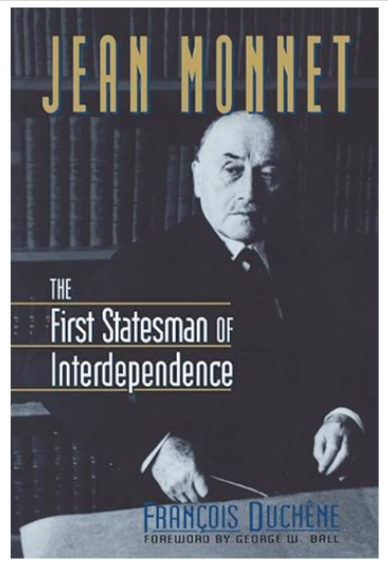
Editor: Reader more than any other consideration Macron covets his place on the World Stage, with the other EU dullards! Jean Monnet of the Coal and Steel Cartel iertration, is celegrated in Francois Duchene hagiography that cemented the Monnet’s status as Founder of this political mirage!
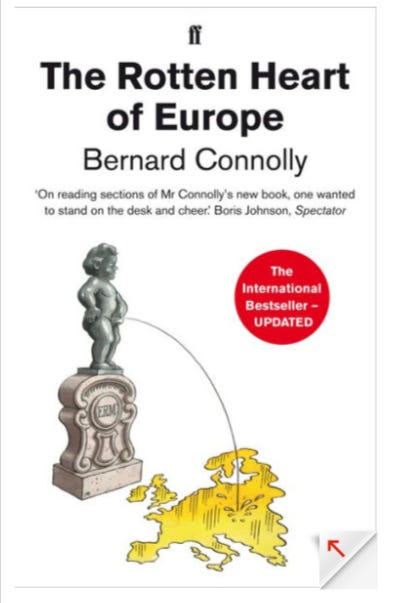
Editor: Yet what might The Reader make of this 1995 Bernard Connolly Best-Seller?
https://www.barnesandnoble.com/w/the-rotten-heart-of-europe-bernard-connolly/1112707953
Editor: What might the reader make of this:
URSULA HUMILIATED: “Ursula Must Go!”, Europe’s Left and Right Unite in Rage
…
‘Get Lost, Raise Grandkids’: EU Chief Faces Mega Revolt As ‘Pro-Russia Wave Picks Pace’ | Watch
American Francophile.
Oct 09, 2025
Opinion Global trade
A world with two predatory superpowers
Nations must work out how to contend with Trump’s America and China
Martin Wolf
Editor: A selection form Mr. Wolf’s ‘Two Preditory Superpowers’ essay : that ignores America, as the only Nation to use two sucessive Atomic Bombs against Japan!
Donald Trump’s second term is transforming the world. It is quite likely that the autocratic regime he and his minions in the administration and the Supreme Court are creating will endure. Yet even if it does not, it will have changed the world simply because it has happened. What has happened once can happen again. This must transform views of the future. Yet that future will not just be determined by the US. China is also a superpower. So, what role might it play in this new era?
Let us start with the US. Other democracies used to think it shared core values with them. But this US quite clearly does not. Trump himself is grievance-fuelled, deal-driven and capricious. This alone makes it hard to deal with him. As Célia Belin of the European Council on Foreign Relations adds, his foreign policy “is his domestic agenda, exported”. Thus, she writes, “Trump and his Maga camp are using the same three methods at home and abroad: elimination, transformation and subjugation.” At home, they seek to eliminate the “deep state”, and turn a liberal America into a nationalist one. Abroad, similarly, they seek to eliminate alliances and other commitments and transform allies into vassals.
…
These goals are bad for most of the world and foolish for the US. Adam Posen, president of the Peterson Institute for International Economics takes this long view in a Foreign Affairs article on “The New Economic Geography”. In the post-second-world-war world, he writes, the US provided insurance to other countries against all sorts of risks. But the costs it bore were not uncompensated: other countries invested in the US, opened their economies to US investors, lent money to the US cheaply, made the US dollar the global currency, and turned US capital markets into the hub of global finance. This was then a mutually beneficial deal.
Trump whines that the US has been “ripped off”. The fact, however, is that it has remained the world’s richest and most technologically advanced economy in a period of unparalleled global growth: between 1950 and 2020 average global real GDP per head rose by 360 per cent! Ripped off? Hardly.
…
Alas, Trump has killed this grand bargain. In its place, we see a host of unreliable and predatory deals. In addition to imposing huge tariffs on countries that thought they were friends of America, Trump has demanded money be invested at his own discretion, to the great irritation of foreign partners. This is pure gangsterism.
Another way of thinking about what has happened is that in the old world of trust in the US, there was interdependence, but some countries were more dependent than others. This allowed interdependence to be “weaponised”. As Henry Farrell and Abraham Newman argue, the US did so, rather freely. Within what were seen as mutually favourable long-term relationships, such weaponisation, notably over the use of sanctions, was tolerated, however grudgingly. But Trump is turning interdependence into a chokehold. That is a very different matter.
…
I. F. Stone’s restive ghost.
Oct 09, 2025

Editor: Reader begin your political education about Beddoes here!
Dr. Jeffrey Sachs, Shock Therapist
By Peter Passell
June 27, 1993
The lobby of the Metropole, Moscow’s lovingly restored grand hotel a few blocks from Red Square, is almost deserted on this gray spring afternoon. That’s just fine with Jeffrey D. Sachs, a boyish-looking 38-year-old Harvard professor who is now probably the most important economist in the world. He has appropriated a cluster of comfortable armchairs for a meeting with two members of his team, Americans who work full time in Russia.
The agenda is Russia’s safety net or, more precisely, whether unemployed workers will be able to make ends meet. Russia is plunging out of Communism, if not directly into a capitalist free market. Whether this huge, humiliated nation will stoically bear the pain of the transition is far from clear, and the strength of the safety net could make the difference.
There are plenty of laws on the books, but do they count? “All Russian citizens are legally entitled to free health care,” points out Judith Shapiro, a senior lecturer on policy economics who is on leave from Goldsmith College at the University of London. The catch: they often “only get what they pay for.”
While employees of Government and big enterprises generally have access to adequate service at their own clinics, the less fortunate are denied modern surgery, drugs and even decent sanitation. The problem is apparently growing worse, she notes, because inflation has far outpaced physicians’ salaries, which weren’t high to begin with. Many are now emigrating, or deserting their posts for more lucrative jobs, like driving taxis.
Sachs’s immediate concern is the implication for the Government’s budget, which must be slashed in order to bring inflation under control. If much of the nation’s health expenditures are now buried as fringe benefits on the books of enterprises that depend on Government subsidies, who will pick up the cost once the enterprises are forced to economize?
Getting a handle on the magnitude of the problem is obviously difficult in a country that cannot even explain why life expectancy has fallen sharply in the last two decades. But some number is better than none. And by pressing officials to address this and other pivotal issues, Sachs hopes to accelerate the pace of reform.
Sachs’s message of urgency is not universally accepted. Plenty of Western as well as Russian economists contend that a more gradual approach is not only possible but necessary. “Economic reform is a political process,” says Padma Desai at the Harriman Institute at Columbia University. “First, you must build consensus.”
And even his sympathizers acknowledge that Sachs’s high profile and world-class impatience could generate a backlash in a nation still adjusting to the reality that it is no longer a superpower. “There’s a real dilemma here,” says Stanley Fischer, an international economist at the Massachusetts Institute of Technology. “You have to make a lot of noise to get the attention of the West. But the more noise you make, the more you make it seem that the reform program is a Western program. And that could be the kiss of death.”
Still, Sachs’s brand of “shock therapy” has worked elsewhere. And there is good reason to believe that Russia’s future will turn on how well its leaders learn the catechism of change that he has worked so hard to promulgate.
TO AN AMERICAN JADED BY THE CHOICE OF breakfast flakes with or without bran, dates, sugar-coated raisins and 12 essential vitamins, there’s nothing much to tease the palate or the eye in the Gastronom Smolensk near the center of Moscow. Deli counters, dominated by slabs of butter and wheels of stuff that must be cheese, are still presided over by gorgons in white smocks. Cans of vegetables still bear labels that look like rejects from high-school print shop. Odors of sour milk, industrial cleaner and damp wool assault the senses.
But Sachs recognizes what skeptics often miss. “You should have seen these food stores before the price reforms,” he exclaims. Those were the lean years of perestroika, when everything but the dregs ended up in the commissaries of the well connected or fell off the backs of trucks on the trip from the warehouse.
Yes, there still are queues. But the lines are a result of socialist retailing practices, not food shortages. Shoppers first wait to pick out items for weighing and pricing. Then it’s on to the cashier’s line, where, after interminable delay, they exchange their rubles for receipts. Then it’s back to the food-counter line to collect their 200 grams of smoked fish or half-kilo of margarine.
But goods are largely being allocated by price, notes Sachs, “rather than by whom you know.” And the daily frustrations of shopping will be eased when privatized stores discover that supermarket-style checkout saves scads of money.
It’s easy to overlook the significance of these modest signs of progress, and many Russians and Western intellectuals do. In spite of the strong popular vote of confidence that Boris Yeltsin won in the April referendum, they view Sachs’s relentless optimism about Russia’s capacity for rapid change as a denial of the inertia of a thousand years of Slavic feudalism.
But it is precisely Sachs’s impatience, bolstered by seemingly infinite energy and a sophisticated grasp of modern economics, that has made him a force to reckon with. As an adviser to reform-minded governments from Bolivia to Slovenia to Poland, Sachs led successful battles for fiscal and monetary discipline in economies written off by more cautious practitioners of the dismal science. And as a fierce advocate of international debt relief for essentially bankrupt countries, he helped break the financial gridlock that consigned Latin America to economic stagnation for much of the 1980’s. Now he is prodding the radicals who sometimes have the ear of Boris Yeltsin to press their advantage while they can.
“Poland, with its reforms in place, is the fastest-growing economy in Eastern Europe,” says Sachs. “If Poland can do it, so can Russia.”
SACHS, A specialist in monetary theory and international finance, started down the road to fame and controversy by accident. True, he was a prodigy at Harvard, passing his general exams for a Ph.D. in economics while still in college. And he was invited to join the university’s Society of Fellows, an honor that might not qualify the recipient as a Friend of Bill but confers more status in academia than a Rhodes scholarship. And he won tenure in one of the nation’s best economics departments at the age of 29.
But what might have been merely a distinguished scholarly career took an abrupt turn toward the practical in 1985. Harvard was host to a group of Bolivians, Sachs recalls, including one of his former students — “and I was the only economist on the faculty to show up.”
At the time Bolivia, the poorest country in South America, was suffering what may have been the most virulent inflation any economy has ever suffered outside wartime — an astounding 24,000 percent annual rate. When the discussion turned to the near impossibility of stabilizing prices without triggering a killer recession, Sachs demurred. The least painful way to beat inflation, he argued, was a clean break with the past, a regimen of fiscal and monetary discipline combined with an end to economic regulation that protected the elites and blocked the free market. “If you think you can do it,” challenged one official, “come to Bolivia and prove it.”
He did, and quickly persuaded the newly elected Government to go along. Within weeks, hyperinflation was only a bad memory. And after months of tense negotiation, the country settled its mountain of debt to international lenders for about 11 cents on the dollar. “What Bolivia showed,” concludes Sachs, “is that stabilization is doable, possible, sustainable.”
As Sachs is the first to admit, what later become known as shock therapy was not plucked whole from thin air — similar approaches had more or less worked in Germany after both world wars. Sachs’s special insight was that the logic could apply to economies with no collective memory of free markets or history of evenhanded rules of contract law and property rights. In fact, he is confident that revolution is the natural means of economic change. “If you look at how reform has occurred, it has been through the rapid adaptation of foreign models,” he concludes, “not a slow evolution of modern institutions.”
Poland’s success in stabilizing its currency and jump-starting growth is potent evidence that Sachs is right. But no test could be tougher — or more important — than the effort to transform the Russia of Stalin, Brezhnev and Gorbachev into a prosperous, consumer-driven economy in a single generation.
THE PRESSURE IS ON this morning in Sachs’s temporary Moscow headquarters, a tiny suite in the Ministry of Labor that he and his assistants share with a group from the London School of Economics, two quietly efficient translators, a welter of computer equipment and a few empty pizza boxes. (Yes, they deliver in Russia.) A more comfortable home in the Ministry of Finance is still weeks away.
Topic A is the new agreement between the Finance Ministry and the Russian Central Bank, intended to tame the inflation that is running at 20 to 30 percent a month. It is, in Sachs’s view, a cancer on the economy that is close to metastasis. Sachs has been deeply frustrated by the fatalism and political drift over the past year that has brought the economy to the brink. “Nobody says that 26 percent a month inflation is deeply ingrained in the Russian soul,” he scoffs.
…
Editor: Just a selection from the New York Times of :
Editor: Reader no to forget Zanny Minton Beddoes appearance on The Daily Show in fetching leather pants!
Zanny Minton Beddoes – The Economist | The Daily Show
Editor: In sum Zanny Minton Beddoes is a Neo-Consevative, with a verifiable history of self-serving War Mongering: in defence of the West’s hegemonic abitions, against an emboldened and superior force of Russia, headed by the indefatigable Putin!
Editor: As a long time reader of The Economist, I offer the thought that the once ascendent team of Adrian Wooldridge and John Micklethwait, were more sophisticated advocates of The War On Terror in its various iterations and wan rationalization ! Yet the New York Times offers this sobering reality !

…
Political Observer.
Oct 07, 2025
Editor: In a bleek 2415 words Fukuyama makes his case for a his newley acquired Liberalism?
Ever since the year 2016, when Britain voted for Brexit and Trump was elected president, social scientists, journalists, pundits, and almost everyone else have been trying to explain the rise of global populism. There has been a standard list of causes:
I myself have contributed to this literature, and like everyone else ticked off cause #9, social media and the internet, as one of the contributing factors. However, after pondering these questions for nearly a decade, I have come to conclude that technology broadly and the internet in particular stand out as the most salient explanations for why global populism has arisen in this particular historical period, and why it has taken the particular form that it has.
I’ve come to this conclusion by process of elimination. It is clear that all nine of the factors above have played some role in the rise of global populism. Populism, however, is a multifaceted phenomenon where certain causal factors are more powerful in explaining particular aspects of the phenomenon, or in explaining why populism manifests itself more powerfully in certain countries than others. For example, while racial resentments obviously play an important role in America, they do not in Poland, which is one of the most ethnically homogeneous societies in the world. And yet the populist Law and Justice Party came to power there for eight years.
Editor: Fukuyama presents his 8 point list:
Cause #1, growing economic disparities, was certainly a powerful driver of working-class voters toward populist parties and figures like Trump. However, around half of all Americans voted for Trump at a time when employment and overall growth were relatively high. We were not in the midst of a depression, as was the case in 1933 when Franklin Roosevelt was elected and the unemployment rate stood at nearly 25%. While economic stresses from inflation certainly drove many Americans to vote for Trump in 2024, inflation was far higher and more persistent in the 1970s.
…
Cause #2, the idea that populism is driven by a nativist white backlash, is a plausible one. While countries like Poland and Hungary don’t share America’s troubled racial history, one could argue that fear of immigration and the dilution of the power of those countries’ dominant ethnic groups was a powerful motivator of populist support. But even in America, racial fears are only part of the story. While Trump gets support from overtly racist groups and figures like the Proud Boys or Nick Fuentes, many non-whites, including African-Americans, Hispanics, and Asians, decided to vote for him in 2020 and 2024. Indeed, Trump has succeeded in doing what the Democrats once did: assembling a multi-racial working-class coalition.
…
Cause #3, the broad sorting that has occurred where Democrats have become the party of educated professionals living in big cities, while Republican voters are less educated and more rural, is replicated in many countries around the world. But sorting is more likely an effect of a deeper sociological change rather than a factor driving that change. Americans were not deciding to move to the countryside because they were conservative; rather, there was something about the conditions of life in rural versus urban areas that engendered different political perspectives.
…
Cause #4, the special talents of Donald Trump, is undeniable; he has many imitators but few have demonstrated the demagogic abilities that he has. But the MAGA movement that he has spawned has succeeded in taking over almost completely one of America’s two major parties, something that doesn’t happen purely by one man’s force of will. Becoming a Trump loyalist required many Republicans to abandon long-held beliefs about things like free trade and internationalism that once defined them. The fact that they were susceptible to this conversion is the phenomenon that needs to be explained.
…
Cause #5, the failure of Democratic politicians to solve or even address problems of public order, homelessness, drug use, infrastructure, and housing was obviously important to many centrist and independent voters. This was a big factor as well in many down-ballot races, where blue states and cities compiled poor governance records. But honestly, poor governance under left-leaning politicians has been with us for quite a while (recall New York City under Abe Beame and David Dinkins). One could argue that the social consequences of the pandemic triggered special awareness of these weaknesses, but Trumpism existed well before 2020.
…
Causes #6 and #7—intense dislike of left-coded cultural issues like DEI, affirmative action, political correctness, LGBTQ policies, immigration, and poor leadership by Democrats—are obviously related. It was poor judgment by Democratic politicians that allowed the party to be defined by these cultural factors, rather than staking out clear positions on economic issues of more general appeal. The problem with seeing cultural issues as central to the rise of populism, however, is that they have been around for quite a while. Feminism and social dysfunctions like drug addiction and family breakdown date back to the late 1960s, while identity politics made its debut in the ‘70s and ‘80s. These social movements engendered backlash and contributed to the elections of conservative presidents like Nixon and Reagan. Yet they did not set off the kind of furious reactions seen in the 2020s.
….
Cause #8, human nature, has been raised recently by Bill Galston in his new book Anger, Fear, Domination: Dark Passions and the Power of Political Speech, and celebrated in a recent review by Jonathan Rauch. Galston argues that ugly polarization and partisanship have always been part of human politics; the liberal civility that contemporary democracies have enjoyed in recent decades is an anomaly that needs to be explained, and not the norm of human existence.
…
Editor: Fukuyama and his cadre of political experts who guides the readers way to what? William A. Galston, author of Anger, Fear, Domination (Yale University Press, 2025); Robert Tracy McKenzie, author of We the Fallen People (InterVarsity Press, 2021); and James Kimmel Jr., author of The Science of Revenge (Harmony, 2025). The UnPopulist. Reader who can forget ‘Destined for War: Can America and China Escape Thucydides’s Trap?’ And other writers, like Fukuyama, who trade upon their expertise that reads like maladroit self-adulation. Some samples are instructive:
…
On Human Nature:
The problem with any explanation of a social phenomenon that takes human nature as its starting point is the question of “why now?” Human nature has presumably been constant throughout human history; it does not explain why people’s behavior turned suddenly ugly midway through the second decade of the 21st century.
…
On the Rise Of Populism:
Any satisfactory explanation for the rise of populism has to deal with the timing question; that is, why populism has arisen so broadly and in so many different countries in the second decade of the 21st century.
…
On Conspiratorial Thinking:
As I wrote in a recent article, the current populist movement differs from previous manifestations of right-wing politics because it is defined not by a clear economic or political ideology, but rather by conspiratorial thinking. The essence of contemporary populism is the belief that the evidence of reality around us is fake, and is being manipulated by shadowy elites pulling strings behind the scenes.
…
Conspiracy theories have always been part of right-wing politics in the United States. But today’s conspiracies are incredibly outlandish, like the QAnon belief that the Democrats are operating secret tunnels under Washington, D.C. and drinking the blood of young children.
Cause # 9 appears:
This is what leads me to think that Cause #9, the rise of the internet and social media, is the one factor that stands above the others as the chief explanation of our current problems. Broadly speaking, the internet removed intermediaries, traditional media, publishers, TV and radio networks, newspapers, magazines, and other channels by which people received information in earlier periods.
The Parallel Universe appears:
While previously “truth” was imperfectly certified by institutions like scientific journals, traditional media with standards of journalist accountability, courts and legal discovery, educational institutions and research organizations, the standard for truth began to gravitate instead to the number of likes and shares a particular post got.
Editor: Reader note that Fukuyama posseses no actual literary ability or talent, that will come later. As he will attempt later to burnish his political creather!
Not Yet Finished :
Previously, a major newspaper or magazine could reach perhaps a million readers, usually in a single geographic area; today, an individual influencer can reach hundreds of millions of followers without regard to geography.
The Arrival of Renee DiResta:
Influencers are driven by their audiences to go for sensational content. The currency of the internet is attention, and you don’t get attention by being sober, reflective, informative, or judicious.
Robert F. Kennedy, Jr.
No number of empirical scientific studies could overcome the desire of many people who wanted to believe that there were evil forces in American society pushing things that were harmful to them, and they saw plentiful confirmation of their views on the internet.
…
That is what algorithms do: they don’t understand meaning or context, but simply seek to maximize attention by directing people to popular content.
Video Gaming appears:
This connection was brought home by the case of the young man, Tyler Robinson, who allegedly shot Charlie Kirk. Robinson was evidently radicalized on the internet. He was an active gamer who inscribed memes from that world on the shell casings of the bullets he used.
Editor: In the above Fukuyama dons the triple-personas of Edward Jay Epstein, Arlen Specter and The Warren Comission!
Editor: The Final Two Paragraphs of Fukuyama, and its dismal final sentence!
So the advent of the internet can explain both the timing of the rise of populism, as well as the curious conspiratorial character that it has taken. In today’s politics, the red and blue sides of America’s polarization contest not just values and policies, but factual information like who won the 2020 election or whether vaccines are safe. The two sides inhabit completely different information spaces; both can believe that they are involved in an existential struggle for American democracy because they begin with different factual premises as to the nature of the threats to that order.
None of this means that causes 1 through 8 are not important or helpful in leading us to an understanding of our present situation. But in my view, it is only the rise of the internet that can explain how we can be in an existential struggle for liberal democracy, at a time in history when liberal democracy has never been as successful.
13 days ago · 378 likes · 20 comments · Francis Fukuyama
Political Cynic.
Oct 06, 2025
Editor: Reader before you read my selection of Mr.Colevile’s adoration of Mrs. Thatcher, read William Keegan from Sat 20 Apr 2013 19.03 EDT!
Headline: Margaret Thatcher: the woman, the legend … and the myths
Far from being a time of economic miracles, growth in the 80s was no better than it was in the 70s: and inflation was conquered only by the effects of a long and damaging recession
https://www.theguardian.com/politics/2013/apr/21/margaret-thatcher-woman-legend-myths
In The Man Who Shot Liberty Valance, Ransom Stoddard (played by James Stewart) goes to great lengths, many years after the event, to explain to the local newspaper editor that it was Tom Doniphon (played by John Wayne) who did the deed, not himself. But the editor tears up his notes and declares that he prefers the legend to the facts.
It has been like that following the death of Margaret Thatcher, with the latter in the role of “The Woman Who Transformed the British Economy”. As one who chronicled events from 1979-90, I have to say it did not feel like that then and does not feel like that now.
One would expect a “transformation” of the economy to show up in the statistics for economic growth. But what the facts show, as opposed to the legend, is that the annual rate of increase in GDP between 1980 and 1989 was 2.2%, exactly the same as the 2.2% per annum recorded between 1970 and 1979, the decade when everything was supposed to be going to pot.
These statistics come from the late Christopher Johnson’s balanced assessment of a most controversial period, The Economy under Mrs Thatcher 1979-1990. Johnson concludes: “Mrs Thatcher is likely to go down in history more for her political and military than for her economic and social record.” As for “lasting” effects on economic growth, the average growth of GDP since 2005 has been an exiguous 0.6%. Some transformation!
There was always something bogus about Thatcher. The prayer she quoted in 1979 about peace and harmony was the work of a French cleric during the first world war, and had nothing to do with St Francis. Harmony was the last thing Britain’s first woman prime minister brought to her country.
Unfortunately, the sale of council houses at knockdown prices, while popular, led to no serious attempt to build more social housing – this didn’t fit with the dogma – so the seeds were sown for the housing crisis of today.
Productivity was generally considered one of the successes, but this was less a case of a miraculous industrial revival than of a higher batting average because fewer people were playing. I recall asking whether, in their obsession with small business, it was the Thatcherites’ ambition to turn every large business into a small one.
The problems were evident from the beginning. Having inherited an inflation rate of 10% in 1979 and promised to halve, if not eliminate, it, Thatcher presided over a policy – monetarism – which, far from conquering inflation, was so ineffective that within a year inflation had risen to almost 22%. Thanks to the worst recession since the second world war, the year-on-year rate of inflation was down to 3.7% by the time of the 1983 election.
It was not just dead industrial wood that was lost: many thriving firms went under. At one stage, the chairman of ICI asked Thatcher whether, given the squeeze, she wanted firms such as his to remain in Britain.
Thatcher was the most unpopular prime minister since records began – until the Falklands war. She was lucky to win the 1983 election, because the opposition was split, thanks to the breakaway from Labour by the Social Democrats – who, if they had stayed, might have helped to dissuade Labour from running on a vulnerable ticket.
Apart from trade union reform and misleading achievements in productivity, the Thatcher period was noted for offering privatisation not only to this country but to the rest of the world. Some was good; some was bad.
But the gravamen of the economic charge against her is the neglect of manufacturing industry. Although output did grow a little over the period, our performance was far more sluggish, vis-a-vis the rest of Europe and the wider OECD area, than you would think from all the crowing about economic “miracles”. As Jim Prior, her first employment secretary, wrote of his monetarist colleagues: “Their attitude to manufacturing industry bordered on the contemptuous. They shared the view … that we were better suited as a nation to being a service economy and should no longer worry about production.”
Having created an unemployment crisis in order to reverse the (largely) self-inflicted doubling of inflation, the Thatcher government proceeded to create a “dependency culture”, massaging the figures by encouraging the jobless to claim disability benefit.
Privatisation hardly figured in the 1979 election. It was subsequently seized upon as a diversion from the wider failure of economic policy and a useful source of revenue. But the most adventitious source of revenue was the North Sea – a source to which one Thatcherite would refer as “what we are using to finance unemployment”.
Poverty increased dramatically, as society became more unequal, and the postwar consensus was destroyed. As the sacked cabinet minister Lord Gilmour observed: “The sacrifice imposed on the poor produced nothing miraculous except for the rich.”
Eventually, we had the Lawson boom, with inflation back to 10%, and, all other panaceas having failed, recourse was had to the Exchange Rate Mechanism to control inflation.
Well before the poll tax and the difficulties over Europe, the impression gaining ground in her cabinet was that the prime minister was showing signs of going off her head. The manner in which she behaved, and, finally, the way her cabinet colleagues responded, poisoned the Conservative party.
No wonder they prefer the legend.
https://www.theguardian.com/politics/2013/apr/21/margaret-thatcher-woman-legend-myths
This is the archive of The Observer up until 21/04/2025. The Observer is now owned and operated by Tortoise Media.
Explore more on these topics
Newspaper Reader’s
…
Fundamentally, the Tories have two problems, one big and one small. The smaller problem is that everyone hates them because they ran the country really badly. That’s difficult, but it’s the sort of thing that a political party can — eventually — recover from.
But the bigger problem is that it’s not entirely clear whether the nation really is “Conservative by instinct”. I’ve spent most of the past month studying another Tory leader, Margaret Thatcher, who, as Jason Cowley notes, was born 100 years ago this month. What struck me anew was not just the strength of her philosophy but her willingness — even her determination — to evangelise for it. As I point out in the resulting essay, to be published soon, she could barely go a paragraph without making an argument from principle.
…
Indeed, when they’ve won big in the past, under Baldwin and Macmillan, Thatcher and Johnson, that’s been exactly their coalition.
…
So what to do? Ultimately, I keep coming back to another Thatcher quote: “It’s only on the basis of truth that power should be won — or indeed can be worth winning.”
…
Editor: Mr. Colevile essay relies on Mrs. Thatcher, to add ballast to his otherwise wan argument. The Reader needs to pay attention Colvile’s political chatter, she just needs to look to Starmers jailing of dissidents, and Coleviles political stance of opportunistic Fellow Traveleing, as expresive of political propinquity!
Newspaper Reader.
Oct 06, 2025

The leftwing Socialist party also threatened to vote the government down unless Lecornu suspended Macron’s signature pension reforms.
Far-left leader Jean-Luc Mélenchon described Macron as “the origin of the chaos” and called on him to resign to enable fresh presidential elections, a move the president has repeatedly ruled out.

 StephenKMackSD's Blog