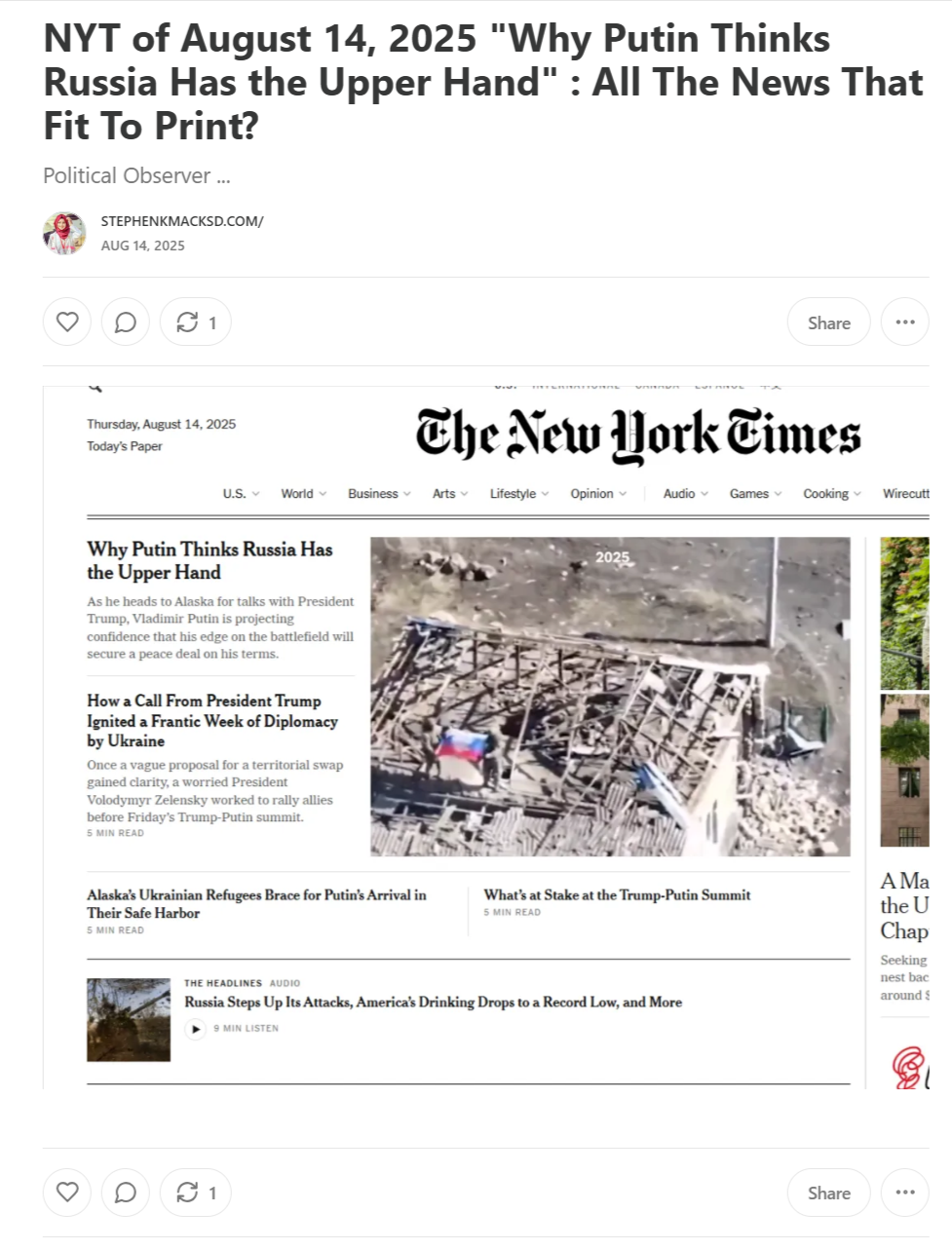
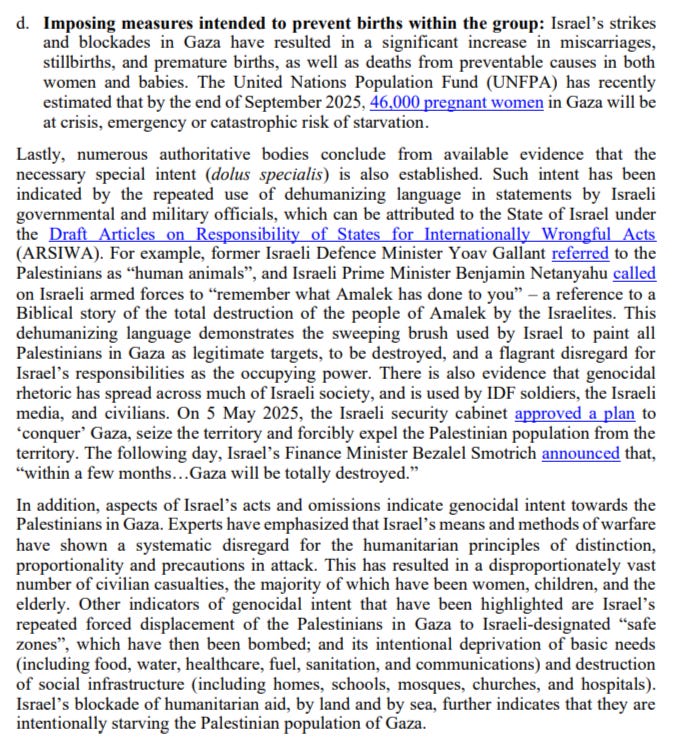
What reader can ever forget ‘The Collapse of The Dream Palaces’? Yet Mr. Brooks’ literary/political moralizing is about maintating ‘Public Order’, as the singular imperative!

American Writer.

stephenkmacksd.com/

Aug 16, 2025

Reading ‘The Collapse of the Dream Palaces’ in July 2019: American Writer’s selective commentary

Posted on July 10, 2019 by stephenkmacksd

 Now that the war in Iraq is over, we’ll find out how many people around the world are capable of facing unpleasant facts.’

https://www.weeklystandard.com/david-brooks/the-collapse-of-the-dream-palaces

What to make of Mr. Brooks’ assertion in 2019? In the present, America is an Occupying power in Iraq, the white phosphorous attack on Falluja, Abu Ghraib and an American embassy that is 104 acres in size, are historically verifiable facts.

The embassy has extensive housing and infrastructure facilities in addition to the usual diplomatic buildings. The buildings include:[10]

Six apartment buildings for employees
Water and waste treatment facilities
A power station
Two “major diplomatic office buildings”
Recreation, including a gym, cinema, several tennis courts and an Olympic-size swimming pool
The complex is heavily fortified, even by the standards of the Green Zone. The details are largely secret, but it is likely to include a significant US Marine Security Guard detachment. Fortifications include deep security perimeters, buildings reinforced beyond the usual standard, and five highly guarded entrances.[citation needed]

https://en.wikipedia.org/wiki/Embassy_of_the_United_States,_Baghdad

Not to forget Sec. Powell’s pivotal UN speech, about non-existent Weapons of Mass Destruction, Sec. Rice’s looming ‘mushroom cloud’ and Judith Miller’s New York Times propaganda. Brooks makes up his list of heretics, whose collective abode were those ‘dream palaces‘.

There is first the dream palace of the Arabists.

Then there is the dream palace of the Europeans.

Finally, there is the dream palace of the American Bush haters.

Mr. Brooks’ literary invention of Joey Tabula-Rasa allows him to add a strategic distance between his bellicose sensibility, and that of 20 year old Joey T-B. Who is a manufactured political naif, whose uncritical acceptance of the Wise Political Elders judgement is an inept propaganda device.

Invent a representative 20-year-old, Joey Tabula-Rasa, and try to imagine how he would have perceived the events of the past month.

This essay was written for an audience of Weekly Standard readers looking for a set of political rationalizations for the ‘Iraq War’ : an endeavor of the now defunct Project for a New American Century. Its Statement of Principals and its signatories:

June 3, 1997

American foreign and defense policy is adrift. Conservatives have criticized the incoherent policies of the Clinton Administration. They have also resisted isolationist impulses from within their own ranks. But conservatives have not confidently advanced a strategic vision of America’s role in the world. They have not set forth guiding principles for American foreign policy. They have allowed differences over tactics to obscure potential agreement on strategic objectives. And they have not fought for a defense budget that would maintain American security and advance American interests in the new century.

We aim to change this. We aim to make the case and rally support for American global leadership.
As the 20th century draws to a close, the United States stands as the world’s preeminent power. Having led the West to victory in the Cold War, America faces an opportunity and a challenge: Does the United States have the vision to build upon the achievements of past decades? Does the United States have the resolve to shape a new century favorable to American principles and interests?
We are in danger of squandering the opportunity and failing the challenge. We are living off the capital — both the military investments and the foreign policy achievements — built up by past administrations. Cuts in foreign affairs and defense spending, inattention to the tools of statecraft, and inconstant leadership are making it increasingly difficult to sustain American influence around the world. And the promise of short-term commercial benefits threatens to override strategic considerations. As a consequence, we are jeopardizing the nation’s ability to meet present threats and to deal with potentially greater challenges that lie ahead.

We seem to have forgotten the essential elements of the Reagan Administration’s success: a military that is strong and ready to meet both present and future challenges; a foreign policy that boldly and purposefully promotes American principles abroad; and national leadership that accepts the United States’ global responsibilities.
Of course, the United States must be prudent in how it exercises its power. But we cannot safely avoid the responsibilities of global leadership or the costs that are associated with its exercise. America has a vital role in maintaining peace and security in Europe, Asia, and the Middle East. If we shirk our responsibilities, we invite challenges to our fundamental interests. The history of the 20th century should have taught us that it is important to shape circumstances before crises emerge, and to meet threats before they become dire. The history of this century should have taught us to embrace the cause of American leadership.

Our aim is to remind Americans of these lessons and to draw their consequences for today. Here are four consequences:

  • we need to increase defense spending significantly if we are to carry out our global
    responsibilities today and modernize our armed forces for the future;
  • we need to strengthen our ties to democratic allies and to challenge regimes hostile to our interests and values;
  • we need to promote the cause of political and economic freedom abroad;
  • we need to accept responsibility for America’s unique role in preserving and extending an international order friendly to our security, our prosperity, and our principles.

Such a Reaganite policy of military strength and moral clarity may not be fashionable today. But it is necessary if the United States is to build on the successes of this past century and to ensure our security and our greatness in the next.

Elliott Abrams, Gary Bauer, William J. Bennett , Jeb Bush, Dick Cheney, Eliot A. Cohen, Midge Decter, Paula Dobriansky,Steve Forbes Aaron Friedberg, Francis Fukuyama, Frank Gaffney, Fred C. Ikle, Donald Kagan, Zalmay Khalilzad, I. Lewis Libby, Norman Podhoretz, Dan Quayle, Peter W. Rodman, Stephen P. Rosen, Henry S. Rowen, Donald Rumsfeld, Vin Weber, George Weigel, Paul Wolfowitz

https://web.archive.org/web/20050205041635/http://www.newamericancentury.org/statementofprinciples.htm

Mr. Brooks’ evolution/de-evolution from Neo-Conservative war monger, to a self-appointed Political/Moral Prophet, with his books , riffing on the themes of an ersatz Sociology made to measure: The Social AnimalThe Road to Character and The Second Mountain places this essay, in a past that Mr. Brooks might find inconvenient? Although, like the adroit grifter, he might characterize this essay as a part of his moral/political evolution to his current point of enlightenment.

American Writer


Opinion

The Winnable War

David Brooks

By David Brooks

  • March 26, 2009
  • Share full article
  • 333

Khyber Pass, Afghanistan

I came to Afghanistan skeptical of American efforts to transform this country. Afghanistan is one of the poorest, least-educated and most-corrupt nations on earth. It is an infinitely complex and fractured society. It has powerful enemies in Pakistan, Iran and the drug networks working hard to foment chaos. The ground is littered with the ruins of great powers that tried to change this place.

Moreover, we simply do not know how to modernize nations. Western aid workers seem to spend most of their time drawing up flow charts for each other. They’re so worried about their inspectors general that they can’t really immerse themselves in the messy world of local reality. They insist on making most of the spending decisions themselves so the “recipients” of their largess end up passive, dependent and resentful.

Every element of my skepticism was reinforced during a six-day tour of the country. Yet the people who work here make an overwhelming case that Afghanistan can become a functional, terror-fighting society and that it is worth sending our sons and daughters into danger to achieve this.

In the first place, the Afghan people want what we want. They are, as Lord Byron put it, one of the few people in the region without an inferiority complex. They think they did us a big favor by destroying the Soviet Union and we repaid them with abandonment. They think we owe them all this.

That makes relations between Afghans and foreigners relatively straightforward. Most military leaders here prefer working with the Afghans to the Iraqis. The Afghans are warm and welcoming. They detest the insurgents and root for American success. “The Afghans have treated you as friends, allies and liberators from the very beginning,” says Afghanistan’s defense minister, Abdul Rahim Wardak.

Second, we’re already well through the screwing-up phase of our operation. At first, the Western nations underestimated the insurgency. They tried to centralize power in Kabul. They tried to fight a hodgepodge, multilateral war.

Those and other errors have been exposed, and coalition forces are learning. When you interview impressive leaders here, like Brig. Gen. John Nicholson of Regional Command South, Col. John Agoglia of the Counterinsurgency Training Center and Chris Alexander of the U.N., you see how relentless they are at criticizing their own operations. Thanks to people like that, the coalition will stumble toward success, having tried the alternatives.

Third, we’ve got our priorities right. Armies love killing bad guys. Aid agencies love building schools. But the most important part of any aid effort is governance and law and order. It’s reforming the police, improving the courts, training local civil servants and building prisons.

In Afghanistan, every Western agency is finally focused on this issue, from a Canadian reconstruction camp in Kandahar to the top U.S. general, David McKiernan.

Fourth, the quality of Afghan leadership is improving. This is a relative thing. President Hamid Karzai is detested by much of the U.S. military. Some provincial governors are drug dealers on the side. But as the U.N.’s Kai Eide told the Security Council, “The Afghan government is today better and more competent than ever before.” Reformers now lead the most important ministries and competent governors run key provinces.

Fifth, the U.S. is finally taking this war seriously. Up until now, insurgents have had free rein in vast areas of southern Afghanistan. The infusion of 17,000 more U.S. troops will change that. The Obama administration also promises a civilian surge to balance the military push.

Sixth, Pakistan is finally on the agenda. For the past few years, the U.S. has let Pakistan get away with murder. The insurgents train, organize and get support from there. “It’s very hard to deal with a cross-border insurgency on only one side of the border,” says Mr. Alexander of the U.N. The Obama strategic review recognizes this.

Finally, it is simply wrong to say that Afghanistan is a hopeless 14th-century basket case. This country had decent institutions before the Communist takeover. It hasn’t fallen into chaos, the way Iraq did, because it has a culture of communal discussion and a respect for village elders. The Afghans have embraced the democratic process with enthusiasm.

I finish this trip still skeptical but also infected by the optimism of the truly impressive people who are working here. And one other thing:

After the trauma in Iraq, it would have been easy for the U.S. to withdraw into exhaustion and realism. Instead, President Obama is doubling down on the very principles that some dismiss as neocon fantasy: the idea that this nation has the capacity to use military and civilian power to promote democracy, nurture civil society and rebuild failed states.

Foreign policy experts can promote one doctrine or another, but this energetic and ambitious response amid economic crisis and war weariness says something profound about America’s DNA.

Editor: Mr. Brooks demonstartes his Neo-Conservative politics, in this sucessoer to the utterly purile ‘The Collapse’ !


Editor: From July 15, 2021

Opinion

David Brooks

The American Identity Crisis

July 15, 2021

For most of the past century, human dignity had a friend — the United States of America. We are a deeply flawed and error-prone nation, like any other, but America helped defeat fascism and communism and helped set the context for European peace, Asian prosperity and the spread of democracy.

Then came Iraq and Afghanistan, and America lost faith in itself and its global role — like a pitcher who has been shelled and no longer has confidence in his own stuff. On the left, many now reject the idea that America can be or is a global champion of democracy, and they find phrases like “the indispensable nation” or the “last best hope of the earth” ridiculous. On the right the wall-building caucus has given up on the idea that the rest of the world is even worth engaging.

Many people around the world have always resisted America’s self-appointed role as democracy’s champion. But they have also been rightly appalled when America sits back and allows genocide to engulf places like Rwanda or allows dangerous regimes to threaten the world order.

The Afghans are the latest witnesses to this reality. The American bungles in Afghanistan have been well documented. We’ve spent trillions of dollars and lost thousands of our people. But the two-decade strategy of taking the fight to the terrorists, in Afghanistan and elsewhere, has meant that global terrorism is no longer seen as a major concern in daily American life. Over the past few years, a small force of American troops has helped prevent some of the worst people on earth from taking over a nation of more than 38 million — with relatively few American casualties. In 1999, no Afghan girls attended secondary school. Within four years, 6 percent were enrolled, and as of 2017 the figure had climbed to nearly 40 percent.

But America, disillusioned with itself, is now withdrawing. And there’s a strong possibility that this withdrawal will produce a strategic setback and a humanitarian disaster. The Taliban are rapidly seizing territory. It may not be too long before Afghan girls get shot in the head for trying to go to school. Intelligence agencies see the arming of ethnic militias and worry about an even more violent civil war. The agencies worry about a flood of refugees, and terrorist groups free to operate unmolested once again.

Over the past decades America and its allies have betrayed our values and compromised with tyrants innumerable times. But at their core the liberal powers radiate a set of vital ideals — not just democracy and capitalism, but also feminism, multiculturalism, human rights, egalitarianism, L.G.B.T.Q. rights and the dream of racial justice. These things are all intertwined in a progressive package that puts individual dignity at the center.

If the 21st century has taught us anything, it is that a lot of people, foreign and domestic, don’t like that package and feel existentially threatened by it. China’s leaders are not just autocrats, they think they are leading a civilization state and are willing to slaughter ethnic minorities. Vladimir Putin is not just a thug, he’s a cultural reactionary. The Taliban champion a fantasy version of the Middle Ages.

These people are not leading 20th-century liberation movements against colonialism and “American hegemony.” They are leading a 21st-century Kulturkampf against women’s rights, gay rights, minority rights, individual dignity — the whole progressive package.

I guess what befuddles me most is the behavior of the American left. I get why Donald Trump and other American authoritarians would be ambivalent about America’s role in the world. They were always suspicious of the progressive package that America has helped to promote.

But every day I see progressives defending women’s rights, L.G.B.T.Q. rights and racial justice at home and yet championing a foreign policy that cedes power to the Taliban, Hamas and other reactionary forces abroad.

If we’re going to fight Trumpian authoritarianism at home, we have to fight the more venomous brands of authoritarianism that thrive around the world. That means staying on the field.

Editor : The purile feeds on the purile !
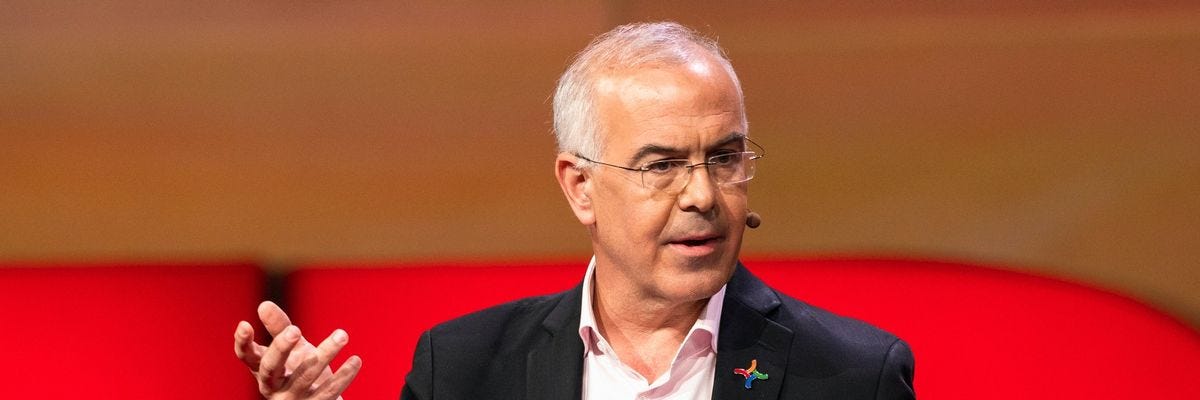

Brooks

What does David Brooks see when he looks in the mirror?

The War on Terror-era neocon is at it again, scolding America for withdrawing from Afghanistan and advocating we stay in the game.

https://responsiblestatecraft.org/2021/07/21/what-does-david-brooks-see-when-he-looks-in-the-mirror/

Marcus Stanley of Responsable Statecraft of July 21, 2021 provides The Reader with actual political and moral thought, not the chatter of a well paid Technocrats who follow the NYT Party Line!

If you were politically aware during the buildup to the 2003 Iraq War, David Brooks’s recent column calling for America to stay in Afghanistan and take a more aggressive role overseas might feel uncomfortably familiar.

Once again, as he did when promoting the Iraq invasion, he calls for America to be the “indispensable nation” and “democracy’s champion.” Once again, there is the obliviousness to the human costs of a supposedly humanitarian U.S. intervention. That was already strange in 2003, but it’s now grotesque after the death of more than 1.3 million human beings in just the first ten years of the War on Terror that Brooks had championed.

The studied turning away from the costs of our wars to those who live in the places where they are fought turns almost surreal in the part of his column devoted to Afghanistan. Brooks cheerfully informs us that “in 1999, no Afghan girls attended secondary school…and as of 2017 the figure had climbed to nearly 40 percent,” all at the cost of “relatively few” American casualties. The cost of a quarter of a million Afghan dead, over 70,000 of them civilians, in a country with a smaller population than California gets zero mention in his column. Neither does the widespread human rights violations associated with the foreign military presence, ranging from torture and detentions to ignoring the return of institutionalized child rape by U.S.-aligned Afghan security forces, something that even the Taliban never tolerated.

After Iraq and Afghanistan, Brooks observes, America “lost faith in itself and its global role, like a pitcher who has been shelled and lost confidence in his own stuff.” Apparently the U.S. is losing its mojo in the democracy-championing business. With the upcoming 20th anniversary of 9/11 the champions of the War on Terror seem to think we are reaching some kind of statute of limitations for the relevance of our past actions. One might have more confidence in this assertion if there had been real accountability and reckoning in Washington for the individuals and ideology that drove the catastrophic decisions made after 9/11.

But this article underscores that there has been no such reckoning. What it instead illustrates is the through-line that links the ideology of global dominance that drove our decisions then, and the way we still look at the world today. The invasion of Iraq was justified by commentators like Bill Kristol using a Manichean distinction between “a world order conducive to our liberal democratic principles and our safety, or… one where brutal, well-armed tyrants are allowed to hold democracy and international security hostage.” Twenty years later, Brooks, a champion of that invasion, still depicts the world as “enmeshed in a vast contest between democracy and different forms of autocracy…a struggle between the forces of progressive modernity and reaction.” And it’s true, as Brooks claims, that this view is close to that espoused by some in the Biden administration.

The problem here is not the belief that American values differ from those held by rulers of other countries, or that we can and should advocate for those values on the global stage. It’s the black- and-white, all-or-nothing vision that divides the world into two hostile camps and abstracts from historical complexity. That complexity includes both the complex origins of cultural and values diversity between sovereign nations and the difficult history of America’s own repeated and systemic violations of the values we claim to uphold. By raising moral condemnation of our rivals to a fever pitch and blurring the distinction between nations as diverse as a Communist dictatorship like China and an Islamic theocracy like the Taliban, it turns difficult and situation-specific challenges around the world into a single global crusade that only America can lead.

But the lesson of the last 20 years is the way in which trying to impose American dominance in the name of our own moral superiority can betray the democratic and humanitarian goals it claims to pursue. Saddam Hussein was a more brutal and arbitrary dictator than the leaders of China and Russia today, and one might have thought that no intervention would have made the situation in Iraq worse. Yet American intervention did just that, and dramatically so. Likewise, Brooks’s call to remain in Afghanistan relies purely on condemnation of the Taliban as evil, without tallying the costs of continued American intervention in sustaining a bloody and stalemated civil war.

Of course, many things have changed since 2001, and Brooks’ article does reflect those changes. He now appeals not to center-right values of democratic capitalism, but to the left values of “feminism, multiculturalism, human rights, egalitarianism, L.G.B.T.Q. rights and the dream of racial justice.” He tries to tap domestic partisan energies by claiming that foreign rivals are united with Donald Trump domestically in leading a reactionary “21st century kulturkampf” against these progressive values. It takes a certain chutzpah to appeal to the dream of racial justice to support continued bombing of brown villagers in Afghanistan, or the values of multiculturalism to claim America’s cultural and moral authority to impose its values on the rest of the world. But Brooks has never lacked for chutzpah.

The more subtle difference, acknowledged by Brooks in a brief statement that “we’re never going back to the Bush doctrine,” is a belief we can avoid the overreach of boots-on-the-ground invasions of foreign countries while still pursuing claims to unilateral U.S. global leadership. This recasts the Iraq and Afghanistan wars as driven not by ideological overreach but by a short-sighted failure to anticipate the practical difficulties of invasion and occupation. Calls for new hot wars are out; a sweeping, ill-defined global cold war with the forces of reaction domestically and abroad is in. But cold wars carry their own dangers — including igniting a hot war in any of the numerous simmering low-level conflicts with our ideological enemies around the world, from Ukraine to the Persian Gulf to the Taiwan Strait.

Brooks closes by saying that without aggressively fighting this new global conflict between authoritarianism and progressive values we won’t be able to “look at ourselves in the mirror without a twinge of shame.” It’s an odd moral calculus that tries to ignore shameful acts facilitated by the United States itself and instead calls on us to be ashamed of the actions of foreign governments based on the vague hypothetical claim that U.S. intervention could prevent them. But it’s at the heart of the humanitarian interventionism Brooks sold 20 years ago and is still selling today. We should hope that this time there won’t be buyers in Washington.


American Writer.
Posted in Uncategorized | Leave a comment

On ‘Puck’ and Fellow Travelers!

Political Cynic comments!

stephenkmacksd.com/

Aug 16, 2025

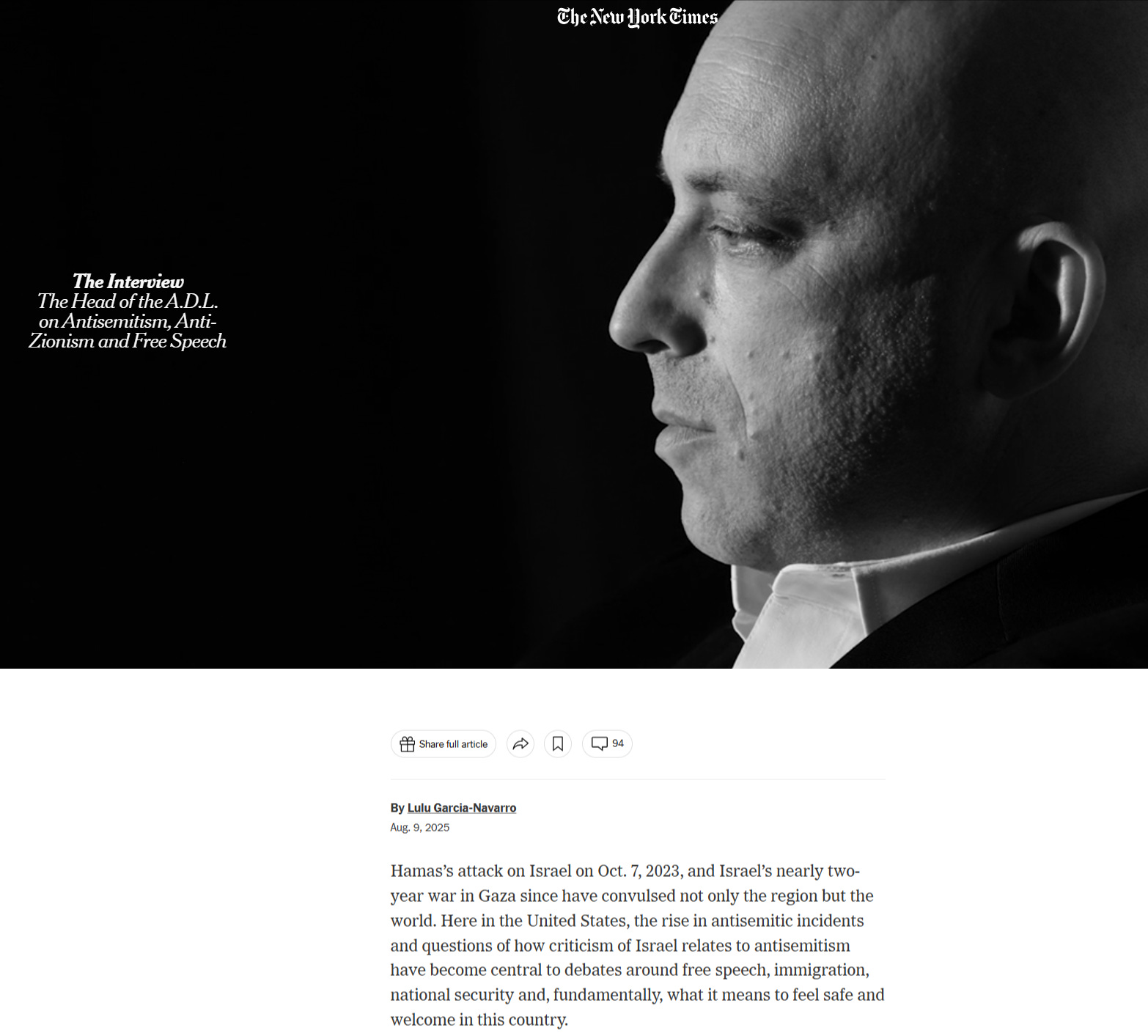
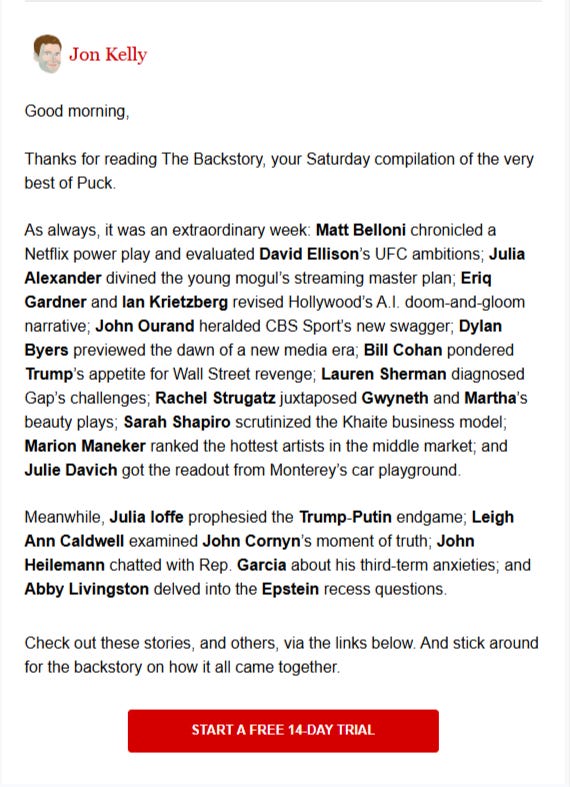
PUCK is the want-to-be Version of Gradon Carters Vanity Fair, that morphed into ‘Air Mail’ , bathed in reductive nostalgia, held afloat by garish ADVERTISEMENTS! No more Dominick Dunne: But nerver fear, Neo-Con gouhl Julia Ioffie, offers the parched reader of the inefable? Reader don’t miss Jonathan Greenblatt’s interview in The Times! Fellow Travelers!

Political Cynic!

Posted in Uncategorized | Leave a comment

Who is Franz-Stefan Gady? The Financial Times unearths these War Mongers…

Former Reader!

stephenkmacksd.com/

Aug 15, 2025

Franz-Stefan Gady : Join the Front-line soldiers, otherwise be silent, Technocrat!

Former Reader!

Posted in Uncategorized | Leave a comment

Re-posting my commentery on Bret Stephens: Posted on August 4, 2020!

stephenkmacksd.com/

Aug 14, 2025

Like Paul & Luther, Bret Stephens shames The Heretics. Political Observer comments

Posted on August 4, 2020 by stephenkmacksd

The reader quickly realizes the ‘why’ of the Jerusalem Post hiring, of the 28 year old Bret Stephens, to be its editor. This newspaper is the propaganda arm of the Zionist State. And Stephens regurgitates the ever evolving rationales for this European Settler State, he knows it by wrote, but is also able to extemporize, at will, on its themes.
Mr. Stephens is given to impugning his opponents, like the anguished Liberal Zionist Beinart. Reminding this reader of Paul, in the commentary by Karl Barth, of ‘The Epistle To The Romans’ or of Luther’s ‘1517 Disputation Against Scholastic Theology’ and his ‘The Heidelberg Disputation’ . Stephens is a zealot, that shares that commonality with the Protestant Reformation and its Biblical precursor..

The last two paragraphs of his essay is about the waning power of Jewish Identity, where such a concept appears as ineluctable, as conceived by Stephens, being the sine qua non of the Zionist State’s survival.

It used to be that Israelis depended on a secure and thriving American Jewry to help stand up their fragile state. Today it is American Jewry that is fragile, threatened by dwindling cultural influence, stagnant demographic trends, increasing alienation from the Democratic Party and abiding discomfort with the G.O.P., and rising anti-Semitism — sometimes masked as anti-Zionism — from across the political spectrum.

Should American Jews start looking for the exits — just as every other Diaspora community in history has done, and continues to do — they will be grateful to find a Jewish state that resisted the siren song of “one state.”

https://www.nytimes.com/2020/08/03/opinion/israel-palestine-one-state-solution.html?action=click&module=Opinion&pgtype=Homepage

Isn’t the survival of this state predicated upon lavish economic support given by America?

Headline: Key U.S. lawmakers want to boost Israel’s $38 billion defense aid package

https://www.reuters.com/article/us-usa-israel-defense-idUSKCN1GB2NQ

Political Observer

Posted in Uncategorized | Leave a comment

Posted in Uncategorized | Leave a comment

NYT’s resident Neo-Con ghoul, Bret Stephens, frames his latest Anti-Putin diatribe, with Robert Kraft as victim of Putin?

Political Thinker wonders!

stephenkmacksd.com/

Aug 13, 2025

Editor: Bret Stephens is the natural inheritor of mantle of Fred Schwarz nototious for Christian Anti-Communism Crusade! How do I know this? In 1961 Schwartz came to my Highschool, in Lynwood California, to give his presentation. Mr. Sculnick a teacher of mine, hated Schwartz. Mr. Sculnick had a ‘talk’ with me about my Levi’s jeans, my first and only pair: Lynwood Highschool wanted to improve it’s standing, by having students appear more polished, in sum to appear more Middle Class. Mr. Sculnick and Fred Schwarz were on on my ‘LIST’! It was the early 1960’s and ‘The Man in the Gray Flannel Suit’, book and Movie, with the aid of ‘The Organization Man’ made conformity, in its myriad expressions, a valuable political commodity! This paragraph is introductery!


Donald Trump, the world’s greatest negotiator according to himself, may not think he needs much advice before his summit meeting in Alaska with Vladimir Putin on Friday. But the president should give Robert Kraft a call.

Kraft, the owner of the New England Patriots, knows what it’s like to be fleeced by the Russian president. On a visit to Russia in 2005 with U.S. business leaders, Kraft, at the urging of Citigroup’s then-chairman, Sandy Weill, showed Putin one of his $25,000 Super Bowl rings.

“And he put it on and he goes, ‘I can kill someone with this ring,’” Kraft recounted in 2013. “I put my hand out and he put it in his pocket, and three K.G.B. guys got around him and walked out.” Kraft said he was urged by the Bush administration to pretend the ring had been a gift, while Putin later mocked Kraft’s complaint and suggested that the ring was embarrassingly cheap.

Editor: The Reader might wonder the source of this tale? Kraft himself , carefully embroidered? Or just apocryphal? Putin is by nature untrustworthy or just a thief : in sum a man without scruple: it comfortably dovetailes with the remainder Stephens diatribe?

Editor: These paragraps provide more ballist for Stephen’s :

Petty crooks sometimes become big-time ones, and Putin’s career is a case in point — from reports of pilfering high-tech secrets from the West as a K.G.B. agent in East Germany to suspicions about corrupt contracts while a mayoral deputy in St. Petersburg in the 1990s, orchestrating electoral theft in Russia and electoral meddling abroadplundering the Russian economy and seizing territory from Georgia and now Ukraine.

This is not grand strategy at work. It’s grand larceny. It’s the essence of what Putin is about — and surely helps explain Trump’s long-held admiration for him.


Editor: Here is a selection from Stephens essay:

He may also be conscious that some of his predecessors made fools of themselves in past Russia summits, including George W. Bush (“I looked the man in the eye. I found him very straightforward and trustworthy … I was able to get a sense of his soul”) and Barack Obama (“After my election I have more flexibility,” he said to Putin’s front-office man Dmitri Medvedev).

There are many ways this summit could go wrong, including vague talk of “land swapping” between Russia and Ukraine. But there’s also a way Trump can do something useful.

Editor: Mr. Stephens offers this maladroit sumation… The Russina’s are relentlessly advancing day my day!

The most positive thing that can be said about this summit is that it can be cast as a final good-faith effort by the administration to give Russia a face-saving way to cut its losses: an estimated million casualties, the loss of much of its stock of tanks and bombers, NATO’s expansion, the slow strangulation of the Russian economy, a war without end.

Stephens: A few items to lay on the table: (Editor: consonent with the Neo-Con Wet Dream)

Working with Europe to seize the estimated $300 billion of frozen Russian government assets to serve as a funding pool for Ukrainian purchases of Western arms. The president has the legal authority to do this under the 1977 International Emergency Economic Powers Act, and George H.W. Bush already set a precedent by freezing and transferring Iraq’s frozen assets to a compensation fund following Saddam Hussein’s invasion of Kuwait.

Signing the bipartisan Senate sanctions bill on Russia, which includes a 500 percent tariff “on all goods and services imported into the United States from countries that knowingly engage in the exchange of Russian-origin uranium and petroleum products.”

Removing all technical or targeting restrictions on Ukraine’s use of U.S.-supplied weapons.

Pursuing a defense and technology cooperation pact with Kyiv on the model of U.S. military ties to Israel. Today especially, America has a lot to learn from Ukraine about the rapid development and fielding of drones on the battlefield.

Supplying Kyiv with additional squadrons of F-16s and other weaponry that can defend Ukraine’s skies and hold Russian military targets at risk.


Editor: Mr. Stephens still can’t let go of his self-serving version of a History’, that is collapsing before his eyes!

The choice between these two sets of options — the off-ramp versus the road to hell — should be Putin’s to make. Though public opinion counts for almost nothing in Putin’s Russia, Russians should still know that their president was offered an honorable peace and refused it.

The choice will also have to involve Volodymyr Zelensky and the Ukrainian people, who run the risk of being treated in this summit much as the government of Czechoslovakia was treated by the powers who met in Munich in 1938. Neville Chamberlain is yet another leader to whom Trump won’t want to see himself compared. Friday is Trump’s chance to show he’s better.

While he’s at it, he can also ask Putin to return Kraft’s ring.

Editor: Mr. Stephens is a Neo-Con, and is trapped in its toxic mythology, as presented by Leo Strauss failed attempt to Re-Write the History of Philosophy!

Political Thinker.

Posted in Uncategorized | Leave a comment

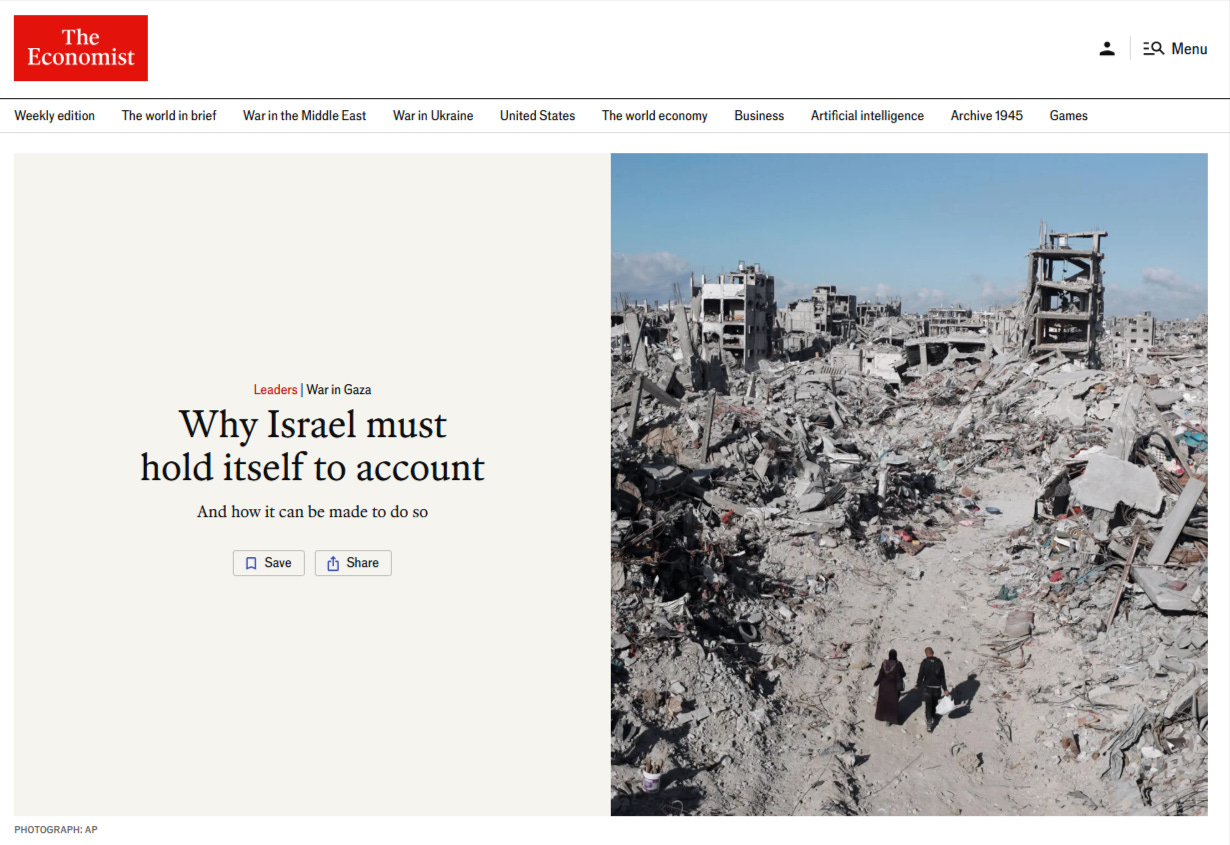
The Economist, under Zanny Minton Beddoes & Company, practices the art of Political Equivocation, regarding the Gaza Genocide…

Political Observer on The Gaza Genocide and Hiroshima and Nagasaki?

stephenkmacksd.com/

Aug 12, 2025

Editor: Here is the bedinning of ‘call to account’ offered by this news magaine : featuring the Soviet Union as the untimate, indeed the toxic political actor of the 20th Century. How fleeting is the political memory of this newspaper and it’s minions, about the Crime’s perpitated by America in the bombing of Hiroshima and Nagasaki!


Other estimates made in the immediate postwar, for which the methodology is not available, include the following, which were cited in some of the aforementioned reports:

  • Hiroshima Red Cross Hospital estimated 70,000 dead, and another 50,000-60,000 dead within the next two months, for a total of around 125,000 dead;
  • The British estimated, based on their own population estimates, that some 70,000-90,000 people died at Hiroshima, and an additional 100,000 were injured; at Nagasaki, they initially estimated 39,500 killed, but later reduced this to 34,000; they also estimated that at least 60,000 were injured at Nagasaki;
  • The Navy technical mission to Japan estimated 80,000 dead at Hiroshima and 45,000 at Nagasaki;
  • The United States Strategic Bombing Survey’s Civilian Defense Division estimated that 25,761 had died in Nagasaki, with 30,460 injured and 1,927 missing;
  • The Supreme Commander for the Allied Powers headquarters put the dead at Hiroshima at 78,000 in early 1946;
  • In July 1946, Lt. Col. George V. LeRoy, a physician assigned to the Joint Commission and a member of the Manhattan Project’s health physics division at the University of Rochester, gave an address that claimed that at Hiroshima 80,000 had died and 40,000 had been injured, and at Nagasaki 40,000 had died and 25,000 had been injured.

Again, the fact that most of these numbers hover around similar orders of magnitude (66,000-90,000 dead at Hiroshima, 25,000-45,000 at Nagasaki) should probably be understood as being essentially based on the same types of data for the populations of the cities, and they may not be totally independent estimates.

Various Japanese estimates were also made during this time. As we have seen, the American forces viewed Japanese accounts with some skepticism, rightly or wrongly. At the end of August 1945, officials in both Hiroshima and Nagasaki prefectures estimated that there were 63,614 dead and missing at Hiroshima, and 25,672 dead and missing at Nagasaki. The Joint Commission concluded that an investigation into the data behind these estimates “reveals several errors in calculation and judgment.”

The police at Hiroshima prefecture estimated that there were 92,133 dead and missing from the city at the end of November 1945. In March 1946, the city of Hiroshima put the same number at 64,610. In August 1946, the city put the number of dead and missing at one year after the bombing at 122,338. In 1949, a Nagasaki City committee estimated that 73,884 people had died. Both of these latter estimates are obviously considerably higher (nearly double) the other estimates, and it is not clear what the methodologies used to compile them were. (They are cited in Table 10.11 on page 364 of Hiroshima and Nagasaki: The Physical, Medical, and Social Effects of the Atomic Bombings.)

Recommended Reading

The physical and medical effects of the Hiroshima and Nagasaki bombs

A team of scientists appraises Japanese studies of the after-effects of the bombings of Hiroshima and Nagasaki in 1945.

Most of the deaths occurred on the first days of the attacks, and most of those that did not happen immediately happened within several months.

The only other estimate of note that I have come across from the 1940s is from Shinzo Hamai, the mayor of Hiroshima in 1949, who asserted that 210,000-240,000 had died from the bombing. He claimed to base this on his own personal experience in working with the rice rationing cards, and also on his belief that the military dead were removed from the official statistics. (The United States Strategic Bombing Survey had previously estimated that only 6,789 soldiers, out of 24,158 in Hiroshima, were killed or missing because of the bombing.) The only reportage I have on this estimate is from American newspaper sources (and so may be inadequately communicated or poorly translated), but it is of interest not only because of its significant variance with the other numbers given, but also because it was reported on quite widely in 1949 specifically because of that variance.

Almost all of these estimates are the dead within several months of the bombing. The question of time is an important one: Are we talking about how many people died on the day of the bombing, within a month, within several months, until the present? The estimates on this are, of course, as sketchy as they are for anything else. An American doctor, Verne R. Mason, from 1947 reported that the last of those who died of acute radiation exposure at Hiroshima had expired by late September 1945; a Japanese study of mortality rates from 1951 found that about 70% of those who had died by November 1945 had died on August 6. (See Table 7.8 on page 112 of Hiroshima and Nagasaki: The Physical, Medical, and Social Effects of the Atomic Bombings.) The Joint Commission had itself estimated that around 40,000-50,000 (about 70% of their 64,000 total) died at Hiroshima on the first day. They similarly estimated that maybe 10,000 had died immediately at Nagasaki, as well.

These kinds of estimates are even looser than the estimates of total dead. But the basic conclusion is an important one, because it is perhaps surprising to people approaching this topic for the first time that most of the deaths occurred on the first days of the attacks, and that most of those that did not happen immediately happened within several months. The question of long-term radiation-related deaths (e.g., from cancer) will be discussed in a moment.


Editor: The opening paragraphs of this ‘History Made to Measure’ and The Soviet Union, that appeals to The Economist’s reactinary readership! Not to speak of this maudlin pastiche: From the beginning, the world has struggled to live up to the high ideals of 1948.


ON MAY 14TH 1948, in its Declaration of Independence, Israel embraced universal human rights “irrespective of religion, race or sex”. This belief in individual human dignity is also enshrined in the Geneva Conventions, submitted to governments that same month. Today the founding vision of Israel and the laws of war are under attack in Gaza. In its bombed and barren landscape the fate of both lies in the balance.

From the beginning, the world has struggled to live up to the high ideals of 1948. Israel was born in violence and ever since it has wrestled with the tension between upholding universal rights and being the home of a people in a contested land. The cold war was a stand-off between two systems that too often treated humanitarian law as inconvenient. Even so, the decades after the fall of the Soviet Union gave rise to aspirations that law-breaking leaders could be held to account.

Editor: The toxic, indeed murderious action of the Zionist Faschist State has been continious since 1948! This political fact eludes the Economist’s ladder of political checks and balances, that ends in its final political product !


Gaza shows how this vision is failing. The laws of war are being broken and the system for upholding them is not working. However, that failure does not exonerate Israel from having to answer for its actions in Gaza, including war crimes and crimes against humanity. Indeed, its foundations as a liberal democracy demand that it must.

Something has gone very wrong in Gaza. Israel’s just war against the terrorists who massacred its people on October 7th 2023 has turned into death and destruction on a biblical scale. Most of Gaza lies in ruins, millions of civilians are displaced and tens of thousands have been killed. And still, Israel’s prime minister, Binyamin Netanyahu, cannot stop himself. This week it emerged that he wants to occupy all of Gaza. But Hamas is no longer a military threat, so the war no longer has a strategy and fighting on is no longer just.

Worse, Israel’s government, despite its duties as an occupying power, has used the distribution of food to civilians as a weapon against Hamas. It continued even when, as predicted, that led to starvation and the death of desperate people queuing for survival rations. By corralling civilians in pockets as it systematically bulldozes their homes, Israel is also practising ethnic cleansing.

Editor: The above pagraphs are followed by this collection of Bad Political Actors that widens the scope, and offers a brief respite, of a self-serving kind, in sum a self-serving apologetic of a kind?

Gaza is not alone. Civilians are being slaughtered and driven from their homes in the Democratic Republic of Congo, Myanmar, Sudan, Ukraine and pretty much every other warzone today. Hamas, don’t forget, started the current Gaza conflict 22 months ago with an orgy of hostage-taking and crimes against humanity. Instead of seeking peace, it has gorged on the misery of its own people. It recently described the recognition of a Palestinian state promised by Britain, Canada and France as the “fruits” of October 7th.


Editor: This political indictment, of a kind?, rambles on and and on! Reader here are the final paragraphs of this Economist Chatter, that in it’s meadering way, seeks the the ‘Redemption’ of The Zionist Faschist State!

Those officials understand that Israel has an interest in the law, too. Some Israelis calculate that they can do what they like now and patch up relations with the West later. But views of Israel are bleak in Europe and are changing in America among Democrats and the MAGA right. If Israel becomes an ethno-nationalist state that annexes the West Bank and crushes its people, the violence will not cease.

You might argue that, after suffering the worst attack in its history, Israel will have no appetite for prosecuting its own leaders. However, the penetrating insight which emerges from the Geneva Conventions is that countries which break the laws of war without shame or recourse do not just harm their victims: they also harm themselves.

Israel has an existential interest in seeing justice done. If instead it glorifies those who orchestrate famine and ethnic cleansing in Gaza, its politics and society will lurch towards demagoguery and authoritarianism. The young, idealistic country that was born in May 1948 will have been eclipsed. ■


Political Observer.

Posted in Uncategorized | Leave a comment

Religious Hysteric Amy Coney Barrett scolds Ketanji Brown Jackson.( The full text of the Jackson’s dissent)

Political Observer comments: Is the ‘Judicial Reasoning’ hard to follow? Of course it is! This is ‘The Law’ the provence of ‘Juriprudential Reasoning’, the product of a Corrupt Technocracy!

stephenkmacksd.com/

Aug 09, 2025

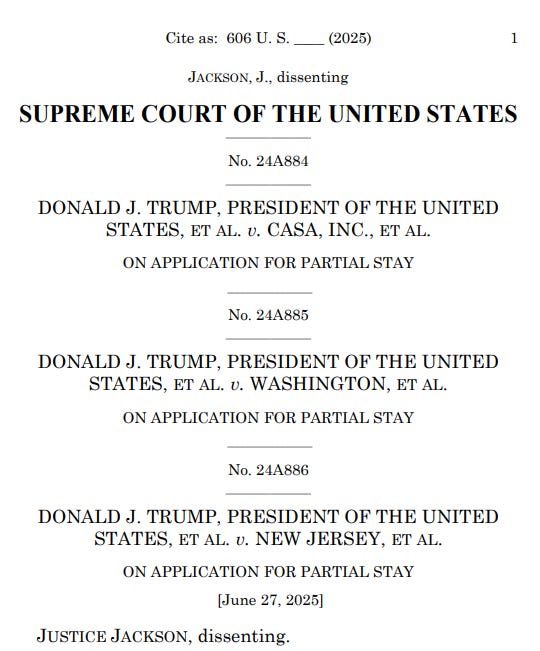
Cite as: 606 U. S. ____ (2025) 1 Opinion of the Court SUPREME COURT OF THE UNITED STATES No. 24A884

DONALD J. TRUMP, PRESIDENT OF THE UNITED STATES, ET AL. v. CASA, INC., ET AL. ON APPLICATION FOR PARTIAL STAY _________________ No. 24A885

DONALD J. TRUMP, PRESIDENT OF THE UNITED STATES, ET AL. v. WASHINGTON, ET AL. ON APPLICATION FOR PARTIAL STAY _________________ No. 24A886

DONALD J. TRUMP, PRESIDENT OF THE UNITED STATES, ET AL. v. NEW JERSEY, ET AL. ON APPLICATION FOR PARTIAL STAY [June 27, 2025]

JUSTICE BARRETT delivered the opinion of the Court.

The principal dissent focuses on conventional legal terrain, like the Judiciary Act of 1789 and our cases on equity. JUSTICE JACKSON, however, chooses a startling line of attack that is tethered neither to these sources nor, frankly, to any doctrine whatsoever. Waving away attention to the limits on judicial power as a “mind-numbingly technical query,” post, at 3 (dissenting opinion), she offers a vision of ——————

16Acknowledging these problems, the principal dissent admits that “[t]here may be good reasons not to issue universal injunctions in the typical case.” Post, at 23 (opinion of SOTOMAYOR, J.). This concession, while welcome, is inconsistent with the position that the universal injunction is a “nothing to see here” extension of the kind of decree obtained on a bill of peace. Neither the principal dissent nor respondents have pointed to any evidence that such decrees presented any of the universal injunction’s systemic problems or that they were reserved for situations in which the defendant’s conduct was “patently unconstitutional” and risked “exceptional” harm. Post, at 22–23. It is precisely because the universal injunction is a new, potent remedy that it poses new, potent risks. Our observation in Grupo Mexicano rings true here: “Even when sitting as a court in equity, we have no authority to craft a ‘nuclear weapon’ of the law.” 527 U. S., at 332.

the judicial role that would make even the most ardent defender of judicial supremacy blush. In her telling, the fundamental role of courts is to “order everyone (including the Executive) to follow the law—full stop.” Post, at 2; see also post, at 10 (“[T]he function of the courts—both in theory and in practice—necessarily includes announcing what the law requires in . . . suits for the benefit of all who are protected by the Constitution, not merely doling out relief to injured private parties”); see also post, at 11, n. 3, 15. And, she warns, if courts lack the power to “require the Executive to adhere to law universally,” post, at 15, courts will leave a “gash in the basic tenets of our founding charter that could turn out to be a mortal wound,” post, at 12.

Rhetoric aside, JUSTICE JACKSON’s position is difficult to pin down. She might be arguing that universal injunctions are appropriate—even required—whenever the defendant is part of the Executive Branch. See, e.g., post, at 3, 10–12, 16–18. If so, her position goes far beyond the mainstream defense of universal injunctions. See, e.g., Frost, 93 N. Y. U. L. Rev., at 1069 (“Nationwide injunctions come with significant costs and should never be the default remedy in cases challenging federal executive action”). As best we can tell, though, her argument is more extreme still, because its logic does not depend on the entry of a universal injunction: JUSTICE JACKSON appears to believe that the reasoning behind any court order demands “universal adherence,” at least where the Executive is concerned. Post, at 2 (dissenting opinion). In her law-declaring vision of the judicial function, a district court’s opinion is not just persuasive, but has the legal force of a judgment. But see Haaland v. Brackeen, 599 U. S. 255, 294 (2023) (“It is a federal court’s judgment, not its opinion, that remedies an injury”). Once a single district court deems executive conduct unlawful, it has stated what the law requires. And the Executive must conform to that view, ceasing its enforcement of the law against anyone, anywhere.17 We will not dwell on JUSTICE JACKSON’s argument, which is at odds with more than two centuries’ worth of precedent, not to mention the Constitution itself. We observe only this: JUSTICE JACKSON decries an imperial Executive while embracing an imperial Judiciary. No one disputes that the Executive has a duty to follow the law. But the Judiciary does not have unbridled authority to enforce this obligation—in fact, sometimes the law prohibits the Judiciary from doing so. See, e.g., Marbury v. Madison, 1 Cranch 137 (1803) (concluding that James Madison had violated the law but holding that the Court lacked jurisdiction to issue a writ of mandamus ordering him to follow it). But see post, at 15 (JACKSON, J., dissenting) (“If courts do not have the authority to require the Executive to adhere to law universally, . . . compliance with law sometimes becomes a matter of Executive prerogative”). Observing the limits on judicial authority—including, as relevant here, the boundaries of the Judiciary Act of 1789—is required by a judge’s oath to follow the law. JUSTICE JACKSON skips over that part. Because analyzing the governing statute involves boring “legalese,” post, at 3, she seeks to answer “a far more basic question of enormous practical significance: May a federal court in the United States of America order the Executive to follow the law?” Ibid. In other words, it is unecessary to consider whether Congress has constrained the Judiciary; what matters is how the Judiciary may constrain the Executive. JUSTICE JACKSON would do well to heed her own admonition: “[E]veryone, from the President on down, is bound by law.” Ibid. That goes for judges too.


Political Observer.


Editor: Justice Jackson demands to be read in full!

 I agree with every word of Justice Sotomayor’s dissent. I write separately to emphasize a key conceptual point: The Court’s decision to permit the Executive to violate the Constitution with respect to anyone who has not yet sued is an existential threat to the rule of law.

 It is important to recognize that the Executive’s bid to vanquish so-called “universal injunctions” is, at bottom, a request for this Court’s permission to engage in unlawful behavior. When the Government says “do not allow the lower courts to enjoin executive action universally as a remedy for unconstitutional conduct,” what it is actually saying is that the Executive wants to continue doing something that a court has determined violates the Constitution—please allow this. That is some solicitation. With its ruling today, the majority largely grants the Government’s wish. But, in my view, if this country is going to persist as a Nation of laws and not men, the Judiciary has no choice but to deny it.

Stated simply, what it means to have a system of government that is bounded by law is that everyone is constrained by the law, no exceptions. And for that to actually happen, courts must have the power to order everyone (including the Executive) to follow the law—full stop. To conclude otherwise is to endorse the creation of a zone of lawlessness within which the Executive has the prerogative to take or leave the law as it wishes, and where individuals who would otherwise be entitled to the law’s protection become subject to the Executive’s whims instead.

 The majority cannot deny that our Constitution was designed to split the powers of a monarch between the governing branches to protect the People. Nor is it debatable that the role of the Judiciary in our constitutional scheme is to ensure fidelity to law. But these core values are strangely absent from today’s decision. Focusing on inapt comparisons to impotent English tribunals, the majority ignores the Judiciary’s foundational duty to uphold the Constitution and laws of the United States. The majority’s ruling thus not only diverges from first principles, it is also profoundly dangerous, since it gives the Executive the go-ahead to sometimes wield the kind of unchecked, arbitrary power the Founders crafted our Constitution to eradicate. The very institution our founding charter charges with the duty to ensure universal adherence to the law now requires judges to shrug and turn their backs to intermittent lawlessness. With deep disillusionment, I dissent.

I

To hear the majority tell it, this suit raises a mind-numbingly technical query: Are universal injunctions “sufficiently ‘analogous’ to the relief issued ‘by the High Court of Chancery in England at the time of the adoption of the Constitution and the enactment of the original Judiciary Act’ ” to fall within the equitable authority Congress granted federal courts in the Judiciary Act of 1789? Ante, at 6. But that legalese is a smokescreen. It obscures a far more basic question of enormous legal and practical significance: May a federal court in the United States of America order the Executive to follow the law?

A

To ask this question is to answer it. In a constitutional Republic such as ours, a federal court has the power to order the Executive to follow the law—and it must. It is axiomatic that the Constitution of the United States and the statutes that the People’s representatives have enacted govern in our system of government. Thus, everyone, from the President on down, is bound by law. By duty and nature, federal courts say what the law is (if there is a genuine dispute), and require those who are subject to the law to conform their behavior to what the law requires. This is the essence of the rule of law.

Do not take my word for it. Venerated figures in our Nation’s history have repeatedly emphasized that “[t]he essence of our free Government is ‘leave to live by no man’s leave, underneath the law’—to be governed by those impersonal forces which we call law.” Youngstown Sheet & Tube Co. v. Sawyer343 U. S. 579, 654 (1952) (R. Jackson, J., concurring). “Our Government is fashioned to fulfill this concept so far as humanly possible.” Id., at 654–655. Put differently, the United States of America has “ ‘ “a government of laws and not of men.” ’ ” Cooper v. Aaron358 U. S. 1, 23 (1958) (Frankfurter, J., concurring) (quoting United States v. Mine Workers330 U. S. 258, 307 (1947) (Frankfurter, J., concurring in judgment)); see also, e.g., Mass. Const., pt. 1, Art. XXX (1780), in 3 Federal and State Constitutions 1893 (F. Thorpe ed. 1909) (J. Adams); Marbury v. Madison, 1 Cranch 137, 163 (1803) (Marshall, C. J., for the Court); United States v. Dickson, 15 Pet. 141, 162 (1841) (Story, J., for the Court).

That familiar adage is more than just mere “ ‘rhetorical flourish.’ ” Cooper, 358 U. S., at 23. It is “ ‘the rejection in positive terms of rule by fiat, whether by the fiat of governmental or private power.’ ” Ibid. Indeed, “constitutionalism has one essential quality: it is a legal limitation on government; it is the antithesis of arbitrary rule; its opposite is despotic government, the government of will instead of law.” C. McIlwain, Constitutionalism: Ancient and Modern 21–22 (rev. ed. 1947); see also id., at 21 (“All constitutional government is by definition limited government”).

Those who birthed our Nation limited the power of government to preserve freedom. As they knew all too well, “constant experience shows us that every man invested with power is apt to abuse it, and to carry his authority as far as it will go.” Montesquieu, The Spirit of Laws, in 38 Great Books of the Western World 69 (T. Nugent transl., R. Hutchins ed. 1952). But the Founders reasoned that the vice of human ambition could be channeled to prevent the country from devolving into despotism—ambition could be “made to counteract ambition.” The Federalist No. 51, p. 322 (C. Rossiter ed. 1961) (J. Madison). If there were, say, a Constitution that divided power across institutions “in such a manner as that each may be a check on the other,” then it could be possible to establish Government by and for the People and thus stave off autocracy. Ibid.; see also Myers v. United States272 U. S. 52, 293 (1926) (Brandeis, J., dissenting) (“The doctrine of the separation of powers was adopted by the Convention of 1787, not to promote efficiency but to preclude the exercise of arbitrary power”). Through such separated institutions, power checks power. See Montesquieu, The Spirit of Laws, at 69. Our system of institutional checks thus exists for a reason: so that “the private interest of every individual may be a sentinel over the public rights.” The Federalist No. 51, at 322.

B

The distribution of power between the Judiciary and the Executive is of particular importance to the operation of a society governed by law. Made up of “ ‘free, impartial, and independent’ ” judges and justices, the Judiciary checks the political branches of Government by explaining what the law is and “securing obedience” with it. Mine Workers, 330 U. S., at 308, 312 (opinion of Frankfurter, J.); see Marbury, 1 Cranch, at 177. The federal courts were thus established “not only to decide upon the controverted rights of the citizens as against each other, but also upon rights in controversy between them and the government.” United States v. Lee106 U. S. 196, 220 (1882).

Quite unlike a rule-of-kings governing system, in a rule-of-law regime, nearly “[e]very act of government may be challenged by an appeal to law.” Cooper, 358 U. S., at 23 (opinion of Frankfurter, J.). In this country, the Executive does not stand above or outside of the law. Consequently, when courts are called upon to adjudicate the lawfulness of the actions of the other branches of Government, the Judiciary plays “an essential part of the democratic process.” Mine Workers, 330 U. S., at 312. Were it otherwise—were courts unable or unwilling to command the Government to follow the law—they would “sanctio[n] a tyranny” that has no place in a country committed to “well-regulated liberty and the protection of personal rights.” Lee, 106 U. S., at 221. It is law—and “ ‘Law alone’ ”—that “ ‘saves a society from being rent by internecine strife or ruled by mere brute power however disguised.’ ” Cooper, 358 U. S., at 23 (quoting Mine Workers, 330 U. S., at 308).

 The power to compel the Executive to follow the law is particularly vital where the relevant law is the Constitution. When the Executive transgresses an Act of Congress, there are mechanisms through which Congress can assert its check against the Executive unilaterally—such as, for example, asserting the power of the purse. See K. Stith, Congress’ Power of the Purse, 97 Yale L. J. 1343, 1360 (1988) (describing Congress’s ability to “regulat[e] executive branch activities by limitations on appropriations”). But when the Executive violates the Constitution, the only recourse is the courts. Eliminate that check, and our government ceases to be one of “limited powers.” Gregory v. Ashcroft501 U. S. 452, 457 (1991). After all, a limit that “do[es] not confine the perso[n] on whom [it is] imposed” is no limit at all. Marbury, 1 Cranch, at 176.1

II

With that background, we can now turn to this suit and focus on the ways in which the majority’s ruling undermines our constitutional system. Justice Sotomayor has laid out the relevant facts, see ante, at 9–13 (dissenting opinion), and I will not repeat what she has said. It suffices for my purposes to reiterate that, before these applications arrived here, three District Courts had concluded that Executive Order No. 14160—which attempts to alter the Constitution’s express conferral of citizenship on all who are born in this Nation, Amdt. 14, §1—likely violates the Constitution. Those courts each thus enjoined the Executive from enforcing that order anywhere, against anyone. See 763 F. Supp. 3d 723 (Md. 2025), appeal pending, No. 25–1153 (CA4); 765 F. Supp. 3d 1142 (WD Wash. 2025), appeal pending, No. 25–807 (CA9); Doe v. Trump, 766 F. Supp. 3d 266 (Mass. 2025), appeal pending, No. 25–1170 (CA1). Three Courts of Appeals then declined to upset these injunctions during the pendency of the Government’s appeals. See 2025 WL 654902 (CA4, Feb. 28, 2025); 2025 WL 553485 (CA9, Feb. 19, 2025); 131 F. 4th 27 (CA1 2025).

The majority now does what none of the lower courts that have considered Executive Order No. 14160 would do: It allows the Executive’s constitutionally dubious mandate to go into effect with respect to anyone who is not already a plaintiff in one of the existing legal actions. Notably, the Court has not determined that any of the lower courts were wrong about their conclusion that the executive order likely violates the Constitution—the Executive has not asked us to rule on the lawfulness of Executive Order No. 14160. But the majority allows the Executive to implement this order (which lower courts have so far uniformly declared likely unconstitutional) nonetheless.

 Given the critical role of the Judiciary in maintaining the rule of law, see Part I, supra, it is odd, to say the least, that the Court would grant the Executive’s wish to be freed from the constraints of law by prohibiting district courts from ordering complete compliance with the Constitution. But the majority goes there. It holds that, even assuming that Executive Order No. 14160 violates the Constitution, federal courts lack the power to prevent the Executive from continuing to implement that unconstitutional directive.

As I understand the concern, in this clash over the respective powers of two coordinate branches of Government, the majority sees a power grab—but not by a presumably lawless Executive choosing to act in a manner that flouts the plain text of the Constitution. Instead, to the majority, the power-hungry actors are . . . (wait for it) . . . the district courts. See ante, at 1 (admonishing district courts for daring to “asser[t] the power” to order the Executive to follow the law universally). In the majority’s view, federal courts only have the power to “afford the plaintiff complete relief ” in the cases brought before them; they can do nothing more. Ante, at 16. And the majority thinks a so-called universal injunction—that is, a court order requiring the Executive to follow the law across the board and not just with respect to the plaintiff—“grant[s] relief to nonparties.” See ante, at 6–8. Therefore, the majority reasons, issuing such orders exceeds district courts’ authority. See ante, at 21.

 So many questions arise.2 The majority’s analysis is fully interrogated, and countered, in Justice Sotomayor’s dissent. My objective is to expose the core conceptual fallacy underlying the majority’s reasoning, which, to me, also tends to demonstrate why, and how, today’s ruling threatens the rule of law.

The pillar upon which today’s ruling rests is the majority’s contention that the remedial power of the federal courts is limited to granting “complete relief ” to the parties. Ante, at 15–16. And the majority’s sole basis for that prop osition is the practice of the High Court of Chancery in England. Ante, at 6–7. But this cramped characterization of the Judiciary’s function is highly questionable when it comes to suits against the Executive. That is, even if the majority is correct that courts in England at the time of the founding were so limited—and I have my doubts, see ante, at 18–20 (Sotomayor, J., dissenting)—why would courts in our constitutional system be limited in the same way?

The Founders of the United States of America squarely rejected a governing system in which the King ruled all, and all others, including the courts, were his subordinates. In our Constitution-centered system, the People are the rulers and we have the rule of law. So, it makes little sense to look to the relationship between English courts and the King for guidance on the power of our Nation’s Judiciary vis-à-vis its Executive. See The Federalist No. 69, at 416 (A. Hamilton) (explaining how the President differs from the King, including because “[t]he person of the King of Great Britain is sacred and inviolable; there is no constitutional tribunal to which he is amenable”). Indeed, it is precisely because the law constrains the Government in our system that the Judiciary’s assignment is so broad, per the Constitution. Federal courts entertain suits against the Government claiming constitutional violations. Thus, the function of the courts—both in theory and in practice—necessarily includes announcing what the law requires in such suits for the benefit of all who are protected by the Constitution, not merely doling out relief to injured private parties.

Put differently, the majority views the Judiciary’s power through an aperture that is much too small, leading it to think that the only function of our courts is to provide “complete relief ” to private parties. Sure, federal courts do that, and they do it well. But they also diligently maintain the rule of law itself. When it comes to upholding the law, federal courts ensure that all comers—i.e., everyone to whom the law applies and over whom the court has personal jurisdiction (including and perhaps especially the Executive)—know what the law is and, most important, follow it.3

III

(Editor my italics)

Still, upon reading the Court’s opinion, the majority’s foundational mistake in mischaracterizing the true scope and nature of a federal court’s power might seem only marginally impactful. Indeed, one might wonder: Why all the fuss? After all, the majority recognizes that district courts can still issue universal injunctions in some circumstances. See ante, at 16–18. It even acknowledges that the lower courts may reimpose the same universal injunctions at issue in these cases, if the courts find on remand that doing so is necessary to provide complete relief to the named plaintiffs. See ante, at 19. From the standpoint of outcomes, that’s all welcome news. But, as I explain below, from the perspective of constitutional theory and actual practice, disaster looms.

What I mean by this is that our rights-based legal system can only function properly if the Executive, and everyone else, is always bound by law. Today’s decision is a seismic shock to that foundational norm. Allowing the Executive to violate the law at its prerogative with respect to anyone who has not yet sued carves out a huge exception—a gash in the basic tenets of our founding charter that could turn out to be a mortal wound. What is more, to me, requiring courts themselves to provide the dagger (by giving their imprimatur to the Executive Branch’s intermittent lawlessness) makes a mockery of the Judiciary’s solemn duty to safeguard the rule of law.

A

Do remember: The Executive has not asked this Court to determine whether Executive Order No. 14160 complies with the Constitution. Rather, it has come to us seeking the right to continue enforcing that order regardlessi.e., even though six courts have now said the order is likely unconstitutional. What the Executive wants, in effect, is for this Court to bless and facilitate its desire to operate in two different zones moving forward: one in which it is required to follow the law (because a particular plaintiff has secured a personal injunction prohibiting its unlawful conduct), and another in which it can choose to violate the law with respect to certain people (those who have yet to sue).

In the first zone, law reigns. For the named plaintiffs in the suits before us, for example, the lower courts’ determi nation that Executive Order No. 14160 is likely unconstitutional and cannot be implemented has teeth. Per the courts’ orders, the Executive is prohibited from denying citizenship to the offspring of the named plaintiffs. See ante, at 26 (leaving the injunctions in place to the extent “necessary to provide complete relief to each plaintiff with standing to sue”). Within this zone, the courts’ rule of decision—that Executive Order No. 14160 is likely unconstitutional—applies.

But with its ruling today, the majority endorses the creation of a second zone—one in which that rule of decision has no effect. In this zone, which is populated by those who lack the wherewithal or ability to go to court, all bets are off. There is no court-issued mandate requiring the Executive to honor birthright citizenship in compliance with the Constitution, so the people within this zone are left to the prerogatives of the Executive as to whether their constitutional rights will be respected. It does not matter what six federal courts have said about Executive Order No. 14160; those courts are powerless to make the Executive stop enforcing that order altogether. In effect, then, that powerlessness creates a void that renders the Constitution’s constraints irrelevant to the Executive’s actions. Of course, the Executive might choose to follow the law in this zone as well—but that is left to its discretion. And the Solicitor General has now confirmed that, in the absence of a personal injunction secured by a particular plaintiff, this Executive’s view is that compliance with lower court rulings on matters of constitutional significance is optional.4

I am not the first to observe that a legal system that operates on two different tracks (one of which grants to the Executive the prerogative to disregard the law) is anathema to the rule of law.5 Thus, the law-free zone that results from this Court’s near elimination of universal injunctions is not an unfamiliar archetype. Also eerily echoing history’s horrors is the fact that today’s prerogative zone is unlikely to impact the public in a randomly distributed manner. Those in the good graces of the Executive have nothing to fear; the new prerogative that the Executive has to act unlawfully will not be exercised with respect to them. Those who accede to the Executive’s demands, too, will be in the clear. The wealthy and the well connected will have little difficulty securing legal representation, going to court, and obtaining injunctive relief in their own name if the Executive violates their rights.

Consequently, the zone of lawlessness the majority has now authorized will disproportionately impact the poor, the uneducated, and the unpopular—i.e., those who may not have the wherewithal to lawyer up, and will all too often find themselves beholden to the Executive’s whims. This is yet another crack in the foundation of the rule of law, which requires “equality and justice in its application.” Papachristou v. Jacksonville405 U. S. 156, 171 (1972). In the end, though, everyone will be affected, because it is law’s evenhanded application—“to minorities as well as majorities, to the poor as well as the rich”—that “holds society together.” Ibid.

The majority “skips over” these consequences. Ante, at 23. No one denies that the power of federal courts is limited—both by the Constitution and by Congress. But the majority seems to forget (or ignores) that the Constitution and Congress also limit the power of the Executive. In addition, it is indisputable that the Executive’s power to leverage physical force in a manner that directly threatens to deprive people of life, liberty, or property creates uniquely harmful risks when unconstrained by law. But the majority today roots its holding in a purported statutory limitation, not a constitutional one. Ante, at 5, n. 4. And, as I have explained, our Constitution gives federal courts the authority to order the Executive to stop acting unlawfully. See Part I, supra. To the extent Congress has attempted to strip federal courts of that power via the Judiciary Act (and, to be clear, I do not think it has, for the reasons Justice Sotomayor discusses, see ante, at 23–31), it is powerless to do so.

(Editor: italics mine!)

The bottom line is this: If courts do not have the authority to require the Executive to adhere to law universally, a dual-track system develops in which courts are ousted as guardians in some situations and compliance with law sometimes becomes a matter of executive prerogative. But “[t]here can be no free society without law administered through an independent judiciary.” Mine Workers, 330 U. S., at 312 (opinion of Frankfurter, J.). “If one man”— even a very important man, and even a democratically elected man—“can be allowed to determine for himself what is law, every man can. That means first chaos, then tyranny.” Ibid.

B

This leads me to another potentially destructive aspect of today’s decision—the Court’s dismissive treatment of the solemn duties and responsibilities of the lower courts. Sworn judicial officers must now put on blinders and take a see-no-evil stance with respect to harmful executive conduct, even though those same officials have already announced that such conduct is likely unconstitutional. Yes, certain named plaintiffs have brought particular lawsuits seeking protection of their legal rights. But their claim is that Executive Order No. 14160 violates the Constitution. If the court agrees with them, why on Earth must it permit that unconstitutional government action to take effect at all?

I have already explained why the majority’s answer—because the court is powerless to do anything but give “complete relief ” to those parties—is wrong in terms of the actual scope of federal courts’ authority. See Part I, supra. I now observe that this response also erroneously suggests that a court does something wrongful when it imposes a universal injunction in a single plaintiff ’s lawsuit—akin to giving a windfall to those who do not deserve the law’s protection because they have not sued. Ante, at 8–9, 12–15. This way of conceptualizing universal injunctions mistakes that remedy for the unearned spoils of particular adversarial engagements, rather than a necessary tool employed to defend the Constitution by reinforcing pre-existing rights.

Here is what I mean. Our Constitution indisputably con fers individual rights that operate as unequivocal protections against government action.6 Thus, a constrained Executive—i.e., one who is bound by the Constitution not to violate people’s rights—is a public benefit, guaranteed to all from the start, without regard to the nature or existence of any particular enforcement action.7 Properly understood, then, when the Executive violates those pre-existing rights in a nonparticularized manner, a universal injunction merely restores what the People were always owed; that remedy does not improperly distribute an unearned benefit to those who did not have the temerity to secure it for themselves by filing a lawsuit.

Or consider it the other way: When a court is prevented from enjoining the Executive universally after the Executive establishes a universal practice of stripping people’s constitutional rights, anyone who is entitled to the Constitution’s protection but will instead be subjected to the Executive’s whims is improperly divested of their inheritance. The Constitution is flipped on its head, for its promises are essentially nullified.8 So, rather than having a governing system characterized by protected rights, the default becomes an Executive that can do whatever it wants to whomever it wants, unless and until each affected individual affirmatively invokes the law’s protection.

A concrete example helps to illustrate why this turnabout undermines the rule of law. Imagine an Executive who issues a blanket order that is blatantly unconstitutional—demanding, say, that any and all of its political foes be summarily and indefinitely incarcerated in a prison outside the jurisdiction of the United States, without any hearing or chance to be heard in court. Shortly after learning of this edict, one such political rival rushes into court with his lawyer, claims the Executive’s order violates the Constitution, and secures an injunction that prohibits the Executive from enforcing that unconstitutional mandate. The upshot of today’s decision is that, despite that rival’s success in persuading a judge of the unconstitutional nature of the Executive’s proclamation, the court’s ruling and injunction can only require the Executive to shelve any no-process incarceration plan that targets that particular individual (the named plaintiff ); the Executive can keep right on rounding up its other foes, despite the court’s clear and unequivocal pronouncement that the executive order is unlawful.

The majority today says that, unless and until the other political rivals seek and secure their own personal injunctions, the Executive can carry on acting unconstitutionally with respect to each of them, as if the Constitution’s due process requirement does not exist. For those who get to court in time, their right not to be indefinitely imprisoned without due process will be protected. But if they are unable to sue or get to the courthouse too late, the majority says, oh well, there is nothing to be done, despite the fact that their detention without due process is plainly prohibited by law.

(Editor: Justice Jackson’s humor is most welcome!)

A Martian arriving here from another planet would see these circumstances and surely wonder: “what good is the Constitution, then?” What, really, is this system for protecting people’s rights if it amounts to this—placing the onus on the victims to invoke the law’s protection, and rendering the very institution that has the singular function of ensuring compliance with the Constitution powerless to prevent the Government from violating it? “Those things Americans call constitutional rights seem hardly worth the paper they are written on!”

(Editor: italics mine)

These observations are indictments, especially for a Nation that prides itself on being fair and free. But, after today, that is where we are. What the majority has done is allow the Executive to nullify the statutory and constitutional rights of the uncounseled, the underresourced, and the unwary, by prohibiting the lower courts from ordering the Executive to follow the law across the board. Moreover, officers who have sworn an oath to uphold the law are now required to allow the Executive to blatantly violate it. Federal judges pledge to support and defend the Constitution of the United States against all enemies, foreign or domestic. 5 U. S. C. §3331. They do not agree to permit unconstitutional behavior by the Executive (or anyone else). But the majority forgets (or ignores) this duty, eagerly imposing a limit on the power of courts that, in essence, prevents judges from doing what their oaths require.9

(Editor: I will simply quote the remainder of Justice Jackons invaluable dissent!)

I view the demise of the notion that a federal judge can order the Executive to adhere to the Constitution—full stop—as a sad day for America. The majority’s unpersuasive effort to justify this result makes it sadder still. It is the responsibility of each and every jurist to hold the line. But the Court now requires judges to look the other way after finding that the Executive is violating the law, shamefully permitting unlawful conduct to continue unabated.

 Today’s ruling thus surreptitiously stymies the Judiciary’s core duty to protect and defend constitutional rights. It does this indirectly, by preventing lower courts from telling the Executive that it has to stop engaging in conduct that violates the Constitution. Instead, now, a court’s power to prevent constitutional violations comes with an asterisk—a court can make the Executive cease its unconstitutional conduct *but only with respect to the particular plaintiffs named in the lawsuit before them, leaving the Executive free to violate the constitutional rights of anyone and everyone else.

* * *

( Editor: No wonder the collection of political hacks who self-present as The Masters of American Law, attacked with such juriprudenial ferosity, Justice Jackson telling, not to speak of unrelenting critique! )

Make no mistake: Today’s ruling allows the Executive to deny people rights that the Founders plainly wrote into our Constitution, so long as those individuals have not found a lawyer or asked a court in a particular manner to have their rights protected. This perverse burden shifting cannot coexist with the rule of law. In essence, the Court has now shoved lower court judges out of the way in cases where executive action is challenged, and has gifted the Executive with the prerogative of sometimes disregarding the law. As a result, the Judiciary—the one institution that is solely responsible for ensuring our Republic endures as a Nation of laws—has put both our legal system, and our system of government, in grave jeopardy.

“The accretion of dangerous power does not come in a day.” Youngstown, 343 U. S., at 594 (opinion of Frankfurter, J.). But “[i]t does come,” “from the generative force of unchecked disregard of the restrictions that fence in even the most disinterested assertion of authority.” Ibid. By needlessly granting the Government’s emergency application to prohibit universal injunctions, the Court has cleared a path for the Executive to choose law-free action at this perilous moment for our Constitution—right when the Judiciary should be hunkering down to do all it can to preserve the law’s constraints. I have no doubt that, if judges must allow the Executive to act unlawfully in some circumstances, as the Court concludes today, executive lawlessness will flourish, and from there, it is not difficult to predict how this all ends. Eventually, executive power will become completely uncontainable, and our beloved constitutional Republic will be no more.

Perhaps the degradation of our rule-of-law regime would happen anyway. But this Court’s complicity in the creation of a culture of disdain for lower courts, their rulings, and the law (as they interpret it) will surely hasten the downfall of our governing institutions, enabling our collective demise. At the very least, I lament that the majority is so caught up in minutiae of the Government’s self-serving, finger-pointing arguments that it misses the plot. The majority forgets (or ignores) that “[w]ith all its defects, delays and inconveniences, men have discovered no technique for long preserving free government except that the Executive be under the law, and that the law be made by parliamentary deliberations.” Id., at 655 (opinion of R. Jackson, J.). Tragically, the majority also shuns this prescient warning: Even if “[s]uch institutions may be destined to pass away,” “it is the duty of the Court to be last, not first, to give them up.” Ibid.


Political Observer

Posted in Uncategorized | Leave a comment

As the ghosts of John F. Kennedy Jr. Carolyn Bessette-Kennedy are replaced by Seth Rogan & Zionist Hysteric Jonathan Greenblatt: @NYT of August 9, 2025!

Political Cynic wades in the muck!

stephenkmacksd.com/

Aug 09, 2025


Political Cynic!

Posted in Uncategorized | Leave a comment

While the Gaza Genocide continus, NYT Pollyanna David Brooks opines: ‘I hope you don’t mind if I pierce the general gloom with a piece of wonderful news’

Political Cynic offers a rebuke to this Political Poser!

stephenkmacksd.com/

Aug 08, 2025

Headline: Why More People in the World Are Feeling Hopeful (Except Us)

Editor: Reader recall Mr. Brooks’ War Propganda ‘The Collapse of the Dream Palases’? Or has time weakened your recolective powers? Reader let me just present the first four paragraphs of his latest rancid, but celebratory, political chatter

I hope you don’t mind if I pierce the general gloom with a piece of wonderful news. More people around the world report that they are living better lives than before. Plus they are becoming more hopeful about the future. In a new survey, the Gallup organization interviewed people across 142 countries and asked them a series of questions to determine whether they felt they were thriving in their lives or struggling or, worst of all, suffering.

The number of people who say they are thriving has been rising steadily for a decade. The number of people who say they are suffering is down to 7 percent globally, tying with the lowest level since 2007. This trend is truly worldwide, with strong gains in well-being in countries as far-flung as Kosovo, Vietnam, Kazakhstan and Paraguay.

Unfortunately, there is a little bad news. Some people reported sharp declines in well-being. That would be us. The share of the population that is thriving is falling in America, Canada, Western Europe, Australia and New Zealand. In 2007, 67 percent of Americans and Canadians said they were thriving. Now it’s down to 49 percent.

To put it another way, the nations with some of the highest standards of living are seeing the greatest declines in well-being. We still enjoy higher absolute levels of well-being than nations in the developing world do, but the trend lines are terrible.

Political Cynic.

Posted in Uncategorized | Leave a comment