I’ve read this David Brooks column before by Political Observer

http://www.nytimes.com/2011/09/27/opinion/brooks-the-lost-decade.html?_r=1&partner=rssnyt&emc=rss

          The Lost Decade is the latest intellectual entity to make for a cliché ridden column by Mr. Brooks. It is Plato with a heavy garnish of Hegel, not the most palatable repast.  But let us begin at the beginning.  Mr. Brooks speaks as if The Lost Decade came out of nowhere, as if the acts of legislators, policy advocates, pundits, political hacks and political conformists are wholly meaningless, when these acts of advocacy are played out in historical time.  The politics of the Free Market  has brought us where we are today, in economic terms, not the mired problem solving ideas of ideological pols, although that has contributed to our burdens. In this excerpt Mr. Brooks almost sounds like a radical while maintaining his Conservative credentials:

“Simplify the tax code. End corporate taxes and create a consumption tax. Reshape the European Union to make it either more unified or less, but not halfway as it is now. Reduce the barriers to business formation. Reform Medicare so it is fiscally sustainable. Break up the banks and increase capital requirements. Lighten debt burdens even if it means hitting the institutional creditors.”

The world made new under Enlightened Capital has the familiar ring of the promise of the Financial Reform of 1999. Dare we trust a man and thinker whose policy advocacy, across many areas of concern, have ended in calamity?

Political Observer

Posted in Uncategorized | Leave a comment

Is social chaos possible in the USA? by Almost Marx

Is Occupy Wall Street a harbinger of things to come? Social chaos is not good for business. So the mass arrests of protestors in New York City are probably not surprising. But the brutality of the police is being documented by the protestors using the new social media, and the spread of the news of these occurrences is instantaneous and utterly hard to control. But should we be surprised by these historical events? The Mass media are in their own disingenuous way trying to discredit the protesters, as fringe elements of discontent, in the vain hope that they will disappear. As if we are not subject to the dismal conservative governance of Obama and a Republican Party controlled by Tea Party Jacobins, whose stance toward governance is an unyielding nihilism. Add to that an economy that is headed toward an ever deepening recession and the failing Austerity Solution hailed as the only solution to our economic plight.

Americans believe themselves to be exceptional in all things: the notion that somehow the current course, that is failing, and is impeding a generation’s economic rise has only begun to work its way through the social fabric. American are also deeply conservative, but how much Austerity will it take to push a citizenry steeped in the dogmas of Free Market economics, and its political corollaries to rise up in revolt, no matter how seemingly inexplicable and unrelated they may first appear? The loss of hope for a better life can lead to destructive, seemingly irrational behavior, to constructive political action, or to a mix of both.

Almost Marx

Posted in Uncategorized | Leave a comment

Books of Interest: Public Philosopher, Selected Letters of Walter Lippmann edited by John Morton Blum

Public_philosopher

Excerpt from a letter dated October 25,1940 to Alexander Woollcott page 397:

“…For while I want my friends to understand what I do, I have a fanatical conviction that columnists who undertake to interpret events should not regard themselves as public personages with a constituency to which they are responsible.

It seems to me that once the columnist thinks himself as a public somebody over and above the intrinsic value and integrity of what is published under his name, he ceases to think as clearly and as disinterestedly as his readers have a right to expect him to think. Like a politician, he aquires a public character, which he comes to admire and to worry about preserving and improving; his personal life, his self-esteem, his allegiances, his interests and ambitions become indistinguishable from his judgements of events. In thirty years of journalism I think I have learned to know the pitfalls of the profession and, leaving aside the gross forms of corruption, such as profiting by inside knowledge and currying favor with those who have favors to give, and following the fashions, the most insidious of all the temptations is to think oneself as engaged in a public career on the stage of the world rather than as an observant writer of newspaper articles about some of the things that are happening in the world.

So I take the view that I write of matters about which I think I have something to say but that as a person I am nobody of any public importance, that I am not adviser-at-large to mankind or even those who read occasionally or often what I write. This is the code which I follow. …”     

Posted in Uncategorized | Leave a comment

Christopher Caldwell on the American Character:Guest Starring Barack Obama

http://www.ft.com/intl/cms/s/0/fa9208f0-e480-11e0-92a3-00144feabdc0.html#axzz1YppvW0CO


Is it my imagination or does Mr. Christopher Caldwell, in his latest essay at the Financial Times web site titled ‘The president just does not get the American centre’, dated September 23, 2011, seem to be suffering from an acute case of political confusion or is his ideology just a bit askew? All during the campaign of 2008 the Right and its spokesmen and women continually reminded voters that Obama was not ‘one of us’. Coded or un-coded that was the central message of much of the rhetoric.  But today Mr. Caldwell discards that well worn trope in favor of making President Obama an ordinary American; but characterized as grinning and inscrutable and unwilling to help someone in need, an unflattering  description of Americans by an American. Is this the newest propaganda ploy of a desperate columnist needing to meet his word quota? Has this rhetorically pejorative description of the American character become the latest contribution of Neo-Conservatism to our national dialogue? Are Americans hypocritical, suspicious and unworthy of trust? Or is Mr. Caldwell striking a pose for arguments sake?

The crux of the matter is that Mr. Caldwell will, now, after this inauspicious but rhetorically useful introduction, begin his attack on the deeply conservative political practice of President Obama. Mr. Caldwell can’t resist larding his text with catch phrases, clichés and aphorisms that captivate the reader’s attention. After a catalogue of the most egregious Obama sins, and those are well known, even notorious to his critics, and indeed to most political observers. Mr. Caldwell comes to the point that Obama’s flaws are not ideological but personal. He is not one of us, even if he meets the definitional parameters laid out in Mr. Caldwell’s sketch of the American character. The question that remains to be answered: is Mr. Caldwell’s analysis of the American character correct?

Political Observer   


Posted in Uncategorized | Leave a comment

Tea Party Jacobins Triumphant? From Crisis to Crisis and Back Again! by Political Observer

http://www.thedailybeast.com/articles/2011/09/22/house-vote-to-defeat-spending-bill-raises-new-government-shutdown-threat.html


Is it anything like a surprise that the Tea Party Jacobins now run the Republican Party? The confidence that the old guard expressed to everyone who would listen; to the hushed tone of confidence in the ability of Washington to change these radical nihilists into confident governors, fully vested in the power of  long term occupancy of political office has proven to be not yet possible.  Will it be possible or are the incorruptible blind to the benefits of playing the game? It has been almost a year since they were sworn in but their zeal is unslaked and the Republican leadership seems in total agreement with their unwillingness to compromise, to the point of a government shutdown, again? It is hard not to think of the Republican Party under Ronald Reagan and its meticulous attention to every nuance of the art of salesmanship, of its ability to blunt almost every criticism with the talent of probably the most brilliant political pitchman of recent history. His was the soft sell complete with a delivery bathed in a golden sentimental, nostalgic light: even if that political nostalgia was pure rhetorical invention. The Jacobins are hard, rigid and without anything resembling persuasiveness, or the cultivated charm of the Great Communicator.

Political Observer      

Posted in Uncategorized | Leave a comment

Coincidence?

Posted in Uncategorized | Leave a comment

The Strange Confluence of Opposite Opinions? By Political Observer

http://www.washingtonpost.com/blogs/right-turn/post/clinton-and-obama-learned-nothing-remembered-nothing/2011/03/29/gIQA9zHVoK_blog.html#pagebreak

In her column of September 22,2011 Jennifer Rubin severely scolds President Obama and President Clinton for deviating from the AIPAC and Neo-Conservative line on Israel. Not anything like a surprise from an American Likudnik.

http://www.opendemocracy.net/opensecurity/james-renton/palestines-un-bid-lessons-from-history-of-zionism

But here is James Renton at Open Security offering some very important background information that might just put this polemical outburst into a context; as more readily understood as a holding action, to prevent the collapse of a historically untenable exceptionalism.

Political Observer  

Posted in Uncategorized | Leave a comment

Books of Interest: A Sociology of Religious Emotion by Ole Riis and Linda Woodhead and The Greek Pursuit of Knowlwdge edited by Brunschwig/Lloyd

http://www.oup.com/us/catalog/general/subject/ReligionTheology/SociologyofRel…

I just received my September 16, 2011 issue of the TLS. In it is Bernice Martin’s review titled Feel the Power in which she reviews A Sociology of Religious Emotion. Ms. Martin does engage in a disagreement with Jurgen Habermas and his belief in the superiority of political secularism. She believes that it is failed and makes an almost convincing argument as to the failed nature of his faith, in that secular mythology. Although she sounds like a believer and as an atheist I find these defensive polemics a bit wearing, in this case she brings a great to deal of light to the conflict of the secular and religious, in her review. Challenging the Habermas’ view of the necessary primacy of a secularist politics by raising the rise of National Socialism as an object lesson in the failure of secularist politics/reason. One could add, in the spirit of polemic, that the American experience of the rise of our own indigenous religious fundamentalists has demonstrated a degree of intolerance toward the relativism that is the pervasive phenomenon of the secular faith, as defined by that very religious sub-set of civic actors. That might make Ms. Martin’s faith in religious tolerance sound a dissonant note in the American civic space, to this secularist.  But that does not in the least take away from this review or the book under review; both are well worth respectful readerly attention.
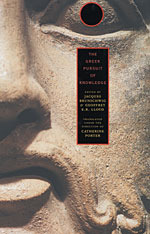
The_greek_pusuit_of_knowledge

http://www.hup.harvard.edu/catalog.php?recid=27712

This morning with Ms. Martins review fresh in my mind, I read it before turning out the light, I was reading Michael Frede’s entry, The Philosopher, in this indispensible compendium of essays, originally published in a large format hardback as Greek Thought, A Guide to Classical Knowledge and then two smaller easier to handle and read paperbacks. The excerpt that caught my attention is as follows:

“We learn from Stoic physics that the world is governed by an imminent divine rational principle that arranges the world down to the smallest detail so as to be a perfect world. We also know from Stoic physics that we are constructed in such a way as to be guided by reason toward the good, and that, hence, as part of our development, we have to acquire the approximate beliefs as to what is good, bad, or neither; what it is appropriate for us to do, if we are guided by a concern for the good; and how good action consists precisely in this, doing what is appropriate out of concern for the good.”

If I am willing to imagine myself to be follower of Rorty then I might say, in the spirit of generosity that is the guiding spirit of Rorty, as the philosophical successor of James, that we could view that immanent divine rational principle as Nature. Shorn of its divinity but a potent idea none the less.

I will confess that I only become a radical atheist, when confronted with the ideological intransigence and moral/ethical, not to speak political, surety of believers; who insist that all must live by their covenants, while living under the protection of a secular state that recognizes the rights of all religious citizens, to practice their faiths, unencumbered.

Stephen
Posted in Uncategorized | Leave a comment

The End of a Political Romance: David Brooks on Obamaism by Political Observer

http://www.nytimes.com/2011/09/20/opinion/brooks-obama-rejects-obamaism.html?_r=4&partner=rssnyt&emc=rss


 "I’m a sap, a specific kind of sap. I’m an Obama Sap.”

 It is a rather well worn rhetorical trope to make oneself the butt of one’s criticism of another by indirection. Mr. Brooks like so many others fails to make the critical distinction between the Rhetorical Obama and the Political Obama and how this very canny and adroit pragmatist works both sides of the political street; although he has managed to alienate his base and their hunger for the fulfillment of the promise of the Rhetorical Obama. But Mr. Brooks declares his disillusionment with the reassertion of the Rhetorical Obama, as opposed to the policies of the Political Obama, which remain monuments to a rather dull conservative political/economic ethos. In all this rhetorical chaff, one can see a shining core emerge out of this debris, of the self-proclaimed reasonableness of our writer, brought to this disappointing conclusion by certain facts, like the dishonesty of the President on the matter of taxing the rich. On which Mr. Brooks provides statistical data from the IRS. Mr. Brooks does not touch on the failure of Free Market Economics to deliver on its well advertised promises, he being one of its long time advocates.Nor on the continuing economic ramifications of the collapse of 2008.That might be a kind of honesty demanded by our present crisis but wholly beyond the reach of this political moralist. One final note, a quote from the essay is illustrative of two issues.

“Being a sap, I still believe that the president’s soul would like to do something about the country’s structural problems.”

He speaks first of President Obama’s soul which is a wholly irrelevant matter and perhaps could be  the subject  of a more deeply argued theological discussion, if one believes in a construct called soul. But here it is used pejoratively as pure condemnation of the self-willed forgetting of one of the cornerstones of Mr. Obama’s Christian faith, as interpreted by Mr. Brooks. As for structural problems one could conjecture that that could mean the final dismantling of what is left of the New Deal as unnecessary in the 21st Century, captained by Enlightened Conservatives like Mr. Brooks and his political fellow travelers.

Political Observer


Posted in Uncategorized | Leave a comment

Books of Interest: Descartes an Intellectual Biography by Stephen Gaukroger

Descartes_biography

Just rereading pages 340 to 343 on the cogito.

‘When someone says I am thinking therefore I am, or exist, he does not deduce existence from thought by means of a syllogism, but  recognizes it as something self-evident by a simple intuitus of the mind.”

Posted in Uncategorized | Leave a comment