https://www.youtube.com/watch?v=3d4ocWsS2Ww
Sep 07, 2025

Sep 06, 2025
Editor : It’s impossible to find out Kapadia net worth! *Should the American reader wonder at the why of this choise by The Economists? The Reader just needs to fosus on his opening paragraphs and his political persona of ‘Jerry’ !
WE’VE ALL been at a party with a well-meaning but exhausting guest; let’s call him Jerry. Jerry’s stories meander without a clear point. He equivocates, laments past failures, complains about the status quo and offers no solutions for the future. He talks without listening. Everyone feels for Jerry, but no one wants to be around him. The vibes give everyone the ick.
Jerry’s predicament is exactly the bind Democrats find themselves in. They have lost the thread, and it is showing; of the 30 states that track voter registrations by party, the Democrats have lost ground in every single one of them over the past four years, with a negative voter-registration swing of 4.5m.
…
Editor : ‘Jerry’ is an untouchable exspesssed as ‘ick’ , concocted by Kapadia as the would be springboard, for his maladriot political chatter from a man of not just means, but the of wealth, that is a well kept secret! Kapadia and his ilk share in there contempt for this self-serving construct of ‘Jerry’. That is freighted by his political bad judgement: Kapadia who lacks the retorical skill to bring ‘Jerry’ to life except as straw man!
…
Editor: the next two paragraphs awash in wan political cliches, fails to mention The Clinton’s as corrupt Neo-Liberal actors that distroyed Glass-Stegal, of Obama of ‘lets put this all behind us’ and Simpson-Bowles, and the feckless senile Joe Biden that ushered in the Trump second term! The Clintons made the Democrtic Party Neo-Liberal! Old Money Gavin Newsom, now tears down Homeless Encampments, instead of advocating for the Poor!
The party that once embodied American optimism now sounds perpetually pessimistic. Where Democrats once championed growth and possibility, they now focus on managing decline and redistributing scarcity. They have become the party that explains why things can’t be done rather than the party that gets things done. Worse, they’ve become hopelessly reactive, always responding to whatever Republicans do instead of charting their own course.
To get their aura back, the Democrats need to listen to a fresh crop of leaders. It isn’t that hard; at cocktail parties and in politics people gravitate towards authenticity, optimism and those who listen and show respect for others. People lean away from those who make excuses, complain and patronise them. If the Democrats can harness their dynamic young talent and offer common-sense solutions that help Americans get on top of their most important issues, the vibes will be immaculate.
Editor: That ‘dynamic young talent’ is headed by Gavin Newsom!
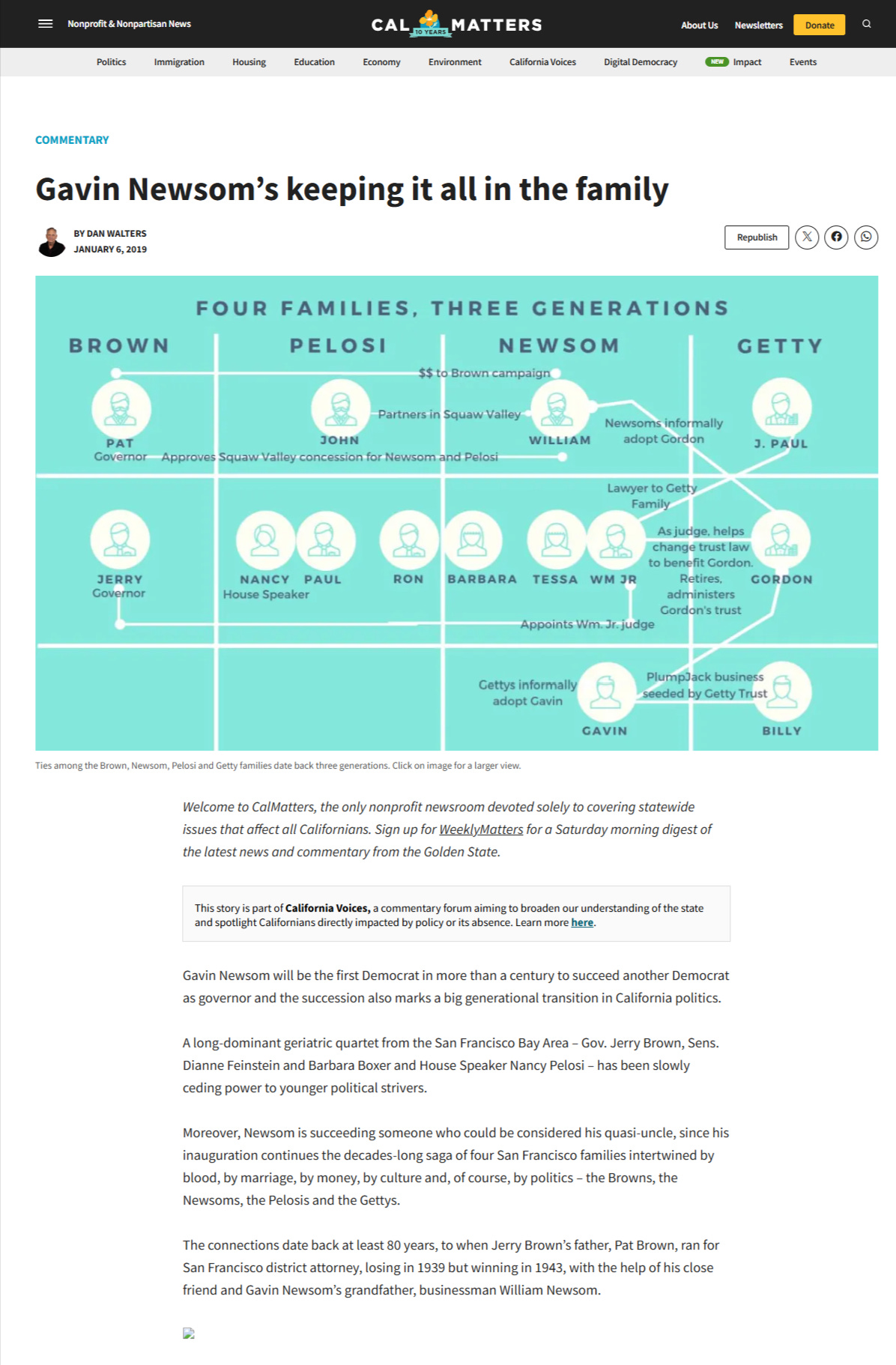
Editor: Here is Gaurav Kapadia summation: the reader is almost reminded of Ronald Regans stump speecheds of 1980 ?
Ronald Reagan’s 1980 Neshoba County Fair speech
…
I believe in states’ rights; I believe in people doing as much as they can for themselves at the community level and at the private level. And I believe that we’ve distorted the balance of our government today by giving powers that were never intended in the constitution to that federal establishment. And if I do get the job I’m looking for, I’m going to devote myself to trying to reorder those priorities and to restore to the states and local communities those functions which properly belong there.
…
https://neshobademocrat.com/stories/ronald-reagans-1980-neshoba-county-fair-speech
Americans want a party that believes the pie can grow bigger, not one that just argues about how to slice it smaller. This means getting stuff done: more homes built faster, more good jobs created, more paths to prosperity opened. Take housing. Young teachers can’t afford to live in the districts where they work. Nurses commute for two hours because homes near hospitals cost a fortune. Small-business owners can’t find workers because their employees can’t find places to live. Accepting the weaponisation of regulation by special interests in building housing and letting constituents fend for themselves has alienated voters. Democrats have let themselves get captured by every constituency except the most important one: people who need somewhere to live.
The same pattern crushes entrepreneurship. Lower-income workers and budding business-owners are being hobbled by conflicting and unreasonable rules and red tape. Hair-braiders in some states need 500 hours of training. New York City’s decade-long waiting lists for food-truck permits have created an illegal secondary market where aspiring vendors pay exorbitant rates to lease permits from existing holders. Democrats claim to champion the American Dream while making it harder to fulfil. When even democratic-socialist mayoral candidates call for slashing small-business regulations, maybe it’s time for the party to listen.
The required getting-things-done mindset extends beyond housing to every challenge Democrats claim to care about. Climate change? Stop blocking nuclear plants and transmission lines. Economic mobility? Cut the licensing requirements that keep people from starting businesses. Infrastructure? Build the roads and bridges instead of spending five years on environmental reviews for projects everyone agrees are needed.
Democrats need to embrace logical policies regardless of their source. If Republicans propose something that works, steal it and make it better. Immigration is a prime example. America’s asylum process is indeed broken; working across the aisle to fix it should be a priority. If business leaders identify regulatory barriers to job creation, fix them. If local mayors figure out how to cut permit times in half, scale their innovations nationally.
There are reasons for optimism. In Ohio, Democrat-led Cincinnati has pushed zoning reforms and set up a trust fund to make it easier for families to find affordable homes. In Maryland, a “Feds to Eds” programme helps ease teacher shortages by fast-tracking teaching licences for laid-off federal workers. Across the country, younger Democratic leaders are showing that efficiency, pragmatism and partnership with business can produce results.
Democrats have a choice: embrace the vanguard of leaders who make things work, or remain the party that excuses away why they don’t. Americans are exhausted by broken systems and frustrated by leaders who seem to ignore or misunderstand their complaints. They want less process and more progress.
The party that figures out how to be both principled and practical, both compassionate and competent, will own the next generation of American politics. The party that doesn’t will find itself exactly where Jerry always ends up: talking to an empty room while everyone else has moved on to better conversations.
Editor: Gaurav Kapadia leaves no political cliche at rest. Yet this Reader finds his essay that could have been recorded by a Dictaphone, and reviewed by his auditeor and finalized by Mr. Kapadia! This Reader finds Mr. Kapadia essay tepid at best!
American Reader.
*According to TipRandks Gaurav Kapadia net worth is $3.12B!

https://www.tipranks.com/experts/hedge-funds/gaurav-kapadia
American Reader.
Sep 06, 2025
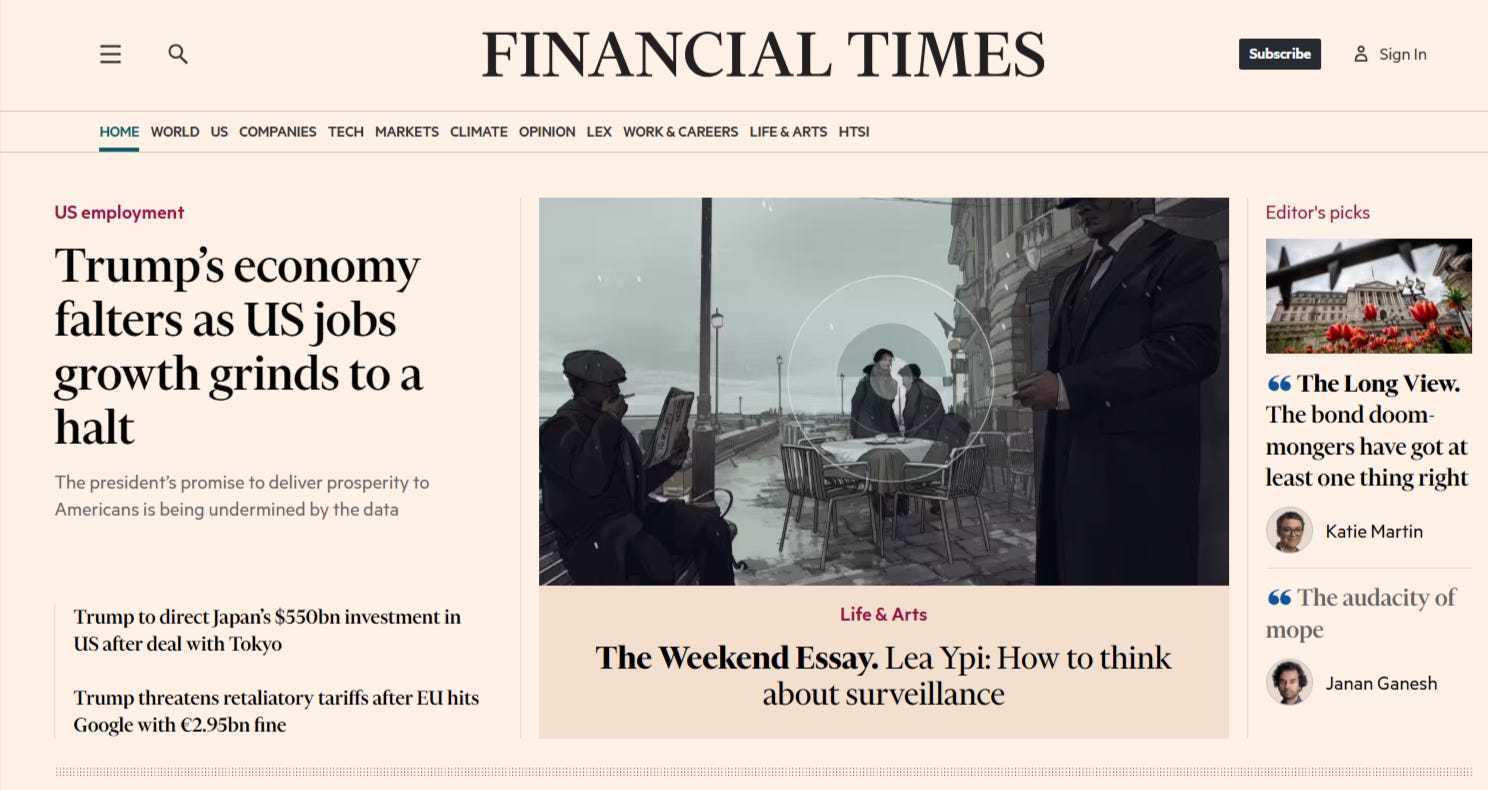
Sep 05, 2025
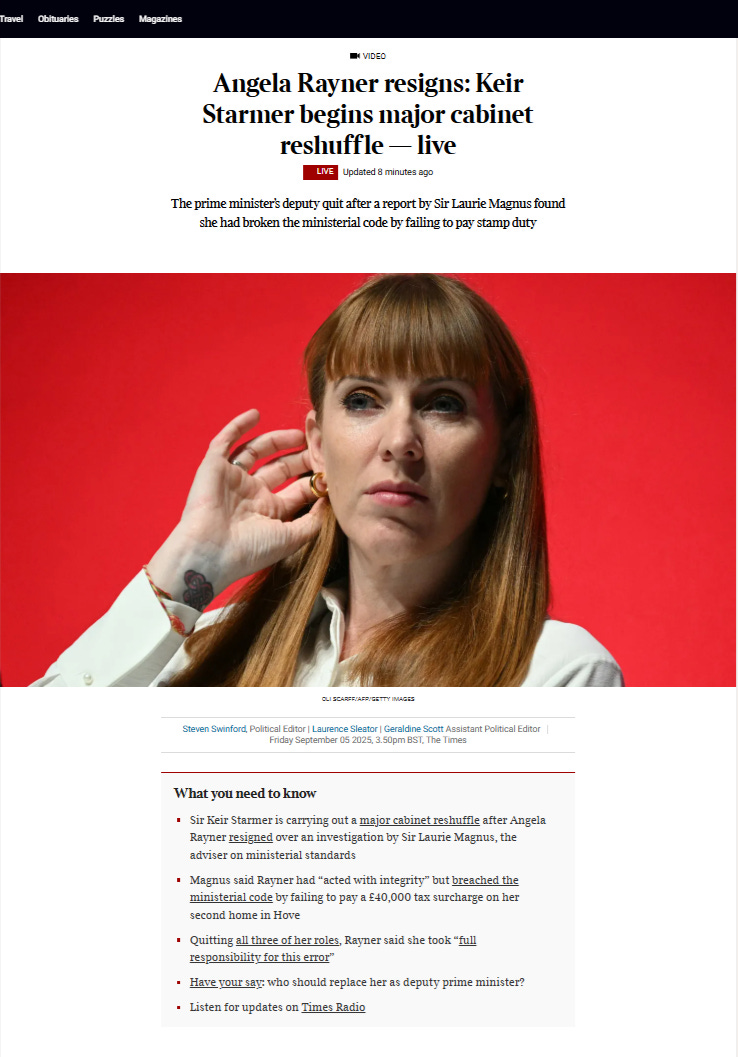
Read on, it just gets better!
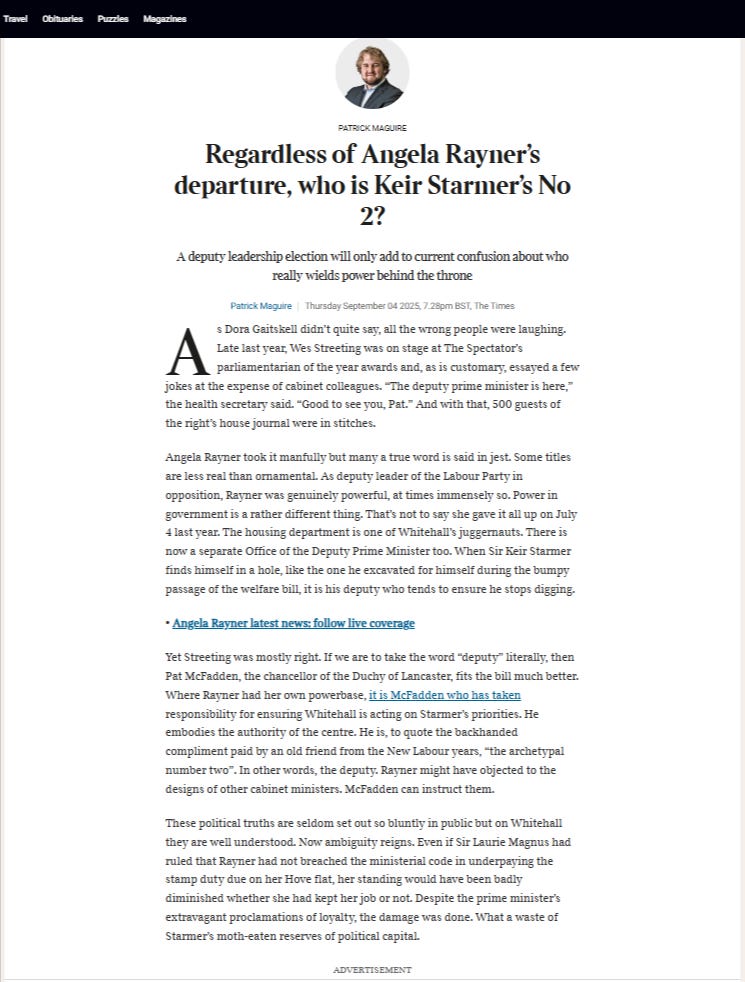
Yours,
A. O.
…
Were is Thatcherite Ghoul Robert Colvile?
And:
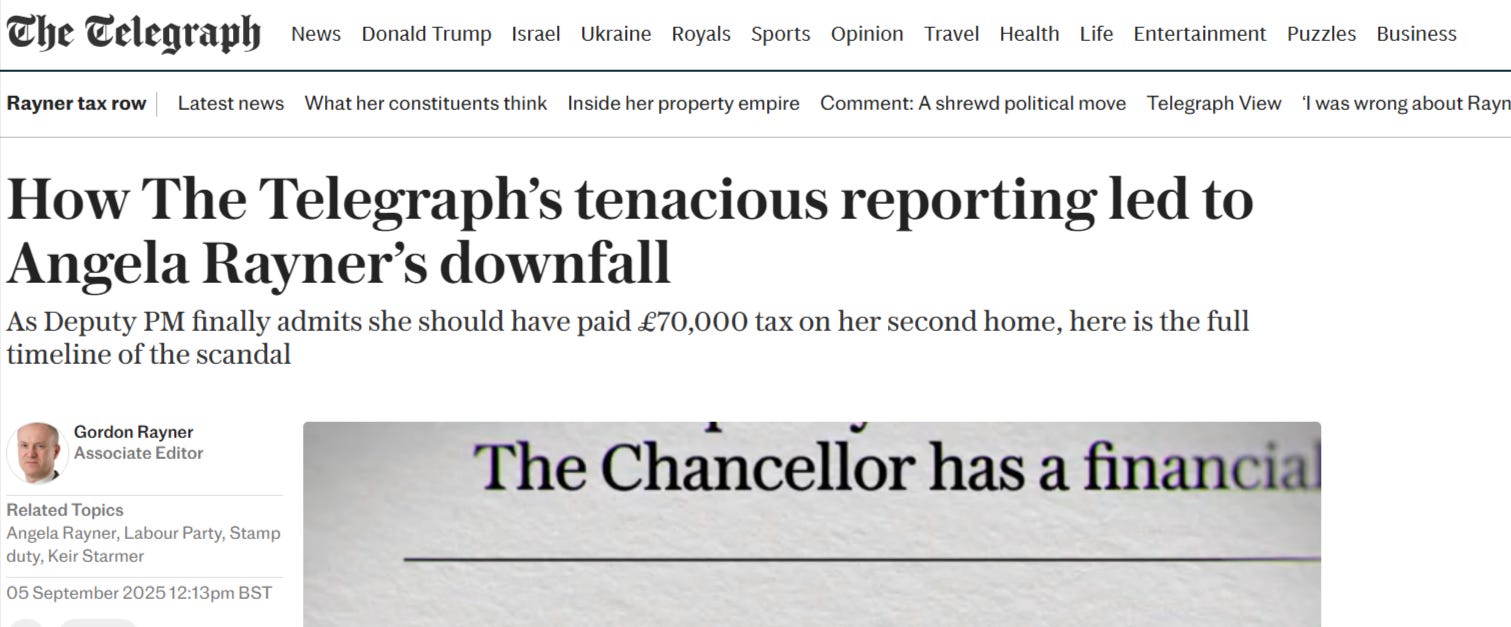
https://www.telegraph.co.uk/politics/2025/09/03/how-the-telegraph-exposed-rayner-tax-dodge/
Sep 04, 2025
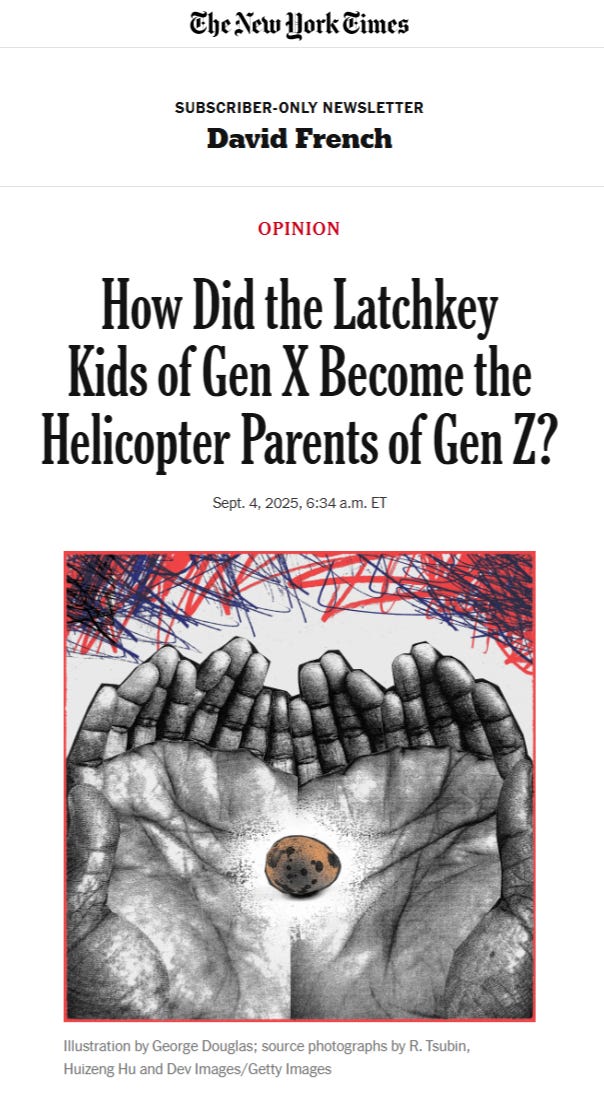
It’s early on a January morning in 1979, I’m 10 years old, and the adventure is about to begin.
My alarm jolts me awake. Snow is falling outside, and my mother tells me that school is canceled. We canceled school every time it snowed in Kentucky, and for me, that was always the best possible news. I grab my winter gear, scarf down some Cheerios, and then I’m off. “Bye, Mom,” I say. “I’m going to Brent’s house,” and that’s the last she sees of me for about 10 hours — until I’m home for family dinner.
The day starts with a pickup hockey game on a frozen pond in our neighborhood and then moves to snow football in Brent’s backyard. We play for hours, and we’re almost ready to go inside for some hot chocolate when we hear the ultimate siren song for a young boy’s brain — go-karts racing in an open field.
We run over and beg to take turns competing on a makeshift dirt track, driving as fast as we can for as long as we can. No one wears helmets. No adults are in sight. And then, with our fingers and toes so cold that we can barely feel them, we hobble back inside — just in time for dinner.
“How was your day?” my mother would ask. “Fun,” I’d respond, and I’d regale my family with tales of my athletic exploits. I’d smooth out the rough edges. I wouldn’t tell them about the minor fistfight over late tackles in the snow football game, or the fact that Jeff drove one of the go-karts into a tree (he was fine; there was only a little blood).
I’d end the day exhausted, happy — and praying fervently that the snow would keep falling. I lost our snow football game, and I needed to get my revenge.
…
French’s essay blossoms, like a thirty minute black and white television Family Comedy, via an esatz Sociological Study… Reader think of David Brooks ‘The Road to Character’ & ‘The Social Animal’ merde!
…
My memory tracks the story that Gen X likes to tell about itself. We’ve been called the least-parented generation in American history, with some justification. It’s not just that we were free-range kids — given permission to roam our neighborhoods at will. Then, independent childhoods were the norm. But we were also the first peacetime generation that grew up with two working parents as a normal part of life, and we were the first generation to live with the consequences of widespread divorce and single parenting, which at that time meant almost entirely single mothers.
In other words, we weren’t experiencing fantastic adventures as much as many of us were experiencing loneliness and abandonment. All across America, young kids would get off their school buses, unlock their houses and fend for themselves for hour after hour, until Mom or Dad came home from work. We were, in the phrase that launched a thousand newsweekly covers, latchkey kids.
My parents exerted tremendous efforts to make sure that one of them was home when my sister and I came home from school, so my latchkey experience is measured in weeks and months, not years, like it was for many of my friends.
For me, the experience was benign, fun even. I was too much of a rule-following nerd to get into real trouble. So my life during those afternoons after school mainly consisted of challenging my neighbor Rob to chess matches and one-on-one basketball games.
…
Editor : Reader prepare yourself for an avilanch of 1548 words, even Newton’s third law of motion is dragooned! Mr. French’s ‘essay’ is deserving of a stinging retorical brevity!
Political Observer.
Editor: In lieu of actual Sociology, Mr. French engages in a New York Times version, pionered by David Brooks? Not to forget that French trades in the territory of Philip Wylie of another time, place and discusive framing, that puts the blame Generationaly, rather than on ‘Momism’. The Reader might ask is there a propinquity?
The Man Who Hated Moms: Looking Back on Philip Wylie’s “Generation of Vipers”
Wylie’s moms were middle-aged and menopausal Cinderellas, hirsute and devoid of sex appeal.
By Peter L. WinklerAugust 13, 2021
…
Generation of Vipers (whose full title is Generation of Vipers: A Survey of Moral Want • A Philosophical Discourse suitable only for the Strong • A Study of American Types and Archetypes • And A Signpost on the two Thoroughfares of Man: the Dolorosa and the Descensus Averno • Together with sundry Preachments, Epithets, Modal Adventures, Political Impertinences, Allegories, Aspirations, Visions and Jokes as well as certain Homely Hints for the care of the Human Soul) sold terrifically when it hit bookstores in January 1943, thanks to the endorsement given it the week before publication by popular columnist Walter Winchell. The first printing of 4,000 copies sold out in a week, and the book just kept selling. Vipers went through 11 printings in 1943 alone and went on to sell 180,000 copies in hardcover by 1954. In 1950, the American Library Association named Generation of Vipers one of the 50 most influential and important books of the last 50 years.
“Mom,” Wylie begins the chapter “Common Women,” “is an American creation. Her elaboration was necessary because she was launched as Cinderella.” Here Wylie refers to an earlier chapter in which he explained how American women were inculcated in a distorted version of the fairy tale that conditioned them to expect material wealth, not because of virtuous activities but merely because they were female. “The idea women have that life is marshmallows which will come as a gift — an idea promulgated by every medium and many an advertisement — has defeated half the husbands in America,” Wylie wrote. “It has made at least half our homes into centers of disillusionment. […] It long ago became associated with the notion that the bearing of children was such an unnatural and hideous ordeal that the mere act entitled women to respite from all other physical and social responsibility.” He went on:
Past generations of men have accorded to their mothers, as a rule, only such honors as they earned by meritorious action in their individual daily lives. Filial duty was recognized by many sorts of civilizations and loyalty to it has been highly regarded among most peoples. But I cannot think, offhand, of any civilization except ours in which an entire division of living men has been used, during wartime, or at any time, to spell out the word “mom” on a drill field, or to perform any equivalent act.
This was an example of the sort of “Megaloid” mom worship that Wylie dubbed “Momism.”
…
Editor: The Discursive Generational Framing.
Greatest Generation (1901-1927), the Silent Generation (1928-1945), Baby Boomers (1946-1964), Generation X (1965-1980), Millennials (1981-1996), Generation Z (1997-2012), and Generation Alpha (2013-present).
Political Observer.
Sep 02, 2025
Is the Right Choice a Good Bargain?
Despite all the arguments of Sunstein and Thaler, Sunstein and Hastie, and Sunstein solo, there is still a lot of room for partisan politics. I mean that to include deliberation—which is necessary in a democracy despite the risks of impulsive thinking, mental shortcuts, cascades, and conformity—but not to stop there. For the truth is that much of our political life is not deliberative at all, not, at least, in the sense of a deliberation aiming at a “right decision.” There is also bargaining, which may produce a compromise between two positions, one of which we think right and the other wrong, and even between positions that are, both of them, “right.” And then there is everything that comes under the heading of “political action”: organizing, campaigning, agitating, demonstrating—for all these are also central to democratic decision-making.
Political action is necessary because many people are missing from the group decision-making described in Wiser. Sunstein and Hastie report that low-status members of the research groups, and also of many real groups, commonly defer to high-status members. This assumes that the low-status members are in the room, but the truth is that very often they aren’t. One of the reasons that group decision- making goes wrong is that the people most affected by the decisions aren’t participating in the deliberations.
Wiser has a brief discussion of “asking the public”—but only to comment, not to join in the actual business of deciding. And yet the conditions of both powerlessness and inequality may be more important than the problems associated with groupthink. They are certainly a central source of “partisan divides.” Organizing, agitating, demonstrating—these are ways of bringing the powerless to the attention of the powerful. They can contribute importantly to democratic decisions, even if they seem nondeliberative, even if the shouting in the street sounds like, and probably is, the product of emotive System 1 thinking.
Sunstein himself is clearly an advocate of greater equality. Years ago he published a book praising President Roosevelt’s 1944 State of the Union address, in which FDR called for a radically redistributive “second bill of rights.”
But in the books considered here, he and his coauthors don’t recall FDR’s famous response to people who urged him actively to promote a redistributive program: “Make me.” Government agencies will make better decisions, at least on such questions as greater equality, if they feel political pressure from outside the room.
Sometimes we will want the people outside the room actually to win—to organize and agitate so successfully that they take over the small groups who dominate decision-making, with the result that they change the political conversation. We may think that their view is right, even if no one has “rigged” the choices. But in fact, all political choices are shaded by our uncertainties, our knowledge of past mistakes, and, in the best of cases, our respect for the people who disagree with us. So, yes, we need to be wiser in the ways described by Sunstein and Hastie; but we also need a radically different kind of decision-making than what they describe, involving a larger number of people inside and outside the rooms where small groups sit.
Read these books; there is much to learn from them. And then pick up Machiavelli, and then Marx.
Is the Right Choice a Good Bargain? from the March 5, 2015 issue
To the Editors:
In “Is the Right Choice a Good Bargain?” [NYR, March 5], Michael Walzer asserts that “statistical groups do especially well in answering factual questions,” and refers to an article of Francis Galton (“Vox Populi,” Nature, March 7, 1907) to support the claim. The phrase Walzer puts in quotes—“The ox weighed 1,198 pounds; the average estimate…was 1,197 pounds, more accurate than any individual’s guess”—is nowhere to be found and completely subverts Galton’s main point.
Galton didn’t even bother to compute the average of the 787 contestants who tried to estimate the weight of the ox: he picked out the “middlemost” estimate. One week earlier (“One Vote, One Value,” Nature, February 28, 1907) he had written:
How can the right conclusion be reached…? That conclusion is clearly not the average of all the estimates, which would give a voting power to “cranks” in proportion to their crankiness…. I wish to point out that the estimate to which least objection can be raised is the middlemost estimate, the number of votes that it is too high being exactly balanced by the number of votes that it is too low.
This does not in the least deny Walzer’s assertion, but has enormous importance in determining collective decisions.
Michel Balinski
Directeur de recherche de classe
exceptionnelle (emeritus)
CNRS and École Polytechnique
Paris, France
Is the Right Choice a Good Bargain? from the March 5, 2015 issue
To the Editors:
Michael Walzer [“Is the Right Choice a Good Bargain?,” NYR, March 5] points to a central problem with Cass Sunstein’s perspective: the assumption that what is needed is to improve procedures of group decision-making in order to increase the likelihood of making “right” choices about ends, which are conceived as givens. This is technical rationality, which holds ends to be fixed and concentrates on efficiency of means. As Walzer observes, Sunstein misses the larger, and more important, questions of real politics in which ends themselves are subject to an ongoing process of negotiation, debate, and reformulation. Yet Walzer himself also conceives of change-oriented, citizen-involving politics as targeting institutions more than transforming them. To address the problems of politics in today’s world we need more than agitation from outside institutional life, the “system world” in the language of Jürgen Habermas, long a theoretical reference point for Sunstein.
Sunstein, like Habermas and many others, sees major institutions as largely fixed and unchangeable, not subject to democratizing change. This assumption generates fatalism, which has shrunk our imaginations about decision-making, politics, and democracy itself. The challenge is to recognize that institutions of all kinds are human creations that in turn can be recreated, reconnected to questions of civic and democratic purpose. For this task we need to bring in Max Weber as well as Machiavelli and Marx. Weber described the “iron cage” that results from technical rationality. In his essay “The Profession and the Vocation of Politics,” Weber also evocatively termed the pattern “the polar night of icy darkness.” Thawing the polar night is a frontier of democracy in the twenty-first century.
Harry Boyte, Augsburg College, St. Paul, Minnesota; Albert Dzur, Bowling Green University, Bowling Green, Ohio; Peter Levine, Jonathan M. Tisch College of Citizenship and Public Service, Tufts University, Medford, Massachusetts
I certainly agree, and so would Sunstein and Reid Hastie, that it’s a good idea to read Max Weber; and I also agree, and so would they, that political and economic institutions are human creations. As they were formed, so they can be reformed and transformed. Since Professors Boyte, Dzur, and Levine don’t tell us which institutions they want to transform, I can’t say whether I am ready to join them. Meanwhile, important decisions are still being made inside institutions, like the US Congress and its committees, for example, or inside the White House, and I can’t see what is wrong with trying to influence those decisions to make them more serviceable to ordinary Americans. I don’t think that will happen, or happen in significant ways, until those ordinary Americans organize themselves to bring pressure on the institutional decisions-makers. These writers want something more than that, but that much, these days, would be well worth celebrating.
StephenKMackSD
Sep 02, 2025
Headline: Cass Sunstein on What Lefty College Kids Get Wrong, the Dangers of Trump and His Own Regrets
Sub-headline: In a new book, the longtime legal scholar offers a defense of liberalism from its critics on both the right and the left.
https://www.politico.com/news/magazine/2025/08/30/cass-sunstein-book-liberalism-interview-00535620
…
Ankush Khardori is a senior writer for POLITICO Magazine and a former federal prosecutor at the Department of Justice. His column, Rules of Law, offers an unvarnished look at national legal affairs and the political dimensions of the law at a moment when the two are inextricably linked.
…
Cass Sunstein, a legal scholar with a new book in defense of liberalism, served as C Here he poses for a photo near the White House on March 16, 2011. | AP
Editor: I recall when Mr. Sunstein set a letter to my address that contained two one dollar bills ! He was director of the Office of Information and Regulatory Affairs in the waining days of Obama administration, and like Bush The Elder, he lacked any acquaintanceship with the lives of ordinary citizens. Two dollars tips belong in the Depression Era, or its sucessor the Neo-Liberal collapse of 2007-2008’! I sent the two dollers back! Reader note that Cass Sunstein and Ankush Khardori share in the rerified air of a practiced political confomity!
…
Ankush Khardori opines:
Liberalism is under unprecedented attack in the United States. Not liberalism as in the ideology typically associated with the Democratic Party, but the broad and complex constellation of political commitments and aspirations that include respect for individual rights, pluralism and the rule of law, which have long been the foundation of American society.
The threat isn’t new, and it hasn’t just been coming from President Donald Trump or the political right. Prominent figures and thinkers on the left have tried to restrict free speech and enforce ideological conformity.
In a new book to be released on Tuesday, Cass Sunstein, a prolific legal scholar and high-level official in the Barack Obama and Joe Biden administrations, mounts a stirring intellectual defense of liberalism from its critics across the political spectrum. On Liberalism: In Defense of Freedom draws on — and ties together — the work of thinkers like John Stuart Mill and Friedrich Hayek, and it argues that they operate in a similar, broad tradition of liberalism that is in desperate need of revitalization.
In a wide-ranging interview about the book, we discussed why he wrote it and what he sees as some of the most pressing contemporary pressures on the liberal tradition both in the United States and abroad.
“There’s something about the idea of someone who’s in charge, who says ‘Fuck you’ and won’t take any shit,” he said at one point. “That resonates.”
We also touched on the Supreme Court, the state of the legal academy, his biggest regrets from his time in government, and, of course, Prince and Star Wars.
This book began with a guest essay that you wrote for the New York Times back in 2023 that provides a numbered list of propositions or claims that you associate with liberalism. You say that the response to that essay spurred you to write the book. What did you hear, and what do you want to accomplish?
Editor:
Ankush asks:
I’m going to start with a deceptively simple question. In 2025, what is liberalism to you?
Sunstein answers:
Liberalism is a set of commitments to freedom, pluralism, the rule of law, respect for individual autonomy, and security and self-government. Those are the ideals that liberalism represents.
Ankush asks:
So you view this as an intellectual project that can bring in people from across the political spectrum.
Sunstein answers:
I almost called the book Big Tent Liberalism, and I have a little bit of regret that I didn’t.
…
Editor: Reader spare yourself the the trouble of reading the Ankush & Sunstein self-congratulatory chatter , by going to the New York Times of Nov. 20, 2023 , which offers a predigested 34 part condensation, of this Politico Diatribe and its auteur, and fellow traveler Ankush Khardori!
Editor: Reader here from October 9, 2014 is Jeremy Waldron’s eviseration of Mr. Sunstein, and his telling reply , to Sunstein’s comment.
It’s All for Your Own Good
Jeremy Waldron
‘Why Nudge?’ by Cass Sunstein
In their book Nudge, Richard Thaler and Cass Sunstein considered the choices made by ordinary people about their retirement.
Many employees have the opportunity to enroll in a 401(k) plan, in which their contributions will be sheltered from taxes and to which their employer will also contribute. But a considerable number of people do not choose to enroll in a 401(k) plan and of those who do, many select levels of contribution that are far below what would be most advantageous to them. Why? Probably because of inertia. It is easier not to make a decision than go to the trouble of calculating an optimal contribution
Employers sometimes try to educate people to make better choices, offering them retirement-planning seminars, for example. But the lessons of these seminars are soon forgotten: “Employees often leave educational seminars excited about saving more but then fail to follow through on their plans.” And so Sunstein and Thaler suggested a different strategy. Instead of teaching people to overcome their inertia, we might take advantage of their inertia to solve the problem. Suppose we arrange things so that enrollment at some appropriate level of contribution is the default position—the position that obtains if the employee does nothing. Something has to be the default position; why not make it the position that accrues most to the employee’s benefit, “using inertia to increase savings rather than prevent savings”?
Resetting the default position this way is what Thaler and Sunstein call a “nudge.” It exploits the structure of the choice to encourage a more desirable option. The decision is not taken entirely out of the employee’s hands. She can still change it and revert to a strategy of no contributions or diminished contributions to her retirement funds. But in that case she has to make an effort; this is where she has to overcome her inertia.
Nudging is an attractive strategy. People are faced with choices all the time, from products to pensions, from vacations to voting, from requests for charity to ordering meals in a restaurant, and many of these choices have to be made quickly or life would be overwhelming. For most cases the sensible thing is not to agonize but to use a rule of thumb—a heuristic is the technical term—to make the decision quickly. “If it ain’t broke don’t fix it,” “Choose a round number,” “Always order the special,” and “Vote the party line” are all heuristics. But the ones people use are good for some decisions and not others, and they have evolved over a series of past situations that may or may not resemble the important choices people currently face.
Now, every decision we face presents its own “choice architecture,” in which the possibilities we have to choose from are arrayed in a certain order. Some make themselves clamorously known; others have to be unearthed. There may be limited time to make a choice and then some possibilities expire. Or if nothing is done, something may still come to pass: there are default options (as opposed to possibilities a person has to positively choose). There is no getting away from this: choices are always going to be structured in some manner, whether it’s deliberately designed or happens at random.
Nudging is about the self-conscious design of choice architecture. Put a certain choice architecture together with a certain heuristic and you will get a certain outcome. That’s the basic equation. So, if you want a person to reach a desirable outcome and you can’t change the heuristic she’s following, then you have to meddle with the choice architecture, setting up one that when matched with the given heuristic delivers the desirable outcome. That’s what we do when we nudge.
All of this sounds like a marketer’s dream, and I will say something about its abusive possibilities later. But Sunstein and Thaler have in mind that governments might do this in a way that promotes the interests of their citizens. Governments might also encourage businesses and employers to use it in the interests of their customers and employees. The result would be a sort of soft paternalism: paternalism without the constraint; a nudge rather than a shove; doing for people what they would do for themselves if they had more time or greater ability to pick out the better choice.
…
Cass R. Sunstein, reply by Jeremy Waldron
On freedom of choice, autonomy, and dignity
It’s All for Your Own Good from the October 9, 2014 issue
To the Editors:
I am most grateful to Jeremy Waldron for his generous and clear-headed review of my books Why Nudge? The Politics of Libertarian Paternalism and Conspiracy Theories and Other Dangerous Ideas [NYR, October 9]. Waldron worries that nudging poses a risk to autonomy and dignity, but it is important to see that nudges are meant to promote both of those values. Disclosure of relevant information (about the terms of a school loan or a mortgage, for example) is hardly a threat to human dignity. When people are asked what they would like to choose, their autonomy is enhanced, not undermined. (Active choosing is a prime nudge.) A GPS certainly nudges, but it does not compromise what Waldron favors, which is “a steadfast commitment to self-respect.” Waldron is right to worry about the risk of manipulation, but the whole idea of nudging is designed to preserve freedom of choice, and in that sense both autonomy and dignity.
Cass R. Sunstein
Robert Walmsley University Professor
Harvard University
Cambridge, Massachusetts
I appreciate this clarification. Many nudges simply involve an improvement of the decision-making environment and of the information available to choosers. Professor Sunstein is right that there can be no objection to that. But in his book, the term “nudge” also comprises attempts to manipulate people behind their backs, using their own defective decision-making to privilege outcomes that we think they ought to value. I think both of us should be concerned about that and about a world in which that more sinister sense of nudging becomes a widespread instrument of public policy.
Old Socialist.
Added 9/3/2025.
Editor: Here is Steven Poole, who offers a telling critique of professional Technocrat Cass Sunstein, of Thu 20 May 2021 02.30 EDT : Reader take the time to explore the full range of Mr. Poole’s evisertion of this Technocrat! I’ll just post the final paragraphs of Steven Poole’s epic eviseration of this Techno!
Headline : Liars by Cass R Sunstein review – in search of the ‘optimal chill’
Sub-headline:Who should regulate false information? A ‘nudge’ expert and former adviser to Barack Obama takes on free speech.
…
So if it’s to be the government’s job to regulate lies, what happens when that power rests in the hands of a lying government? Yes, it’s the old quis custodiet ipsos custodes question, which applies just as much to the social media giants whom Sunstein praises in this book for their “inventive” approach to the problem, such as tagging dubious statements with “get the facts” and so forth. But who is accountable when Twitter decides to suppress links, as it did last October, to a New York Post story about Hunter Bide ? In a recent financial statement, though not in this book, Sunstein discloses having done consulting work for Facebook and Apple, so he is perhaps inclined to take a friendly view.
The formula Sunstein arduously arrives at for his new regulatory scheme is as follows: “False statements are constitutionally protected unless the government can show that they threaten to cause serious harm that cannot be avoided through a more speech-protective route.” But this is precisely what autocrats such as Viktor Orbán and Vladimir Putin claim they are showing when they shut down dissent. We could have a law, Sunstein also suggests, “that speakers may be fined for knowingly spreading lies about candidates for public office”, as though such power could never be abused.
In Sunstein’s world, though, such powers will never be abused (perhaps because of magic democracy), and instead will regulate speech smoothly for everyone’s increased benefit. What shall we call the new government department responsible for such regulation? If only “the Ministry of Truth” didn’t have such unfortunate connotations. Don’t sweat the details, though. “The only question is whether it is possible to administer such a system,” Sunstein writes. “The best answer is that when there is a will, there is a way.”
This isn’t an answer but merely a hand-waving hope, quite apart from the general rule that when you see an American popular nonfiction writer claiming to identify “the best answer” to something, you should check your wallet again. Happily, at least, the best answer to the Covid-19 pandemic wasn’t, in fact, to lecture people about their cognitive failures to understand probability, but more along the lines of what celebrated legal scholar Sunstein told the trusting readers of Bloomberg News less than a month later: that lockdowns actually work.
Old Socialist.
Aug 31, 2025
Mr. Freedland is a notorious political opportunist, so the predations of Trump and his political minions, are the perfect opportunity to draw attention away form the Gaza Genocide, and the arrest of British Citizens for vocal dissents against the Zionist Faschist States crimes!
Headline: Step back and take it in: the US is entering full authoritarian mode
Sub-headline: Trump’s dictator-like behaviour is so brazen, so blatant, that paradoxically, we discount it. But now it’s time to call it what it is
https://www.theguardian.com/commentisfree/2025/aug/29/us-authoritarian-donald-trump-national-guard
Editor: Freedland wallows in the crimes of Trump, as British Dissenters are put in jail cells without legal recourse!
…
Of course, the greatest check on Trump would come from the opposition winning power in a democratic election, specifically Democrats taking control of the House of Representatives in November 2026. Trump is working hard to make that impossible: witness this month’s unabashed gerrymander in Texas, where at Trump’s command, Republicans redrew congressional boundaries to give themselves five more safe seats in the House. Trump wants more states to follow Texas’s lead, because a Democratic-controlled House would have powers of scrutiny that he rightly fears.
Meanwhile, apparently prompted by his meeting with Vladimir Putin, he is once again at war against postal voting, baselessly decrying it as fraudulent, while also demanding a new census that would exclude undocumented migrants – moves that will either help Republicans win in 2026 or else enable him to argue that a Democratic victory was illegitimate and should be overturned.
In that same spirit, the Trump White House now argues that, in effect, only one party should be allowed to exercise power in the US. How else to read the words of key Trump adviser Stephen Miller, who this week told Fox News that “The Democrat party is not a political party; it is a domestic extremist organisation.”
It’s the same picture on every front, whether it’s plans for a new military parade in Trump’s honour or the firing of health officials who insist on putting science ahead of political loyalty. He is bent on amassing power to himself and being seen to amass power to himself, even if that means departing from economic conservative orthodoxy to have the federal government take a stake in hitherto private companies. He wants to rule over every aspect of US life. As Trump himself said this week, “A lot of people are saying, ‘Maybe we’d like a dictator.’” The former Obama adviser David Axelrod is not alone when he says, “We have gone from zero to Hungary faster than I ever imagined.”
The trouble is, people still don’t talk about it the way they talk about Hungary, not inside the US and not outside it. That’s partly the It Can’t Happen Here mindset, partly a reluctance to accept a reality that would require, of foreign governments especially, a rethink of almost everything. If the US is on its way to autocracy, in a condition scholars might call “unconsolidated authoritarianism”, then that changes Britain’s entire strategic position, its place in the world, which for 80 years has been predicated on the notion of a west led by a stable, democratic US. The same goes for the EU. Far easier to carry on, either pretending that the transformation of the US is not, in fact, as severe as it is, or that normal service will resume shortly. But the world’s leaders, like US citizens, cannot ignore the evidence indefinitely. To adapt the title of that long-ago novel, it can happen here – and it is.
Editor: Recall Freedland’s from Fri 18 Mar 2016 16.09 EDT?
Headline: Labour and the left have an antisemitism problem.
Sub-headline: Under Jeremy Corbyn the party has attracted many activists with views hostile to Jews. Its leaders must see why this matters
https://www.theguardian.com/commentisfree/2016/mar/18/labour-antisemitism-jews-jeremy-corbyn
…
Editor: the final paragraphs of Freedland’s diatribe:
But Zionism, as commonly used in angry left rhetoric, is rarely that historically precise. It has blended with another meaning, used as a codeword that bridges from Israel to the wider Jewish world, hinting at the age-old, antisemitic notion of a shadowy, global power, operating behind the scenes. For clarity’s sake, if you want to attack the Israeli government, the 50-year occupation or hawkish ultra-nationalism, then use those terms: they carry much less baggage.
To state the obvious, criticism of Israel and Zionism is not necessarily anti-Jewish: that’s why there are so many Jewish critics of Israel, inside and outside the country. But it doesn’t take a professor of logic to know that just because x is not always y, it does not follow that x can never be y. Of course opposition to Israel is not always antisemitic. But that does not mean that it is never and can never be antisemitic. As Downing and Kirby have helpfully illustrated.
I hope that, as a result, many on the left will pause next time Jews raise the alarm about antisemitism. I hope they’ll remember that, while most anti-Israel activists are acting in good faith, some are motivated more darkly, while others carelessly express their opposition to Israel in language or imagery that has a melancholy history.
There’s a deeper reason to pause. Many good people on the left want to make things neat and simple by saying that Israel and Zionism have nothing to do with Jews or Judaism. That they can deplore the former even while they protect and show solidarity with the latter. But it’s not quite as easy as that.
While many Jews – especially in conversations with each other – condemn Israeli government policy going back many years, they do identify strongly with Israel and its people. A recent survey found that 93% of British Jews said Israel formed some part of their identity. Through ties of family or history, they are bound up with it. When Jews pray they face east – towards Jerusalem. And they have done that for 2,000 years.
It’s inconvenient, I know, but that needs to be remembered by those who insist that there’s no connection between Israel and Jews, that it’s perfectly possible to loathe everything about Israel – the world’s only Jewish country – without showing any hostility to Jews.
Jews themselves usually don’t see it, or experience it, that way. That doesn’t mean no one should ever criticise Israel, for fear of treading on Jewish sensitivities. Of course it doesn’t. But it does mean that many Jews worry when they see a part of the left whose hatred of Israel is so intense, unmatched by the animus directed at any other state.
They wonder why the same degree of passion – the same willingness to take to the streets, to tweet night and day – is not stirred by, say, Russia, whose bombing of Syria killed at least 1,700 civilians; or the Assad regime itself, which has taken hundreds of thousands of Arab lives. They ask themselves, what exactly is it about the world’s only Jewish country that convinces its loudest opponents it represents a malignancy greater than any other on the planet?
Which brings us to Jeremy Corbyn. No one accuses him of being an antisemite. But many Jews do worry that his past instinct, when faced with potential allies whom he deemed sound on Palestine, was to overlook whatever nastiness they might have uttered about Jews, even when that extended to Holocaust denial or the blood libel – the medieval calumny that Jews baked bread using the blood of gentile children. (To be specific: Corbyn was a long-time backer of a pro-Palestinian group founded by Paul Eisen, attending its 2013 event even after Eisen had outed himself as a Holocaust denier years earlier. Similarly, Corbyn praised Islamist leader Sheikh Raed Salah even though, as a British court confirmed, Salah had deployed the blood libel.)
Thanks to Corbyn, the Labour party is expanding, attracting many leftists who would previously have rejected it or been rejected by it. Among those are people with hostile views of Jews. Two of them have been kicked out, but only after they had first been readmitted and once their cases attracted unwelcome external scrutiny.
The question for Labour now is whether any of this matters. To those at the top, maybe it doesn’t. But it feels like a painful loss to a small community that once looked to Labour as its natural home – and which is fast reaching the glum conclusion that Labour has become a cold house for Jews.
…
Mr. Freedland and his cadre of Zionist Shills defamed Corbyn, and his maufactured crimes- the whole respectable British Class were united in the defamation of Corbyn. Even such Literary Luminaries, such as the foremost T.S. Eliot critic Anthony Julius whose ‘T.S. Eliot, and-Antisemitism ,and literary form’ were the fellow travelers of Freedland!
American Observer.
Aug 30, 2025
Editor: ‘The Bagehot’ of August 20, 2025:
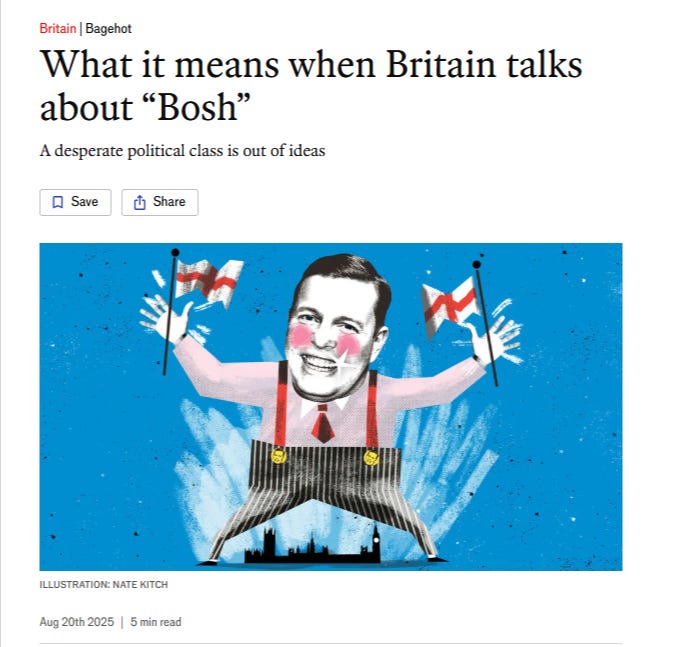
https://www.economist.com/britain/2025/08/20/what-it-means-when-britain-talks-about-bosh
The Reader might wonder about the books he published:
Lombard Street: A Description of the Money Market by Walter Bagehot
The English Constitution by Walter Bagehot
“Physics and Politics, or, Thoughts on the Application of the Principles of ‘Natural Selection’ and ‘Inheritance’ to Political Society”
Editor: Walter Bagehot could never be considered a satirist, yet in the hands of the present day Economist writer, Duncan Robinson mocks the Great Man!
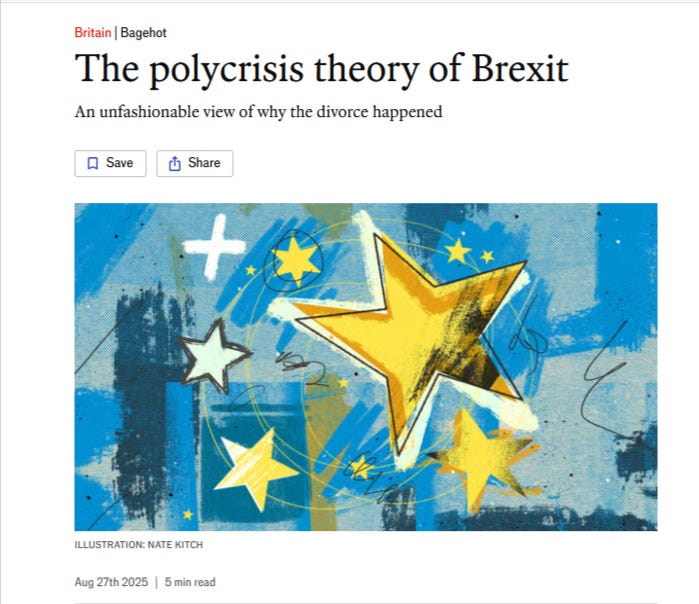
https://www.economist.com/britain/2025/08/27/the-polycrisis-theory-of-brexit
Editor : Duncan Robinson in a ‘serious mood’, postulates ‘the polycrisis theory of brexit!’ in two short paragraphs
Parliament has lost interest, but Britons still devour books about Brexit. Those books tend to belong to one of two schools. One is the Great Man—or rather, inadequate boys—theory of history, exemplified by “All Out War”, by Tim Shipman. It argues that the divorce was propelled by the betrayals, blunders and petty feuds at the court of David Cameron, whose campaign was hopelessly focused on warning of economic disaster.
A second school takes the long view. In “Between The Waves”, a rich and incisive new history of British Euroscepticism to be published next month, Tom McTague begins the journey with Enoch Powell, a Tory imperialist, driving through the Algerian desert in 1943. From the very birth of the European project, he argues, the British dilemma between sovereignty outside the club or influence within it was acute. The break of 2016, if not inevitable, was foretold many times.
Editor: Duncan Robinson:
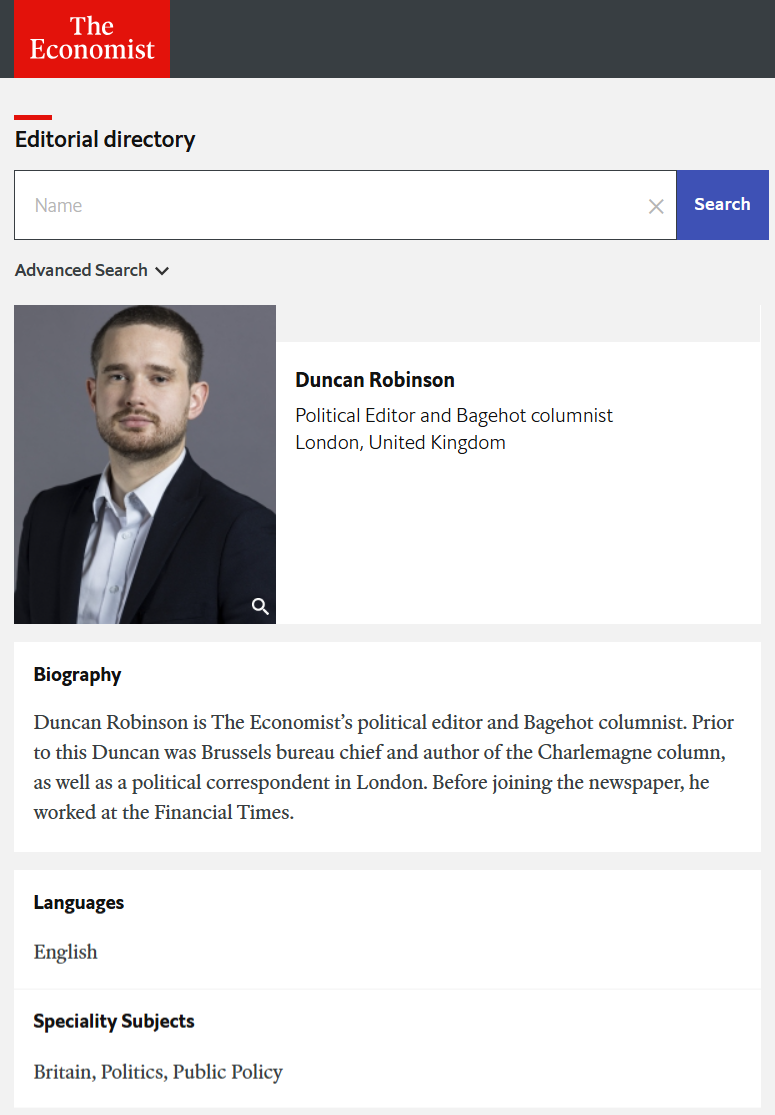
Robinson in the guise of Walter Bagehot, in his first two paragraphs fails to mention Bernard Connolly’s ‘The Rotten Heart of Europe’ in its 2012 edition:
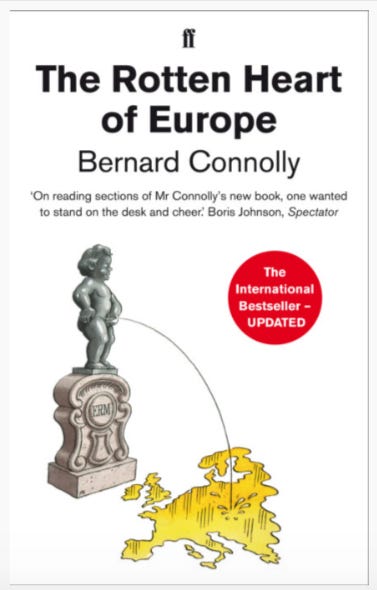
Bernard Connolly’s 400 page History is indictive of the inability of the Eurocratic clique, to let go of the tattered remaines of the legacy of Jean Monnet, and the Coal and Steel Cartel that metatisised into the Bankrupt E.U. of the current political moment! With Ukraine about to topple, and Ursula von der Leyen with her loyalists Macron, Starmer, Merz promising weapons not yet in production. What is the reader to think of Robinson as Bagehot, that offers the reader a maladroit, or just an imagined cordon sanitaire of a kind?
Editor: Just a sample of this collection of strung together Political Actors? Or just call it by another name, once favored by that long forgotten master of free association Sigmund Freud?
…
Revisit the continent that Lord Cameron, fresh from an election victory, toured in the summer of 2015 as he hawked his renegotiation plan.
…
Greece’s prime minister, Alexis Tsipras, called a referendum to defy the austere terms of a bail-out by his bankrupt country’s creditors. As cash machines ran dry, Grexit loomed—until, in an all-night summit,…
…
Parliament has lost interest, but Britons still devour books about Brexit. Those books tend to belong to one of two schools. One is the Great Man—or rather, inadequate boys—theory of history, exemplified by “All Out War”, by Tim Shipman. It argues that the divorce was propelled by the betrayals, blunders and petty feuds at the court of David Cameron, whose campaign was hopelessly focused on warning of economic disaster.
A second school takes the long view. In “Between The Waves”, a rich and incisive new history of British Euroscepticism to be published next month, Tom McTague begins the journey with Enoch Powell, a Tory imperialist, driving through the Algerian desert in 1943. From the very birth of the European project, he argues, the British dilemma between sovereignty outside the club or influence within it was acute. The break of 2016, if not inevitable, was foretold many times.
Both schools have merit, but Bagehot finds a third view compelling: Brexit was a matter of inept timing. Mr (now Lord) Cameron made the risky gambit of a referendum near-suicidal by asking Britons to pass judgment on the European Union after its most perilous year. Jean-Claude Juncker, then the European Commission’s president, called it the polycrisis: an era in which the prospect of Brexit combined with a euro-zone debt crisis, a migrant crisis and Islamist terrorism to threaten the foundations of Europe. With such a context, perhaps the only surprise is that Leave’s victory, with 52% of the vote, was so narrow. That crisis forms the backdrop to the last quarter of Mr McTague’s account. In the public debate, it has been largely forgotten.
Revisit the continent that Lord Cameron, fresh from an election victory, toured in the summer of 2015 as he hawked his renegotiation plan. In Brussels, the mood was leaden—like the eve of the first world war, as Donald Tusk, the Polish prime minister and an EU bigwig, later put it.
…
Greece’s prime minister, Alexis Tsipras, called a referendum to defy the austere terms of a bail-out by his bankrupt country’s creditors. As cash machines ran dry, Grexit loomed—until, in an all-night summit, Mr Tsipras cracked, “waterboarded” by his fellow leaders, as one diplomat put it. For the British left, the breaking of his Syriza party left a foul taste. “It’s time to reclaim the Eurosceptic cause,” wrote Owen Jones, a Guardian columnist.
….
Greece was also the entry point for many of the 1m migrants who arrived in Europe in 2015, often in dinghies over the Aegean. The largest group were Syrians displaced by war. “Wir schaffen das!” said Angela Merkel in August, declaring Germany up for the challenge.
…
The migrant crisis fused with another fear. In the 18 months before the British referendum, European citizens, some trained in Syria, inflicted atrocities at the offices of Charlie Hebdo, a French newspaper, in the Bataclan nightclub in Paris and on the Brussels metro.
….
But European leaders resented being asked to sort out the Conservative Party’s neuroses as they battled to save their project. At summit after summit, the British question fell to the bottom of the agenda, after the coffee and petits fours.
…
Brexit, it claimed, was the last lifeboat to preserve the status quo; staying in a crisis-riven bloc was the real danger. That was the meaning of “Take back control”. Or as the campaign’s less-well-remembered slogan put it: “Vote Leave is the safer option.”
…
The reality, that running against the EU as the euro burned was playing politics on easy mode, is awkward for everyone. The Great Man theory is more flattering than dumb luck.
…
The polycrisis marked the end of this innocent age. It put iron in the blood: the harshness meted out to Mr Tsipras would be visited on British ministers in the Brexit years. Brussels became a lot less about farm regulations and more about flexing geopolitical muscle: a Europe of events, not rules, as Luuk van Middelaar, a Dutch historian, puts it. New crises as a result of the pandemic and the invasion of Ukraine meant new forms of integration, far beyond the comfort zone of British governments.
….
Any attempt to reverse Brexit would need to embrace this new reality. Europe’s annus horribilis made Brexit unstoppable; the changes it brought may make rejoining unthinkable.
…
American Reader.

 StephenKMackSD's Blog