Newspaper Reader : @FT seemes to echo Zanny Menton Beddoes, and her cadre of kitch meisters, that are Re-Writing American History via readable Politial Snapshots. Daumier & Hogarth be dammed!
Feb 10, 2026

Feb 10, 2026
Feb 09, 2026
The visible hand
The crisis of Western liberal capitalism has coincided with the rise of a powerful new form of state capitalism in emerging markets, says Adrian Wooldridge
Jan 21st 2012
https://www.economist.com/special-report/2012/01/21/the-visible-hand
…
State capitalism increasingly looks like the coming trend. The Brazilian government has forced the departure of the boss of Vale, a mining giant, for being too independent-minded. The French government has set up a sovereign-wealth fund. The South African government is talking openly about nationalising companies and creating national champions. And young economists in the World Bank and other multilateral institutions have begun to discuss embracing a new industrial policy.
That raises some tricky questions about the global economic system. How can you ensure a fair trading system if some companies enjoy the support, overt or covert, of a national government? How can you prevent governments from using companies as instruments of military power? And how can you prevent legitimate worries about fairness from shading into xenophobia and protectionism? Some of the biggest trade rows in recent years—for example, over the China National Offshore Oil Corporation’s attempt to buy America’s Unocal in 2005, and over Dubai Ports’ purchase of several American ports—have involved state-owned enterprises. There are likely to be many more in the future.
The rise of state capitalism is also undoing many of the assumptions about the effects of globalisation. Kenichi Ohmae said the nation state was finished. Thomas Friedman argued that governments had to don the golden straitjacket of market discipline. Naomi Klein pointed out that the world’s biggest companies were bigger than many countries. And Francis Fukuyama asserted that history had ended with the triumph of democratic capitalism. Now across much of the world the state is trumping the market and autocracy is triumphing over democracy.
Ian Bremmer, the president of Eurasia Group, a political-risk consultancy, claims that this is “the end of the free market” in his excellent book of that title. He exaggerates. But he is right that a striking number of governments, particularly in the emerging world, are learning how to use the market to promote political ends. The invisible hand of the market is giving way to the visible, and often authoritarian, hand of state capitalism.
Editor: Reader look to Wooldridge’s Cast Of Characters and the redoubtable Ian Bremmer, given to exaggeration!
Old Socialist.
Feb 09, 2026
Headline: Britain Needs So Much More Than a New Prime Minister
By Adrian Wooldridge
February 9, 2026 at 4:50 AM PST
As a long time reader of The Economist when Adrian Wooldridge and John Micklethwait held political sway, via one of their many their Best Sellers ‘The Right Nation: Conservative Power in America’ featuring the toxic politics of Bush The Younger, and his masters Vice President Dick Cheney and the long forgotten Karl Rove Mr. 1 % !
The resignation of Keir Starmer’s chief of staff, Morgan McSweeney, on Sunday brings the Starmer era in British politics to an end. The precise timing and mechanism of the prime minister’s defenestration is unclear. But his authority is shot to pieces, and his government has lost what purpose it had.
There is only one subject on the Labour Party’s mind: Who should replace him? The pros and cons of the two main candidates are endlessly debated. Wes Streeting, the health secretary, is a deft media performer. But is that a strength rather than a weakness in the post-Peter Mandelson era, with the party’s former spinmeister now in disgrace? Angela Rayner, the ex-deputy leader, is a charismatic champion of the left. But what about her tax affairs? Al Carns, the armed-services minister and former special-services officer, has made a well-publicized visit to NATO’s northernmost border on Norway’s Russia border. At least this relative unknown is free of political baggage.
But Labour needs more than a new leader. It needs a new sense of direction. The problem with Starmer’s leadership is not simply that he isn’t very good at politics. It is that he has never known what he wanted to do with power. He occasionally flirted with silly ideas — “mission-driven government” one day and reviving the spirit of Harold Wilson the next — only to abandon them. He never had an answer to the basic question: What am I here for?
Ideas are essential to politics because they give you both a sense of direction and purpose. Margaret Thatcher and Tony Blair were successful prime ministers because they knew where they were headed and were willing to make sacrifices to get there. Starmer made up for his absence of ideas by over-relying on political operatives, most notably McSweeney, and their standard tools of spin, manipulation and “out of the box thinking,” culminating in the appointment of Jeffrey Epstein’s “best pal” Mandelson as British ambassador to the US.
Where can the Labour government get new ideas from at this late stage? Not from the Blairite right. The Mandelson affair has reminded us of everything that was wrong with the clique of insiders who ran the country during the Blair era. Not from think tanks such as the Resolution Foundation. Clever policies cannot deliver unless they are linked by a guiding philosophy. And not from the big-spending left, whatever Rayner’s political talents. Liz Truss’s disastrous Tory premiership has limited the slack the bond markets will grant the country.
…
Editor: When dose it become utterly transparent that Blair and his cadre, not to speak of whole of the British Political Class, that made a protraced war against Jeremy Corbyn, while Blair nourished the political ambitions of an utter mediocratiy of Starmer! Yet some how the greater of too evils is the very definition of what Stamer manifested?
Newspaper Reader.
Feb 09, 2026
Headline: If you’re not terrified by AI, you’re not paying attention
Sub-headline: In Britain it often feels as if this revolution isn’t happening — but it very much is.
Saturday February 07 2026, 11.00pm GMT, The Sunday Times
https://www.thetimes.com/comment/columnists/article/ai-uk-technology-ll28d70n8
Robert Colevile in the Sunday Times of Saturday February 07 2026, 11.00pm GMT, The Sunday Times
Editor: The once reguilar reader of The Economist will be surprised by the comments of Adrian Wooldridge, who now writes for Bloomberg Opinion on the question of Mandelson’ and Starmer’s political trajectories
The challenges for Prime Minister Keir Starmer are piling up. He now faces another blow to his leadership, as further details about ties between Britain’s former Ambassador to the US, Peter Mandelson, and disgraced financier Jeffrey Epstein emerge. In his latest Bloomberg Opinion piece, Adrian Wooldridge argues that the fall of Mandelson may be an opportunity for systemic reform, with politicians and the press corps needing to break the habit of manipulating the country from on high and think about the long-term national interest. Adrian Wooldridge joins Stephen Carroll and Anna Edwards on Bloomberg radio to discuss.
Reader I will treat the these paragraphs as the comments of Adrian Wooldridge and not of his fellow travelers!
The Epstein files threaten to topple the government. Not Donald Trump’s in Washington, but Keir Starmer’s in London.
The British prime minister huddled with Labour MPs yesterday in a desperate effort to quell a party rebellion over his disgraced former ambassador to Washington, Peter Mandelson, and his frequent appearances across the 3.5 million pages released by the US Justice Department.
Starmer issued a public apology to Epstein’s victims and said “sorry” for believing Mandelson’s assurances about the nature of his ties with the deceased convicted pedophile.
It may not be enough.
While Westminster is no stranger to sleaze, the explosiveness of the scandal has few parallels in recent British history. Some reach back more than six decades to the Profumo affair, when the then-secretary of state for war’s dalliances with a woman linked to Soviet officials precipitated the downfall of Harold Macmillan’s government.
Already weak and unpopular, Starmer looks to be governing on borrowed time, preserved only because his most likely replacements — such as Health Secretary Wes Streeting and former Deputy Prime Minister Angela Rayner — aren’t ready to challenge him.
The prime minister faces pressure to fire his chief of staff. Betting odds on Starmer leaving office in the first half of the year have soared. It’s been a shocking reverse for the man who led Labour to a landslide election win barely 18 months ago promising a renaissance of the British left.
Instead, he’s battling a resurgence of the populist right, in the form of an antagonistic Trump administration and Reform UK leader Nigel Farage.
While Trump’s Democratic opponents were hoping the Epstein files would weaken the president, his British ally Farage may be the biggest beneficiary for now.
The Brexit campaigner only has to stand back and cheer the ongoing scandal.
Little wonder Farage joked yesterday he didn’t want Starmer ousted: “I want him to stay forever.”
Newspaper Reader.
Feb 09, 2026
‘We, journalists of Agence France-Presse, believe management’s plan would lead to our complete demise’
AFP’s journalists’ association
In an effort to cut costs, Agence France-Presse (AFP) management wants to reduce the number of expatriate positions by two-thirds. The reform, which would spell the end of staff mobility, would result in the loss of the agency’s network, warns the AFP’s journalists’ association.
Published on February 6, 2026, at 4:45 pm (Paris) 3 min read Lire en français
Today, behind the acronym AFP, which readers find at the bottom of thousands of articles on the web and in the newspapers worldwide, without always fully understanding what it stands for, behind those three letters mentionned in passing during news flashes on radio and television broadcasts, or appearing under the photos that illustrate the news, lies a global network of several hundred journalists, driven by an ambition to offer their clients the fastest and most reliable information possible.
AFP has forged its strength from its unique perspective on the world, enriched by the six languages it operates in. This unifying force is a diverse and shared vision, regardless of the nationality of its journalists.
As a wholesaler of news, AFP sells its wires, photos, videos, live coverage, fact-checks and infographics to thousands of clients worldwide, the vast majority of whom are other media outlets that value our unique perspective, our rigor, and our independence.
AFP is facing financial difficulties, like many media organisations. To cut costs, management wants to undermine its very foundation and strength: the mobility of its journalists throughout its global network. Because it believes AFP can no longer afford this, it wants to reduce by two-thirds the number of expatriate positions that last three to five years.
Shortsighted plan
Only 80 to 90 positions would retain the financial support (housing, schooling for children, travel, etc.) they currently receive, while the others would be subject to significantly less advantageous local conditions (contracts under the law of the country, salaries, social protection, retirement, etc..).
The strength of the AFP network lies in the synergy between local and expatriate journalists: the in-depth expertise of the former combined with the fresh perspective of the latter and their mastery of in-house know-how. Expatriates are a key element in this balance. They help spread the company culture within the offices and protect their colleagues from pressure by local authorities, particularly in countries with authoritarian regimes.
Reducing the number of expatriates by more than two-thirds (from 270 to 80) will dangerously weaken foreign offices and undermine the principle of journalist mobility. How can you believe that drastically reducing their compensation packages will convince as many journalists to go abroad in the future? How can you believe that, in return, local salaries will be increased, given that management has set itself the objective of making savings?
More seriously, by effectively killing mobility, this reform will cause the agency’s network to collapse – a network in which management is also considering merging bureaus, with the risk of becoming detached from the field, at a time when being close to what is happening has never been more important.
We are obviously aware of the financial difficulties that AFP is facing, like all players in the sector. But we believe that management’s short-sighted plan – driven solely by accounting considerations, would lead to our complete demise.
Without a strategy or a vision for the future, the Agency might stabilise its finances, but its integrity and purpose will die. If what constitutes the very essence of AFP is diluted or disappears, what added value will we have compared to our competitors?
The French state helps fund our international network in the name of our public service mission. If we turn our backs on who we are, there is a real danger that this public funding will diminish or even disappear.
As news agency reporters, we work behind the scenes, in the shadow; our names are not in the spotlight. We have only one ambition: to inform, and keep informing; to be on the ground everywhere; to go where others do not go or no longer go.
Today, given the gravity of the situation, we are appealing for the support of all our clients –media outlets, institutions, NGOs, businesses – of all those committed to maintaining the only international news agency of French and European origin in this world where information has become a battlefield.
AFP’s journalists’ association, with the support of all trade union organizations (SNJ, SNJ-CGT, FO, SUD, CFDT, CFE-CGC, CFTC) and employee representatives on the AFP board of directors.
AFP’s journalists’ association
Translation of an original article published in French on lemonde.fr; the publisher may only be liable for the French version.
Feb 08, 2026

The American reader of The Economist’s ‘our review of American History’ in short self-serving pithy paragraphs, and presents it’s self as a ‘review’ instead of a more complex and nuanced History ! In sum this is propaganda, aimed at an auidence whose actual asquentenceship with American History is minimal at best. Even if they are American: The Women and Men who trade in the Business of Markets and other forms of Investments, need a relable source of carefully packedged ‘History’ provided by Zanny Minton Beddoes and her cadre of undelings. To impress others with a kind of glib knowledge: a self-presentation that demonstrates even an ersatz iteration of mastery, in conversation, is another mode of manipulation. The Economist and its writers have harnesed a kind of ‘History’ via the predations of Madison Avenue!

Feb 07, 2026

146K subscribers
Subscribe
2.2K
Share
Ask
Save
Download
153K views 2 days ago #DailyRecord #epsteinfiles
In a House Of Commons debate about the appointment of Peter Mandelson, SNP MP Stephen Flynn made his feelings clear regarding Prime Minister Sir Keir Starmer and his handling of the Jeffrey Epstein saga.
…
Feb 07, 2026
Britain | Bagehot
Headline: Britain’s worst political scandal of this century
Sub-headline: The Mandelson affair threatens Sir Keir Starmer’s premiership
https://www.economist.com/britain/2026/02/04/britains-worst-political-scandal-of-this-century
Editor: The first two paragraphs of this execise, in a bubious approximation, of the intellectual giant Bagehot?
In retrospect, the signs were there. In February 2025 Peter Mandelson was asked by the Financial Times about his relationship with the deceased sex offender Jeffrey Epstein. The soon-to-be British ambassador to America offered a forthright response. “I’m not going to go into this. It’s an FT obsession and frankly you can all fuck off. OK?”
Exactly a year on, Lord Mandelson has gone, and Sir Keir Starmer’s government is embroiled in Britain’s worst political scandal of this century. The peer lost his job in September, after emails emerged in which he questioned Epstein’s conviction for procuring a minor. On January 30th another tranche of emails revealed an intimate relationship. Lord Mandelson and Epstein giggled about strippers and joked about “a well hung young man”, in between discussing multi-million-dollar jobs post-politics and casually leaking confidential government documents. A political embarrassment has become a criminal investigation. Lord Mandelson’s behaviour raises depressing questions about the past but a more intriguing one about the present. What is the point of Sir Keir staying in office?
Editor: Let me engage in a bit of self-serving prestidigitation! The Reader might even conjecture, that I follow the well worn a pastisch of what an ‘actual Bagehot’ might opine?
…
“Keir’s not driving the train. He thinks he’s driving the train, but we’ve sat him at the front of the DLR,” a driverless train in east London, which has a pretend control panel for the enjoyment of toddlers. Somehow the Starmer train has still crashed.
…
To add insult, former ministers shuffled to the backbenches last year were surprised to learn that Lord Mandelson had offered advice on the reshuffle, in between canapés at the White House. It is one thing to lose your job; it is another to do so at the behest of a man who will go down as a 21st-century John Profumo, a Tory minister whose exit because of sex, lies and spies became the benchmark for government-crushing scandal.
…
Sir Keir’s failings on Lord Mandelson were common across parts of the Labour Party, which could never resist the charms and talents of the former minister, despite his flaws. More gifted politicians than Sir Keir have fallen prey to them.
…
In a rare bout of clear-eyed analysis, Sir Keir saw the damage being done by the Mandelson scandal. He warned his cabinet that “the public don’t really see individuals in this scandal, they see politicians.” For all the prime minister’s failings, he understands the seriousness of the moment, even if he does not himself possess the means to meet it. Sir Keir is correct that the shamelessness personified by Lord Mandelson is a fatal poison for the body politic. But if he truly believed what he said, he too would go.
Editor: The Reader of this essay might even come to the unwelcome conclusion, that David Cameron, Theresa May, Boris Johnson, Liz Truss, Rishi Sunak and Kier Starmer represent the utter failure of the whole British Political Class! How telling that Jeremy Corbyn was/is a possible represetative of a politics of reliability, and steadfastness, that even the shade of Bagehot might have found …?
Newspaper Reader.
Feb 06, 2026
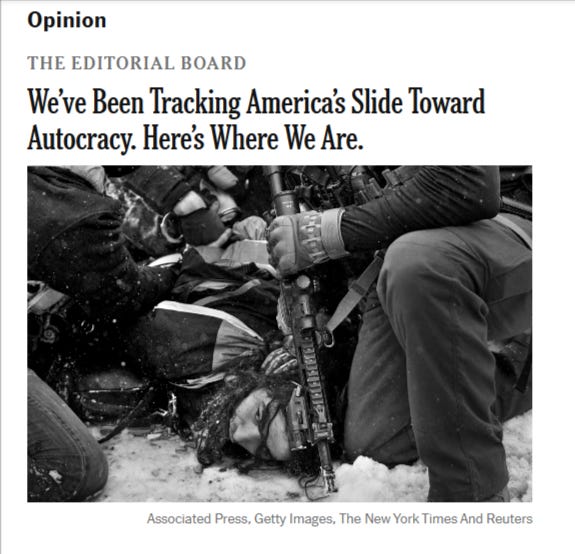
Editor: The regular reader of @NYT recalls the acent of David Brooks to the New York Times cadre of Zionist apologists, via his war mongering ‘The Collapse of the Dream Palaces’! But who can forget the New York Times’ Bret Stephens toxic essay March 21,2023 ? The Final paragraphs of Stephens war mongering chatter is instructive of the perpetual mendacity of the Straussian!
Bret Stephens
20 Years On, I Don’t Regret Supporting the Iraq War
March 21, 2023
…
Then there was the argument that we could have contained Hussein indefinitely through sanctions and other means. Maybe in theory, but not in practice. The human misery caused by the sanctions against Iraq had become a fervent global cause by the late 1990s. They were internationally unsustainable. They were also easily flouted for the regime’s benefit, as the U.N.’s oil-for-food scandal laid bare.
Ultimately, the choice for the United States and our allies in early 2003 wasn’t invasion or containment. It was invasion or, over time, the quasi-rehabilitation of Hussein’s Iraq. This was a Hussein that, as the Duelfer report on Iraq’s W.M.D. noted in 2004, “wanted to recreate Iraq’s W.M.D. capability — which was essentially destroyed after 1991 — after sanctions were removed and Iraq’s economy stabilized.”
Finally, there is the argument that George W. Bush and his administration lied about the intelligence. I think they sincerely believed the (mis)judgments of the C.I.A., which, as the bipartisan Robb-Silberman report concluded, sincerely believed in them itself. “The intelligence community was dead wrong in almost all of its prewar judgments about Iraq’s weapons of mass destruction,” the report noted. But it “was what they believed.” The consequences of this confusion are dangerous.
Critics of the war now make the point that the intelligence fiasco wrecked America’s credibility. It’s true. But no less damaging was the never-ending “Bush lied” charge that, 10 years later, morphed into the “Obama lied” charge when it came to Bashar al-Assad’s use of chemical weapons in Syria or the suggestion that President Biden is lying about last year’s sabotage of the Nordstream pipeline. One conspiracy theory tends to beget another, in ways that are destructive to all sides.
Readers will want to know whether, knowing what I know now, I would still have supported the decision to invade. Not for the reasons givenErnst Jünger at the time. Not in the way we did it. But on the baseline question of whether Iraq, the Middle East and the world are better off for having gotten rid of a dangerous tyrant, my answer remains yes.
Editor: Mr. Stephens is the etiolated version of Ernst Jünger? Thomas R. Nevin book provides vauable insights into Ernst Jünger!

Political Observer.


