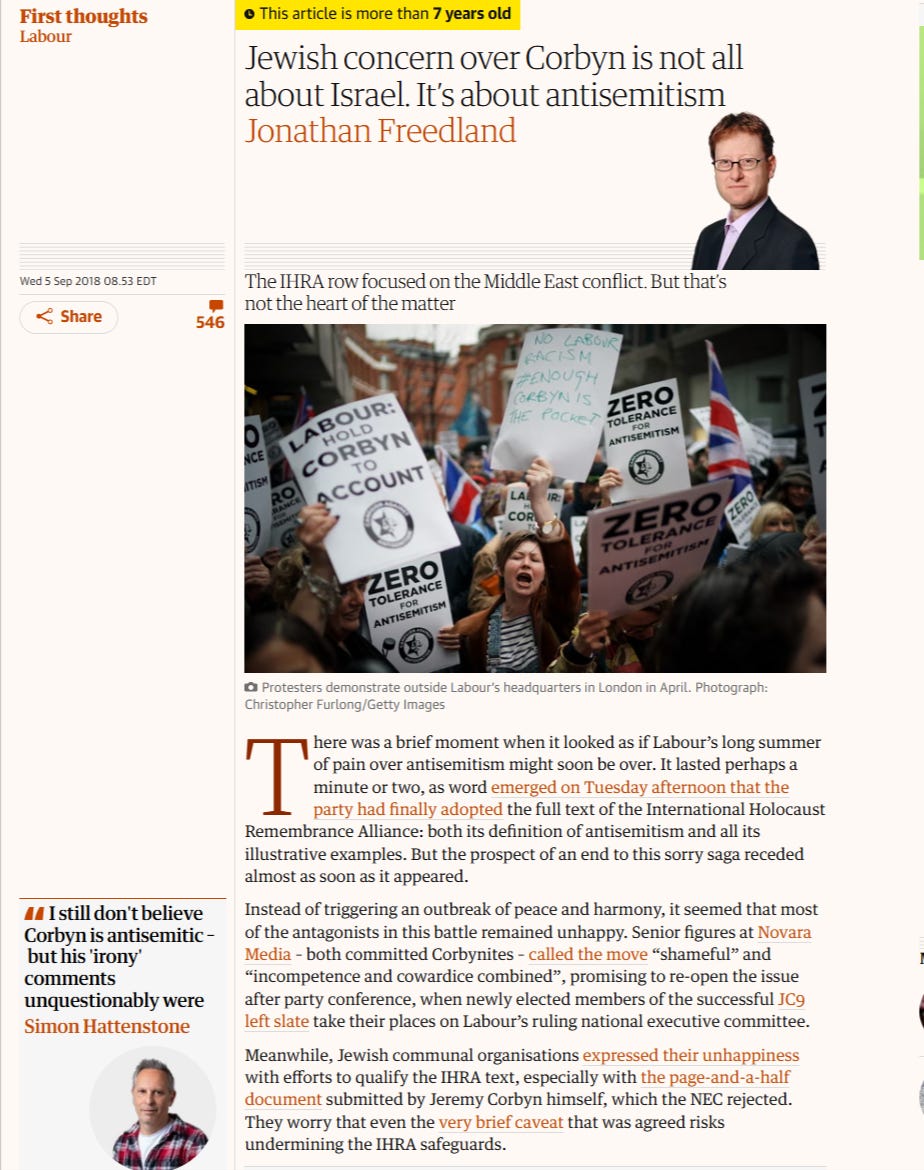
Editor: Jonathan Freedland joins the other Zionists regulars at the Times: Thomas L. Friedman, David Brooks, Bret Stephens & David French! It can’t surprise the regular reader of this newspaper, that Mr. Freedland is used to embroider on well worn themes! With no mention of The Gaza Genocide, committed by Netanyahu and his Fellow Travelers: Joe Biden, A Cadre of US Senators and House Members, all with monitary support for the utterly Faschist AIPAC! Not to mention Donald Trump purchased by Miriam Adelson, and a Presidential Medal of Freedom recipient! My digression points to Jonathan Freedland’s placement of his history in a usable past, freighted by heroism from various sections of German Life, including Jews! Yet Freedland uses his story as a toxic blind to attemp a political erasure of the Gaza Genocide by Netanyahu and his minions!
Editor: A selection from the concluding paragraphs of Mr. Freedland’s Public Moralizing:
…
Several key players in the drama were women whose upbringing shared another striking aspect: a close relationship with a strong father. That was true of Ms. von Thadden and both countesses, Maria and Lagi. In all three cases, the women were not just loved by their fathers; they were trusted by them. In a way that was unusual in the era before modern feminism, they were deemed by their fathers to be the equal of any man, capable of taking on any task. Long after their fathers were dead, the women carried that confidence with them. By the time the Nazis ruled Germany, it had blossomed into courage.
The strength of those women was buttressed by that deeper conviction that is perhaps the key determinant of who defies an oppressive regime and who buckles before it: belief in an authority higher than the government of the day. Most rebels at the tea party also came to understand that such a belief demanded action as well as thought.
For some, that translated into small gestures of defiance, like Lagi Solf and her shopping bags. For others, such as Otto Kiep, it meant acts of audacious resistance, coming within touching distance of a plot to assassinate Hitler. Through deeds large and small, they demonstrated — to themselves and one another — that obedience was not the only option.
To be clear, most aristocratic Germans did not rebel against Hitler. On the contrary, the German nobility largely fell in line behind the Nazis, drawn in part by the Führer’s pledge to restore titles abolished in the Weimar era. And of course, we cannot neatly read across from that place and that time to our own age.
But if there is a lesson to be gleaned from the deadly fate of those men and women, it might just be that the best safeguard against tyranny is a legion of people who believe in an authority higher than any political program, prince — or president.
Editor: Did both The Guardian and Matthew Avery Sutton delay the mention of a notorious Straussian Peter Theil, as the latest figure that trades in “Antichrist” hysteria. How might a Straussian enter this ‘place’ the question hangs in the air like a wild fire that connot be contained?
Let’s recall that Thiel believes:
July 4, 2025 :
Can The New Citizens, like Peter Thiel, associated with Asperger’s syndrome, a form of autism, now present an opportunity to view humanity within another frame? ‘The Straussian Moment’ is now superceded by men who are attached to how their brain functions, as outside ‘the norm’. ?
Editor: Matthew Avery Sutton is a Guggenheim Fellow, that establishes him as an Expert, in sum a Technocrat that writes newspaper commetaries? He is the Claudius O and Mary Johnson distinguished professor and chair of the department of history at Washington State University. (Editor: This puts me in my place!)
Two scenes from the past two weeks capture something unsettling – and familiar –about American public life. In San Francisco, a tech billionaire delivered a sold‑out, off‑the‑record lecture series on the antichrist. In Michigan, a man rammed his pickup truck into a Latter‑day Saints meetinghouse during Sunday worship, opened fire and set the building ablaze, apparently believing that Mormons are the antichrist.
The antichrist is clearly back. But perhaps he has never really left.
As a historian of American apocalypticism, I’ve traced how this symbol – a protean figure cobbled together from obscure biblical passages – has repeatedly migrated from pulpits to politics and back again.
Almost a century ago, fundamentalists mapped European dictators and New Deal bureaucrats on to biblical prophecy. During the cold war, evangelicals scanned Moscow and Jerusalem for signs of the Beast. In the first Gulf war, some Christians argued that Saddam Hussein was the antichrist who was rebuilding the Tower of Babel.
Whenever American power felt threatened or social change accelerated, antichrist talk surged. Today’s version arrives with AI, deepfakes and venture funding. And with bullets.
…
Editor: In a brief but scintillating 1004 words Matthew Avery Sutton narrates the story that is repeated by other men, and a woman, who are like Peter Thiel: Elon Musk, Larry Ellison, Bill Ackman, Shari Redstone etc! Thinking about Peter Thiel can be simpified, by thinking about him as a hybred: in sum a cross between Cotton Mather and Leo Strauss!
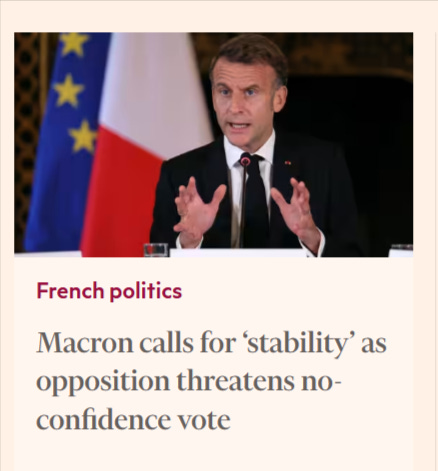
Headline: New French cabinet shows Macron is still calling shots
Sub-headline: Unveiled Sunday night, the new government led by reappointed Prime Minister Sébastien Lecornu faces two no-confidence votes this week and must push through a budget before year’s end.
By Mariama Darame Published today at 11:21 am (Paris), updated at 5:48 pm
If further proof were needed that French President Emmanuel Macron retains control over the prime minister’s office, the composition of Sébastien Lecornu’s new cabinet is the ultimate demonstration. After a three-hour meeting at the Elysée on Sunday, October 12, the president and his prime minister unveiled, just before 10 pm and via a statement from the presidency, the 35 ministers who will face, as soon as this week, two votes of no confidence from La France Insoumise (LFI, the radical left) and the Rassemblement National (RN, the far right).
Lecornu presented a revised version of his initial cabinet, which was deemed too Macronist and had led him to resign after just 14 hours, on October 6. This time, he downplayed the political aspect of his lineup, calling it on X “a government with a mission” that transcends “personal and partisan interests” and whose goal is to “give France a budget before the end of the year.”
…
“The government’s political base has shrunk further, both on the left and the right. And these waves of poaching and expulsions do not bode well for smooth relations with the parties,” said Harold Huwart, a centrist in the LIOT group.
The survival of Lecornu’s government now depends more than ever on the Socialists’ goodwill, as the rest of the left has vowed to bring it down. The Socialists are demanding an end to the use of Article 49.3 of the Constitution, which allows the government to pass legislation without a vote; measures to lower the cost of living; and the “immediate and complete” suspension of the contested 2023 pension reform. These demands must be included in the prime minister’s government policy statement on Tuesday at 3 pm if the Socialists are to spare the government, the party said.
Lecornu has scheduled a meeting with his ministers on Monday afternoon. He will lay out the marching orders ahead of the presentation of the budget bill at the Council of Ministers on Tuesday morning, after Macron returns from a diplomatic trip to Egypt.
Lecornu’s office has instructed outgoing and incoming ministers to keep the traditional handover ceremonies brief and away from the press. His new government has all the hallmarks of a non-event, even for its main players.
Editor: Macron is addicted to his meeting with various ‘leaders’ as a sign of his importance! Mariama Darame and Le Monde play a shabby Political Game!
Headline: Macron is risking a regime crisis
Sub-headline: After the president refused to acknowledge the results of the 2024 legislative elections that his camp lost, his insistence on retaining control has already led two prime ministers to fail in less than 12 months.
Macron refuses to contradict himself or erase part of his record. Yet his most loyal supporters have understood that the Elysée needed to take a step back. Former minister Agnès Pannier-Runacher called for the new prime minister to be someone “not from the Macronist camp,” and Gabriel Attal, one of Macron’s former prime ministers, urged the Elysée not to “persist in trying to control everything.” To no avail.
Has Macron realized that he must step back from his own second term, at least regarding domestic policy, to salvage what remains? After refusing to acknowledge the results of the 2024 legislative elections, his insistence on retaining control has already caused two prime ministers to fail in less than 12 months. Another successful no-confidence motion the week of October 13 would almost certainly force him to call snap elections that would solve nothing and plunge all parties of government into an increasingly strange defeat.
Editor: Even Le Monde’s Editorialist finds Macron’s flacid politicking patently absurd!
Editor: Here are the documents of the R2P. Reader note that this Doctrine is the twin of Neo-Conservatism’s unslakable bloodlust under a ‘Liberal’ guise!
World Summit Outcome Document
138. Each individual State has the responsibility to protect its populations from genocide, war crimes, ethnic cleansing and crimes against humanity. This responsibility entails the prevention of such crimes, including their incitement, through appropriate and necessary means. We accept that responsibility and will act in accordance with it. The international community should, as appropriate, encourage and help States to exercise this responsibility and support the United Nations in establishing an early warning capability.
139. The international community, through the United Nations, also has the responsibility to use appropriate diplomatic, humanitarian and other peaceful means, in accordance with Chapters VI and VIII of the Charter, to help to protect populations from genocide, war crimes, ethnic cleansing and crimes against humanity. In this context, we are prepared to take collective action, in a timely and decisive manner, through the Security Council, in accordance with the Charter, including Chapter VII, on a case-by-case basis and in cooperation with relevant regional organizations as appropriate, should peaceful means be inadequate and national authorities are manifestly failing to protect their populations from genocide, war crimes, ethnic cleansing and crimes against humanity. We stress the need for the General Assembly to continue consideration of the responsibility to protect populations from genocide, war crimes, ethnic cleansing and crimes against humanity and its implications, bearing in mind the principles of the Charter and international law. We also intend to commit ourselves, as necessary and appropriate, to helping States build capacity to protect their populations from genocide, war crimes, ethnic cleansing and crimes against humanity and to assisting those which are under stress before crises and conflicts break out.
1Pillar OneEvery state has the Responsibility to Protect its populations from four mass atrocity crimes: genocide, war crimes, crimes against humanity and ethnic cleansing.
2Pillar TwoThe wider international community has the responsibility to encourage and assist individual states in meeting that responsibility.
3Pillar ThreeIf a state is manifestly failing to protect its populations, the international community must be prepared to take appropriate collective action, in a timely and decisive manner and in accordance with the UN Charter.
Albanian-born political theorist Lea Ypi has built her reputation on turning the ruins of communism into poignant meditations on freedom and dignity. Her new book presents a moving portrait of her grandmother, though its reliance on fictionalized scenes undermines the power of lived memory.
VIENNA – Three decades ago, history swept away communist regimes across Europe. Yet the habits, bureaucratic practices, and instincts of submission and obedience endure, even as societies have established democratic institutions – courts, parliaments, constitutions – and privatized state property.
Since 1989, the most stubborn barrier to democratic change in Central and Eastern Europe has been in the heads and hearts of the region’s people. Hungarian Prime Minister Viktor Orbán, for example, has remained in power for 15 years of “single-party democracy” by offering voters a recognizable imitation of authoritarian predecessors like the fascist-era leader Admiral Miklós Horthy and the communist János Kádár and their brand of reactionary or communist national populism.
The persistence of authoritarian patterns tells us that opening to the global market and copying Western institutions can leave untouched the deepest reservoirs of allegiance within a population. Human consciousness remains haunted by vanished pasts. It clings to habits that have been repurposed by new demagogues, pushes back against the myriad new freedoms on offer, and maintains forms of inner obedience as protection against a headlong rush into an unknown future.
Freedom and Its Discontents
One of the most interesting observers of our inner reluctance to accept the acceleration of history is Lea Ypi, an Albanian-born political theorist who teaches at the London School of Economics. Her 2021 book Free made her famous, in part because of its ironic and ambiguous one-word title, which implied that one freedom – within her childhood home and among her vividly remembered parents and friends –was lost when the communist regime collapsed and the chaotic new “freedom” of the West prevailed.
Through a mordantly comic and ironic retelling of her childhood in the collapsing communist “paradise” of Enver Hoxha, who ruled Albania for 41 years, Ypi put a question mark after the word freedom itself, stripping it of the self-congratulatory insularity of the West’s post-Cold War narrative. She revealed both what was lost when this freedom came and what was violent, rapacious, and corrupt about its arrival. Yet as Ypi herself understood when she left to study philosophy in Rome and later completed her doctorate at the European University Institute in Florence, once Western freedom arrived, there was no going back.
Is it any surprise that this editorial at The Economist begins with Left Wing hysteria mongering? This as the West finds itself covered in the soot of the Neo-Liberal delusion that turned to ash? The failure of Neo-Liberalism demands further Neo-Liberal ‘reforms’, so goes the Party Line of the apologists for that exhausted,demonstrably failed political/economic mirage. See Philip Mirowski’s Never Let A Serious Crisis Go To Waste for the dismal history of the Neo-Liberal Thought Collective’s mendacious ascendency and staying power:
The fact that the Germans were bailed out four times in the 20th Century 1924, 1929, 1932 and 1953. What bearing might that have on the Left Wing hysteria mongering at the Economist, and the issue of the Greeks and debt forgiveness? And/or a range of other options, open to EU technocrats, in alliance with the Greeks, to first and foremost alleviate the suffering of Greek citizens, as the primary issue, not the rescue of the Neo-Liberal delusion in it’s various iterations! But the alleviation of the suffering of the Greeks is utterly antithetical to the whole of the Neo-Liberal Project: civic good is in direct opposition to the argued ‘value’ of Markets and Market Discipline!
The death of Mr. Wolfe has produced a great deal of praise for this literary capon in a white suit: a Dandy as imagined by Walt Disney:
Here is an excerpt from Janan Ganesh’s obituary , at The Financial Times, of Tom Wolfe that makes Wolfe look like a harbinger of the Trump Populism, although he clarifies/corrects any assumption the reader might have made, this in the latter part of his essay.
He exposed the credulity of the rich for artistic fads. He made fun of their recreational left-wingery, or, in that unimproveable phrase, their “radical chic”. Among the vanities that went into his bonfire was the idea of America as classless. At the risk of tainting him with politics, there was something Trumpian about his ability to define himself against Manhattan’s grandest burghers while living among them.
…
The mutation of these thoughts into a brute populism in western democracies cannot be pinned on Wolfe, who was civility incarnate. Like a good reporter, he wrote what he saw and left it to the world to interpret. What he saw were people who had wealth, refinement and so much of the wrong stuff.
Matt Purple at The American Conservative makes Mr. Ganesh’s essay look like faint praise, except for this bit of literary candor, tinctured by fulsome praise of a literary giant.
That lens may have proven distorted in New York, but position it over present-day America and it suddenly seems less smudged. Wolfe’s understanding of humanity was primarily tribal: people take on the customs and prejudices of the groups they belong to and clash with those they don’t. Hence why his characters are often accused of being universals rather than particulars. Hence, too, why his final (and weakest) novel, Back to Blood, was set in Miami and covered the tensions engendered by mass immigration. Contra Hitchens, what could be more prescient than that? In Back to Blood, the Cuban-American mayor of Miami tells the African-American police chief: “I mean we can’t mix them together, but we can forge a secure place for each nationality, each ethnic group, each race, and make sure they’re on the same level plane.” Is this our destiny, an America of subgroups that never quite melt into the pot? Are we doomed for more conflagration a la Charlottesville? Or is the liberal multicultural dream still possible, even desirable? That we’re even asking these questions suggests Wolfe has been vindicated more than his critics allow.
Ultimately, the only way we’ll get the answers is if we trouble to embark into this America of ours, sneakers laced, notebook paper crinkling in the breeze, lush phrases turning in our minds, determined to confront the weirdness in our backyard and chronicle it in a way that is—saints preserve us!—fun to read. Tom Wolfe’s work is ours now. May he rest in peace.
For another telling bit of information about Mr. Wolfe’s testiness, in regard to criticism of his work, from a writer who had actual contact with the Great Man, Louis Menand ,this short essay published by The New Yorker offers insight. The concluding paragraphs of Mr. Menand’s essay offer some clues as to who that Great Man was.
My brief Tom Wolfe moment—apart from coming across him one day waiting to cross Park Avenue; he was not an easy figure to miss—had to do with a piece I wrote on Maya Lin’s Vietnam Veterans Memorial. I had quoted Wolfe, along with other critics of the design, as calling it “a monument to Jane Fonda.” In due course, I received a fantastically high-handed letter from Wolfe, protesting that he had not been judging the design; he had only been repeating what someone else had said. This seemed to me beyond absurd. Of course Wolfe hated Lin’s memorial. Why would he pretend that that was not his view? I wrote him back to explain that he had, in fact, written those words as his own, and to ask why he was troubling to insist otherwise.
I received a second letter from Wolfe, this one even more fantastically high-handed, in which he deftly filleted every sentence in my letter to him and ended by putting it to me that my reportorial talents were beneath notice. No doubt they were, or are. Still, he had clearly devoted a lot of time to the composition of two longish letters concerning less than a single sentence in my piece. I concluded that he must be suffering from writer’s block on whatever novel he was working on, and did him the kindness of declining to continue the correspondence. However, I saved the letters.
Christopher Hitchens’ 1983 essay titled ‘A Wolfe in Chic Clothing’ , as recently re-published at Mother Jones site, is, to say the least, Mr. Hitchens at his most biting and insightful on this writer:
Here is Hitchens reviewing ‘A Man in Full’ in the London Review of Books of January 7,1999 (Behind a paywall). He first provides a devastating review of Bonfire of the Vanities and a view of New York of the period and ‘Bonfire’ as the literary paradigm that Wolfe used for his other novels.
Like every writer before him who has ever scored a triumph … Fallow was willing to give no credit to luck. Would he have any trouble repeating his triumph in a city he knew nothing about, in a country he looked upon as a stupendous joke? Well … why should he? His genius had only begun to flower. This was only journalism, after all, a cup of tea on the way to his eventual triumph as a novelist.
The Bonfire of the Vanities (1987)
Take it for all in all, The Bonfire of the Vanities was a blockbuster. It rewrote the whole career description of commercial-cum-literary success. And it got people where they lived, if they lived on or near Park Avenue. These days, New York City is becoming a ramified variant of St Louis, Missouri or Des Moines, Iowa: a great big ‘thank you for not smoking’ town, with ‘buckle up’ messages played on automatic tapes in the yellow cabs, and the cheery, kitsch sovereignty of Walt Disney exerted over what was once Times Square and 42nd Street. The golden arches of McDonald’s are to be seen winking near the Bowery, and cops look out for jay-walkers as if patrolling some dire Jim Carrey utopia. The mayor of the city, and the governor of the state, are two mirthless white ethnic conservatives named Giuliani and Pataki. They have restored capital punishment, and encouraged franchising of all sorts while discouraging loitering and littering. Not long ago, a Haitian immigrant named Abner Louima was grabbed outside a funky nightclub, roughed up in the police van, hurled into a cell at the station-house and held down while a guardian of the peace forced a rupturing lavatory plunger all the way up his ass. The foul object was then violently withdrawn, only to be shoved into his mouth (breaking many teeth) and down his throat. This was a hot case, for about ten days.
There has probably never been a less prescient journo-novel than The Bonfire of The Vanities, which subliminally heralded a New York that was given over to wild and feral African politics at one end (reading from north to south of Manhattan Island) and dubious market strategies at the other. The market strategies continue. Indeed, Wall Street has almost deposed the opinion polls as the index of national well-being. The ethnic spoils system, meanwhile, is manipulated by the same class as ever. If either of these elements ever undergoes a dramatic metamorphosis, it won’t be Tom Wolfe who sounds the alarm.
Yet, even as he tries to move to another city, and to make the leap from former journalist to actual novelist, Wolfe keeps The Bonfire of the Vanities constantly at hand. It worked once. Why should it not work again?
The reader can look to Edward Copeland’s ‘The Silver Fork Novel: Fashionable Fiction in the Age of Reform’ as a paradigmatic description of Status Anxiety in a British context. Where addresses mattered, where one went to eat, for relaxation and the promenading of one’s self before the public gaze. Not to mention one’s politics: Historical refraction aides in seeing Mr. Wolfe’s journo-novel’s as politics/morality by another means, in sum, Conservative Melodrama, in which brevity of exposition played not part: A Man in Full was almost as unwieldy as my copy of War and Peace.
Take note that Mr. Wolfe moved to New York city, with all the other Social Climbers, and shared in the Status Anxiety that he chronicles. Wolfe chose to make himself the center of attention, by his manner of dress. He was a Dixiecrat in the guise of a Dandy, as the in-order-too of establishing his pseudo-independence from the thrall of the Social Climber’s existential malady of Status Anxiety.
‘Yet how else should he have been? Wolfe, whose death this week left our literary scene all the hollower, is known today for his novels.’ Once a Dandy, Disraeli wrote novels as a way of giving his politics life, speculations on political possibilities, within a Conservative frame. Mr. Wolfe was a Dandy as imagined by Walt Disney, with a politics to match that old gargoyle’s. But T. S. Eliot immortalized Mr. Wolfe in his ‘The Hollow Men’:
We are the hollow men We are the stuffed men Leaning together Headpiece filled with straw. Alas! Our dried voices, when We whisper together Are quiet and meaningless As wind in dry grass Or rats’ feet over broken glass In our dry cellar
Shape without form, shade without colour, Paralysed force, gesture without motion;
Editor: Mr. Stephens offers these brief but almost compelling introductory paragragraphs.
According to Alfred Nobel’s will, a Nobel Prize is meant to be given to those who “during the preceding year, shall have conferred the greatest benefit on mankind.” Note the word “preceding”: Those of us who think Donald Trump deserves the Nobel Peace Prize for his part in ending (or at least pausing) the war in Gaza will have to wait until next year’s awards are announced.
We shouldn’t hold our breath.
In the meantime, the Norwegian Nobel Committee chose well in awarding this year’s peace prize Friday to María Corina Machado, the 58-year-old Venezuelan opposition leader now in hiding from the regime of Nicolás Maduro. By doing so, the committee also indicted that regime and its 26-year record of ruin, carried out in the name of “Bolivarian” socialism with the credulous support of many Western progressives.
Machado earned her Nobel last year when, after being blocked by the government from running for president, she rallied behind Edmundo González, a nonpartisan candidate, further helping to consolidate a once-divided opposition camp. González went on to win the vote by more than two to one, according to independent surveys, only to see Maduro ignore the result and install himself for another six-year term, throwing nearly 2,000 political dissidents into prison in the bargain.
Machado’s own career as a dissident began more than 20 years ago, after she co-founded an election-monitoring group because of her fears of the ways that Maduro’s immediate predecessor, Hugo Chávez, was systematically undermining Venezuela’s democratic institutions. In 2005, his regime charged her with treason for supporting a recall referendum; in 2014, she faced treason charges again for participating in anti-regime protests. In 2024, she published an opinion essay in The Wall Street Journal that began: “I am writing this from hiding, fearing for my life, my freedom, and that of my fellow countrymen from the dictatorship led by Nicolás Maduro.”
…
Editor: Andrea Lobo provides a more than compelling evaluation of the real María Corina Machado!
Nobel Prize for imperialist war and regime change goes to Washington’s Venezuelan puppet María Corina Machado
At the very least, the prize to Machado is an endorsement by powerful sections of the European ruling elite of a war for regime change with all its potential for opening a new front in the emerging third world war. France’s embattled “president of the rich,” Emmanuel Macron, as representative of the transatlantic establishment, declared Machado a “fighter for liberation.” What a farce!
…
“I want to tell how grateful we are to President Trump and the administration for addressing the tragedy that Venezuela is going through,” she said. “Maduro has turned Venezuela into the biggest threat to the national security of the US and the stability of the region.”
…
Beyond her support for imperialist intervention, the embrace of Machado’s fascist political pedigree—like the thunderous acclamations given to fascist Argentine president Javier Milei—signifies an endorsement by the “respectable” layers of the world oligarchy of a return in Latin America to the regime of terror created under the US-backed dictatorships that seized power across the region in the latter half of the 20th century.
…
Machado is a champion of “free market” policies, above all the privatization of the state oil company PDVSA, whose public ownership has been upheld by a wide spectrum of bourgeois parties since the 1970s. She has endorsed Milei’s economic program of “shock therapy” in which “freedom” means the liberation of corporations to eliminate social spending and exploit the working class without any restrictions or regulations.
The scion of a Venezuelan oligarchic dynasty, her far-right politics have always been animated by hatred of the working class and of any challenge to social inequality. On this basis, she has supported crippling US sanctions that by 2020 were estimated to have caused some 100,000 excess deaths, while forcing millions to flee the country. She has likewise remained silent on the punitive anti-immigrant policies pursued by the Trump administration against hundreds of thousands of Venezuelans who sought refuge in the US.
Machado has repeatedly appealed to the Venezuelan military as the country’s ultimate political arbiter, making clear that any regime she were to head would take the form of a military dictatorship from day one, committed to crushing opposition to her vastly unpopular economic and social policies.
…
The anointment of Machado by imperialism is, above all, a warning: the ruling class is preparing for new crimes on a world scale. The answer must be the independent mobilization of the international working class, made conscious of its strength and its historic tasks.
Headline: Macron keeps Lecornu on as prime minister despite political parties’ hostility
Sub’headline: The reappointment of Sébastien Lecornu to form a ‘government of mission’ that would be ‘disconnected from presidential ambitions’ has reignited criticism of the president, who has been accused of staying in denial, not only by the opposition parties but now by his own camp, too.
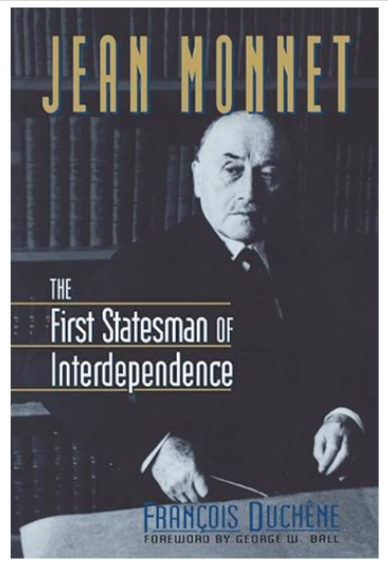
Editor: Reader more than any other consideration Macron covets his place on the World Stage, with the other EU dullards! Jean Monnet of the Coal and Steel Cartel iertration, is celegrated in Francois Duchene hagiography that cemented the Monnet’s status as Founder of this political mirage!
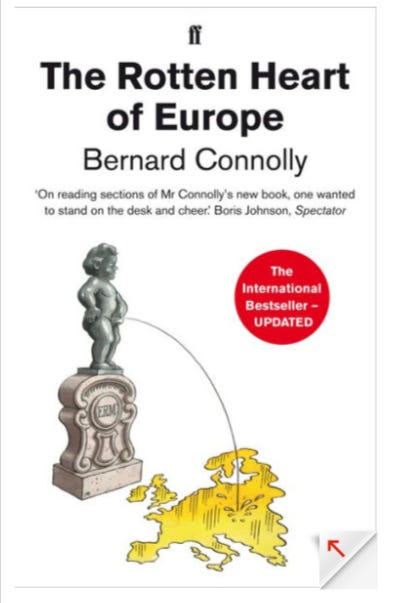
Editor: Yet what might The Reader make of this 1995 Bernard Connolly Best-Seller?


 StephenKMackSD's Blog