Is this essay Sol Stern seeks the root of the current revival of ‘antisemitism’ to it’s origin: the great Jewish thinker and Heidegger apologist Hannah Arendt. Here we have the latest installment of the current war on the policies and practices of the Zionist state’s critics, in the guise of an intellectual history of a prominent ‘self-hating Jew’ (a term that has lost it appeal because it no longer retains its ability to shock and confound) published by The Manhattan Institute’s City Journal. Here is an informative paragraph that appears early in the essay,I quote it in full:
“Since the publication of Eichmann in Jerusalem, serious scholars have debunked the most inflammatory of Arendt’s charges. Nevertheless, for today’s defamers of Israel, Arendt is a patron saint, a courageous Jewish intellectual who saw Israel’s moral catastrophe coming. These leftist intellectuals don’t merely believe, as Arendt did, that she was the victim of “excommunication” for the sin of criticizing Israel. Their homage to Arendt runs deeper. In fact, their campaign to delegitimize the state of Israel and exile it from the family of nations—another kind of excommunication, if you will—derives several of its themes from Arendt’s writings on Zionism and the Holocaust. Those writings, though deeply marred by political naivety and personal rancor, have now metastasized into a destructive legacy that undermines Israel’s ability to survive as a lonely democracy, surrounded by hostile Islamic societies.”
Mr. Stern has mapped the territory of his polemic, so the rest is simply elaboration on his chosen theme. What we do know from Young-Bruehl’s biography of Arendt is that she had an agreement with her professors, that she would leave her classes if the antisemitic remarks by her fellow students became too much. So her consciousness of her Jewishness was a phenomenon that probably came earlier that Mr. Stern indicates in his essay. Although that piece of key evidence might just subvert the political intention of his piece, even if it’s impact be minimal to his argument. That Arendt and many young intellectuals including, Karl Löwith, Hans Jonas, Herbert Marcus were spellbound by the lectures of Heidegger, he taught a generation of German students. Consult :The Young Heidegger,Rumor of the Hidden King by John van Buren and Heidegger’s Children by Richard Wolin.
In this long essay Mr. Stern merely sketches the political missteps, bad faith and political naivete of Arendt on the Zionist question that serves his narrative thrust, that she was an apostate to the followers of the evolving party line of mainstream Zionism: she was radically independent, she went her own way, a dissenter. That is the problem with Arendt, she thought independently and expressed herself forcefully;her intellectual heirs share her problem. The party line is not served by dissenters, by apostates. (Let me conjecture here that Arendt was in all likelihood one of the few women involved in any capacity with the formation of the state of Israel, at least in its intellectual dimension: she was a lone female voice in a field dominated by men habituated to their patriarchal privilege.) That is the central argument is this piece of backhanded propaganda, masquerading as intellectual history,updated to serve the needs of present day apologists for the self-destructive nihilism of Israeli politics.
But let me quote the prescient Arendt on the future of Israel, that seems to elude Mr. Stern’s intellectual and argumentative grasp.
“degenerate into one of those small warrior tribes about whose possibilities and importance history has amply informed us since the days of Sparta. Their relations with world Jewry would become problematical, since their defense interests might clash at any moment with those of other countries where large numbers of Jews lived. Palestine Jewry would eventually separate itself from the larger body of world Jewry and in its isolation develop into an entirely new people. Thus it becomes plain that at this moment and under present circumstances a Jewish state can only be erected at the price of the Jewish homeland.”
This could be a description of the fortress state of contemporary Israel, although Mr. Stern misses it’s currency. Another quote from near the end of this seemingly interminable indictment:
“Making the charges all the more outrageous is that we now know that she herself, at the time of the trial, was voluntarily engaged in a collaboration of sorts with Heidegger, who never repented for his Nazi allegiance. According to the historian Richard Wolin, Arendt served “as Heidegger’s de facto American literary agent, diligently overseeing contracts and translations of his books.”
Arendt always spoke to the fact that her work owed its genesis to the philosophical project of Heidegger, and that she maintained a deep intellectual connection and affection for him. Was he worth her loyalty and affection? Perhaps we should ask the same question of Marcuse, Jaspers, Gadamer, Löwith, and a host of his other students. I have chosen to comment on certain sections of Mr. Stern’s long polemic against Arendt, as apostate, but let me quote from the end of most telling paragraph:
“Those writings, though deeply marred by political naivety and personal rancor, have now metastasized into a destructive legacy that undermines Israel’s ability to survive as a lonely democracy, surrounded by hostile Islamic societies.”
Israel has the best equipped and trained military out side of the USA, that is America’s 147 billion dollars military investment, our unmanageable protectorate. It has between 100 and 400 atomic weapons and the capability and the means to deliver them. Israel is neither beleaguered nor threatened, except in the collective mind of certain political factions, whose reason to be is to stir up war fever against Iran: the only ‘Middle East Democracy’ flourishes on an unending flow of American dollars.
It must be so nice to play Hannah Arendt. No fewer than five actresses are on stage this evening at the Deutsches Theater Berlin to portray the philosopher. The piece is an adaptation of the graphic novel by American illustrator Ken Krimstein about the philosopher’s life, called “The Three Escapes of Hannah Arendt,” combined with scenes from the famous interview that journalist Günter Gaus conducted with Arendt in 1964 for German public broadcaster ZDF.
Five actresses, then. They play Arendt and a few of her contemporaries, the philosopher Martin Heidegger, the writer Walter Benjamin, her husband Heinrich Blücher. There is a great deal of speech in the play, especially from Arendt herself. The places of her life are ticked off, her childhood in Königsberg, her student years in Marburg and the affair with Heidegger. Life in Berlin in the early 1930s and her flight from Germany when the Nazis came to power. Exile in Paris and arrival in New York, where she then became known as a political theorist in the early 1950s.
It is clever, sometimes also funny, and when the five actresses stand on stage at the end and receive the audience’s applause while standing next to a small table piled with Arendt’s books, the whole thing is a bit reminiscent of “I’m Not There,” that film in which five actors (and one Cate Blanchett) play Bob Dylan.
Bob Dylan though? Is that the category we’re speaking about when we talk about Hannah Arendt?
She passed away 50 years ago. She suffered a heart attack on December 4, 1975. As a result, she was unable to complete her last book, which was supposed to be called “The Life of the Mind.” She was well-known at the time, but far from famous.
Half a century later, she is everywhere. The Thalia Theater in Hamburg just premiered a play in which Corinna Harfouch plays the philosopher; and an Arendt play is also running in Stuttgart. Two new biographies have just been published, even though one came out just two years ago. There are now at least a dozen of them. A film about Arendt also hit the silver screen in late summer. Every politician who has ever held a book in their hand has dropped a few sentences about Arendt in an interview. Angela Merkel, Robert Habeck, Frank-Walter Steinmeier. The governor of Baden-Württemberg, Winfried Kretschmann, has even written a book about her, published a few weeks ago.
Everyone wants a piece of her. The liberals, because freedom was the concept around which her thinking revolved. The leftists, because she always stood up to power. The conservatives, because she could find nothing appealing in socialism. The feminists, because she was a self-confident woman who refused to be intimidated in the male-dominated world of great thinkers. The conspiracy theorists, because Arendt believed that politics must not allow science to take away the primacy of decision-making. The critics of Israel, who believe they can align themselves with her criticism of the state of Israel. The friends of Israel, who recall her Zionist activism.
And the influencers, because she was cool and not only wrote thick books but also left behind sentences that look good on any Instagram post. Some really are direct quotes – while others are only almost verbatim. “No one has the right to obey.” “The meaning of politics is freedom.” “Unthinking men are like sleepwalkers.” “The problem was not what our enemies did, but what our friends did.” “Thinking is dangerous.” The list goes on and on. And we still haven’t mentioned the “banality of evil,” the kind of signature sentence reserved only for the likes of Theodor Adorno (”There is no right life in the wrong one”) or René Descartes (”I think, therefore I am”).
Is that, though, all people want from Arendt? A good saying, a bit of confirmation and a pat on the back? Is Hannah Arendt helpful in dark times because she makes one feel good?
Present-day upheavals would undoubtedly have felt familiar to Arendt. Authoritarian rulers, anti-Semitism, post-factual politics, mass migration, conspiracy theories, democracy on a shaky foundation. She experienced all of this herself. Fascism, communism, liberalism. World War I, Weimar, World War II, Cold War. She defended herself against the challenges of her era in ever new ways – by trying to understand them. One must “be completely present,” Arendt believed. That is an extremely compelling attitude in a confusing world like today’s.
Is this essay Sol Stern seeks the root of the current revival of ‘antisemitism’ to it’s origin: the great Jewish thinker and Heidegger apologist Hannah Arendt. Here we have the latest installment of the current war on the policies and practices of the Zionist state’s critics, in the guise of an intellectual history of a prominent ‘self-hating Jew’ (a term that has lost it appeal because it no longer retains its ability to shock and confound) published by The Manhattan Institute’s City Journal. Here is an informative paragraph that appears early in the essay,I quote it in full:
“Since the publication of Eichmann in Jerusalem, serious scholars have debunked the most inflammatory of Arendt’s charges. Nevertheless, for today’s defamers of Israel, Arendt is a patron saint, a courageous Jewish intellectual who saw Israel’s moral catastrophe coming. These leftist intellectuals don’t merely believe, as Arendt did, that she was the victim of “excommunication” for the sin of criticizing Israel. Their homage to Arendt runs deeper. In fact, their campaign to delegitimize the state of Israel and exile it from the family of nations—another kind of excommunication, if you will—derives several of its themes from Arendt’s writings on Zionism and the Holocaust. Those writings, though deeply marred by political naivety and personal rancor, have now metastasized into a destructive legacy that undermines Israel’s ability to survive as a lonely democracy, surrounded by hostile Islamic societies.”
Mr. Stern has mapped the territory of his polemic, so the rest is simply elaboration on his chosen theme. What we do know from Young-Bruehl’s biography of Arendt is that she had an agreement with her professors, that she would leave her classes if the antisemitic remarks by her fellow students became too much. So her consciousness of her Jewishness was a phenomenon that probably came earlier that Mr. Stern indicates in his essay. Although that piece of key evidence might just subvert the political intention of his piece, even if it’s impact be minimal to his argument. That Arendt and many young intellectuals including, Karl Löwith, Hans Jonas, Herbert Marcus were spellbound by the lectures of Heidegger, he taught a generation of German students. Consult :The Young Heidegger,Rumor of the Hidden King by John van Buren and Heidegger’s Children by Richard Wolin.
In this long essay Mr. Stern merely sketches the political missteps, bad faith and political naivete of Arendt on the Zionist question that serves his narrative thrust, that she was an apostate to the followers of the evolving party line of mainstream Zionism: she was radically independent, she went her own way, a dissenter. That is the problem with Arendt, she thought independently and expressed herself forcefully;her intellectual heirs share her problem. The party line is not served by dissenters, by apostates. (Let me conjecture here that Arendt was in all likelihood one of the few women involved in any capacity with the formation of the state of Israel, at least in its intellectual dimension: she was a lone female voice in a field dominated by men habituated to their patriarchal privilege.) That is the central argument is this piece of backhanded propaganda, masquerading as intellectual history,updated to serve the needs of present day apologists for the self-destructive nihilism of Israeli politics.
But let me quote the prescient Arendt on the future of Israel, that seems to elude Mr. Stern’s intellectual and argumentative grasp.
“degenerate into one of those small warrior tribes about whose possibilities and importance history has amply informed us since the days of Sparta. Their relations with world Jewry would become problematical, since their defense interests might clash at any moment with those of other countries where large numbers of Jews lived. Palestine Jewry would eventually separate itself from the larger body of world Jewry and in its isolation develop into an entirely new people. Thus it becomes plain that at this moment and under present circumstances a Jewish state can only be erected at the price of the Jewish homeland.”
This could be a description of the fortress state of contemporary Israel, although Mr. Stern misses it’s currency. Another quote from near the end of this seemingly interminable indictment:
“Making the charges all the more outrageous is that we now know that she herself, at the time of the trial, was voluntarily engaged in a collaboration of sorts with Heidegger, who never repented for his Nazi allegiance. According to the historian Richard Wolin, Arendt served “as Heidegger’s de facto American literary agent, diligently overseeing contracts and translations of his books.”
Arendt always spoke to the fact that her work owed its genesis to the philosophical project of Heidegger, and that she maintained a deep intellectual connection and affection for him. Was he worth her loyalty and affection? Perhaps we should ask the same question of Marcuse, Jaspers, Gadamer, Löwith, and a host of his other students. I have chosen to comment on certain sections of Mr. Stern’s long polemic against Arendt, as apostate, but let me quote from the end of most telling paragraph:
“Those writings, though deeply marred by political naivety and personal rancor, have now metastasized into a destructive legacy that undermines Israel’s ability to survive as a lonely democracy, surrounded by hostile Islamic societies.”
Israel has the best equipped and trained military out side of the USA, that is America’s 147 billion dollars military investment, our unmanageable protectorate. It has between 100 and 400 atomic weapons and the capability and the means to deliver them. Israel is neither beleaguered nor threatened, except in the collective mind of certain political factions, whose reason to be is to stir up war fever against Iran: the only ‘Middle East Democracy’ flourishes on an unending flow of American dollars.
Editor: Let me begin my quotation of Friedman here:
I am sure President Trump and his envoys to Russia, Steve Witkoff and Jared Kushner, sincerely want to stop the killing in Ukraine, but they are failing and will continue to fail as long as they persist in their naïve view that this is just a big real estate deal and that their backgrounds in real estate give them an advantage. It is utter nonsense on multiple levels.
For starters, yes, you could say that Vladimir Putin is in the real estate business in Ukraine, but not in the way Trump or Witkoff or Kushner have been in the business. Putin is in the real estate business in Ukraine the same way Hitler was in the real estate business in Poland. Hitler coveted territory not to build a hotel or housing for profit to benefit the local residents. He, instead, coveted real estate to fulfill a nationalist fantasy. Ditto Putin. He has shown no interest in the welfare of Ukraine’s people.
In that kind of situation, having a bunch of “real estate deal guys” as America’s negotiators is a liability, not an advantage. You want a Henry Kissinger or James Baker-type statesman who understands the difference between real estate and war and peace. Real estate is a positive-sum game — both sides can profit from a well-struck transaction. And that is the goal. In war and peace, when one side holds fascist views and is the clear aggressor and the other side holds democratic views and is the clear victim, you are in a zero-sum game.
Or as Ronald Reagan famously put it when asked how the Cold War should end: “We win, they lose.”
Reagan understood that real estate deals are purely over value (price per square foot) and interest rates. He understood that war-and-peace deals are about advancing and preserving moral values and strategic interests. And you don’t compromise on those with a fascist aggressor. We waged three wars, including the Cold War, alongside our allies in Europe to preserve the spread of our shared democratic values and our shared interests — namely that no major power in Europe that did not share those values could be allowed to dominate the continent.
I can think of no other American president who would have acted as if America’s values and interests dictated that we now be a neutral arbiter between Russia and Ukraine and, on top of that, an arbiter who tries to make a profit from each side in the process — as Trump has done. This is one of the most shameful episodes in American foreign policy, and the entire Republican Party is complicit in its perpetuation.
Editor: reader recall ?
Aug. 3, 1980: Reagan Gives “State’s Rights” Speech at Neshoba County Fair
On August 3, 1980, presidential candidate Ronald Reagan addressed a large crowd at the Neshoba County Fair as he campaigned in his bid for the presidency.
The fairgrounds are mere miles away from the site where three civil rights workers — one a student participating in Mississippi Freedom Summer and the other two CORE members — were murdered and buried in shallow graves by members of the Ku Klux Klan in 1964.
Reagan appealed to the “George Wallace-inclined voters” dreaming of a return to segregation and freedom of unfettered white supremacy in his stump speech:
I believe in states’ rights; I believe in people doing as much as they can for themselves at the community level and at the private level. And I believe that we’ve distorted the balance of our government today by giving powers that were never intended in the constitution to that federal establishment. And if I do get the job I’m looking for, I’m going to devote myself to trying to reorder those priorities and to restore to the states and local communities those functions which properly belong there.
In his appeal to white supremacists, he did not acknowledge the murders, which had been investigated by the FBI and were just one instance of violent assaults on local Black civil rights advocates and white allies in recent history.
Read the full speech at the Neshoba Democrat and learn more about the place of the speech in U.S. political history at The Intercept.
The significant danger now is that Putin will agree, conditionally, to some sort of Trump-endorsed “peace plan,” putting unbearable diplomatic pressure on Kyiv to accept it. Among other effects, this will fracture Ukrainian politics, fracture the NATO alliance, rescue Russia’s economy, strengthen pro-Russian voices in European politics and give Russia time to recover its military strength. In exchange, Ukraine will get the kind of paper promises it got back in 1994, when it gave up its nuclear weapons for nonbinding security guarantees — another reminder that disarmament is as often a road to war as it is to peace.
A question for Marco Rubio: How good will U.S. security guarantees for Kyiv be in 2029, when he’s a private citizen, JD Vance is president and Putin is hungry again for another choice cut of Ukraine?
There’s always the chance that Putin will overplay his hand, once again giving Trump the feeling that the Russian is “tapping us along,” as he put it in May, and reviving the administration’s appetite to defend Ukraine. Besides being the right thing to do, it would signal to China that the administration will not bargain away the independence of Taiwan for the sake of lucrative business opportunities for the Trump family and its friends.
Zelensky and his remaining supporters in Europe shouldn’t count on it. They may soon have to make a terrible choice between grasping for a temporary peace or continuing to suffer through a punishing war. Far be it for a columnist writing from the safety of New York to offer his advice, but another line from Churchill is worth recalling: “Nations that went down fighting rose again, but those which surrendered tamely were finished.”
The larger warning here is for free nations everywhere, particularly in Europe. The era of Pax Americana may soon be drawing to a close. From then on it will be every region, or country, for itself, against emboldened and avaricious adversaries. For a sense of how to fight, look no further than the Ukrainians whom we abandon at our peril and to our shame.
While Bret Stephens continues his War Mongering from the comfort of his office! At the least The Reader can look to the bellicose Joe Alsop, who was in Asia and Korea during these Wars/Conflicts, as a role model for Stephens?
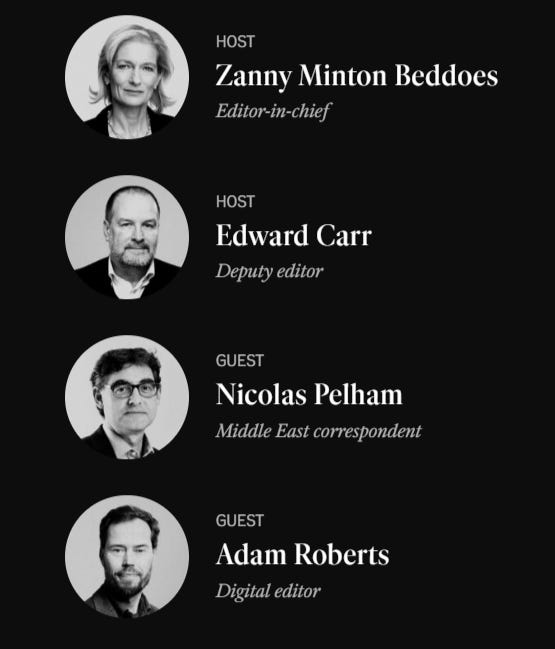
Zanny Minton Beddoes, Edward Carr, Nicolas Pelham & Adam Roberts discuss: ‘Dispatch from Tehran: how dangerous is the Iranian regime today?’
Editor: What is not supplied to the reader is an actual redable transcript of this conversation, that might lead the reader to look upon this conversation, as an exercise in political propaganda!
Neo-Con Zanny Minton Beddoes and her cadre of men explore such questions: ‘After 46 years of theocracy and a brief but bruising war, where does power now lie? What are the regime’s nuclear ambitions? And with the prospects of a succession crisis, has Iran been permanently weakened—or is it storing up trouble?’
This Reader observes that there is no actual trascript, with which to follow the arguments as each of Beddoes employees, as they make their argumanments/ contrbutions?
Episode summary
Nicolas Pelham, our Middle East correspondent, and Adam Roberts, our digital editor, are just back from a rare reporting trip to Tehran. They join our top editors in the studio to discuss what they learnt from an interview with Iran’s foreign minister and consider the future of the Islamic Republic. After 46 years of theocracy and a brief but bruising war, where does power now lie? What are the regime’s nuclear ambitions? And with the prospects of a succession crisis, has Iran been permanently weakened—or is it storing up trouble?
StephenKMackSD.
Just to establish my credentials a long time reader of The Economist, I hold in my hand a Book Review of A.W. Alschuler’s ‘Law Without Values: The Life ,Work, And Legacy Of Justice Holmes’ from page 86 dated Febuary 24, 2001.
StephenKMackSD
Added 11/22/2025 !
Editor: Hear is one of Beddoes’ Oxbridgers, Adam Roberts, chattering about Ukraine, like a reliable employee and Fellow Traveler !
Hello from London,
How vulnerable is Volodymyr Zelensky? It’s not only winter that is closing in. The closest aide to Ukraine’s president was compelled to resign on Friday, as anti-corruption investigators continue to expose a scandal in the energy sector said to involve kickbacks worth $100m or more. The loss of Andriy Yermak as chief of staff is undoubtedly a painful blow. Mr Yermak had been in charge of handling diplomatic pressure from America and Russia—countries trying to impose a grim-sounding peace deal on weary Ukraine. Read our story on the fall of Mr Yermak.
Add fears that Russia, bit by bit, is gaining the upper hand on the battlefield. In a war of attrition Russia’s economic and manpower advantages are starting to tell. Its more recent advantage in drone firepower looks worrying, too. None of that means any sort of decisive military breakthrough is likely. It’s still not clear to me even whether all of Pokrovsk, a symbolically important town in the Donbas that Russia has been on the cusp of seizing for 14 months, has actually fallen, for example. But it adds to a sense of gloom.
Some Ukrainians would like to see Mr Zelensky go. It’s widely assumed that Valery Zaluzhny, who was sacked as commander of Ukraine’s armed forces early in 2024, is eager to become president himself. I assume that Donald Trump would like Mr Zelensky gone if that would make it easier for him to declare the war over (whatever the consequences for Ukrainians and for Europe as a whole). Undoubtedly, Vladimir Putin hopes to see his foe gone. Mr Zelensky has played a big part in humiliating the Russian autocrat. Mr Putin’s supposed three-day invasion of Ukraine, back in 2022, has become a bloodbath that has now lasted more than 1,370 days and cost over 1m Russian dead and injured.
Editor: Adam Roberts whistling in the dark!
Despite the recent pressure on Mr Zelensky I don’t see him as powerless. Europeans, who actually provide Ukraine with weapons (bought from America) and economic aid, are sticking by him, as they should. They know that it’s crucial both to fend off American efforts to impose a dreadful sort of peace deal on Ukraine, and to make sure that Mr Zelensky’s forces can inflict military and other pain on Russia. Maritime drone attacks on shadowy oil tankers in the Black Sea over the weekend suggest a new effort to block Russian exports. The regular signs of Russian threats in other parts of Europe—such as drones over Moldova this weekend—are reminders that Mr Putin’s real goal is to make Europe much weaker. Every effort to help Ukraine continue to resist, in other words, is entirely in Europe’s own interest.
I recently asked for your views on Ukraine and the consequences if Russia seizes Pokrovsk. Rui Manuel Marques Rodrigues suggests it would not lead to any ceasefire, but only to more Russian aggression. Margaretha Jud has the same view, and she is sure that none of the proposals for a ceasefire deal would lessen Mr Putin’s appetite to take over Ukraine. Richard W. Murphy, meanwhile, emphasises the “miracle” of the long Ukrainian defence of Pokrovsk, at huge cost to the Russian attackers. I entirely agree. Finally, many of you also wrote in with observations about Iran, after my recent visit there with a colleague. I’d still welcome your thoughts on that country, and on whether any change is possible there. Please write to me at economisttoday@economist.com.
Editor: Alan Wolfe provides a canny evaluation of John Micklethwait and Adrian Wooldridge!
What Gave Us the Right
By Alan Wolfe
Nov. 28, 2004
THE RIGHT NATION Conservative Power in America. By John Micklethwait and Adrian Wooldridge. 450 pp. The Penguin Press. $25.95.
LEO STRAUSS AND THE POLITICS OF AMERICAN EMPIRE By Anne Norton. 235 pp. Yale University Press. $25.
Is George W. Bush not only the most conservative president we’ve ever had, but an entirely new kind of conservative whose ideas will dominate American politics for the foreseeable future? Or is he — along with the neoconservative “Straussians” who advised him to go to war in Iraq+- not really a conservative at all, but a daring crusader who’d make a real conservative like Leo Strauss turn over in his grave? Oddly, the better-written and more politically astute of two recent books, “The Right Nation,” by John Micklethwait and Adrian Wooldridge, offers the wrong answer to these questions, while the often incoherent one, Anne Norton’s “Leo Strauss and the Politics of American Empire,” gets them right.
Micklethwait, the United States editor for The Economist, and Wooldridge, its Washington correspondent, are the authors of a wonderful book on business advice manuals, “The Witch Doctors: Making Sense of the Management Gurus.” In “The Right Nation,” they show how the conservative movement that brought Bush to power is not recognizable as conservative from a European perspective. Ours is not a Tory conservatism respectful of the landed gentry, deferential to the privileges of an established church, fearful of class division — and, at least in modern times, incompetent in politics.
Rather, the authors argue, American conservatism is exceptional because America is. Fueled by free-market enthusiasts, gun-toting libertarians, Bible-believing Christians and welfare-hating exurbanites, the conservatism of a Grover Norquist or Tom DeLay knows what it stands for, has the confidence that gloomy liberals lack and best represents the places in America that are growing most rapidly, like Colorado Springs, Texas, the South. So powerful is its appeal that liberals must alter their ideas to counter it (one reason John Kerry posed with a shotgun during the campaign). Americans love business, freedom and the military, and on these key issues, the liberal disadvantage is palpable. “The stage is set,” Micklethwait and Wooldridge believe, “for a possible realignment of American politics, to make the Republicans the natural party of government in the same way that the Democrats once were.” Their analysis, presented well before the 2004 election, now seems more prescient than talk of an emerging Democratic majority — or, if a mea culpa is permissible, of one nation, after all.
…
Micklethwait and Wooldridge are not cheerleaders for the right; they keep their politics to themselves and balance their respect for conservatism’s success with numerous examples of its limits and failures. Ideological tilt is not the flaw of their otherwise engaging book; superficial analysis is. The most obvious defect in their treatment is that Bush has not run as a hard-right conservative. In 2000, he displayed his compassion for all to see. In 2004, he attacked Kerry as a liberal and didn’t endorse the hard-right position on gay rights or abortion. His victory was as strategically brilliant as it was ideologically imprecise. Micklethwait and Wooldridge know he is a conservative, and Bush himself knows he is a conservative, but there are not a few voters out there, including many who voted for him, who have not been let in on the secret.
…
Micklethwait and Wooldridge fail to appreciate the conservative appropriation of liberal ideas because their book pays little attention to ideas of any sort. Conservatism, they write, is new and different, but they never say whether it makes sense. Yes, conservatives thought out of the box in denouncing Europe and pursuing a unilateralist policy in Iraq, but if the ideas behind their foreign policy are disastrous, as they evidently are, perhaps one should be more guarded about conservatism’s triumph. The same could, and should, be said about the right’s domestic policies. It is adventurous to spend money the government does not have. But if the result is as unwise as it is irresponsible, those who promote such a program will pay a significant political price in the future.
…
Editor: My comment from May 16, 2024 : Adrian Wooldridge and John Micklethwait were mere bit players, but they did provide ballist to Seabright’s essay.
Political Cynic takes the measure of Mises/Hayek/Friedman’s successor?
I’ve been a reader of The Economist from the early 1990’s and on and off since then. The stogey old white men, represented by those once stalwarts Adrian Wooldridge and John Micklethwait, Oxbridgers both, and their best sellers like The Right Nation: Conservative Power in America compendiums of their various essay subjected to studious re-writes. When the comments section was closed, that was marked my canceling of my subscription, though I later returned. Beddoes was not a member of that club, so that high-flown rhetoric must patiently wait for paragraphs like these? In this essay Amazon is the arbiter of Popular Taste, with Mr Seabright’s off and on appearances, aided by some ‘Big Names’. This is propaganda!
God gets mixed reviews on Amazon. This is perhaps surprising. His marketing campaign (now in its third millennium) has been strong. His slogans (“God is Great!”) are positive. And indeed many shoppers effuse. “Wonderful!” reads one five-star review beneath His best-known work, the Bible. “Beautiful,” says another. “Amen,” adds another satisfied customer.
Other reviewers are critical. One, after giving the Bible just a single star, observes bluntly, if rather blasphemously, that it is a “boring read”. Another review complains: “the plot is not cohesive”. A third disgruntled reader argues that there are “Too many characters” and that the main protagonist is a bit full of himself.
The patient reader need just wait as Mr Seabright describes himself:
…
My research lies in the areas of microeonomic theory, industrial and competition policy, intellectual property and the digital society, development economics, economics and human evolution, the economics of gender, the economics of religion. A common theme to these apparently chaotically diverse topics is the foundations of human cooperation and social trust: I examine the way in which our prehistorically evolved psychology interacts with modern institutions to make social cooperation possible.
The Reader might just wonder, indeed ponder the reach of ‘Economic Science’, in the thought of Mr Seabright! He seems to bypass the Neo-Liberal Chatter of that Toxic Trio of Mises/Hayek/Friedman!
The Reader might wonder at what Economist might offer the The Believer, The Atheist , and or the completely disinterested?
If it feels surprising that God is reviewed on Amazon, it should not. God may have made heaven and earth, but he also makes an awful lot of money, as Paul Seabright, a British economist and professor at the University of Toulouse in France, points out in a new book.
The utter boredom of God Talk: The Economist.
…
Secularists may smirk at religion as silly, but it deserves proper analysis. “The Divine Economy” looks at how religions attract followers, money and power and argues that they are businesses—and should be analysed as such. Professor Seabright calls religions “platforms”, businesses that “facilitate relationships”. (Other economists refer to religions as “clubs” or “glue”.) He then takes a quick canter through the history, sociology and economics of religions to illustrate this. The best parts of this book deal with economics, which the general reader will find enlightening.
Economists were slow to study religion. Some 250 years ago Adam Smith observed in “The Wealth of Nations” that the wealth of churches was considerable.He used secular language to describe how such wealth arose, observing that churches’ “revenue” (donations) flowed in and benefited priests, who he argued were sometimes animated less by love of God than by “the powerful motive of self-interest”. He also argued that if there were a better functioning market in religious providers, this would lead to increased religious harmony. According to Laurence Iannaccone, a professor of economics at Chapman University in California, Smith’s analysis was “brilliant”—and for a long time largely ignored.
…
The Religious Hucksters, what ever their guise, trade in Sacred Texts like the Bible, the Koran, The Talmud. Mr. Sebright uses Economics as the ‘Key’ . It’s like the etiolated Neo-Liberal Trinity of Hayek/Mises/Friedman in a new key! Economics is the central driver in human existence: The Wisdom of the Market is the singular imperative of human striving?
Some selective quotation: The Economist: Two descriptors apply: ‘Potted History’ or ‘History Made To Measure’!
Divinity departments are staffed by theologians rather than economists; the idea of mixing the dismal science with the divine strikes many people at the very least “as odd and at worst strikes them as blasphemous”, says Mr Iannaccone. People associate God with angels, not with Excel.
Yet religions lend themselves to economic analysis nicely. They offer a product (such as salvation); have networks of providers (priests, imams and so on) and benefit from good distribution networks. It is not just trade that travels on trade routes: ideas, diseases and religions do, too. Roman roads allowed the plague of Justinian to spread across Europe with a rapidity never seen before. They also allowed Christianity to.
Starting in the 1970s, some economists have been approaching religion with more academic devotion, analysing, for example, the economics of extremism and obtaining a place in the afterlife. This mode of thinking can help to clarify complicated religious history. When historians talk about the Reformation they tend to do so using thorny theological terms such as “transubstantiation”. Economists would describe it more simply as the moment when a monopoly provider (the Catholic church) was broken up, leading to an increase in consumer choice (Protestantism) and the price of services declining (indulgences were out).
A greater variety of suppliers started to offer road-maps to heaven. Henry VIII swapped his old service provider, Catholicism, for the new one—which was not only cheaper, but also allowed him to divorce a troublesome wife. There were, admittedly, some bumps: the pope was not pleased, and the habit of burning picky customers at the stake dented consumer confidence. But overall, the Reformation enabled people and their rulers to “get a better bargain”, says Davide Cantoni, a professor at Ludwig Maximilian University of Munich.
Seabright returns briefly, then some Brand Names, Nations, then it becomes a muddle of Economist chatter!
(Christianity and Islam), Walmart, Lidl and Tesco, the Catholic church, like McDonald’s, Vatican or Venezuela, Baal , the Bible, Tom Lehrer, Catholics, The Vatican Rag, “The Divine Economy”, ‘ a rational Bayesian framework, God, as Friedrich Nietzsche stated, Jordan Peterson, a Canadian academic.
The final salvo: The Economist
God might wish he were dead when He hears such things. He is not.
( Call this the profession of Faith of ‘The Economist’?)
Headline: Your Party’s spectacular own-goal squanders a golden opportunity
Sud-headline: A chunk of Keir Starmer’s core vote were there for the taking, but Jeremy Corbyn’s party has instead succumbed to the hard-left’s self-destructive tendencies
Patrick Maguire is chief political commentator for The Times. He is the co-author of Left Out, the definitive history of Jeremy Corbyn’s Labour Party, and Get In, the Sunday Times bestselling account of Sir Keir Starmer’s rise to power.
Despite appearances, it really didn’t have to be like this. Jeremy Corbyn’s friends and advisers despair that the traumatic birth and chaotic infancy of Your Party — which struggled to come of age at its ill-tempered inaugural conference in Liverpool this weekend — has legitimised the tired but irresistible clichés they have spent a lifetime trying to escape.
Dave Spart, the People’s Front of Judea, Corbyn present but not involved: usually the hard left feels affronted by this vein of mockery. But speak to them in private and they admit, by turns angry and despondent, that for once their detractors might have a point.
By and large, Westminster struggles to suppress its collective impulse to laugh at Corbyn in particular and the organised left in general. Like all addictions, it is a self-destructive habit. More than once the Labour establishment has learnt that to its cost, and last year’s election suggested that their assumptions and entitlement would again end up shattered by a political force they prefer to ignore.
Corbyn and four other independent MPs who won seats Labour ought to have won at a canter had created a historic opportunity. For decades movements to the left of the Labour Party have comprehensively failed to prove the existence of an electoral coalition large enough to put their candidates in parliament.
Editor: Reader imagine this brodacast on a 21 inch black & white television screen in 1952! Patrick Maguire script writing lacks verve!
It is an impenetrable row but not an entirely pointless one, for it clarifies exactly whether Your Party will ever speak to anyone but a few thousand activists. Worryingly for Team Corbyn, there are signs Sultana might be winning it. On Sunday morning delegates narrowly voted to endorse the model of collective leadership she had championed: activists will now run and speak for the party in public, and not an individual MP. Neither Corbyn nor Sultana will be able to run for the leadership until the rules are reviewed in 2027, by which point, judging by the rancorous scenes on the conference floor, Your Party may no longer exist.
One senior party official, aligned with Corbyn, privately derides Sultana’s approach as the “0.7 per cent strategy”, a reference to the share of the vote they believe Your Party will win if it chooses the dogma of Trotskyist groupuscules over the populist politics that won the Gaza independents their seats. “She wants to be queen of the ashes,” the official complained. After this weekend, there is unlikely to be much more than that left.


 StephenKMackSD's Blog