Mr. Crenshaw manages the shot-gun wedding of the year: the Neo-Liberal Trinity of Hayek/Mises/Friedman to the self-hating, hysterical American Divine Johnathan Edwards’ ‘Sinner in the Hands of an Angry God’! Neo-Liberalism marries Christianity with Mr. Crenshaw officiating. The Estate of ‘Man’ : suffering/redemption, with Government standing watch, declaring its neutrality, in this dull-witted Social Darwinist Melodrama. (Pamphleteer Ayn Rand waits off-stage)
Macron’s signature ‘Jupertarian Politics’ is the deadest of dead letters! He (M. 37%) has stumbled over his own egoism, and his toxic ambition to lead the foundering EU, Neo-Liberalism’s in all its ghostly apparitions, has stalled in answer to The Pandemic . But Victor Mallet repeats the Party Line on Macron and the gilets jaune. The violence of the French Police, against demonstrators, has been well documented, except on Corp. Media, who act as apologists for Macron’s ‘reforms’.
…
Macron’s signature economic reforms, for example to the costly state pension and unemployment benefits systems, have also been stopped in their tracks by the pandemic. Those reforms had already been challenged by the sometimes violent anti-government gilets jaunes protests that erupted across the country in 2018 and persisted for more than a year, but they had appealed to many of the country’s centre-right voters.
By keeping the reforms on his to-do list, Macron alienates many working-class voters, and by failing to follow through with them he alienates entrepreneurs and much of the middle class. Significantly, many gilets jaunes protesters at the start of the movement were Le Pen supporters from outside Paris, even if some of the later demonstrations were taken over by anarchists and supporters of the far left.
These protests have continued every Saturday, and haven’t been reported in this newspaper, an impediment to the worship to this incompetent énarque . Twitter is a ‘source’ antithetical’ to Corp. Media?
Macron once looked like the political actor, who would eviserate French Socialism. Here is Neo-Con Bret Stephens in 2017, in The New York Times, in thrall to his own infatuation with the ‘reformer’ Macron.
Here is a telling part of Ben Hall’s essay on Macron:
…
It was always hard to slot Emmanuel Macron into a political category. He ascended the pinnacle of the French state as a party outsider who went beyond left and right while borrowing from both. “En même temps” turned into an early trademark. Progressive on cultural issues and a critic of the over-weaning state, Macron has never been the true liberal foreigners saw or wanted to see.
Now, nearly four years into his presidency, it is harder than ever to identify the essence of Macronism. But the question of what he stands for is becoming ever more pressing. In little over a year, France will be in the midst of another polarising presidential election campaign. In all likelihood, it will end in a repeat of 2017’s run-off between Macron and the far-right leader Marine Le Pen. If November’s election was a pivotal moment for US democracy, next year’s contest will determine the fate of the Fifth Republic and probably survival of the EU if an ultranationalist like Le Pen took over the Elysée Palace.
Mr. Ganesh employs his talent for aphorism, here, for a remarkable assertion, wrapped in a pastiche of that rhetorical gift. Or is it the product of the headline writers? The reader might just ask many questions and consider many avenues of thought…
At some point, these figures become less striking than Biden’s ability to propose them without political cost. More than a decade ago, Republicans framed President Barack Obama as a spendthrift radical for vastly less. Against Biden, the same line of attack elicits more giggles than nods.
Should the reader look to Bush The Younger’s Secretary of the Treasury Henry Paulson’s approach to the Crash of 2008, and his adaptation of Keynesianism? A crisis of massive proportions demands both swift action and policy flexibility? The Pandemic is a catastrophe: 30,532,965 cases and 554,064 deaths according to the CDC. At 77 Biden had better secure ‘his legacy’ with bold and decisive action : forgetting that $2000 and the $15 minimum wage?
Mr. Ganesh opines on ‘troubled Progressives’ which is the stand-in for ‘The Left’ ?
If they care to notice, there is a lesson here for troubled progressives in Westminster, Paris, Berlin, Canberra and beyond. Only an established moderate can win from the left and then govern from there.
Biden then acts as ‘outwardly innocuous a leader’ : the heroic political actor of Ganesh’s political imaginings? Does Ganesh stand for or against the Progressive Agenda, if it is consonant with The Left Political Program: if that can even be defined by its antagonist? Or is Mr. Ganesh engaging in some word play, just fancy foot-work, that might just pass for political analysis? Which by some form of ‘logic’, as the in order to win, via this scenario, constructed by Ganesh: the Left/Progressives coterie must put forward an innocuous candidate? Mr. Ganesh is not deterred by such ‘logical‘ demands!
The more outwardly innocuous a leader, the bolder the schemes they can smuggle under cover of superficial blandness. Journalists never see them coming. Voters back them not to over-reach. Opponents who allege extremism radiate an unbecoming hysteria.
If anything, Biden is one of the less vivid examples of this phenomenon. What stands out about the greatest US reformers of the last century is how fantastically improbable they were.
A history made to measure relying on American and British sources , follows featuring FDR. Then these two paragraphs attaching two Left-Wing Social Democrats, as exemplars of his reviled ‘Left’, are given a strategic walk-ons. Except that Warren didn’t drop out of the 2020 contest even though she only received eight delegates, in her home state. And her declaration that she was ‘a Capitalists to her bones’ places her in the Neo-Liberal category. In sum Warren entered the Clinton Coterie by doing its dirty work! Mr. Ganesh unctuous prose, enlivened by near paradoxes can’t quite match the headline. Propaganda is about serving evocative political purposes, here this writer almost makes it work
As long as the one emits a Tuscan-tanned perkiness, and the other daunting intensity, the misperception will hold. Such are the heuristics with which our erring species forms some of its deepest judgments.
To wish away the superficiality of politics is itself frivolous. The point is to bend it in one’s favour. Consciously or not, Biden is putting on a masterclass. We can never know, but I suspect he is spending more than a President Bernie Sanders or a President Elizabeth Warren could have done as out-and-proud leftists. Even that is to assume the White House was ever plausibly theirs for the taking.
In Andy’s essay of 1,599 words, the pronoun ‘I’ is used 44 times and ‘me’ 10 times. This essay is not just about Andy’s returning to Worship, after the Covid-19 Pandemic, but a retrospective on the failings of that Church during the AIDS crisis, and the denial, obfuscation, not to speak of criminal conspiracy to protect pedophile priests.
Its the anguished, bewildered cry of one betrayed, who continues his addiction or can’t leave an abusive relationship! The reader can name their own descriptors. It’s as if Andy, for all his ‘expertise’ , his ‘knowledge’, all self-proclaimed, had missed Kant’s well known imperative of ‘self-emancipation from tutelage‘?
The featured players in Andy’s Psychodrama: Cardinal McCarrick, Cardinal Wuerl, Christopher Hitchens, Michael Oakeshott, Jean Cocteau, Gallup, Millennials, psychedelic drugs, Prosperity Gospel, evangelical Christianity, Christianity, the Capitol, Eric Metaxas, GOP, organized Christianity in America, wokeness, Manichean, the individual soul, confessions of sin, the Kingdom of Anti-Racism, pseudo-religions will fail, transcendent/redemptive, Christianity/humility/conviction.
Headline: A Clash of Civilizations with Chinese Characteristics
Sub-headline: A civilizational struggle of the “rest” versus the West articulated by Mao Zedong and embraced by Xi Jinping is at the very core of the ideological foundations of the grand strategy of the Chinese Communist Party.
The author of this essay: Wesley Jefferies is a graduate student at the Walsh School of Foreign Service’s Security Studies Program at Georgetown University in Washington, DC. Is Mr. Jefferies following the time honored tradition, of cultivating the favor of his teachers, and adapting to the current climate of opinion, of the Foreign Policy Security Experts, who will judge his academic worthiness to receive a Degree in ‘Foreign Service’s Security Studies’ ? It seems like the obvious question. The reader should consider the cost of pursuing a post-graduate degree of such a specialized area of study. In line with that, the establishment of your political credentials seems the paramount consideration?
‘The Clash’ has lain fallow for sometime, Prof. Huntington’s hysterical xenophobia, all dressed in World Historical finery reads just like what it is, a paranoid screech against the ‘other’ that threatens the hegemony of Pax Americana. Even though later in his essay he denies the ‘othering’ of the Chinese.
This sentence :
‘The central problem of these analogies that they all refer to competition between powers or systems of Western origin. The rise of China poses conceptual and strategic challenges that do not lend themselves to ready-made analogies from the official canon of Western military and diplomatic history.’
And the next sentence:
The conceptual and geopolitical dimensions of the Chinese threat are not accounted for the historical and theoretical explanations to which Western scholars and commentators are accustomed.
‘The rise of China’ in all its benignity, is followed by ‘the Chinese threat’: propaganda must always appear to be benign, in Mr. Jefferies hands it is self-canceling? Yet the last iteration of what ‘China is’ in ‘conceptual and geo-political terms’ is ‘threat’ the most likely to be recalled is that final term.
What precedes this is a collection of cliché’s : The Cold War, The Great Game, the so called Thucydides Trap, as ways of providing rhetorical ballast to his essay, by mere reference, rather than an actual consideration-in sum-a of presentation of relevant arguments. Should the critical reader dub this pseudo-knowledge, as maladroit a descriptor as I could produce in the moment!
What follows is a potted history of the geopolitical outcomes of world wars: decolonization. Here is Mr. Jefferies dizzying historical reductionism:
The most significant geopolitical outcome of the world wars was decolonization. The most dynamic and deadly manifestations of the competition between the new superpowers that emerged after the world wars occurred in the contested spaces left behind by the former empires. The most dynamic and deadly manifestations of the competition between the new superpowers that emerged after the world wars occurred in the contested spaces left behind by the former empires. What was once the greatest prize among these spoils has become the largest player among them and the character of its resulting challenge to world order represents the axis of contemporary geopolitics. A civilizational struggle of the “rest” versus the West articulated by Mao and embraced by Xi is at the very core of the ideological foundations of the grand strategy of the Chinese Communist Party.
The titles of the successive parts of this essay are illustrative of Mr. Jefferies ‘methodology’. I will select from the essay what captures the reader’s attention. I will treat this essay as propaganda.
Mao’s Revolution and the Rise of the Third World:
This section is devoted to a made to measure history of China, in the International System. And its participation in the colonial and post colonial eras.
…
The paradoxical interplay between China’s superiority complex as a former empire and victim mentality as post-colonial framed a set of ambitions and grievances for Mao that would set him at odds with the superpowers. The first task at hand for Mao, as the leader of this emerging colossus caught between the superpowers, would be to secure freedom of action in a bipolar system. The second task would be to leverage China’s sovereignty and status to claim a position as leader and champion of the post-colonial spaces over which the superpowers were competing for influence. This, in turn, would lay the ground for the third task of world revolution, in which colonialism, as much as class struggle, would be a theme. China would regain a central place in international affairs through this process. In other words, world revolution would be the vehicle for world domination.
…
The Rise of Xi and the “Rest” versus the West:
…
The relationship between the United States and China that emerged after the Sino-Soviet split has similarly encountered tensions and contradictions following the end of the Cold War. Mao’s vision of geopolitics has seen its greatest comeback under the highly personalized rule of Xi Jinping. A civilizational-scale challenge from the CCP has now emerged that goes beyond simply competing with U.S. strategic and commercial interests.
China under Xi is emulating Mao’s call for Chinese leadership of the ‘rest’ against the West while simultaneously working to undermine the societies and institutions of Western countries. The former has been articulated by Xi Jinping’s argument that the Chinese model of government and development is a better example for developing countries than the West because it will “speed up their development while preserving their independence” from Western influence. The latter is manifested by the use of corruption, espionage, and disinformation by agents of the CCP, including Chinese academic researchers and business ventures, in what FBI Director Christopher Wray described as “a whole-of-society threat” posed by Beijing.
…
The Geopolitical Axis of the Clash of Civilizations:
…
Since the original thesis for a ‘clash of civilizations’ was popularized by Bernard Lewis and Samuel Huntington as a prediction for the international system after the end of the Cold War, it has become deeply controversial and unfashionable to suggest that ideas and perceptions about culture and identity might play a role in future tensions and conflicts. U.S. diplomat and scholar Kiron Skinner drew intense criticism for suggesting in 2019 that the wider civilizational gulf that exists between China and the United States than between the United States and the USSR would require a vastly different understanding and approach than what was applied to the Soviet threat.
The purpose for this focus is not “othering” the CCP or the billion and a half people subject to its rule. It is to reveal the “center of gravity” through which China under the rule of Xi seeks to displace the West and thus point to where and how U.S. strategy must change.
…
Mr. Huntington’s ‘Clash’ was a political document predicated upon an hysterical xenophobia, of World Historical proportions. This followed by his ‘Who Are We? The Challenges to America’s National Identity’ It is an attack on the Mestizo Hordes that are threatening Anglo-Protestant Virtue. Call Mr. Huntington a white supremacist with an impressive set of academic credentials.
The ‘Clash’ available on the internet: The version printed in Foreign Affairs ; New York; Summer 1993; Huntington, Samuel P; (9 pages)
I read this essay, thanks to one of the Librarians , at the Angelo M. Iacoboni Library in Lakewood California. She printed out a copy of the essay, whose link is above. This essay seemed bloated when I first read, in this form, and the book remains on my shelf ,unread. Fukuyama’s ‘End of History’ essay suffered from the same rhetorical malady! The ‘critics’ swooned over the mention of Hegel.
The ‘Reverse Kissinger’ is the high point of Mr. Jefferies remaining ‘history made to measure’:
…
.For similar reasons, the United States must also consider the urgent necessity for exploring options for a modus vivendi with the Russian Federation. The “reverse Kissinger” proposed by some astute writers and commentators should be considered more seriously by policymakers. Washington should see the opportunity in the risks the CCP’s ambitions in Central Asia and the Middle East pose to a Russia facing demographic decline and long vulnerable borders. What the United States has been doing instead has been adopting a punitive approach to the only country in Europe that could still conceivably balance against China. If a “grand bargain” can be reached with the Russian Federation regarding its deep-seated insecurities about its territorial integrity and historically precarious borders in Eastern Europe, as well as lingering concerns in the Kremlin over U.S. attempts to promote regime change in Russia, there will be fewer grounds for Russian leaders to convince a domestic audience that the real threat lies to the West.
…
Surprising this reader, Mr. Jefferies advocates an alliance with Modi :
The United States should also be working for a closer partnership with India. It is the only country with a population that may exceed China’s, as well as untapped economic potential that could rival what has been achieved in China since the reforms of Deng Xiaoping. For this to work, Washington must be willing to fully support the reform agenda of Narendra Modi to overcome the myriad obstacles India faces in exploiting its domestic talent and demographic advantages. A closer alignment between India and the United States would also strike at the heart of the “rest versus the West” dynamic that lies at the ideological core of the CCP’s grand strategy.
Mr. Jefferies shares this idea with Janan Ganesh of The Financial Times of March 30. 2021. Although Ganesh looks upon it as a hypothetical.
‘As for the largest potential friendship of all, that with India, is there anything Prime Minister Narendra Modi could do there to make the US spurn so grand a prize?
Headline: The US cannot be choosy about its allies
Sub-headline: The network of countries that worry about China are not all liberal paragons
America began losing its ‘moral authority’, an inheritance of Wilsonian Idealism, when it’s ascendant manufactures of electronics moved their operations ‘offshore’ , in order to increase their profits and avoid taxation by holding those profits off shore. The Greed of Steve Jobs and his fellows had a toxic political/moral facet? The ‘Supply Chains’ are an utter failure in terms of The Pandemic, and the care and maintenance of a vital working and middle class ,as the sine qua non of a thriving Social Democracy: a victim of an utterly pervasive and toxic Neo-Liberalism. Mr. Ganesh’s political cynicism about the character of ‘allies’, or the lack of that prerequisite, is about the collapse of that Wilsonian Idealism as a guiding principle . No matter its own toxicity, an unapologetic white supremacy. All the above unnecessary history would interfere with Ganesh’s propose, if that be readily apparent to the reader?
This diplomatic work is harder, and the resulting strength in numbers more formidable, than direct confrontation with Beijing. To that extent, Republican slurs about Democratic softness on China are as asinine as ever. Once more, though, liberal values have perverse consequences. The US can be morally scrupulous. It can string together a mighty web of friends. But it cannot achieve both feats at the same time.
Is the US going to refrain from courting, say, Thailand, on the basis of its lapses into junta rule or its lèse majesté laws? As the Philippines blows hot and cold, will Biden stop bidding for its loyalty if its populist government breaks a liberal norm too many? As for the largest potential friendship of all, that with India, is there anything Prime Minister Narendra Modi could do there to make the US spurn so grand a prize?
Mr. Ganesh’s defense of a relaxation of that Wilsonian Standard, in the name of political expediency is unsurprising. Or have I misread him?
In this way, the administration will hit its head from time to time against the moral bar it has set itself. The more rigorously Biden applies US values, the narrower his strategic options will be. The more he observes them in the breach, the higher the cost in US trustworthiness and credibility. For a 78-year-old man, the predicament is only softened by its eerie familiarity. His country struggled with it for much of his life.
The Biden/Blinken alliance, in its full dull-witted flower, represents the power of the Mass Media’s propaganda: that Trump was, in sum, ‘soft’ on both Russia and China. Both the President and the Secretary of State look like what they are bungling amateurs. The appointments of Blinken, Powers and Nuland, and a host of Obama veterans is predicative of what is to come?
Mr. Ganesh’s essay is marked by ‘history made to measure’ and by lapsing into a muddled prescriptiveness at its end.
If anything, the temptation of moral compromise is far stronger now. The frontline of the cold war was Europe, which had democratic governments in place from Dublin to Bonn. There are prominent examples of those in Asia, the new zone of competition, but there are also military rulers, technocratic city states, one-party systems, vulnerable democracies and established ones trending the wrong way.
If Antony Blinken’s commitment to “support democracy around the world” while abjuring force is to mean anything, the secretary of state must be willing to pass up convenient relationships out of liberal principle. The regional winner, if he does, hardly needs naming. And so he probably won’t. There is no disgrace at all in such pragmatism. But there is disillusion and acrimony stored up in pretensions to the opposite.
Political Realist
P.S. Consider Mr. Ganesh’s essay the companion piece to Gideon Rachman’s essay of March 29, 2021:
Headline: A second cold war is tracking the first
Sub-headline: US-led western alliance is once again squaring up to Russia and China
Living in The United States of Amnesia I recognise all of Mr. Rachman’s arguments/talking points, so carefully collected, to make the greatest impact on the reader. In Mr. Rachman’s telling leads to the thought of how close to striking is the Dooms-Day Clock?
With due regard for the Old Cold War, inspired in part by Kennan’s ‘Long Telegram’ and its publication as the work of Mr. X – Lippmann replied to this essay. But Kennan changed his mind, he ‘evolved’.
Mr. Rachman ignores the hysterical Hillary Clinton about the 2016 election, ‘Russian Interference’ with the aid of Brennan and Clapper’s connivance, The Mueller Report that inspired yawns, Schiff and the Star Witnesses Vindman and Fiona Hill. The New Cold War was fueled by the Corporate Media, at full cry warning about those Russians, with out end until this House of Cards collapsed!
Mr. Rachman comments doesn’t even qualify as hand-wringing , its the nervous tic of a pundit, aided by some potted history, and the not quite prick of conscience.
The reader has to wonder about how long Mr. Luce has been ‘the US national editor and columnist at the Financial Times‘ such is his political myopia on the American ‘fixation on race’ as he frames it. The comments section of this essay have ‘not been enabled’ ,in Financial Times jargon!
The beginning of the American Story: the treatment of Native Peoples, by the settler colonialists and ‘The Peculiar Institution’ a respectable bourgeois history of slavery by Kenneth M. Stampp of 1956, might be starting points for the inquirer? If an actual historical inquiry was what Luce’s latest column was about. Such is Mr. Luce’s arrogance, wedded to a cultivated ignorance of American history.
What Mr. Luce writes is propaganda, which in this case uses, Martin Luther King as its starting point. Which is perfectly legitimate, if it were not an opportunity for an Oxbridger, to set right the errors of America, in the very narrowest, most advantageous, not to ignore its unctious moralizing tone. This is Mr. Luce’s maladroit commentary on,‘ killing of 10 people in Boulder, Colorado‘…
What might the reader consider when constructing a reply to Luce’s hectoring essay? Should the reader look to the long history of the British Empire’s looting of the natural resources and human labor of its Colonies? The case of of India is paradigmatic:
Headline: The Great Loot: How Britain stole $45 trillion from India
Take up the White Man’s burden– Send forth the best ye breed– Go bind your sons to exile To serve your captives’ need; To wait in heavy harness, On fluttered folk and wild– Your new-caught, sullen peoples, Half-devil and half-child.
Take up the White Man’s burden– In patience to abide, To veil the threat of terror And check the show of pride; By open speech and simple, An hundred times made plain To seek another’s profit, And work another’s gain.
Take up the White Man’s burden– The savage wars of peace– Fill full the mouth of Famine And bid the sickness cease; And when your goal is nearest The end for others sought, Watch sloth and heathen Folly Bring all your hopes to nought.
Take up the White Man’s burden– No tawdry rule of kings, But toil of serf and sweeper– The tale of common things. The ports ye shall not enter, The roads ye shall not tread, Go mark them with your living, And mark them with your dead.
Take up the White Man’s burden– And reap his old reward: The blame of those ye better, The hate of those ye guard– The cry of hosts ye humour (Ah, slowly!) toward the light:– “Why brought he us from bondage, Our loved Egyptian night?”
Take up the White Man’s burden– Ye dare not stoop to less– Nor call too loud on Freedom To cloke your weariness; By all ye cry or whisper, By all ye leave or do, The silent, sullen peoples Shall weigh your gods and you.
Take up the White Man’s burden– Have done with childish days– The lightly proferred laurel, The easy, ungrudged praise. Comes now, to search your manhood Through all the thankless years Cold, edged with dear-bought wisdom, The judgment of your peers!
Mr. Luce’s shames the fixation on race of Americans, but he saves the final weak salvo for the Left, the perennial enemy of the self-proclaimed Political Center:
At the same time, the US left needs to recognise that whites will be the majority for decades to come — not least as many Hispanics define themselves as white. No side ever wins in an endless feud. The only beneficiaries are the elites directing events, far away from most people’s reality.
This was predictable as Luce is of the Political Center: that can be defined in Atlantacist terms, as the alliance between the Neo-Cons,The New Democrats and New Labour.
The reader of Mr. Luce’s essay would be wise to read ‘Identity And Violence: The Illusion Of Destiny’ by Amartya Sen that argues that ‘identity’ is not an expression of ‘singularity’, but of ‘multiplicity’ of adopting various identities, as a response to the life situations: e.g. one adopts the identity of mother,daughter,wife, husband, father,son within the shifting parameters of a life lived, with and through other significant persons: as the unfolding of life in the ever renewing present!
‘hearing the long, withdrawing roar of the Sea of Faith, promises to be true to his love amid the confused and ignorant battles sweeping the naked world left behind by the ebbing of religion.’
Judging from the biography of Arnold by Ian Hamilton titled ‘A Gift Imprisoned: the poetic life of Matthew Arnold’ Arnold spent his life sunk in regret and self-disappointment: a portion of Blake Morrison’s insightful review of Ian Hamilton’s book:
…
The answers go back to childhood, and his father, Dr Thomas Arnold, controversialist, disciplinarian and headmaster of Rugby school, from out of whose shadow even the toughest boy would have found it hard to escape. Young Matt, nicknamed “Crabby”, coped with his father’s domineering manner and strict regimes by cultivating a cool, languid, at times facetious manner. He was thought to be idle – and not especially bright. No one was more surprised than Dr Arnold when he won a scholarship to Balliol College.
The Doctor, needless to say, had been at Oxford, too, and was back there hard on his son’s heels to give a series of lectures. As Matthew developed a taste for wine, cards and fancy clothes, contrasts were drawn between the earnest father and his feckless offspring. Matthew protested, knowing there was a serious side to him waiting to be expressed, perhaps in poetry. When his father died of a heart attack shortly afterwards, the poetry and seriousness, the “sad lucidity of soul”, did slowly begin to emerge. But there was also some deeper malaise (the malaise of the child of an energetic father), which he never succeeded in defeating.
Could the reader look to ‘Dover Beach’ as a kind of sign that Arnold was in fact as described by Morrison: (the malaise of the child of an energetic father), which he never succeeded in defeating.‘ The Age of The Father had been eclipsed, yet Matthew could not exercise a self-emancipation? This question cannot be answered, but it does offer possibilities for consideration.
The question that concerns this reader is the idea of ‘ensoulment’ as presented by Prof Wolfe:
…
Although talk of the soul is complicated, John Cottingham is convinced that it is not only legitimate but ultimately unavoidable. His own contribution is to affirm the trustworthiness of the basic human experience of ensoulment, and to probe the metaphysical horizons within which it thrives.
Cottingham does not treat “soul” as a simple notion, but as a placeholder for that by virtue of which we are each a self: a subject rather than merely an object. The first chapter chronicles facets of this experience of selfhood or ensoulment: the presence of the world and other people as realities we encounter emotionally, rationally and actively; our ineradicable sense of the demands of truth, goodness and love; our lifelong striving for a “better” or “truer” self. Many scientists and philosophers, seeking to pare away unnecessary entities, analyse these experiences as by-products of processes more basic than consciousness, aimed at survival and self-propagation. Cottingham, like Raymond Tallis, regards this analysis as self-referentially incoherent: it denies the fundamental significance of the difference between illusion (even advantageous illusion) and truth which motivates and enables scientific work in the first place.
According to th OED ‘ensoulment’ is defined as, to put or take into the soul; to unite with the soul; to infuse a soul into, to fill with soul, to dwell in animate, as a soul,become part of the (Divine soul) .
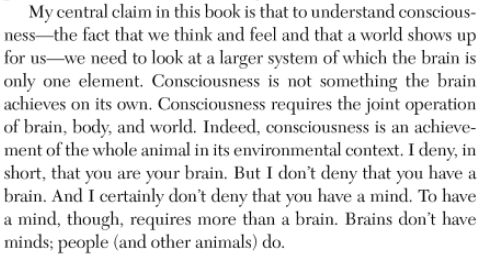
In sum, the question of ‘ensoulment’ is purely theological. On the question of ‘Consciousness’ Alva Noe provides the reader with this:
The synergy between Brain,Body and World, as presented by Noe isn’t freighted with Theological/Philosophical baggage, The second quoted paragraph of Prof. Wolfe’s essay is awash in that very particular baggage.
This union of Theology, Philosophy, and the Metaphysics common to both these ways of viewing the world, and the place of humans in it, was a challenge to this reader. As was Christopher J. Insole’s ‘The Intolerable God : Kant’s Theological Journey’ another Professor of Philosophical Theology.
As rewarding and challenging to my philosophical world view as Prof. Wolfe’s essay was, the final paragraph using Wittgenstein’s ‘therapeutic release into life’ hitched to ‘the peculiarly human itch to flay our skin with Occam’s razor‘ is
Ultimately, this would come as no surprise to Cottingham. His book (in the words of its subtitle) is a “philosophical essay”, not in the analytic sense of a demonstration but in Wittgenstein’s of a therapeutic release into life. Only for Cottingham, the question of God is not a distraction, but part of a therapy capable of releasing us from the peculiarly human itch to flay our skin with Occam’s razor.
The Austinian temperament of Wittgenstein, and his venerated musings… He was a misfit, like Kierkegaard, though not an actual rebel, but a particular kind of egoist. I am a misfit, who came late to the self-acceptance of that status. Perhaps my insights can be useful , or just an expression of my own egotism?
The ‘radically unavailable president’ of the headline writers, Mr. Ganesh celebrates in the more sedate ‘the bolder stratagem of unavailability‘. Biden apologetics, in his telling looks away from the Blinken faux pas with the Chinese, meant to demonstrate ‘toughness’ ? Blinken is not a diplomat, but a New Cold War Ideologue. And Joe’s being goaded/manipulated by New Democratic Loyalist Stephanopoulos into calling Putin a ‘killer’! Putin recalled the Russian Ambassador for consultations. Putin’s response, as reported in The New York Times is telling!
“When I was a child, when we argued in the courtyard, we said the following: ‘If you call someone names, that’s really your name,’” Mr. Putin said, quoting a Russian schoolyard rhyme. “When we characterize other people, or even when we characterize other states, other people, it is always as though we are looking in the mirror.”
The Ganesh View of Biden doesn’t confront the fact that the president can’t even climb the stairs to his jet, but he meets Mr. Ganesh’s ‘the bolder stratagem of unavailability‘. Mr. Ganesh needs to sharpen his skills as Biden Apologist. Perhaps a re-read of that Edward L. Bernays classic of 1928?

 StephenKMackSD's Blog