And both Democrats and Republicans generally agree that the country would be better off with fewer pregnant teenagers, fewer unwanted children, fewer absent fathers, fewer out-of-wedlock births.
Where cultural liberals and social conservatives differ is on the means that will achieve these ends. The liberal vision tends to emphasize access to contraception as the surest path to stable families, wanted children and low abortion rates. The more direct control that women have over when and whether sex makes babies, liberals argue, the less likely they’ll be to get pregnant at the wrong time and with the wrong partner — and the less likely they’ll be to even consider having an abortion. (Slate’s Will Saletan has memorably termed this “the pro-life case for Planned Parenthood.”)
The conservative narrative, by contrast, argues that it’s more important to promote chastity, monogamy and fidelity than to worry about whether there’s a prophylactic in every bedroom drawer or bathroom cabinet. To the extent that contraceptive use has a significant role in the conservative vision (and obviously there’s some Catholic-Protestant disagreement), it’s in the context of already stable, already committed relationships. Monogamy, not chemicals or latex, is the main line of defense against unwanted pregnancies.
Government’s power over fertility rates is limited, but not nonexistent. America has no real family policy to speak of at the moment, and the evidence from countries like Sweden and France suggests that reducing the ever-rising cost of having kids can help fertility rates rebound. Whether this means a more family-friendly tax code, a push for more flexible work hours, or an effort to reduce the cost of college, there’s clearly room for creative policy to make some difference.
More broadly, a more secure economic foundation beneath working-class Americans would presumably help promote childbearing as well. Stable families are crucial to prosperity and mobility, but the reverse is also true, and policies that made it easier to climb the economic ladder would make it easier to raise a family as well.
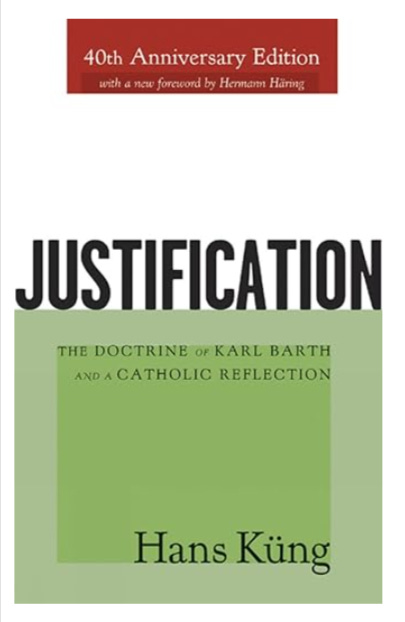
Editor: Note the primary problem as presented by Douthat is couched in the long dead Ultramontane Chatter of another time and place, and held aloft by decadence? Do Karl Barth and Hans Kung of November 3, 2004offer the reader what is utterly absent from Douthat’s New York Times chatter?
Beneath these policy debates, though, lie cultural forces that no legislator can really hope to change. The retreat from child rearing is, at some level, a symptom of late-modern exhaustion — a decadence that first arose in the West but now haunts rich societies around the globe.It’s a spirit that privileges the present over the future, chooses stagnation over innovation, prefers what already exists over what might be. It embraces the comforts and pleasures of modernity, while shrugging off the basic sacrifices that built our civilization in the first place.
Such decadence need not be permanent, but neither can it be undone by political willpower alone. It can only be reversed by the slow accumulation of individual choices, which is how all social and cultural recoveries are ultimately made.
I have yet to read Robin Wigglesworth’s essay/news report, but I have read Mr. Edward. N. Littwak’s essay Hidden Costs at the Times Literary Supplement, August 19,2016 A review of The Panama Papers, that for it’s cast of characters, that includes Mr. Singer as a seeker after the his pound of flesh, President Macri of Argentina, and Cristina de Kirchner as clients of Mossack Fonseka. What was Argentina’s Neo-Liberal White Knight Mercri doing business where embezzler de Kirchner also did business? The Argentine Melodrama never ends, but there are more names of the politically respectable bourgeois politicians, and other civic actors…
Stayed tuned,
StephenKMackSD
2)
Poor Mr. Singer! The goose that laid the golden egg is kaput? Mr. Singer and his ilk produce nothing. He is not like the notorious Henry Ford, who at the least, paid his workers enough to buy the cars they produced on the assembly line! Ford produced a product that people bought, and provided jobs that enabled generations of Americans to purchase a home, to save for retirement, and put their children through school and even college. No matter Mr. Ford’s egregious beliefs, he did something that Mr. Singer and his investors cannot do, provide those jobs that built America and got us through two World Wars.
But times are now tough for the Vultures, as Capitalism, in it’s Neo-Liberal iteration, has collapsed, and what is on offer from the Elites, that the dread Populists are rebelling against, is the Utopianism of the TTP and the TTIP. Yet we as readers can see that this class of Capitalists relies on the ever shrinking detritus of a system mired in it’s own collapse. The Panama Papers demonstrates that both the Capitalists and their apologists in the Press, in Politics and Academia are wholly corrupt, or put bluntly, just on the take. So Mr. Singer’s dire warnings about an Economic ‘brokenness’ of the Bond Market: while we in America witness daily, the Sideshow of Clinton vs. Trump i.e. of two utterly loathsome self-seeking egoists vying to rule the ‘West’ garnished by the usual ‘the lesser of two evils’ bunk is just more bad news. Mr. Singer who makes Henry Ford look like a paragon of Capitalist Virtue, bemoans his lot: quelle dommage! In the vision of Ayn Rand the world is dived into producers and drones, so one might ask, what category does Mr. Singer fit into? Or to frame it in a way utterly antithetical to Rand, what tangible good does he produce? to frame it a language alien to the ‘Objectivism’ of Rand. The notion of ‘Objectivism’ being a stand in for greed. Perhaps we can turn to Hayek for the comforting news that the Market is the only really viable form of knowledge?
Editor: Never fear that The Economist under Beddoes has even surpassed that team of War Mongers Adrian Wooldridge and John Micklethwait of ‘The Right Nation: Conservative Power in America’ of May 31, 2005 that metaticised into:
At least 37m people made refugees by US ‘war on terror’
At least 37 million people have been displaced by the US “war on terror”, a new study has concluded. The details are contained in a damning report even as western nations continue to grapple with the influx of refugees from war-torn countries.
Creating Refugees: Displacement Caused by the United States’ Post-9/11 Wars was produced by Brown University’s Costs of War Project. It points out that the number of refugees “exceeds those displaced by every war since 1900, except World War Two.”
Highlighting the devastating impact of the now two-decade long “war on terror” the study concluded that 37 million refugees is a “very conservative estimate” and that the real figure could be as high as 59 million.
While the report accounts for the number of people, mostly civilians, displaced from countries targeted by the US in its “war on terror”, such as Afghanistan, Pakistan, Somalia and the Philippines, Middle East countries make up the highest number of refugees. With 9.2 million displaced in Iraq, the 2003 US invasion of the Arab state is seen as the main catalyst for the refugee crises.
“Since the George W. Bush administration launched a ‘global war on terror’ following Al Qaeda’s September 11, 2001 attacks on the United States, the US military has waged war continuously for almost two decades,” said the report. It added that US forces have fought in as many as 24 countries in that time.
Editor : Beddoes cadre of would be ‘Democrats’ within Iran :
…
At less risk, America could help end the communications blackout imposed by the regime, by smuggling Starlink kits into Iran. One sign this matters is that security forces are hunting for those already in the country. The White House is also giving tacit support to an exiled opposition figure, Reza Pahlavi, the former crown prince, who fled from Iran when the shah was toppled in 1979. From a safe distance in Maryland he, too, has been urging protesters to rise up to bring democracy. In the absence of organised opposition inside Iran, perhaps the country could restore some form of monarchy, (see our interview with Mr Pahlavi).
However, just to run through the options shows how hard it will be for American action to succeed. If Mr Trump orders strikes, Iran is armed with a formidable battery of short- and long-range missiles that could hit back across the Middle East, leading to an unpredictable escalation—which is why countries there are warning against an American attack. A decapitation from the air would require exquisite intelligence against an adversary who is forewarned. Even with the ayatollah gone, a Caracas-style deal with the Revolutionary Guards is unlikely to create lasting stability, because grieving Iranians will yearn for vengeance against generals with so much fresh blood on their hands.
The new way of the world
The stakes are extraordinarily high. With Mr Trump in office, old certainties in geopolitics are melting away. His concern will never be to respect international law, nor to foster a club of liberal democracies. But, even as Iran is abandoned by its allies, China and Russia, he is readier than any recent American president to bring about big changes if he believes they will enhance America’s influence and his own prestige. Each intervention is a test of what sort of world that will create.
Once every popular uprising seemed to herald the birth of a new democracy. Alas, after the failures of the Arab spring, it is no longer easy to imagine that Iran’s path could be so simple. The hope nonetheless is that, in time, the collapse of the regime will favour Iran’s courageous people, who have proved once again that they are their country’s greatest blessing.
Editor : The final paragraphs of this essay wallow in a wan pastich of Anglicanism, for want of a better descriptor!
Newspaper Reader urges the reader to further her expoloration of this newpapers attachments: to Pax Americana & fear and loating of Trump/Trumpism: while employing Zionist War Mongers/Fellow travlers
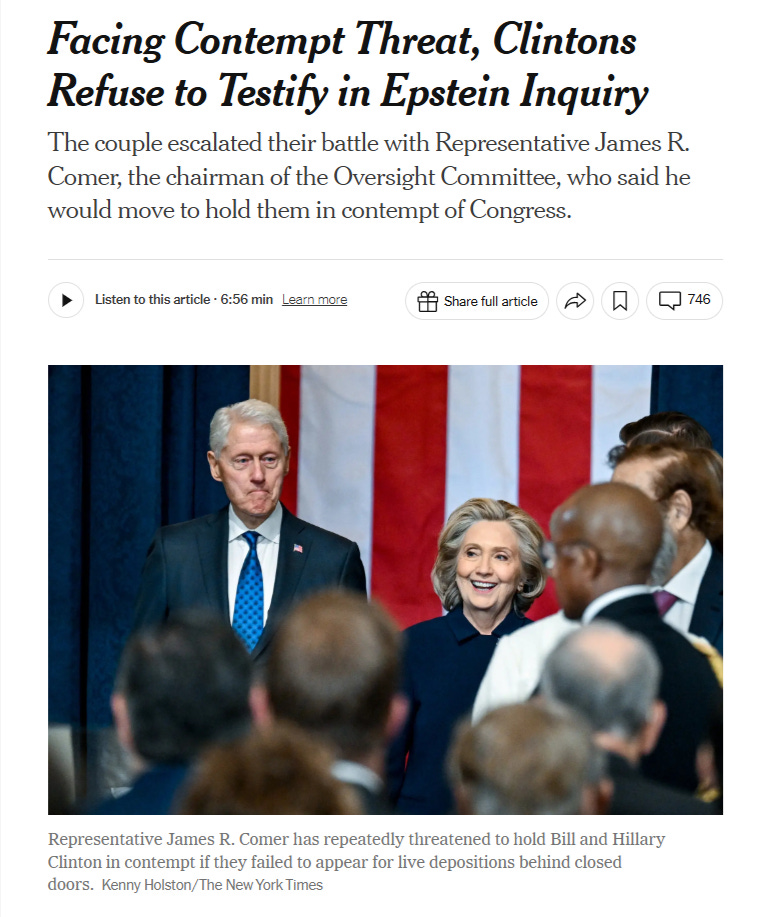
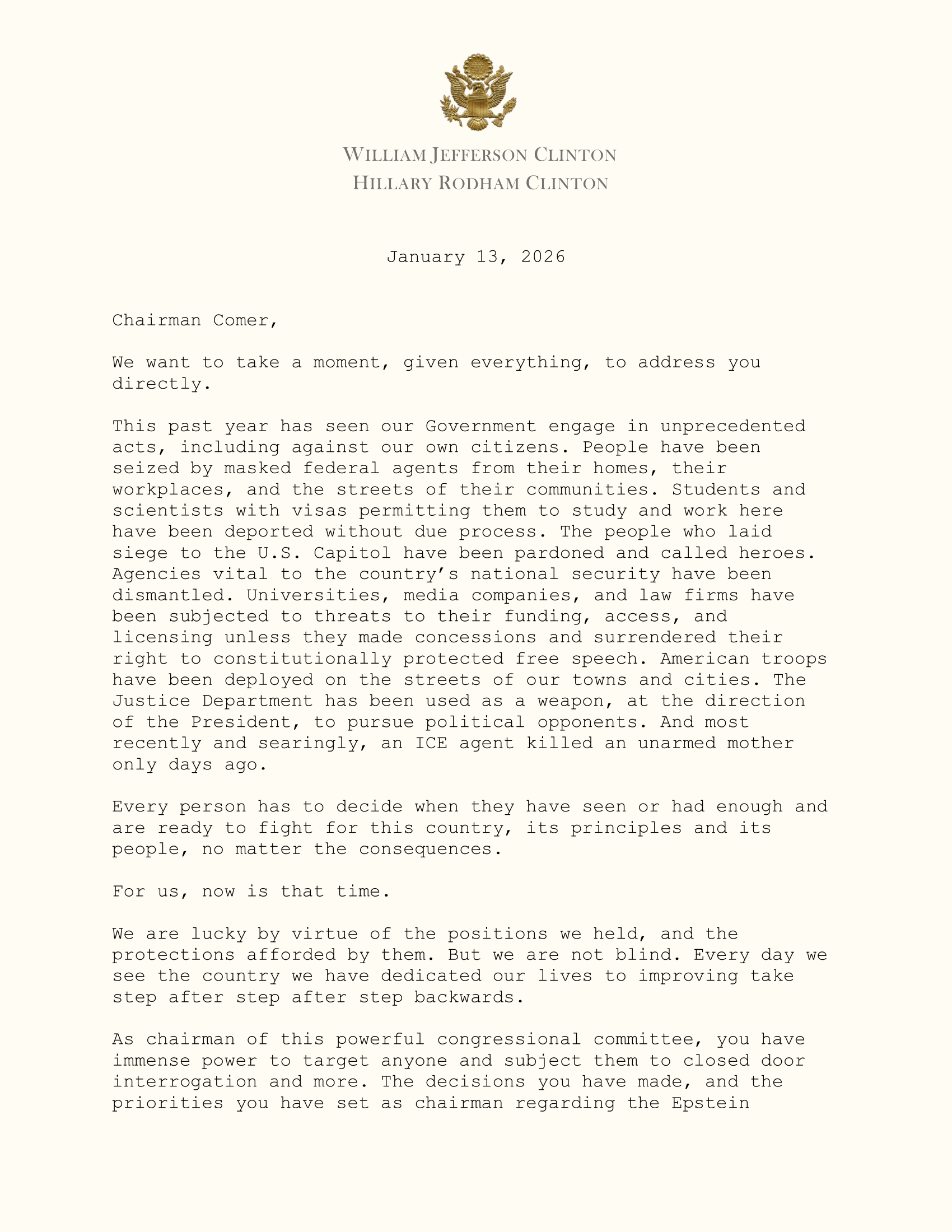
Bill and Hillary Clinton refused on Tuesday to testify in the House’s Jeffrey Epstein investigation, escalating a monthslong battle with its Republican leader, Representative James R. Comer of Kentucky, who quickly said he would take steps to hold them in contempt of Congress.
“Every person has to decide when they have seen or had enough and are ready to fight for this country, its principles and its people, no matter the consequences,” the Clintons wrote in a lengthy letter to Mr. Comer, the chairman of the House Oversight Committee, which was obtained by The New York Times. “For us, now is that time.”
Bill and Hillary Clinton wrote a lengthy letter to Representative James R. Comer of Kentucky, the Republican chairman of the Oversight Committee, refusing to testify in Congress.
Mr. Comer’s relentless efforts to force them to testify reflect his overall approach to his panel’s Epstein inquiry. He has sought to deflect focus from President Trump’s ties to the convicted sex offender and his administration’s decision to close its investigation into the matter without releasing key information. Instead, he has worked to shift the spotlight onto prominent Democrats who once associated with Mr. Epstein and his longtime companion Ghislaine Maxwell.
“Jeffrey Epstein visited the White House 17 times while Bill Clinton was president,” Mr. Comer said on Tuesday, speaking to reporters after holding Mr. Clinton’s scheduled deposition with a chair left empty to call attention to the former president’s absence. He added: “No one’s accusing Bill Clinton of anything, any wrongdoing. We just have questions.”
Mr. Comer has repeatedly threatened to hold the Clintons in contempt if they failed to appear for live depositions behind closed doors, typically a first step in referring someone to the Justice Department for prosecution. He had set a deadline of Tuesday for Mr. Clinton to appear, and Wednesday for Mrs. Clinton.
But hours before the deadline, the Clintons made clear that they had no intention of presenting themselves on Capitol Hill to be questioned by Mr. Comer and members of his committee. They did so by submitting an eight-page legal letter laying out why they considered the subpoenas “invalid and legally unenforceable,” then followed up with a scorching missive that they signed jointly, promising to fight Mr. Comer on the issue for as long as it took.
…
Editor:The Clinton Victimhood:
Mr. Comer’s insistence over months that the Clintons appear, the lawyers said, “brings us toward a protracted and unnecessary legal confrontation.”
Citing specific case law about congressional subpoenas and constitutional precedents, the lawyers wrote that the subpoenas were nothing more than “an effort to publicly harass and embarrass President and Secretary Clinton and an impermissible usurpation of executive law enforcement authority.”
The committee’s attempt to compel the Clintons to testify in person ran afoul of limitations on Congress’ investigative power that have been outlined in cases before the Supreme Court, the lawyers said.
And they noted that the Supreme Court had stated in the past that there must be a “nexus” between the investigations’ legislative aims and the witnesses from whom information was sought. Mr. Comer had not established why the Clintons’ appearance would be relevant, they said.
The lawyers encouraged Mr. Comer to “de-escalate this dispute.”
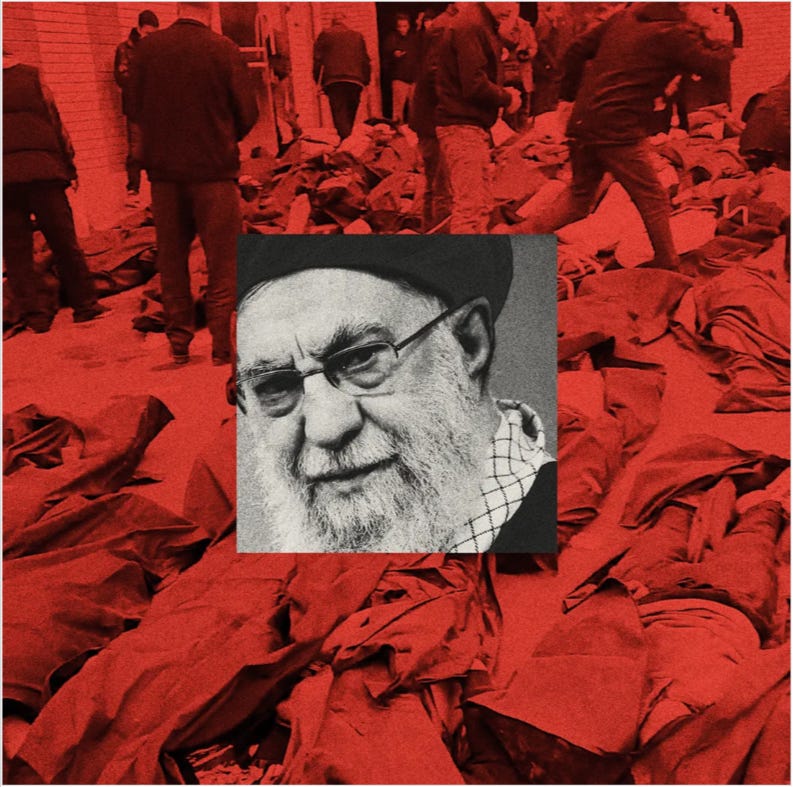
Reader look at the picture of Beddoes that predomintes her latest War Mongering Propaganda!
Where does Iran go from here?
Zanny Minton Beddoes
Editor-in-chief
Two months ago I asked readers of this newsletter whether they thought Iran’s regime would survive the next five years. The results showed a near dead heat: 38% of voters thought the Islamic Republic would endure, 39% thought it wouldn’t and the remainder weren’t sure. Given the scale of the protests in recent weeks, the horrific violence of the crackdown in the past few days and the possibility of American intervention, I’d like to hear if our subscribers’ predictions have changed—please cast a fresh vote in our poll. How will it all end? That’s what I want to explore in tomorrow’s Insider show.
Iran has been shrouded by a state-imposed digital blackout since January 8th, making it difficult to accurately assess the scale of the protests and the brutality of the authorities’ response. But the information that has emerged—often via Iranians’ patchy access to illegal Starlink terminals—suggests that thousands have died so far. Washington DC, where I have been this week, is full of speculation about how and when Donald Trump might intervene. He has promised on Truth Social that “help is on its way”. It is hard to see how military force can directly help those demonstrating on the streets. Striking installations of the Islamic Revolutionary Guard Corps, for instance, is unlikely to paralyse the regime. Large-scale attacks could cause significant casualties. Nonetheless, if I were a betting person, I’d wager that Mr Trump will do something.
To help make sense of what has happened so far—and what might come next—I’ve invited two of our Middle East correspondents, Nick Pelham and Gregg Carlstrom, and Adam Roberts, our new foreign editor, to take part in tomorrow’s Insider show. They’ll join Edward Carr, my co-host and deputy editor, as we consider Iran’s path forward. Nick and Adam visited Tehran only two months ago and I want to ask them if they had an inkling then that this sort of unrest was brewing and how it compares with the protests of 2022 and 2009. Nick has been reporting on Iran for 25 years and has many contacts there. I’m keen to know if he’s managed to reach them and, if so, what he’s heard about the situation on the ground. While in Washington this week, Nick and I took the opportunity to talk to Reza Pahlavi, the former crown prince of Iran and son of the last shah, so we’ll also be hearing from him during the show. Some protesters have been calling for the return of Mr Pahlavi, who reportedly met with Steve Witkoff last weekend, but is he really a credible alternative to the ayatollahs? I’ll be asking the panel to weigh in.
My colleagues and I will also assess the likelihood and prudence of foreign involvement in Iran. What would a Trumpian intervention look like? Perhaps an attempt to repeat a Venezuela-style raid? Perhaps a back-room deal is being cooked up with some elements of the regime? Mr Trump will be attending the World Economic Forum in Davos next week, making a big speech in front of the business world’s elite. I can imagine how he would relish the opportunity to show off American power once again.
I’ll wrap up tomorrow’s show by asking my colleagues what they expect to see happen now. The situation in Iran is highly uncertain, but what are the possible scenarios? Is a democratic transition still a pipe dream? Are there figures within the regime who could bring about change? My team will be answering these questions and yours too. Please tell us what you want to know via the Q&A feature on the episode page and, once you’ve watched the show, please write to me with your thoughts at insider@economist.com. See you tomorrow.
Scott Ritter & Allies offer alternatives to Beddoes War Mongering !
Scott Ritter: Iran’s Missiles will DESTROY US Bases & Israel if Trump Attacks
Headline: Venezuelans believe Donald Trump has offered them a better future
Sub-headline: An exclusive poll for The Economist also reveals an overwhelming desire for democracy
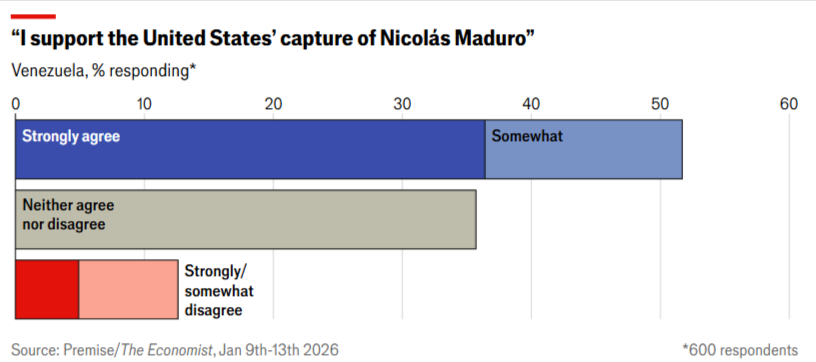
SEEN FROM Caracas, the capital of Venezuela, the small hours of January 3rd were terrifying. Bombs fell, helicopters and planes roared overhead and confusion reigned. By dawn perhaps 100 people were dead and Nicolás Maduro, the country’s authoritarian leader since 2013, had been seized by American special forces. Yet shock and fear quickly gave way to something else: happiness. According to exclusive polling for The Economist by Premise, a research firm based in Virginia, Venezuelans inside the country are pretty pleased with the dramatic turn of events, even if their vision for its future differs from that of President Donald Trump.
The survey offers one of the first glimpses of Venezuelans’ reaction to the snatching of Mr Maduro. Conducted via mobile app, it asked 600 Venezuelan residents their views on the raid, their expectations for the future and their opinions of various figures. The results are weighted by age and sex to reflect the national population.
Editor : The Reader needs only read the highlited paragraph to view this wan attempt at providing ‘data’, Conducted via mobile app assomehow indictive of the reality of what Venezuelans actually think? Maduro abduction by American Thugs is heaverly garnished with more ‘data’, see the attached … what to name it but Propganda?
Editor: this is a Propganda Behemoth created by 600 respondents …
Editor: Reader Note that Binyamin Netanyahu is a defendent in The Iternational Criminal Court Case: The particulars below:
About Defendant
Mr Benjamin Netanyahu, born on 21 October 1949, Prime Minister of Israel at the time of the relevant conduct.
Arrest warrant issued on 21 November 2024
Accused LastName
Netanyahu
Accused FirstName
Benjamin
Charges
Allegedly responsible for the war crimes of starvation as a method of warfare and of intentionally directing an attack against the civilian population; and the crimes against humanity of murder, persecution, and other inhumane acts from at least 8 October 2023 until at least 20 May 2024.
Episode summary ( Editor: provided by The Economist)
Binyamin Netanyahu, Israel’s prime minister, says he wants to be remembered as a leader who helped secure the country’s future. With three stretches in office under his belt—and getting ready to fight for reelection again this year—does he think he’s succeeding? Zanny Minton Beddoes, our editor-in-chief, and Edward Carr, deputy editor, travelled to Jerusalem to put the question to the prime minister directly. They ask him about his approach to domestic division, the threats Israel faces abroad, and whether his grip on power is helping or hurting the country he claims to protect.
Editor: It doesn’t take long for the Reader to become aware of the attempt at a kind of obtuse manipulation, via the utter absence of a readable, reliable and searchable transcript! Which renders this Economist essay as the only logical choice ?
Editor: the full text is this Economist essay is below:
Editor: Reader note that Zanny Mention Beddoes was one of Jeffrey Sacks cadre of Neo-Liberals who desended on the remaines of the Soviet Union!
Dr. Jeffrey Sachs, Shock Therapist
By Peter Passell
June 27, 1993
…
And even his sympathizers acknowledge that Sachs’s high profile and world-class impatience could generate a backlash in a nation still adjusting to the reality that it is no longer a superpower. “There’s a real dilemma here,” says Stanley Fischer, an international economist at the Massachusetts Institute of Technology. “You have to make a lot of noise to get the attention of the West. But the more noise you make, the more you make it seem that the reform program is a Western program. And that could be the kiss of death.”
Still, Sachs’s brand of “shock therapy” has worked elsewhere. And there is good reason to believe that Russia’s future will turn on how well its leaders learn the catechism of change that he has worked so hard to promulgate.
…
Editor: After listening to the full interview with Netanyahu, Beddoes’s questions are at points interesting, and even pointed, though, not to the point of making Netanyahu uneasy. Though she does become heated, when discussing the suffering/deaths of the Palistinians! Beddoes even uses the epithet ‘Lefties’, though discarding it as indicative of another time and political place? Netanyahu is an adroit politician, yet he is and remaines a War Criminal, finanaced by American Money and courted by Beddoes and Edward Carr.
Newspaper Reader.
Editor: The full text of this Economist shortened version above:
Headline: Binyamin Netanyahu’s plan to win Israeli—and global—hearts and minds
Sub-headline” Israel’s longest-serving prime minister is determined to regain his nation’s trust and restore its image abroad
Binyamin netanyahu will be leading the Likud Party in a general election for the 12th time this year. He is already Israel’s longest-serving prime minister, having spent a total of over 18 years in office. If he wins, he could become the longest-serving leader of any democracy since the second world war.
The election date has yet to be set, but speaking to The Economist in a filmed interview for “The Insider” on January 8th in Jerusalem, Israel’s prime minister was very much in campaign mode. One focus is his quest for another term. “As long as I believe that I can secure Israel’s future, to which I’ve devoted my life, both as a soldier and as a politician, as a statesman, then I’ll do so,” he says. Yet in most polls his coalition of nationalist and religious parties is well short of a majority.
Mr Netanyahu is also determined to restore his country’s international standing. Israel has emerged from the two years of war in Gaza with a gravely tarnished global image: not just among its habitual critics but also among many of its former supporters in the West, shocked by the destruction of much of Gaza and the deaths of over 70,000 Palestinians.
“I’d like to do everything I can to fight the propaganda war waged against us,” he says. “Basically, we’ve been using cavalry against f-35s, because they’ve flooded the social networks with the fake bots and many other things.” One early move, he says, could be for Israel to give up the subsidies from the United States that it uses to buy American arms.
Mr Netanyahu built his political career on his swashbuckling speeches and interviews with the international media, going back to his days as ambassador to the un in the 1980s. That reflects his belief that the way for Israel to influence governments is by winning the battle for public opinion. It is a battle Israel is losing.
The prime minister complains that Israel has been subject to unreasonable scrutiny. “I doubt that Churchill could pursue World War Two if people saw what happened there,” he says. “You’re holding this democracy, this beleaguered democracy, to an impossible standard.”
He also blames prejudice against Jews. “In the Middle Ages we were poisoning the wells, we were spreading vermin, we were slaughtering Christian children for the Passover festival using their blood…The vilifications that were delivered on Jewish people are now delivered on to Jewish state.”
He expects the ceasefire in Gaza to help. “The minute the intense fighting stops,” he says, “then the focus of international media and the horrible reporting, often absolutely false reporting that takes place there—the ease with which propaganda takes over facts, or fact checking—that dissipates.”
Mr Netanyahu will also seek to remove potential friction between Israel and its chief ally, America. In the interview the prime minister revealed that he is not seeking the full renewal of the ten-year American military assistance package, which currently stands at $3.8bn annually and needs renegotiating in 2028. For the first time in public, he talked about tapering American aid to zero over ten years. He insisted that he “will continue to fight for the allegiance of the American people”. However, President Donald Trump famously dislikes handing over money, and parts of his maga movement are increasingly critical of Israel.
Last, Mr Netanyahu believes that he can persuade Western voters that they misunderstand the nature of the struggle Israel is waging. “There is a huge battle today between the forces of civilisation, the forces of modernity,” he says. “Very fanatic forces…want to take us back to the early Middle Ages and do so with a violence that is unimaginable. You’ve seen these pictures of people cutting open the chest of an enemy, these Islamists, tearing out the heart. The person is still alive and eating the heart.” The reality, he argues, is that “Israel is defending itself, but in so doing, we’re defending Western civilisation.”
Those are strong claims, but Mr Netanyahu has been using such arguments for decades, which may make them less effective. In addition, while there is some truth to them, they are less powerful when set against the horrors endured by the Palestinians inside Gaza.
To further complicate the prime minister’s task, his message abroad will sometimes run into his election campaign at home. For example, settlement expansion in the West Bank has risen sharply during his term, as has settler violence. Members of his government are calling for annexation.
Yet, asked whether this is an area of disagreement with Mr Trump and Israel’s potential Arab partners, Mr Netanyahu deflects. Mr Trump has in the past been willing to contemplate annexation, he says. And, as for Arab leaders, he predicts an expansion of the Abraham accords. “In private conversations, you want the truth? I mean beyond the regular things? Many of them don’t give a hoot,” he says. “They don’t care about the Palestinian issue. They care about its effect on the street.”
In the election Mr Netanyahu will also face questions about the economy and the role of Israel’s growing ultra-Orthodox community. The economy has recovered from the war remarkably well, to a large degree thanks to continuing foreign investment in the Israeli tech sector and strong demand for Israeli weapons systems, especially from rapidly re-arming Europe.
Israel’s technological edge relies on a small, talented and mobile part of its 10m population, who are mainly from the secular and centrist parts of Israeli society, which are opposed to the current government. Mr Netanyahu brushes off the reports of an incipient brain drain as “ridiculous”. But others, including Naftali Bennett, his main challenger in the election, warn that the threat is real and dangerous.
By contrast, Israel’s ultra-Orthodox parties are Mr Netanyahu’s political allies. Their voters receive excessive social benefits, even though many of them refuse to enlist for military service in a time of war. Many ultra-Orthodox men do not work.
Asked about their role, he argues that ultra-Orthodox women do work and says that he will pass a law encouraging men to serve in the army. He wants to “enable the recruitment of this community”, he says, “but at the same time enable the select few to study the Torah.” That is likely to please nobody—being too much for the ultra-Orthodox and too little for everyone else.
How much time the prime minister has to dedicate to his two campaigns, for re-election and to restore Israel’s international reputation, will be partly determined by events in Iran, where mass protests are threatening to engulf the Islamic regime. For years Mr Netanyahu has called for international action against Iran. During the 12-day war that Israel and America waged on Iran last June, he flirted with regime change. Only last week in a meeting with Mr Trump he secured a public commitment from the president to join Israel in more strikes if Iran moves to rebuild its nuclear programme and continues building ballistic missiles.
Speaking to The Economist, however, Mr Netanyahu was surprisingly reticent about both Iran and Mr Trump. “It may be a moment where the people of Iran take charge of their own destiny,” he observes. “Revolutions are best done from within.” He neither endorsed nor rejected Mr Trump’s threats to act against the regime if it continues gunning down protesters.
His sudden restraint may be a response to warnings of Israeli intelligence officials in recent days that Iran may “miscalculate” and launch an attack on Israel in an attempt to divert the anger of its own people. “I’ll tell you one definite time when we would resume our military activities,” he says. “If Iran attacks us, which they might, then there will be horrible consequences for Iran. That’s definite. Everything else, I think we should see what is happening inside Iran.”
Hanging over both campaigns is the devastating Hamas attack in October 2023. International sympathy for Israel depends on people understanding that it was the greatest trauma in the country’s history. At home the election is likely to be a referendum on whether voters hold Mr Netanyahu responsible for what befell them.
Asked about how Israel was caught unawares, Mr Netanyahu says he is ready to answer questions to an inquiry which he has yet to set up. However, he avoids using the word “responsibility” and is quick to spread the blame to the intelligence services and the rest of his cabinet. The failure of October 7th was indeed a collective one. However, a man who has run a country for so long will find it hard to claim credit for all its successes while avoiding blame for its catastrophes.
Editor: Reader notice that Edward Carr plays a minor role in the questioning of Netanyahu, he is usable baggage? And that Zanny Minton Beddoes wan attemps to confront this War Criminal, and her civility resembles a kind of passive acceptance of Netanyahu Zionist Party Line! Her hope is for further interviews?





 StephenKMackSD's Blog