Here is Elizabeth Drew’s latest essay in the New York Review of Books, Can We Have a Democratic Election? In which she raises many important questions that escape the ‘pundits’ who are covering the campaign as a ‘horse race’. She asks some basic questions that escape the handicapping mentality of her competitors, in the forth estate. That is what gives this essay it’s political resonance: her arguments are powerful, her reasoning hard to refute. She also describes a Republican Party, in the states, as engaging in a concerted campaign of ‘voter suppression’, and the devastating effects of the Citizens United Supreme Court decision.
The Republican Party in desperation after the defeat of 2008 has progressively descended into political nihilism, using the idea of ‘voter fraud’ as rationale for restrictive laws that demand state issued ID’s, in order to cast a vote. No voter fraud has been demonstrated, but the laws were passed in the name of protecting the electorate, from a pernicious problem that does not exist. The young,the poor,black folk and students generally vote Democratic, so that restrictive election laws aimed at these groups make perfect sense, in the domain of Rovian politics.
On the Citizens United decision, one must just recall John Roberts thrilling encomium to stare decisis before the Senate Judiciary Committee, as not just a tribute to his intellectual brass,and mendacity but as simply a eulogy to that legal workhorse, when political motive rules the day. Have I gone too far in the arena of respectable bourgeois political commentary?
If the Republican Party is at the end of it’s political rationality, and Barack Obama asserts the right to execute American citizens by presidential fiat, to attack ‘terrorists’ by the use of drones, wherever they may seek refuge, and NDAA has been passed by Congress and signed into law by the president, which weakens habeas corpus protections: where are we as citizens?
Editor: A revelatory quotation from the final paragraphs of Elizabeth Drew’s essay:
…
Citizens are now faced with evidence of the growing power of organized moneyed interests in the electoral system at the same time that the nation is more aware than ever that the inequality among income groups has grown dramatically and economic difficulties are persistent. This is a dangerous brew. Political power is shifting to the very moneyed interests that four decades of reform effort have tried to contain. The election system is being reshaped by the Super PACs and the greatly increased power of those who contribute to them to choose the candidates who best suit their purposes. But little attention is being paid to the fact that our system of electing a president is under siege. While the political press is excitedly telling us how the polls on Friday compare with the ones on Tuesday, little notice is taken of the danger to the democratic system itself.
Much of the citizenry has become more restive—less accepting of the way things are. Can an election that’s being subjected to such seriously self-interested contortions be accepted by the public as having been arrived at in a fair manner? And what will happen if it can’t?
Editor here are more of Elizabeth Drew’s commentaries:
Editor: I will focus my attentions on the final paragraphs of Stephens diatribe!
…
Iran’s traumatized protesters might have been energized by a U.S. attack when they were still in the street; they would probably be unwilling to risk their necks again. The regime has surely learned the lesson of Israel’s successful strikes last June against its top commanders and is hiding its leaders much more effectively. Last year’s Israeli strikes on Iran’s ballistic missile sites did not keep Iran from restarting production lines once the war had ended. And a U.S. attack, even one that carefully spares civilians, will also reinforce the regime’s propaganda about perfidious Uncle Sam.
Weighed against all this is a different set of risks: of the example of a U.S. president who urged protesters to go in the streets and said help was on the way only to betray them through inaction; of missing the opportunity to cripple an enemy when it is vulnerable, uncertain and — despite its show of force — internally divided; of giving it time to recover its strength, knowing that when it does it will again pose a clear and present danger to the United States and our allies.
And something else: Do we really want to live in a world in which people like Mohseni-Ejei, the judicial leader, can terrorize people with utter impunity? Have decades of vowing “Never again” — this Tuesday marks the anniversary of the liberation of Auschwitz — taught us nothing more than to offer pro forma condemnations when thousands of protesters are gunned down by modern-day Einsatzgruppen?
I know that, for now, thoughtful Americans are much more alarmed by the thuggish killing in Minneapolis on Saturday of Alex Pretti and by the smears to which he’s been posthumously subjected by senior members of the administration. I also know that the president who is so grotesquely at fault for inflaming the situation in Minnesota makes an unlikely champion of protesters in Iran.
But if Pretti’s death is a tragedy, what do we say or do in the face of the murder of thousands of Iranians? Are they, as Stalin might have said, just another statistic?
Editor: The Reader doesn’t need to wonder about the crass moral reductionism, of the the final paragraphs of Stephen’s attempt, at what to mame it? The Reader need only look too the Western amimus to the birth of the Iranian Revolution. Keeping in mind the murder of Iranian Scientests by Mossad, and the fact that Western Powers nurture the internal dissident’s that Stephens presents as heroic figures. ‘Pretti’s death’ is reduced to mere background to the heroism of Iranian Dissidents!
Iranian Revolution, popular uprising in Iran in 1978–79 that resulted in the toppling of the monarchy on February 11, 1979, and led to the establishment of an Islamicrepublic. It involved the participation of a wide range of Iranians—from the secular left to the religious right—who sought an end to the shah’s autocracy and Western interference in the country’s policies. The revolution found expression in the form of Shiʿi Islam, which many supporters considered to be a unifying element of Iranian identity and culture, and ultimately in the guidance of Ruhollah Khomeini, an accomplished religious scholar critical of the shah who had articulated, as an alternative, a populist form of government overseen by a spiritual authority.
We’re offering Stephen Graham’s powerful exposé of how political violence operates through the spaces of urban life, Cities Under Siege, as a free download. Discount applies in-cart.
Cities are the new battleground of our increasingly urban world. From the slums of the global South to the wealthy financial centers of the West, Cities Under Siege traces the spread of political v…
Editor: Reading, or in reality reciting to myself ‘Kants Late Philosophy of Nature’ in the Cambridge Elements series.
Kant’s final drafts, known as his Opus postumum, attempt to make what he calls a ‘transition from the metaphysical foundations of natural science to physics.’ Interpreters broadly agree that in this project Kant seeks to connect the general a priori principles of natural science, as set out in the major critical works, to the specific results of empirical physics. Beyond this, however, basic interpretative issues remain controversial. This Element outlines a framework that aims to combine the systematic ambition of early twentieth-century readings with the rigor of more recent studies. The author argues that a question that has animated much recent scholarship – which ‘gap’ in Kant’s previous philosophy does the Opus postumum seek to fill? – can be profitably set aside. In its place, renewed attention should be given to a crucial part of the manuscript, fascicles X/XI, and to the problematic ‘arrival point’ of the transition, namely, Kant’s question: What is physics?
A Celebration of Life was held for Michael and Graciela at the Frances Arrillaga Alumni Center on June 10. Please enjoy a video recording of the event.
The Stanford Philosophy Department mourns the passing of our colleague, the prominent philosopher Michael L. Friedman, who died at Stanford Hospital on March 24, 2025 after a long illness. He was 77. Friedman was the Suppes Professor of Philosophy of Science at Stanford until his retirement in 2024.
Friedman (Ph.D. Princeton, 1973) had been our colleague in Stanford Philosophy since 2000. He taught previously at Harvard (1972-75), the University of Pennsylvania (1975-82), the University of Illinois at Chicago (1982-94), and Indiana University (1994-2000), where he served as Chair of History and Philosophy of Science. He also held visiting positions at Harvard, UC Berkeley, Western Ontario, Konstanz, Oxford, and the Max Planck Institute for the History of Science in Berlin. He was made Fellow of the American Academy of Arts and Sciences in 2001, and was President of the Philosophy of Science Association in 2000. He was awarded the 1987 Lakatos Prize (for Foundations of Space-Time Theories), the 1985 Matchette Prize (for the same work), and the 2015 Fernando Gil International Prize in Philosophy of Science (for Kant’s Construction of Nature).
Michael Friedman was among the most incisive philosophical intelligences of our era, and his work left an indelible mark on the philosophy of science, on Kant studies, and on philosophy more broadly. His early work on space-time theories and on unification-based theories of scientific explanation was broadly influential. Noteworthy highlights include the Lakatos prize-winning Foundations of Space-Time Theories (1983) and the widely cited paper “Explanation and Scientific Understanding” (J Phil, 1974). Over time, his interests and his contributions steadily moved in the direction of greater historical depth. “Kant’s Theory of Geometry” (Phil Rev, 1985) initiated Friedman’s field-shaping intervention into Kant scholarship, and sparked a series of penetrating studies that found an early culmination in the landmark book Kant and the Exact Sciences (1992), which decisively reoriented Kant studies by restoring the systematic Kantian account of the foundations of exact scientific knowledge to its rightful central place in our understanding of the overall Kantian philosophy.
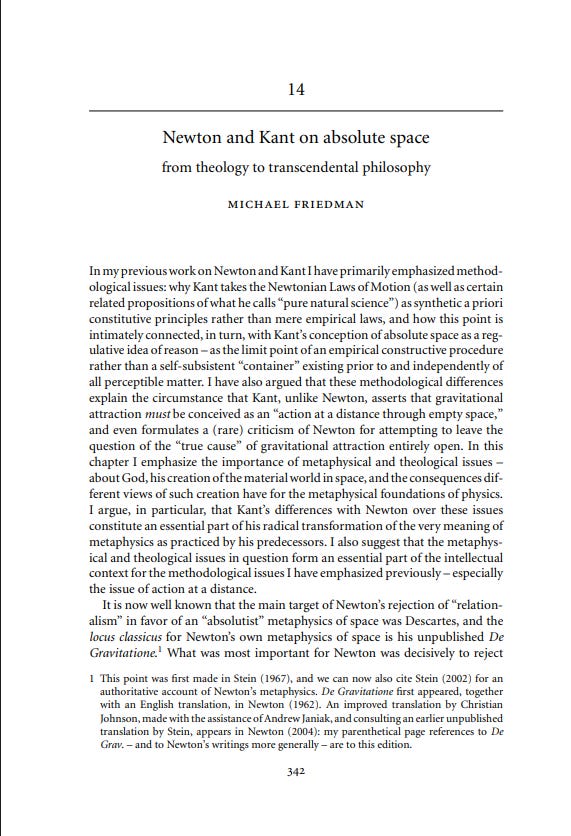
That project kicked off three decades of probing scholarship on Kant and Newton, which included a new translation of Kant’s Metaphysical Foundations of Natural Science (2004) and literally dozens of influential papers. The culmination of this historical work was Friedman’s monumentally detailed, Gil-prize-winning Kant’s Construction of Nature (2013), which probes the deepest and most technical details of Kant’s reconstruction of Newtonian science.
Through this research trajectory, Friedman remade himself into a scholarly historian of philosophy and science, with sensitivity to the historical actors’ own categories and the full strangeness of the past. But he never relinquished the aim of also deploying that historical depth in the service of his own novel explanations of scientific knowledge. Indeed, his historical work fed directly into his distinctive, neo-Kantian theory of the progress of science, which combined Kuhnian insights into the nature of revolutionary scientific change with Kantian ones about how a priori constitutive principles permit the formulation of well-framed scientific questions that can stand in exact relation to evidence. These ideas received initial expression in Dynamics of Reason (2001), work which began life as the 1999 Kant Lectures here at Stanford. The ideas continued to preoccupy Friedman, and a fuller and more detailed working out of the Friedman neo-Kantian conception of science was the subject of his 2012 Spinoza Lectures and his 2015 Isaiah Berlin Lectures at Oxford, as well as late papers and manuscripts on which he continued to work until his health gave out.
Friedman was also one of our major scholarly interpreters of the development of analytic philosophy and its connections to philosophy of science, with particular expertise on Carnap and logical positivism (Reconsidering Logical Positivism, 1999). In addition, he was a leading voice on the emergence of the split between “analytic” and “continental” philosophy. A Parting of the Ways (2000) shed decisive light on the previously under- or even unappreciated role played in that split by differing reactions to certain difficulties that arose in the research program of orthodox neo-Kantianism generally, and within Ernst Cassirer’s work, in particular.
Friedman’s major lecture series on the material about Cassirer, Carnap, and Heidegger, like the ones on the Dynamics of Reason material, were experiences of impressive rigor, remarkable erudition, and unforgettable intellectual excitement for those who were able to attend.
Friedman’s training touched literally dozens of students and postdocs, decisively shaping the intellectual trajectories of an exceptional group of younger scholars across the history of philosophy, the history and philosophy of the exact sciences, and contemporary philosophy of science alike. Many others of us who were never his students likewise benefitted as colleagues from his penetrating pressure and critique, and from studying his careful work. Readers can gain a sense of the depth and power of these intellectual connections from the remarkable 850 pp. volume Discourse on a New Method (2010), which brought together an impressive collection of students and colleagues to engage with themes from Friedman’s work. His own response to the contributors runs to over 200 pp., and should be considered another Friedman book in its own right.
Michael was preceded in death by his beloved wife and philosophical collaborator, our colleague Graciela de Pierris (1950-2024). He is survived by his mother, his sister, her two children, and his three grand nieces, as well as a wide circle of students, colleagues, and admirers worldwide.
Michael was a philosopher’s philosopher. He was immensely serious about our subject, and he was relentlessly demanding—both in the excellence he expected from his interlocutors (and himself), and in his recognition that knowledge and philosophical understanding are a never ending journey demanding continual improvement. As Kant rightly saw, the sort of systematic knowledge to which philosophy aspires is a regulative ideal, not an achieved fact. When one talked with Michael, philosophy was never far from the surface, whatever the ostensible topic.
His death is an enormous loss for our intellectual community here at Stanford, and for the world of philosophy.
Headline: An era of distrust emerges between the US and its Western allies
Sub-headline: Donald Trump’s suggestion that the US could seize Greenland by force has exposed the strategic isolation his administration has chosen, in disregard for the country’s commitments. Even though the Republican president abandoned the idea at Davos, the damage to US credibility is substantial.
Editor: Piotr Smolar opens with an Historical Pastish of a ‘Geopolitical Dictionairy’ entry of a imagined future, that loses its historical bite, after the first tourted paragraph! So much for French -what to name it?
One could imagine a concise entry in a geopolitical dictionary: “United States (1944-2025): a global power and leader of the Western bloc, relying on the dollar, an unmatched economy, a peerless military and its influence in the name of liberal values.”
Editor: Reader procede with caution! I will supply the reader with Piotr Smolar’s Cast of Characters, in various guises and self-serving permutations.
American greatness, Afghanistan and Iraq, American exceptionalism, the Davos conference, China, USAID, the US economy and military might, American goodwill, Denmark’s sovereignty,Article 5 of the charter of the North Atlantic Treaty Organization (NATO). Ukraine, Washington: the United Kingdom, Israel and Canada, Washington, Brexit, Keir Starmer, MAGA (Make America Great Again), France and Germany, Greenland, European Commission President Ursula von der Leyen, European Union, Israel, Gaza Strip, Israel launching strikes on three Iranian nuclear sites in June 2025, But Trump has sometimes clearly and sometimes brutally twisted Benjamin Netanyahu’s arm or ignored his comments, His vision is of a reconfigured Middle East, free from the Iranian threat, in which Israel and the wealthy Arab states must shoulder their responsibilities together and focus on commerce, In a remarkable patriotic awakening, spurred by Trump’s references to a possible “51st state,” the country is reconsidering its place in the Western world, Carney described a “rupture” underway, without naming the US directly, But the warning was clear: “Hegemons cannot continually monetize their relationships.” Trump appears to believe the opposite.
Editor: Reader at your leasure you can knit together this collection usable fragments, into a self-serving whole?
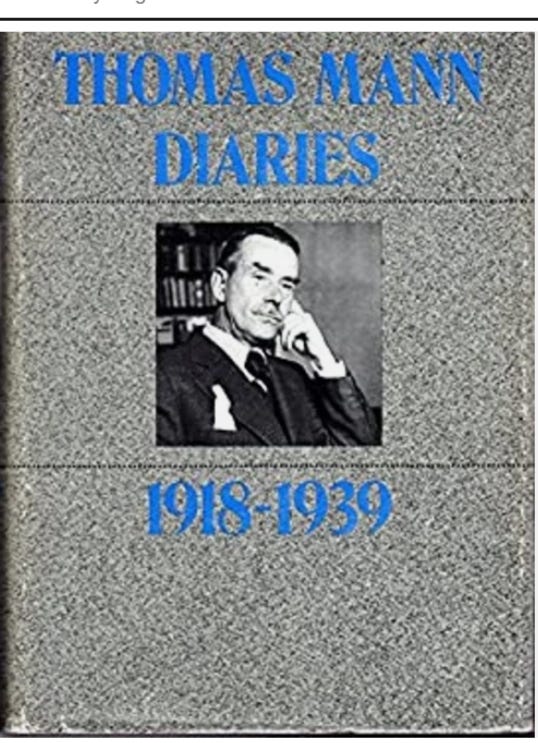
Editor: Here are the opening paragraphs of the perpetual, self congratulatory chatter of Bret Stephens, garnished via Thomas Mann. But carefully elided from the vision, the amerness of NYT reader, Mann’s sexual longing for other men! Reader look to the Diaries. Even though incompleat Stephens can’t erase Mann’s sexuality !
Decades before this Swiss village became famous as a pilgrimage site for global elites attending the annual meeting of the World Economic Forum, it was best known as a destination for well-to-do invalids seeking respiratory relief in the crisp Alpine air. It was that reputation that brought Thomas Mann to Davos (where his wife was convalescing) for a three-week visit in 1912, inspiring his great novel, “The Magic Mountain,” published 12 years later.
The book is set in the years before World War I, and one of its aims is to address the moral and psychological unraveling of European civilization on the eve of its catastrophe. At its heart lies a long argument between two fiercely held and fatally flawed worldviews. The first is represented by the character of Lodovico Settembrini, an earnest but naïve pacifist and internationalist. The second comes from Leo Naphta, a proto-totalitarian figure who thinks that the ideals of freedom are an illusion and that humanity’s “deepest desire is to obey.”
Both men are dying of tuberculosis. In the book’s climactic scene, they face off in a duel in which Settembrini fires his gun in the air and Naphta shoots himself — emblematic of the soft liberalism that lacks the nerve to defend its values, and the despotic will to power that ultimately destroys itself.
That could almost be Davos this week. Officially, the theme of this year’s meeting is “A Spirit of Dialogue” — emollient pablum to suit a modern-day Settembrini. Unofficially, we have entered the territory of Naphta — of open menace and nervous apprehension and calculations of available power. The underlying spirit of Davos this year is fear.
Editor: Reader in these paragraphs Stephens wallows in shopworn pastiche!
Editor: Gordon A. Craig offers a review of the duel biography of the Brothers Mann!
The Brothers Mann: The Lives of Heinrich and Thomas Mann, 1871-1950 and1875-1955. By Nigel Hamilton.New Haven, Conn.: Yale University Press, 1979. Pp. x+422. $16.95.
In one of his essays on French and German literature, Robert Minder has commented upon the distinction drawn in Germany between the Dichter andthe Literat. The former was a term of honor reserved for artists who dealtwith the great and abiding themes of human existence; the latter was alwaysfaintly derogatory and was reserved for writers who insisted upon concerningthemselves with social questions or problems of contemporary politics.That this was not only an artificial distinction used by people who compiledhandbooks of literature is shown by the lives of Heinrich and Thomas Mann.It played an important role in defining their relationship in the years whenthey were establishing their reputations as writers, and it was a source offriction and bitterness between them. Thomas disapproved, and was a bitcontemptuous, of his older brother’s strong democratic convictions and hisinability to leave them out of anything he wrote and, in 1908, in an essayentitled Der Literat und der Kiunstler, it was obviously of Heinrich that hewas thinking when he wrote patronizingly, “The Literat is radical, becauseradicalism means purity, nobility and profundity. . . . [He] is upright to thepoint of absurdity, he is honorable to the point of saintliness….” Heinrich,although with nothing of the censoriousness that often crept into his brother’sreferences to him, disapproved of Thomas’s refusal to become engaged inmovements critical of the course of Wilhelmine policy, and Thomas wassurely in his mind when he wrote in 1910 that for years the German artist hadbeen betraying his proper function either by silence or by unabashed ‘jus-tification of the unspiritual [and] sophistical exculpation of the unjust, . . . hisenemy to the death, Power.”The fragility of the relationship between the brothers reached its breakingpoint during the First World War, which Thomas Mann saw as a strugglebetween German Kultur, which he equated with honor, nobility, and moral-ity, and French ZiOilisation, which he associated with skepticism, the disso-lution of values, and cultural decay. He did not hesitate in his wartimewritings to indicate that he regarded his brother, whose Im Schlaraffenlandand Professor Unrat had attacked the materialism of the Second Reich andwhose essays “’Voltaire-Goethe’ (1910) and “Zola” (1915) had praised thesocial conscience of the great French writers, as a Zivilisationsliterat.This contorted and protracted Bruderzwist is the subject of Nigel Hamil-ton’s splendid double biography, and he has reconstructed it with careful attention to both the interesting parallelism of their literary production andthe contrast between what today would be called their life-styles, thebourgeois propriety of Thomas’s circumstances and the bohemian tendenciesof his brother. But the story he tells is one of a conflict ending in a reconcilia-tion, and the second half of his book is essentially the story of ThomasMann’s development after the First World War, his gradual acknowledgmentof the ideals his brother stood for, their participation, in different ways andwith different weapons, in the fight to save the Weimar Republic, and theirlife and activities in exile.Mr. Hamilton suggests (pp. 189-90) that we may see in the brothers Mann’the most significant literary brotherhood of all time,” not a mere collabora-tion like that of the brothers Grimm or one marked by the complementarycreativity of the Rossettis or the Bronte sisters, but one in which the tragicevolution and agony of a nation’s history was mirrored. “The tragedy,” hewrites, “was that history itself could not simply be reconciled, that theWeimar Republic was only paper thin, and the two sons whose quarrel andrapprochement had suggested such high hope for the destiny of Germany,were exiled, dispossessed and reviled as un-German.”These last words refer to the ironies that accompanied the last years of thetwo great novelists. When Heinrich Mann died in California in March 1950,he was an unknown in the land of his exile except to the few who remem-bered that he had some kind of a connection with Marlene Dietrich’s film TheBllie Angel. This was perhaps understandable. But although copies of hisbooks were selling by the thousands in the Soviet sector of Germany and inRussia itself, and although he was offered the presidency of the Academy ofArts in East Berlin if he would become a citizen of the DDR, his death wasgreeted with official silence in the Bonn Republic, despite his known recordas a courageous fighter for German democracy in the pre-Hitler years.His brother, meanwhile, was at the height of his literary fame, for theJoseph tetralogy had been finished in 1943 and Dr. Faustus, his parable onthe seductive power of Nazism, in 1947. Yet his refusal to return to Germanyas soon as the fighting was over made him the object of abuse from writerswho now sought to argue that their refusal to leave Germany during the Hitlerperiod was somehow nobler than his exile and that there was somethingfaintly treasonable about his anti-Nazi broadcasts during the war. When hedid go back for a visit in 1949 and, ignoring the division of the country, notonly lectured in Frankfurt am Main but went to Weimar to receive theFreedom of the city, he was accused in both the Bonn Republic and theUnited States of being a fellow-traveler, had a lecture that he had planned togive in the Library of Congress cancelled, and was attacked in the House ofRepresentatives as “one of the world’s foremost apologists for Stalin andcompany.” Hamilton’s point about the brothers’ lives mirroring history is,in short, as true for the Cold War as for the two bloodier conflicts that pre-ceded it.
Gordon A. Craig of Stanford Universitv offers this.
There is much evidence of his continued competitiveness, and his desire to be considered up to date is as strong as ever. Reading Beckett’s Molloy in Merkur, he writes: “Music after my time. A kind of Joyce discipleship,” but adds hastily that the comic element he finds in Beckett is not absent from his own work, as one can see in Felix Krull. He thinks often of Goethe, with whom he has long identified himself, and notes after being received by the Pope in April 1953, “Through the standing audience [I was] reminded of Napoleon with Goethe in Erfurt.” His jealousy with respect to honors is unappeased, and in May 1955 he is fretting because the West German Order Pour le Mérite, which he has been told will be offered him and “which lesser men have long worn,” may not arrive before his eightieth birthday.
Inevitably he worried about the slackening of his productive powers, writing in August 1953:
Took a pill and found peace for the night which has become the best part of the day. That’s the way it is when one survives oneself. When he was almost 70, Wagner wrote his concluding work, Parsifal, and died not long afterwards. At about the same age, I wrote my last work of consequence, the Faust, a concluding work in every sense of the word, but went on living. Der Erwählte (The Holy Sinner), still charming, and Die Betrogene (The Black Swan) are excess appendages…. What I’m leading now is an afterlife, which struggles in vain for productive supports. To regard the Krull as a Faust worth bringing to a conclusion, is hardly possible. [He did finish it, however, and 80,000 copies of it were sold before his death.] To go on living is a mistake, especially since I live mistakenly. Eating is a burden and a plague. My only comfort is smoking and drinking coffee, both bad for me.
He was not always so gloomy, and he was too busy to think much about death, and when the thought came his reaction was, on the whole, positive. In October 1954, he wrote: “Thinking about the erection of my bust in stone in a city square in Germany. Duration in sun, rain and snow. Peculiarly reassuring about death and fortifying existence. Death, where is thy sting.” In June 1955, after his eightieth birthday and six weeks before his death, it was life and his own fame that preoccupied him.
The word goes around that seldom or never has a person been so celebrated. Curious, curious. A remarkable thing this life.
Editor: Having read both Barbara W. Tuchman’s ‘The Guns of August’, published in 1962, and Philipp Blom’s ‘TheVertigo Years’published in August 1, 2008, represents not just a generational shift of nearly 50 years?
Editor: Bret Stephens continues to employ his meager execise in self-serving historical patisch!
All this recalls the diseased Europe that Mann sought to capture in “The Magic Mountain” — the one in which old conventions and pieties were evaporating under the heat of new ideas and new technologies, unfulfilled longings and uncontrollable rages. The cultural historian Philipp Blom called the era “the Vertigo Years” and noted the similarities to the present: “Then as now, the feeling of living in an accelerating world, of speeding into the unknown, was overwhelming.” What it wound up speeding into was, of course, a colossal civilizational tragedy.
Critics of the forum meetings like to point out that what happens up here is very far from ordinary life; that an annual confab of the very rich, powerful and influential (and the journalists dispatched to write about them) isn’t representative; that nothing good that happens in Davos is real and that nothing real that happens here is good.
But the Davos that Mann wrote about was not just a microcosm of civilization as it was but also a portent of what it was becoming.
Editor: The the whole of Europe fears ‘The Trump Monster’! But Eaton spies ‘opportinity’ for Tony Blaire’s feckless political catmite Starmer?
Morning Call: The Greenland crisis is an opportunity for Starmer
Donald Trump’s threats have given the Prime Minister a chance to reset his government.
George Eaton of The New Statesman :Jan 19, 2026
Good morning. The tariffs threatened by Donald Trump against the UK and seven other European countries prompted Keir Starmer’s strongest criticism yet of the president, when he declared them “completely wrong”. But does this mark a true turning point for the “special relationship”? That’s what I explore below.
It was in 2019 that Donald Trump first expressed his desire to acquire Greenland. Dismissed as an absurdity then, this expansionist aim now represents the biggest threat to the postwar Western alliance.
As recently as the start of this year some refused to grasp the full implications of what was unfolding. Kemi Badenoch described Greenland as a “second-order issue”; Peter Mandelson chided European countries for their “histrionics” over the territory. Yet not for the first time it was prudent to take Trump both literally and seriously.
Keir Starmer, who always knew that events could force him into a confrontation with the US president, has no option but to stand with Denmark. Territorial sovereignty and integrity are the reddest of red lines. Would those Maga-aligned conservatives who urge Britain to relent say the same of the Falklands? Trump could yet extend his imperial ambitions to those islands – and their untapped oil reserves – or consent to a takeover attempt by his populist ally Javier Milei (who recently reaffirmed Argentina’s claim).
For reasons of self-interest, as much as internationalism, then, Starmer cannot afford to equivocate on this fundamental point. “Any decision about the future status of Greenland belongs to the people of Greenland and the Kingdom of Denmark alone,” he declared at his Downing Street press conference this morning (while insisting, in a hostage to fortune, that Trump is not serious about military action). The UK, which already incurs a blanket 10 per cent tariff on most exports to the US and 25 per cent on steel, now faces further economic punishment: an additional 10 per cent rate on 1 February, rising to 25 per cent on 1 June if a deal is not agreed for “the complete and total purchase of Greenland” (though the US Supreme Court and Republican senators may yet come to Europe’s rescue).
Starmer’s remarks today confirmed that his basic approach to America has not changed. He refused to provide the Mark Carney moment that some crave, deriding “commentary and gesture politics that harm the British people”, and unusually citing the UK’s nuclear deterrent – dependent on US-leased missiles and technology – as justification for maintaining a “good relationship”. In contrast to Emmanuel Macron’s talk of a “trade bazooka”, he offered no hint of retaliatory tariffs.
But there are those inside government who believe Starmer should seek to treat this moment as an opportunity rather than a cost. Firstly, as cabinet ministers such as David Lammy and Wes Streeting have long argued, Starmer could pursue a far more ambitious economic reset with Europe, reopening the question of single market and/or customs union membership. Any notion that the UK can thrive as a freewheeling, buccaneering “global Britain” is being destroyed by events – and an increasingly pro-European electorate knows it. As the continent’s collective security is threatened, the possibility exists for a creative, dynamic negotiation in which traditional obstacles such as the return of unqualified free movement are overcome.
Secondly, Starmer could confront the reality that the UK must take greater responsibility for its own defence and level with the public about the end of the “peace dividend”. There is an argument for Rachel Reeves to turn her planned “Spring Forecast” on 3 March into a full fiscal event, recognising that the world has changed and filling the £28bn black hole left by a vow to raise defence spending to 3.5 per cent of GDP. A year ago, when Trump’s tariffs first loomed, Reeves declined to take the advice of Ed Balls and others to deliver a British Zeitenwende and revise her fiscal approach – events may have given her another opportunity to do so.
All of this would lend new purpose to the government at a time when Starmer and Reeves, both enduring record unpopularity, desperately need it. “You never want a serious crisis to go to waste,” Rahm Emanuel, Barack Obama’s chief of staff, said in the aftermath of the 2008 financial crash. “It’s an opportunity to do things you think you could not do before.” That was good advice then and it’s good advice now.
Editor: The Economist under the command of Madame Defarge (Zanny Menton Beddoes) provided some the data provided by ‘More In Common’
Keir entered Downing Street in July 2024 promising to “stop the chaos” and begin a “decade of national renewal”. He identified a list of government missions that, if achieved, would improve the lot of ordinary people. There are three problems with his approach. First, the targets are too modest. Second, in its first year the government has made very slow progress. Third, Sir Keir’s goals do not have much resonance with voters. The Economist commissioned a survey from More In Common, a polling firm, to find out the kind of metrics that people think would improve their lives and increase their propensity to support the government at the next general election. People told us, for example, that they are more concerned about their own incomes than about GDP, and about lower bills rather than clean energy. And they really dislike potholes.
Our metrics cover eight domains: immigration, income, housing, health, energy, crime, transport and the environment. By normalising every metric on a scale from zero to 100 and taking the average we get an overall government-performance score (read our methodology for further details). It is not a perfect measure—for example, it equates changes in NHS waiting lists with increases in housebuilding—but it serves as a useful gauge which we can track over time. And on this basis, things do not look rosy for Labour. Although the index has risen slightly from its nadir in 2023, the improvement has been painfully slow. Between now and the next general election—which is not expected until spring 2029—we will update the metrics each month to see whether the government is making progress. Explore the eight indicators in detail below.
Editor: Starmer’s ratings look like failure!!!
The Ecomomist offer this seemingly endless set of challendes, problems that Starmer faces!
Things have just got much worse for Sir Keir Starmer. Just three days after threatening the UK with up to 25 per cent tariffs for standing up for Greenland’s sovereignty, President Trump has now taken an axe to one of the most sensitive issues in transatlantic diplomacy: the Chagos Islands.
The islands, which host the critically important US/UK base Diego Garcia, are due to be handed to Mauritius. Diego Garcia will then be leased back at a cost of up to £34 billion for the next 100 years.
The deal was always controversial for the government and Trump has now weighed in, describing Starmer’s decision as an “act of GREAT STUPIDITY and total weakness”.
For Starmer, who on Monday went out of his way not to antagonise Trump over Greenland, it is hard to see the president’s latest missive as anything other than an unprovoked and contemptuous diplomatic slapdown.
Oh for the halcyon days when foreign policy felt like a bit of escapism for Keir Starmer. Now, the Prime Minister is trying to work out whether he really has got himself into as good a position on the world stage – in particular in his relationship with Donald Trump – as he had previously congratulated himself on.
Today we’ve had stand-offs with the US over both the Chagos Islands and Greenland – and ministers trying to explain what many in parliament believe to be the inexplicable reason why the government has now approved the Chinese ‘super embassy’.
The Chagos case was the first on the agenda this morning, with Donald Trump turning on the Labour government over what he called an ‘act of GREAT STUPIDITY’ and ‘total weakness’ in ceding sovereignty of the territory to Mauritius. Starmer has been so careful to tiptoe around Trump, hoping to avoid any disagreements by distracting the US President with flattery and letters from the King – but this outburst underlines that Trump has not been fully mollified.
Neither has he been placated by the UK’s approach on Greenland, which has led some to question once again whether Starmer should be more like Emmanuel Macron (in rhetoric if not sunglasses) and directly take on Trump in a show of verbal force that the President might respect more. Macron today warned other European leaders not to ‘passively accept the law of the strongest, leading to vassalisation and bloc politics’.
In Davos, telling people to ‘keep cool heads’, is Rachel Reeves. ‘That’s what we did all through last year and it actually served us pretty well,’ she told an event at the World Economic Forum. But has what Starmer and his team achieved in their relationship with Trump really landed them in a better position now?
Their approach might have helped with tariffs last year, and it clearly helped mend bridges after Trump’s meltdown with Volodymyr Zelensky in the Oval Office, but that doesn’t mean it will serve the UK – or indeed its other allies – well in the long term. Expect plenty of questions about the approach as well as the current situation at Prime Minister’s Questions tomorrow.
As for what will serve the UK well in the long run, that’s precisely how ministers are trying to present the decision to approve the new Chinese ‘super-embassy’ at the former Royal Mint building near the Tower of London. Security Minister Dan Jarvis had the difficult task of telling MPs about that decision in the Commons today, and he argued that, since the embassy will replace seven different diplomatic sites across London, ‘this consolidation should bring clear security advantages’. Not all MPs were convinced, though Jarvis had plenty of endorsements from intelligence service chiefs to back up his line.
Then there’s parliament’s intelligence and security committee, which has said that ‘on balance we are content that the UK intelligence community had sufficient opportunity to feed in any security concerns and that ministers had the necessary information on which to base their decision’.
On our latest Coffee House Shots podcast, James Heale asks what the economic return will end up being from this: Starmer has his visit to Beijing later this month, where he will be hoping he can use the improved relationship to boost the UK’s flagging economic growth. The Prime Minister may, though, decide that he’d rather spend more time in the House of Commons where things currently seem comparatively simple.
Editor: Reader recall that the Zionist Cadre of the Ellisons, Bari Weiss, Safra Catz, Bill Ackman, Jan Koum and Shari Redstone ? Musk is just another aspirant i.e. ‘Member of this Toxic Cadre’?
Headline: Musk, With a $10 Million Donation, Signals He’s Back for the Midterms
Sub-headline: Elon Musk, the world’s richest person, backed Nate Morris, a Republican businessman, in the primary race to succeed Senator Mitch McConnell in Kentucky.
Elon Musk has donated $10 million to help a Republican businessman in the party’s primary race to succeed Senator Mitch McConnell in Kentucky, in a sign that Mr. Musk, the world’s richest person, may be looking to play an influential role in the midterm elections.
The donation was described by a person briefed on the transaction, who insisted on anonymity to discuss the exchange.
The money went to a group supporting Nate Morris, who is locked in one of this year’s most competitive Republican primary races for Senate. Until now, Mr. Morris, a founder of a waste and recycling company, had been largely self-funding his campaign against Representative Andy Barr of Kentucky and Daniel Cameron, a former state attorney general.
The donation, earlier reported by Axios, is Mr. Musk’s largest disclosed contribution of the 2026 midterm cycle — and it is notable because of his turbulent last year in Republican politics.
After spending hundreds of millions of dollars to elect President Trump in 2024, Mr. Musk led the charge to cut the size of the federal government and served as an influential White House adviser. After a spectacular midyear fallout with Mr. Trump, the tech billionaire had harsh words for the Republican Party and made vague threats about starting a third party. But since last fall, he has worked to repair his relationship with Mr. Trump and has inched back toward the Republican fold.
This cycle, Mr. Musk has funded his own super PAC along with those tied to House and Senate Republican leadership.
Mr. Morris, a friend of Vice President JD Vance’s, is harshly critical of the Republican Party’s old establishment wing, which Mr. McConnell helped lead. Mr. Morris and Mr. Musk spoke recently about the candidate’s opposition to Mr. McConnell, the person briefed on the donation said.
Since at least 2023, Mr. Musk had called for Mr. McConnell to step down as the leader of Senate Republicans. The senator, in his 80s and facing health problems, made a widely expected announcement in 2025 that he would not run for re-election.
Editor: With McConnell in the last stages of senility, Musk is more that willing to own a Republican, to establish himself as a ‘King Maker’, what might go wrong?
Colin Burrow’s essay on Empson’s ‘Some Versions of the Pastoral’ and ‘The Structures of Complex Words’ was unexpected in its lack of reverence for Empson. Having read Michael Wood’s ‘On Empson’ as my introduction to this writer: this led me to read ‘7 Types of Ambiguity’ ,and to my surprise I found it to be enjoyable reading. These two books led me to C.C. Norris’s ‘William Empson and the Philosophy of Literary Criticism’.
The title of Burrow’s essay is The Terrifying Vrooom , a surprising metaphor steeped in the mechanistic , but revelatory none the less. I had highlighted, in my print copy, some of the more telling, not to speak of revelatory, portions of Burrow’s essay:
…
Those flashes of strategic vagueness are vital elements in Empson’s style. They encourage his readers to believe that literary texts can take them beyond the limits of their own perceptions, and that, although generating lists of variant senses is one aspect of reading, jumping across a void is what it’s really all about. Empson described his own practice when he said Pope’s Essay in Criticism implied ‘that all a critic can do is to suggest a hierarchy with inadequate language; that to do it so well with such very inadequate language is to offer a kind of diagram of how it must always be done’. This can certainly generate frustrations, since he was quite capable of creating an interminable taxonomy of interpretative possibilities and then throwing it up in the air as inadequate in a way that would drive a philosopher nuts. He could even do that with entire books. The Structure of Complex Words (1951) concludes with the sentence: ‘All I should claim for this chapter is that it gives a sort of final canter round the field’ – as though he is no more than a stable lad giving the horses a spin. But he was among other things a master of the critical blur. As he put it in an essay on Paradise Lost, ‘it is a delicate piece of brushwork such as seems blurred until you step back.’
…
Double plots, in which one group of people were thematically connected with another in a subplot, were also ‘pastoral’, because a plot that’s echoed in a subplot implicitly suggests that different social groups replicate or parody aspects of one another. The concern in metaphysical poetry with relationships between the ‘one and the many’ was ‘pastoral’ too, according to Empson, since here a single instance could stand for a range of examples and so bring the complexity of the whole into the single simple thing.
…
Plurality was the key concept in his critical thinking, and it was a kind of plurality that allowed for a range of different voices and attitudes to exist within a single society, a single text, a single mind, or a single word. ‘Once you break into the godlike unity of the appreciator you find a microcosm of which the theatre is the macrocosm,’ he wrote. ‘The mind is complex and ill-connected like an audience, and it is surprising in the one case as the other that a sort of unity can be produced by a play.’
…
That is, in Some Versions of Pastoral Empson managed to develop the linguistic concerns of Seven Types of Ambiguity into a social vision, in which a single text could register the shifting and multiple attitudes not just of one mind but of an entire age. Empson’s own mind was complex and ill-connected, and contained many different voices: the poet, the patrician mathematician, the joker, the shocker, the drinker, the social critic, as well as the seraph of vagueness. At one point in his essay on Donne he offers a kind of parody mathematical definition of how Donne treats a single person or thing as an embodiment of a wider whole: ‘This member of the class is the whole class, or its defining property: this man has a magical importance to all men.’ He goes on to relate this use of the representative figure to his own concept of pastoral: ‘If you choose an important member the result is heroic; if you choose an unimportant one it is pastoral.’ That’s the Empson of Some Versions of Pastoral in a nutshell. You have the terrifying vrooom as his foot goes to the floor and your mind can’t quite keep up with where it’s being pulled, and then, perhaps, a slight sense that some kind of magic (or is it trickery?) has happened. And it probably has: the master of ambiguity uses ‘class’ here in a mathematical sense (of a particular category of entities) but with overtones of the social sense (of distinct social groups).
British literary critics who wore the label ‘Empsonian’ with pride tended to follow their master in disliking the overtly theoretical forms that criticism took in the later 1970s and 1980s. In the lectures I went to in Cambridge in the 1980s by Ricks and some of his most brilliant pupils, Empsonising (maybe another one for the OED) was the establishment alternative to what we were taught to think of as the French disease of structuralism. Empson himself was no fan of Derrida, whom he referred to as ‘Nerrida’ in a letter. The principled reason for his hostility to structuralism and post-structuralism was his conviction that the meaning of words is both social and personal: words mean what they mean because this person is using this word in this way to or about this other person, and because this word has this particular history which may or may not complicate how this particular person uses it. That root interest in how people speak to people prejudiced Empson against any depersonalised account of language as a system. It also led to such work as Using Biography (1984), which starts from the sensible belief that people write in the way they do because of the experiences they have had, before travelling from there far into the realms of biographical fantasy.
…
After reading ‘The Young Derrida and French Philosophy, 1945–1968’ and the essays of Richard Rorty, like this Stanford essay titled ‘Richard Rorty: An appreciation of Jacques Derrida’, and his other essay on Derrida: there seems to me a very real propinquity, between Empson’s project, and Derrida’s, no matter the distance between these writers, and their utterly different world views and literary/philosophical traditions.






 StephenKMackSD's Blog