In the dismal Age Of Trump & J.D. Vance, let us not forget Neo-Con Robert Kaplan?

stephenkmacksd.com/

Dec 19, 2025

Robert Kaplan: America is ‘fated to lead’, a comment by Publius

Posted on January 30, 2017 by stephenkmacksd

I have spent the last three days reading Mr. Kaplan’s 24 page rambling screed , ‘The Coming Anarchy‘, at The Atlantic published in 1994, just to become familiar with his writing, and found a font of American white male paranoia about the Other:

http://www.theatlantic.com/magazine/archive/1994/02/the-coming-anarchy/304670/

This exercise in the paranoia of The Hegemon, our enemies are everywhere, is part of the debate in America that included Huntington’s ‘Clash‘ , Fukuyama’s ‘The End of History and the Last Man’ and that cornerstone of Conservative Sociology ‘The Bell Curve’. Huntington tipped his hand, a bit later in his career, as seer of the fact that America was surrounded by Civilizational Enemies, but more particularly by the Mestizo Hordes,south of our borders, about to engulf American Anglo-Protestant virtue in his Who Are We? The Challenges to America’s National Identity. Mr. Kaplan and his philosophical/historical/political allies are of the Neo-Conservative Declinism School of historiography: the marriage of the Staussians and the epigones of Schmitt.

The operative metaphor of “fated to lead” offered by Kaplan, extemporizes of the central theme of European Colonialism’s ‘mission to civilize‘. Parag Khanna review features the idea of ‘East Coast “universalists” as being out of touch with the rest of America. The question occurs, is it Kaplan’s or Khanna’s idea? The actual term for these ‘East Coast “universalists” is political cosmopolitans, Parag Khanna should know this term!

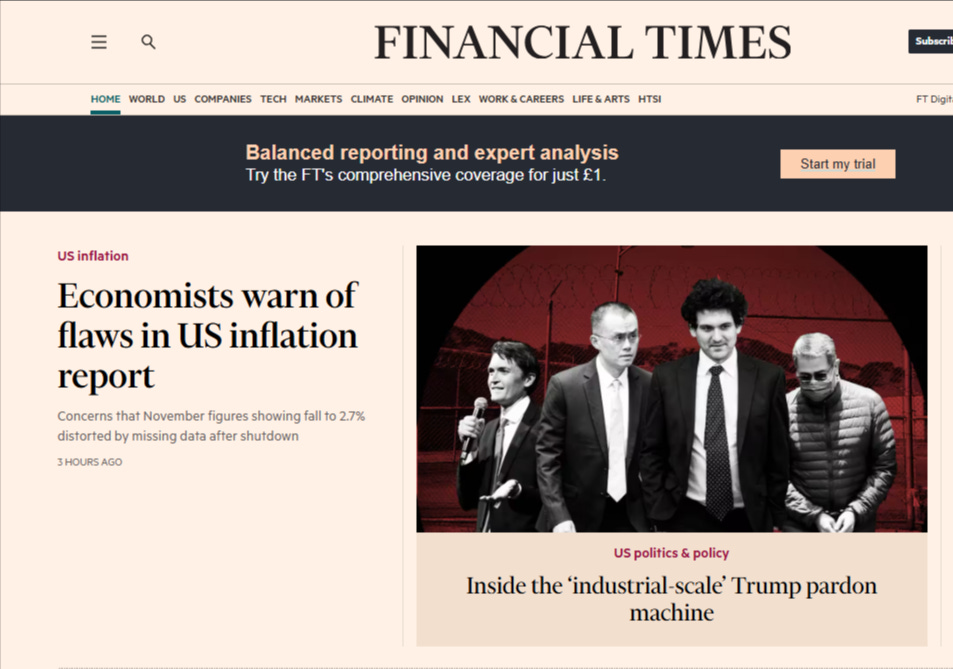
Yet the reader who confronts the empirical evidence of this weekend , January 28 an 29 2017, at airports across America, in the wake of Trump’s presidential edict/order, to halt refugees/travelers, even Green Card holders, from selected Islamic States, to enter or re-enter America, seems to put that notion of American as ‘fated to lead’ into startling perspective, except to the politically myopic. The potential facts of wall building, and the blockage of the free movement of travelers, threatens the very Free Market Ideology that the Financial Time celebrates as the sine qua non , raison d’etre of The West. Or has Kaplan simply intuited the sea change, from Liberal Internationalism to American Nativism, and tailored his historically informed geographical speculations to the Dismal Age Of Trump?

Publius

https://www.ft.com/content/db84bd6a-e243-11e6-9645-c9357a75844a

Posted in Uncategorized | Leave a comment

Ian Ward of ‘POLITICO Nightly’ offers a diagnosis of JD Vance, as a possible contendor for ‘Reagans Welfare Queens’ ?

Political Observer

stephenkmacksd.com/

Dec 19, 2025

Editor:

The Rise and Reign of the Welfare Queen

Rachel Black and Aleta Sprague

Sept. 22, 2016
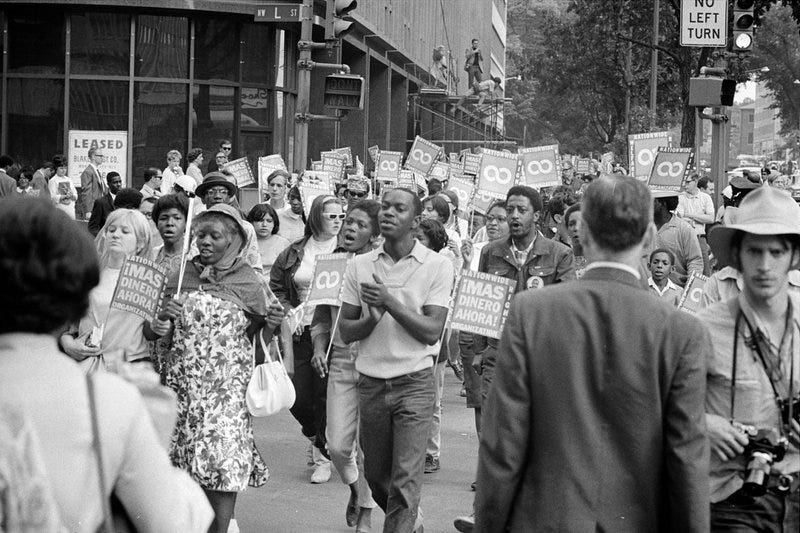
Library of Congress / Public Domain

By

Rachel Black and Aleta Sprague

Sept. 22, 2016

At a campaign rally in 1976, Ronald Reagan introduced the welfare queen into the public conversation about poverty. “She used 80 names, 30 addresses, 15 telephone numbers to collect food stamps, Social Security, veterans’ benefits for four nonexistent deceased veteran husbands, as well as welfare. Her tax-free cash income alone has been running $150,000 a year.”

Who the beneficiary of policy is perceived to be is of material consequence to how it is designed. For the past forty years, U.S. welfare policy has been designed around Reagan’s mythical welfare queen—with very real consequences for the actual families urgently needing support.

Though it was Reagan who gave her the most salient identity, the welfare queen emerged from a long and deeply racialized history of suspicion of and resentment toward families receiving welfare in the United States. Today, 20 years after welfare reform was enacted, this narrative continues to inform policy design by dictating who is “deserving” of support and under what conditions. Ending the reign of the welfare queen over public policy will require recognizing this lineage, identifying how these stereotypes continue to manifest, and reorienting policy design around families as they are—not who they are perceived to be.

Modern-day “welfare” originated from legislation to assist families destabilized by the Great Depression. Although the New Deal laid critical groundwork for future anti-poverty efforts in the U.S., the bifurcation of support along racial lines was present from the start. The 1935 Social Security Act specifically excluded domestic work and agricultural labor—industries that relied heavily on black men and women—from Social Security eligibility. Meanwhile, states had substantial discretion in determining eligibility for welfare, i.e. the Aid to Dependent Children (ADC) program—flexibility that southern states sometimes used to restrict access to benefits during harvesting seasons, effectively coercing poor, black families into working in the fields at whatever wages were offered. By 1939, the ADC caseload was 80 percent white, despite the disproportionate burden of poverty on black families.

As black Americans moved north during the Great Migration, more black mothers began accessing ADC. This change in dynamics precipitated increasing hostility toward the program in north and south alike, which welfare advocates tried to counter by emphasizing “families,” and specifically white families, as the primary recipients of benefits. Indeed, the political rhetoric and imagery around the “War on Poverty” focused on the white, rural poor to maintain broad support.

However, in the years following the reform, as civil rights struggles intensified, the media’s portrayal of poverty and its relationship to race dramatically shifted. In 1964, only 27 percent of the photos accompanying stories about poverty in three of the country’s top weekly news magazines featured black subjects; the following year, it rose to 49 percent. By 1967, 72 percent of photos accompanying stories about poverty featured black Americans.

It wasn’t just photos that changed. In the late 1960s, the emerging welfare rights movement sought to shift the narrative around public assistance, drawing on the civil rights movement’s rhetoric about dignity, opportunity, and justice, and amplifying broader calls for economic rights as a critical complement to civil rights and a prerequisite for substantive equality. Members of the National Welfare Rights Organization (NWRO), who numbered over 100,000 at its peak, “claimed decent income as a right” without tying it to wage work, and, relatedly, also emphasized the work of caregiving. And though the NWRO plan included work incentives so that those who did work would be better off than those who did not, it did not define social citizenship in terms of wage work as prior movements had done.

But, the movement never realized this goal. In fact, the advocacy of low-income black women for a guaranteed income that wasn’t tied to work—and against the backdrop of a national economic recession—triggered a new wave of backlash against welfare recipients and intensified racialized criticisms of the “undeserving” poor.

By the time the “welfare queen” finally emerged on the national stage, the American public was primed for a face to be attached to the perceived waste, fraud, and abuse they saw as enabled by indulgent government programs and absent accountability. By 1989, 64 percent of Americans felt that “welfare benefits make poor people dependent and encourage them to stay poor,” shoring up the political support for reform. When President Bill Clinton declared an end to “welfare as we know it” in 1996, time limits, work requirements, and strict sanctions for noncompliance were presented as acts of repudiation against that system.

In fact, they had the opposite effect: rather than eliminating the myth of the welfare queen, these reforms codified it by shaping policy choices around the prevention of willful idleness and criminal behavior. As a result, welfare reform created a system that expects the worst from families seeking assistance, and in so doing further entrenches a presumed link between poverty and poor character in popular discourse. This orientation is clear in the punitive policies that appear in response to non-existent problems.

Fifteen states, for example, drug-test applicants as part of their screening process for TANF. These policies stem from a perception that people in poverty, and in particular welfare recipients and people of color, are more likely to use illegal drugs, despite evidence contradicting this claim. Predictably, this reliance on stereotypes rather than evidence when designing these policies has proven wasteful and inefficient, costing Missouri, for example, $336,297 to identify a mere 48 positive tests among nearly 40,000 TANF recipients.

Similarly, fifteen states prohibit families from receiving higher benefit levels if a new baby is born while the household is receiving assistance, which “stem[s] from a theory that cash aid serves as a disincentive for poor women to marry and an incentive for them to have more children.” In fact, these policies simply hurt poor children (to say nothing of the absurdity of presuming a woman would have another baby to receive at most an extra few dollars a day, given that the estimated costs of having another child are around $8000 per year).

Over time, politicians have contrived their own modern equivalents of the welfare queen, with policy implications of their own. Newt Gingrich infamously lamented a food stamp recipient who used her benefits to fly to Hawaii at the taxpayer’s expense. As anyone who has actually received SNAP (Supplemental Nutrition Assistance Program) would know, benefits are tightly restricted to food products off of the self (no indulding in the hot bar allowed!) and can’t even be used to buy other necessities like diapers, much less a plane ticket.

Images like these have spurred a new wave of policy restrictions around how benefits are accessed and distributed. Federal legislation passed in 2012 requires states to prevent TANF recipients from using EBT cards in liquor stores, casinos, and strip clubs, despite minimal evidence benefits were used in these establishments. In California alone, this policy resulted in a significant diversion of time and money to deactivate over 6500 ATMs across the state, including in rural and tribal areas where the nearest ATM may simply be in a prohibited location.

Smilarly, in Arizona, policymakers discontinued the direct deposit option for TANF recipients, operating under the misguided assumption that the federal law required them to do so in order to mandate that benefits be administered through a product that allowed the state to monitor for prohibited activity. As a result, households that could have formerly accessed their TANF assistance through their own bank accounts now have no choice but to use the state-issued EBT card, which charges a fee for every ATM withdrawal—chipping away at what is already a paltry $280 a month benfefit for a family of three.

These are not examples of failures within the program; they’re examples of the program functioning exactly as it was designed.

As anti-poverty programs increasingly rely on surveillance and sanctions, they strengthen an association in the public imagination between poverty and criminality. In so doing, these policies further stigmatize the receipt of public assistance rather than strengthening these programs’ capacity to respond to critical needs. Designing public policy around the needs and experiences of real families—not mythical abstractions—will be essential for decoupling public assistance and stigma and achieving a social safety net that truly supports the full participation of all Americans in society and the economy.

https://www.newamerica.org/weekly/rise-and-reign-welfare-queen


Editor: Reader I’ll start with Mr. Ward’s final papragraphs:

Similarly, some researchers have found that foreign-born Americans are slightly more likely native-born ones to express cold feelings toward Jews, though the same researchers stress that the difference is very minor and does not establish a causal link between foreign birth and antisemitic sentiment. Perhaps more significantly, Vance’s attempt to pin rising antisemitism to immigration conspicuously overlooks the role played by openly antisemitic figures on the right — people the white-nationalist commentator Nick Fuentes, who recently sat down for a friendly interview Vance’s close ally Tucker Carlson — in boosting anti-Jewish views.

But it’s fair to assume that Vance isn’t making these comments in the spirit of actually identifying the multivalent causes of these problems. Instead, they’re best understood as Vance’s attempts to manage an increasingly fractious coalition. And as windows into Vance’s own understanding of the primary fault lines dividing the Republican Party, his recent comments are actually quite illuminating.

Vance, who has readily stepped into the role of mediator between MAGA’s various competing factions, seems to have identified the cost-of-living crisis and the rise of antisemitism as two of the major issues splitting Trump’s coalition — with good reason. On the cost-of-living issue, the administration is increasingly coming under fire from populist conservatives who claim that Trump has focused on foreign policy issues at the expense of addressing the affordability crisis at home. Trump has struggled to come up with a compelling rejoinder to this line of critique, instead waffling between assuring voters that he’s taking the cost-of-living crisis seriously and dismissing “affordability” as a “Democrat scam.”

Similarly, the administration has struggled to address the growing divide on the right between stalwart supporters of Israel and “America First” critics of the U.S-Israel alliance — a group that also includes out-and-out antisemites like Fuentes. Trump’s response to this fissure has been to float ambiguously above the fray, publicly doubling down on his support for Benjamin Netanyahu’s government while also reaffirming his backing of Israel critics like Tucker Carlson — a posture has left both camps feeling unsatisfied. Vance, meanwhile, has stayed mostly quiet on the controversy.

At the same time, Vance seems to be betting that opposition to immigration remains the one stance that can unite a movement that is otherwise divided over economics, foreign policy, tech and AI policy, healthcare, the Epstein disclosures and more. Linking these more divisive issues back to immigration offers one strategy for smoothing over the fault lines. It also allows the administration to claim progress on issues where the GOP lacks consensus: If immigrants are causing the housing crisis, then what does it matter if Republicans don’t have a plan for building more housing so long as Trump ramps up his mass deportation efforts?

The risk for Vance is that voters will see through this maneuver and demand more direct plans to address issues like housing costs and stagnating wages, beyond whatever benefits are provided by the administration’s immigration crackdown. But if Vance’s recent appearance in Pennsylvania offers any indication, that’s a danger he’s willing to two-step around. “Why did housing get so expensive, double in price during the Biden administration?,” he asked. “It’s because Joe Biden let in 20 million illegal immigrants who took homes that ought by right go to American citizens.”


Posted in Uncategorized | Leave a comment

@FT 12/18/2025

stephenkmacksd.com/

Dec 18, 2025

Posted in Uncategorized | Leave a comment

Bret Stephens spends an inodinant about of time prasing Rob Reiner & Michele Singer Reiner, though The Trump Political Monster is the proposed subject of his intervention…

stephenkmacksd.com/

Dec 17, 2025

Editor: A selection from Mr. Stephens’ self-serving ‘Victimhood Narrative’ !

Markets will not be moved, or brigades redeployed, or history shifted, because Rob Reiner and Michele Singer Reiner were found stabbed to death on Sunday in their home in Los Angeles, allegedly at the hands of their troubled son Nick.

But this is an appalling human tragedy and a terrible national loss. Reiner’s movies, including “Stand by Me,” “The Princess Bride” and “When Harry Met Sally…,” are landmarks in the inner lives of millions of people; I can still quote by heart dialogue and song lyrics from his 1984 classic, “This Is Spinal Tap.” Until last week, he and Michele remained creative forces as well as one of Hollywood’s great real-life love stories. Their liberal politics, though mostly not my own, were honorable and sincere.

To which our ogre in chief had this to say on social media:

“A very sad thing happened last night in Hollywood. Rob Reiner, a tortured and struggling, but once very talented movie director and comedy star, has passed away, together with his wife, Michele, reportedly due to the anger he caused others through his massive, unyielding and incurable affliction with a mind crippling disease known as TRUMP DERANGEMENT SYNDROME, sometimes referred to as TDS. He was known to have driven people CRAZY by his raging obsession of President Donald J. Trump, with his obvious paranoia reaching new heights as the Trump Administration surpassed all goals and expectations of greatness, and with the Golden Age of America upon us, perhaps like never before. May Rob and Michele rest in peace!”

…the Reiners and so many other Americans trying to hold on to a sense of national decency. Good people and good nations do not stomp on the grief of others.

As Trump was unloading on Reiner, James Woods, probably the most outspoken Trump supporter in Hollywood, lovingly remembered Reiner as a “godsend in my life” who saved his acting career when it was at a low point 30 years ago.

“I think Rob Reiner is a great patriot,” Woods said Monday on Fox News. “Do I agree with some of, or many of, his ideas on how that patriotism should be enacted, to celebrate the America that we both love?

The Reiner murders took place on the same weekend that an assailant, still at large, murdered two students at Brown University, and when an antisemitic massacre at Bondi Beach in Sydney, Australia, gave every Jew in America a pit-of-our-stomachs sense that something like it may soon happen here again, as it did in Pittsburgh seven years ago.

… Brian Thompson was murdered in Manhattan by an alleged assailant who is now a folk hero to the deranged reaches of the left.

It’s a country that feels like a train coming off the rails, led by a driver whose own derangement was again laid bare in that contemptible assault on the Reiners, may their memories be for a blessing.


Syrian-Born Australian Who Tackled Bondi Gunman Hailed as Hero

Video of Ahmed el Ahmed disarming one of the gunmen has gone viral, and officials around the world have hailed his bravery.

Listen to this article · 3:28 min Learn more

  • Share full article

Bystander Who Tackled Sydney Gunman Is Hailed as a ‘Hero’

1:30

The parents of Ahmed el Ahmed, 43, said their son was brave and felt compelled to intervene to tackle one of the gunmen in Sunday’s mass shooting at Bondi Beach in which at least 15 people were killed.CreditCredit…AuBC, via Associated Press

By Amelia Nierenberg and Yan Zhuang

Yan Zhuang reported from St. George Hospital in Sydney, Australia, where Mr. el Ahmed is a patient.

Dec. 15, 2025

Leer en español

Ahmed el Ahmed crouched behind a car in a Sydney parking lot on Sunday, feet away from one of the two gunmen who had just turned a beachside Hanukkah celebration into a massacre.

Then, sirens wailing in the background, Mr. el Ahmed jumped into action.

Even as the gunman fired a shot in a different direction, Mr. el Ahmed ran toward the assailant and pounced on him from behind. The two men tussled for several seconds before Mr. el Ahmed wrested a long firearm from the man, who fell to the ground. As Mr. el Ahmed pointed the weapon at him, the assailant got up and stumbled away.

Mr. el Ahmed — whose actions were caught on a video that has been verified by The New York Times and who was identified on Monday by Australian officials — is being praised as a hero in one of the deadliest terrorist attacks in Australian history.

In the aftermath of the mass shooting, which left the country and its Jewish community reeling, Mr. el Ahmed’s bravery provided much-needed solace.

Mr. el Ahmed, a Syrian-born fruit seller, risked his life and likely prevented the massacre from being even worse, officials said.

“At the best of times, what we see is Australians coming together,” Prime Minister Anthony Albanese said at a news conference, referring to the risks that Mr. el Ahmed took, adding that he had been hospitalized with a “serious injury.” It was not immediately clear how he had been hurt.

Footage of Mr. el Ahmed’s intervention was shared widely across social media and even made its way into the White House, where President Trump called Mr. el Ahmed “a very, very brave person.”

Mr. el Ahmed is an Australian citizen who immigrated from Syria in 2006 and has two daughters, aged 3 and 6, his parents told the Australian Broadcasting Corporation. He had been drinking coffee with a friend near the beach when he heard gunshots, they added.

“He wasn’t thinking about the background of the people he’s saving, the people dying in the street,” Mr. el Ahmed’s father, Mohamed Fateh el Ahmed, told ABC. “He doesn’t discriminate between one nationality and another.”

Ahmed is a real-life hero. Last night, his incredible bravery no doubt saved countless lives when he disarmed a terrorist at enormous personal risk.

It was an honour to spend time with him just now and to pass on the thanks of people across NSW. pic.twitter.com/3xNBW8vxvZ

— Chris Minns (@ChrisMinnsMP) December 15, 2025

Chris Minns, the premier of the state of New South Wales, who visited Mr. el Ahmed in the hospital, said he had “saved countless lives.” In a picture that Mr. Minns posted on social media, Mr. el Ahmed looks alert and appears to be partially upright and speaking.

A GoFundMe page that was set up to support Mr. el Ahmed has raised more than 1.4 million Australian dollars, or about $930,000 — including roughly $66,500 from Bill Ackman, the billionaire investor, according to the fund-raising company.

GoFundMe said in an email that it was working with the organizers of the page to “help ensure funds raised safely reach Ahmed and his family.”

At St. George Hospital, where Mr. el Ahmed was being treated, Talia Gill and her 10-year-old daughter, Georgie, said in an interview that they were leaving gifts and a letter for him. The attack struck close to home for Ms. Gill, who is Jewish and who had friends who were in Bondi when the shooting occurred.

Georgie said she wanted to tell Mr. el Ahmed, “Thank you so much for saving all those people you didn’t even know.” She added, “You’re probably the kindest person ever.”

Amelia Nierenberg is a Times reporter covering international news from London.

Yan Zhuang is a Times reporter in Seoul who covers breaking news.

A version of this article appears in print on Dec. 16, 2025, Section A, Page 6 of the New York edition with the headline: The Syrian-Born Fruit Vendor Who Tackled and Disarmed a Gunman. Order Reprints | Today’s Paper | Subscribe

Posted in Uncategorized | Leave a comment

Richard Waters reviews the Peter Thiel biography, in The Financial Times.

Political Observer comments. stephenkmacksd.com/ Sep 23, 2021

stephenkmacksd.com/

Dec 15, 2025

Just why would the West Coast Editor of The Financial Time ever utter a bad word about a very successful Capitalist ? And a vindictive and querulous Capitalist, whose animus to those who dare to subject his genius, to any variety of critiques, could signal the end to a career?

Henry Luce used his Media Empire: Time, Life etc. in another time, to make war against his many political enemies, real and imagined. Mr. Thiel is just a more contemporary version of that Media Tycoon of another time.

Just a speculation, but perhaps Mr. Chafkin began to loath his subject, as much as the anonymous sources, who reported on this paranoid egoist?

Some selection from Mr. Richard Waters’ review are telling:


His libertarian leanings have involved backing movements such as seasteading, which holds that living on a platform moored at sea offers one of the only routes to true freedom from government. That and other seemingly barmy ideas such as his interest in medical inventions to defeat death made Thiel the inspiration for a memorably messianic but naive character, an investor called Peter Gregory, in the HBO comedy show Silicon Valley. The libertarianism stands in notable contrast to business interests that have relied on activist government, including Palantir’s profiting from government surveillance.

The readiness to attribute selfish, cynical or callous motives to Thiel robs his character of its complexity. Yes, his actions often seem Machiavellian — not least his secret funding of an invasion of privacy lawsuit that bankrupted the blogging empire Gawker — and Chafkin does a good job of highlighting the things that have contributed to this sinister persona. But many people cheered the demise of Gawker, which was frequently the target of litigation, and it seems harsh to undercut so much of what Thiel has stood for.

Chafkin says he spoke to more than 150 people and most chose to remain anonymous out of fear, given Thiel’s “record for trying to hurt those who’ve attempted to uncover his secrets”. The result is an abundant use of unattributed quotes, which certainly help to spice up the story yet also generate a sense that scores are being settled behind the cloak of anonymity. This is one unnamed source summing up Thiel’s relationship with Tesla founder Elon Musk, which had been fraught since he was involved in a mutiny to force Musk out as CEO of PayPal: “Musk thinks Peter is a sociopath, and Peter thinks Musk is a fraud and a braggart.”

https://www.ft.com/content/e2a46b3e-0c19-4a93-9cab-3d420882cd1a

The ‘Friends of Peter Thiel’ seems to be a very select group, if such even exists, given his ability to innovate and make money. Yet those talents are unattached to inspiring loyalty, producing long lasting relationships, both personal and professional. How can the most talented and innovative of ‘leaders’ ,still continue to flourish without a talent for team building, that inspires the indispensable ingredient of loyalty?

Political Observer

Posted in Uncategorized | Leave a comment

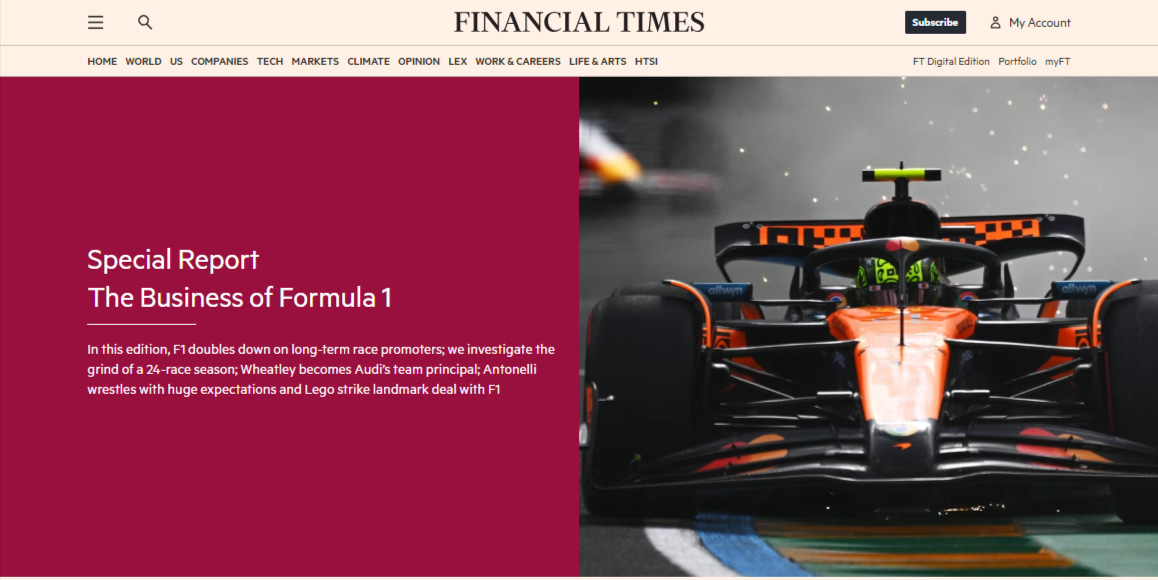
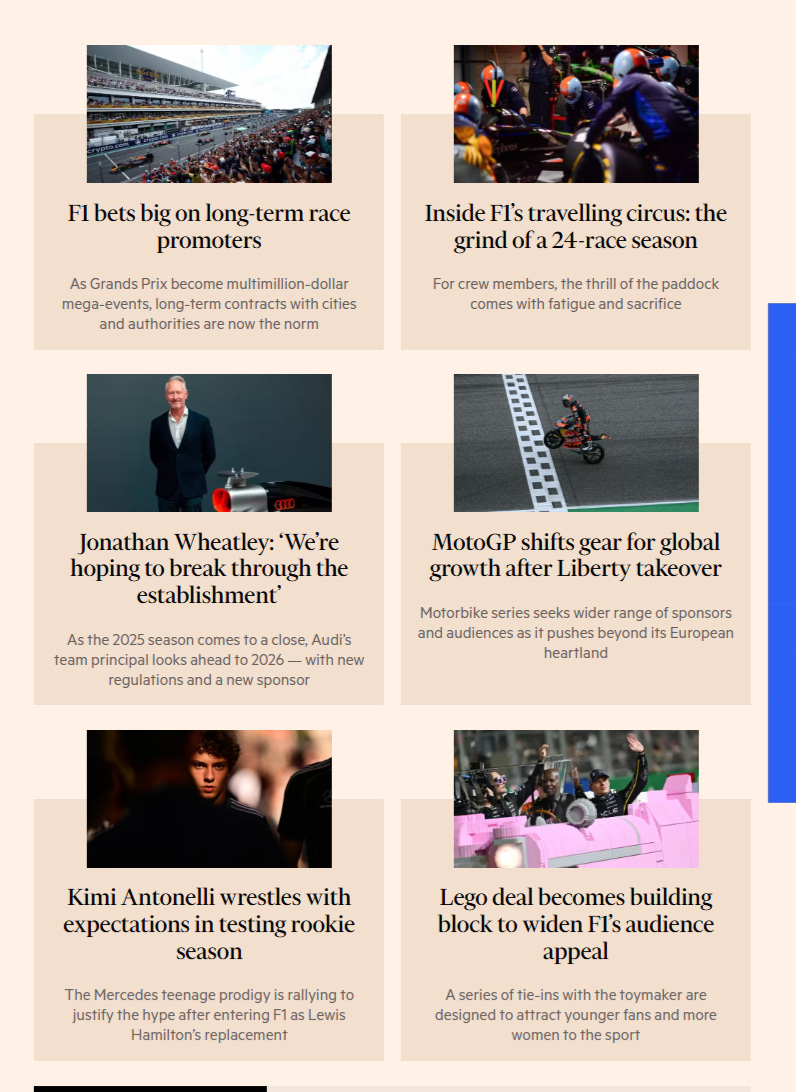
The Financial Times & ‘The Business of Formula 1?’

Former Reader wonders at this – what to name it?

stephenkmacksd.com/

Dec 15, 2025

Posted in Uncategorized | Leave a comment

Jonathan Turley in almost High dudgeon!

Newspaper Reader .

stephenkmacksd.com/

Dec 14, 2025

Reader recall this from Jonathan Turley defender of the Free Speech of Weiss, Dokoupil and company ? See the quote below. Just a sample of this is Turley political comformity that now meets Britain Moves to Curtail Jury Trials and Free Speech ! Turley impersonates an actual Free Speech Advocate? Not to resort to a too distant memorey, see Daniel T. Rodgers of the well received Age of Fracture of 09/03/2012 that in its final chapter demostrated a wan political conformity, via a quotation from the long forgotten Andrew Sullivan!


Editor: The final paragraphs of Turley’s diatribe from Dec 12, 2025

The objections to Dokoupil are particularly revealing. Past CBS hosts and anchors have destroyed the network’s standing with many viewers, particularly those in the middle or right of the political spectrum. The decline was summed up when 60 Minutes’ Lesley Stahl literally laughed on air in the face of President Donald Trump, after he said that Biden was implicated in the influence-peddling scandal involving his son, Hunter. It was not the smug delivery but Stahl categorically denying that Biden was facing a scandal and showing absolutely little interest in the documented millions of dollars that went to the Biden family.

CBS increasingly seemed to be reporting to a shrinking audience composed of themselves, other establishment media, and the far left. The result was a network that was underperforming and little-watched.

The owners and shareholders welcomed a new direction, but many in the staff want a return to the same disastrous path. It is reminiscent of the response of staff at the Washington Post to Jeff Bezos bringing in new editors to reverse the decline of the newspaper.

Post owner Jeff Bezos brought in Washington Post publisher and CEO William Lewis, who promptly delivered a truth bomb in the middle of the newsroom by telling the staff, “Let’s not sugarcoat it…We are losing large amounts of money. Your audience has halved in recent years. People are not reading your stuff. Right? I can’t sugarcoat it anymore.”

The response called for Lewis and other editors to be canned. Again, these reporters would rather give up their very jobs than their bias.

The attacks on Dokoupil’s race, gender, and sexual orientation captured the unhinged and hypocritical character of these critics. They are triggered by any mention of race or gender by others, but regularly move to cancel others using the same identity criteria. It does not matter that Dokoupil has a long journalistic career or that a major change is badly needed if the network is to reverse these trending numbers. His actual talents appear immaterial to the consideration of his race, gender, and sexual orientation.

Editor: Here are the final paragraph of Turler’s adoration of Weiss & Dokoupil!

For those of us who once worked at the network, we are rooting for Weiss and Dokoupil in turning this ship around. CBS has been one of the truly great news organizations. It can be again.

Newspaper Reader.

Posted in Uncategorized | Leave a comment

Kant’s Late Philosophy of Nature The Opus postumum.

https://www.cambridge.org/us/universitypress/subjects/philosophy/philosophy-texts/kants-late-philosophy-nature-iopus-postumumi?format=PB&isbn=9781009013765#contents

stephenkmacksd.com/

Dec 13, 2025

Posted in Uncategorized | Leave a comment

Jonathan Turley is the near penultinate American Lawyer? Or should should the reader look to the storied career of *Louis Nizer?

Newspaper Reader.

stephenkmacksd.com/

Dec 12, 2025

Newspaper Reader: Reader Shari Redstone as just another toxic Zionist!

Trump-CBS lawsuit settlement was ‘right decision’, says former Paramount chair Shari Redstone

By Harshita Mary Varghese and Dawn Chmielewski

December 4, 202510:10 AM PSTUpdated December 4, 2025

Dec 3 (Reuters) – Media mogul Shari Redstone said on Wednesday that Paramount (PSKY.O), opens new tab made the “right decision” by agreeing to pay $16 million to settle a lawsuit filed by U.S. President Donald Trump against CBS over a “60 Minutes” interview.

Speaking at the Reuters NEXT summit in New York City, the former Paramount chair said she was not part of the actual decision-making and recused herself from the board due to the “appearance of conflict which we really believe existed.”

The lawsuit against CBS alleged that the network deceptively edited an interview that aired on its “60 Minutes” news program with former Vice President Kamala Harris in an effort to “tip the scales in favor of the Democratic Party” in the election.

The deal drew criticism that Paramount had effectively bought regulatory approval for its $8.4 billion merger with Skydance Media, which received the Federal Communications Commission’s green light shortly afterwards.

Redstone parted ways with Paramount when the company completed its merger, ending her family’s decades-long controlling stake in the media firm. She made her first move since Paramount by investing in and becoming chair of Israeli studio Sipur.

Media consolidation is fundamentally reshaping the entertainment industry. It is reducing the number of independent studios and creating larger integrated companies positioned to dominate both theatrical and streaming distribution as they compete with more well-financed big tech companies.

Recently, Warner Bros Discovery (WBD.O), opens new tab has put itself up for sale and is currently accepting bids from at least three major players: Paramount Skydance, Netflix (NFLX.O), opens new tab and Comcast (CMCSA.O), opens new tab.

Redstone said the media industry will continue to see consolidation, adding that she does not know who will ultimately end up with Warner Bros Discovery.

The consolidation trend has raised concerns among analysts about its impact on theatrical exhibition, as the global box office struggles to return to pre-pandemic levels while competing with entrenched streaming habits that have changed how audiences consume content.

According to Comscore, the domestic box-office collected $7.8 billion so far this year, compared with $11 billion grossed in 2019.

“It’s more about streaming, the quality of home theaters, and changing consumer habits,” Redstone said, adding that audiences are gravitating only toward blockbuster titles at theaters.

The year-to-date gains for domestic box office this year compared to 2024 stand at a razor thin 1%, said Paul Dergarabedian, Comscore’s head of marketplace trends.

“The industry will need to bank another $1.2 billion through December 31 to hit the $9 billion threshold for annual domestic box office,” Dergarabedian said.

Reporting by Harshita Mary Varghese in Bengaluru; Editing by Arun Koyyur, Anil D’Silva and Maju Samuel

https://www.reuters.com/legal/litigation/trump-cbs-lawsuit-settlement-was-right-decision-says-media-mogul-shari-redstone-2025-12-03/

…………………………………………………………………………………………………………………………………………….

Editor: The final paragraphs of Turley’s diatribe!

The objections to Dokoupil are particularly revealing. Past CBS hosts and anchors have destroyed the network’s standing with many viewers, particularly those in the middle or right of the political spectrum. The decline was summed up when 60 Minutes’ Lesley Stahl literally laughed on air in the face of President Donald Trump, after he said that Biden was implicated in the influence-peddling scandal involving his son, Hunter. It was not the smug delivery but Stahl categorically denying that Biden was facing a scandal and showing absolutely little interest in the documented millions of dollars that went to the Biden family.

CBS increasingly seemed to be reporting to a shrinking audience composed of themselves, other establishment media, and the far left. The result was a network that was underperforming and little-watched.

The owners and shareholders welcomed a new direction, but many in the staff want a return to the same disastrous path. It is reminiscent of the response of staff at the Washington Post to Jeff Bezos bringing in new editors to reverse the decline of the newspaper.

Post owner Jeff Bezos brought in Washington Post publisher and CEO William Lewis, who promptly delivered a truth bomb in the middle of the newsroom by telling the staff, “Let’s not sugarcoat it…We are losing large amounts of money. Your audience has halved in recent years. People are not reading your stuff. Right? I can’t sugarcoat it anymore.”

The response called for Lewis and other editors to be canned. Again, these reporters would rather give up their very jobs than their bias.

The attacks on Dokoupil’s race, gender, and sexual orientation captured the unhinged and hypocritical character of these critics. They are triggered by any mention of race or gender by others, but regularly move to cancel others using the same identity criteria. It does not matter that Dokoupil has a long journalistic career or that a major change is badly needed if the network is to reverse these trending numbers. His actual talents appear immaterial to the consideration of his race, gender, and sexual orientation.

Editor: Here are the final paragraph of Turler’s adoration of Weiss & Dokoupil!

For those of us who once worked at the network, we are rooting for Weiss and Dokoupil in turning this ship around. CBS has been one of the truly great news organizations. It can be again.


*

Louis Nizer, Lawyer to the Famous, Dies at 92

By Eric Pace

Nov. 11, 1994

Louis Nizer, the shrewd and voluble trial lawyer who made a long career of representing famous people in famous cases and whose autobiography, “My Life in Court,” was a best seller, died yesterday at Beth Israel Medical Center in Manhattan. He was 92 and lived in midtown Manhattan.

The cause was kidney failure, said Perry Galler, the managing partner in the New York-based law firm Phillips, Nizer, Benjamin, Krim & Ballon, of which Mr. Nizer was the senior partner.

Mr. Nizer founded the firm with Louis Phillips, and colleagues said yesterday that he remained active, going in to his office almost every day, until 10 days before he died.

Mr. Nizer’s wavy hair and near-classic profile adorned countless courthouses, board rooms and corridors of power as he talked his way to fame and fortune. In the course of his work as a trial lawyer, he made himself an authority on contract, copyright, libel, divorce, plagiarism and antitrust law, and on other kinds of law involving the entertainment world.

Louis Nizer, the shrewd and voluble trial lawyer who made a long career of representing famous people in famous cases and whose autobiography, “My Life in Court,” was a best seller, died yesterday at Beth Israel Medical Center in Manhattan. He was 92 and lived in midtown Manhattan.

The cause was kidney failure, said Perry Galler, the managing partner in the New York-based law firm Phillips, Nizer, Benjamin, Krim & Ballon, of which Mr. Nizer was the senior partner.

Mr. Nizer founded the firm with Louis Phillips, and colleagues said yesterday that he remained active, going in to his office almost every day, until 10 days before he died.

Mr. Nizer’s wavy hair and near-classic profile adorned countless courthouses, board rooms and corridors of power as he talked his way to fame and fortune. In the course of his work as a trial lawyer, he made himself an authority on contract, copyright, libel, divorce, plagiarism and antitrust law, and on other kinds of law involving the entertainment world.

Newspaper Reader.

Posted in Uncategorized | Leave a comment

The mendacity & opportunism of @NYT is utterly reliable!

Newspaper Reader performs some Political Archaeology on The New York Times & the Neo-Conservative Christopher Caldwell !

stephenkmacksd.com/

Dec 11, 2025

Editor: I read this when it was first published!

Headline: The Big Muslim Problem!

Sub-[headline: December 17, 2009 issue

Editor: In the interest of time and space I will print the relevennt porotions of Caldwell’s diatribe:

Powell, who died in 1998, has been castigated as a racist and condemned, not to say vilified, by the liberal left; but as Christopher Caldwell argues in his provocatively titled book, Reflections on the Revolution in Europe: Immigration, Islam, and the West, his demographic predictions have proved remarkably accurate. In one of his speeches Powell shocked his audience by predicting that Britain’s nonwhite population of barely a million would reach 4.5 million by 2002; according to the Office of National Statistics, the size of Britain’s “ethnic minority” population actually reached 4.6 million in 2001. His predictions for the ethnic composition of major cities such as Wolverhampton, Birmingham, and Inner London were similarly on target. Britain’s Commission for Racial Equality predicts that by 2011 the population of Leicester will be 50 percent nonwhite, making it the first major British city without a white majority.

This pattern is being replicated in cities throughout Western Europe. According to Caldwell, Europe is now a “continent of migrants” with more than 10 percent of its people living outside their countries of birth. The figure includes both non-European immigrants and citizens of countries belonging to the enlarged European Union who are permitted to move freely within its territory. But it also includes a substantial body of immigrants—namely Muslims—whom Caldwell regards as posing “the most acute problems” on account of their religion (an issue never mentioned by Powell in his speeches).

The statistics are highly variable since many countries do not register the religion of their citizens. However, it is generally assumed that there are now upward of 13 million Muslims, and possibly as many as 20 million (Caldwell’s preferred figure), living in the European Union. The largest concentrations are in France with more than 5 million, Germany with around 3 million, Britain with 1.6 million, Spain with a million, and the Netherlands and Bulgaria with just under a million. Overall, the proportion of Muslims now residing in the European Union (including the indigenous Bulgarian Muslims) remains at 5 percent, a proportion twice that of the “nearly seven million American Muslims” mentioned by President Barack Obama in his Cairo University speech last June.

Individual cities, however, have much higher concentrations. Karoly Lorant, a Hungarian economist who wrote a paper on the subject for the European Parliament, calculates that Muslims already make up 25 percent of the population in Marseilles and Rotterdam, 20 percent in Malmö, 15 percent in Brussels and Birmingham, and 10 percent in London, Paris, and Copenhagen. If the French national figure of around 5 million were proportionately reproduced in the US, it would make for 24 million American Muslims. Moreover, given that immigrant Muslims have a higher birthrate than indigenous white Europeans or other immigrant groups such as Eastern Europeans or African-Caribbeans, that population seems set to increase, regardless of tighter controls on immigration now being imposed by governments. The US National Intelligence Council expects that by 2025 the Muslim population of Europe will have doubled.

In the first part of his book Caldwell takes some Enoch Powell–like swipes at the policies—or lack of them—that allowed this situation to develop. In the aftermath of World War II, European countries overestimated the need for immigrant labor. Instead of investing in new technology, they drove down labor costs—and undermined the power of labor unions—by importing cheap workers without regard for the social and cultural consequences. Caldwell challenges the assumptions of economists who argue that immigrants increase national wealth. With old industries such as textiles already in decline, immigrant workers merely delayed the necessary process of restructuring. In macroeconomic terms the wealth they generate is nugatory—approximately one three-hundredth of the advanced countries’ output. In any case much of the supposed added value contributed by immigrant businesses that appears in economic statistics is absorbed in the costs of accommodating them in their new environment, or is sent back to their home countries. In 2003, for example, Moroccans living in Europe sent home r3.6 billion ($4.1 billion) in remissions.

The picture Caldwell paints is complex, paradoxical, and sometimes at variance with the anti-immigration thrust of his argument. While he dwells on the obvious aspects of political and cultural dystopia—the terrorist outrages in London and Madrid, the riots in the Paris banlieues, the growing Muslim prison populations, and the horrors of unreconstructed patriarchy in the form of “honor killings,” systemic homophobia, and the bizarre medical “hymen repair operation” that allows young women to recover lost virginities—he acknowledges some of the positive contributions that immigrants make to society. In the case of Italy, for example, he observes that the country’s agriculture, food, and its superb urban landscape—features that lie at the heart of its attractions as the center of European culture—are largely sustained by immigrants:

Italy has lately received more than half a million immigrants a year from Africa and the Middle East, mostly to work in its farms, shops, and restaurants. The market price of certain kinds of Italian produce, so Italian farmers say, is in danger of falling below the cost of bringing it to market. Under conditions of globalization, Italy’s real comparative advantage may lie elsewhere than in agriculture, in some high-tech economic model that is remunerative but not particularly “Italian.”…

Traditional ways of working the land may be viable only if there are immigrants there to work it. You can make similar arguments about traditional Italian restaurants, which in the present economy may be able to hold their own against soulless chains only with the help of low-paid immigrant labor. Ditto the country’s lovely public parks, which have traditionally required dozens of gardeners, a level of manpower that the country’s shrinking population cannot supply, except at a high price….

Some natives may feel “swamped” by the demographic change, but immigration, though not ideal, may be the most practical way of keeping Italy looking like Italy. As the novelist Giuseppe di Lampedusa once wrote, “If we want everything to stay the same, everything must change.”

Caldwell does not suggest that the paradox of foreigners “keeping Italy looking like Italy” is necessarily unsustainable. His concern is that a majority of migrants belong to a religion that a skeptical, post-Enlightenment Europe cannot be expected to contain or resist. The level of Muslim immigration is unprecedented. Whereas in the past, groups of immigrants—“Jewish and Huguenot refugees, a few factory hands from Poland or Ireland or Italy”—were “big enough to enrich the lands of settlement but not so big as to threaten them,” the sheer volume of Muslim immigration endangers the indigenous cultures of Europe, not least because those cultures have become precariously fragile. Political correctness, anti-racism, and multiculturalism, born of guilt about colonialism and shame about the Holocaust, are eroding national cultures, while failing to produce a coherent vision of a common European identity.

No reasonable person would deny that there are problems with some of Europe’s immigrant communities, or that multiculturalism challenges traditional boundaries separating citizenship from ideas centered on loyalty, identity, and allegiance. For the late Sir Bernard Crick, George Orwell’s biographer and a leading educator, “Britishness” is a legal and political structure that excludes culture: “When an immigrant says ‘I am British,’ he is not saying he wants to be English, Scottish or Welsh.” As Caldwell comments:

This was the EU model of belonging: You are one person for your culture and another for the law. You can be an official (legal) European even if you are not a “real” (cultural) European. This disaggregation of the personal personality and the legal personality sounds tolerant and liberating, but it has its downside. Rights are attached to citizenship. As soon as your citizenship becomes a legal construction, so do your rights.

In Caldwell’s view, immigrants to Europe are able to exploit their rights not just as citizens but as residents, by claiming the health and welfare benefits to which natives are entitled. “The postwar Western European welfare states provided the most generous benefits ever given to workers anywhere.” Germany’s job market was the archetype of the systems replicated across Western Europe, with short working hours, seven-week vacations, full health coverage, and wages for unionized workers reaching almost $50 an hour. Although—unlike some other countries—Germany’s jus sanguinis denied full citizenship to immigrant workers, who were mainly from Turkey and Morocco, the economic effects were ultimately the same.

In Caldwell’s vision Europe’s welfare states have been succouring alien intruders: as the native population grows in age and declines in proportion to immigrants, so the value they add to the “social market” economy by contributing to its welfare systems is eroded by their claims on benefits. In Spain for example, the Harvard economist Martin Feldstein has predicted that the ratio of workers to retirees, currently 4.5:1, will fall to 2:1 by 2050. In Britain the Office of National Statistics predicts a population increase of ten million people—two thirds of them immigrants or their children—over the next quarter-century, with the number of people aged eighty-five and over expected to double. For Caldwell the short-term relief that immigrants bring to the welfare state is unlikely to match their longer-term claims on it:

In the extremely short run, a baby bust such as Europe has undergone can enhance living standards, because it reduces the number of dependents per worker. But in the longer run a reckoning awaits, and the longer run has arrived.

The most egregious examples of Caldwell’s aliens are Muslims, because, as he sees it, they are less susceptible to European cultural influences than other immigrant groups such as Slavs, Sikhs, Hindus, non-Muslim Africans, and African-Caribbeans. He flatly ignores evidence produced by numerous scholars such as Aziz al-Azmeh, Tariq Modood, Philip Lewis, and Jytte Klausen that Muslim identities are shifting to meet changing circumstances, that a majority of younger British Muslims, for example, “share many aspects of popular youth culture with their non-Muslim peers,” and that their problem is not so much with the majority culture as with “traditionally-minded parents who seek, usually unsuccessfully, to limit their access to it.”

Caldwell pours scorn on writers who emphasize the diversity of the Islamic traditions in Europe. “For all its pleasing glibness,” he says, “this harping on diversity is misguided.” His reading of Islam takes an essentialist perspective of a primordial religion impervious to change, as if he were oblivious of the way that essentialist views of religion have long been under sustained intellectual attack. No one remotely familiar with the work of scholars such as Aziz al-Azmeh (who ruminates on the diversities of “Islams” and “modernities”) or the political scientist Jytte Klausen, whose brilliant work on European Muslims investigates emerging hermeneutics and epistemologies of faith, would dismiss them, as Caldwell does, as “glib.” Al-Azmeh and his colleagues provide plenty of support to refute “the cliché,” as al-Azmeh writes, “of a homogenous collectivity innocent of modernity, cantankerously or morosely obsessed with prayer, fasting, veiling, medieval social and penal arrangements,” while Klausen has demonstrated convincingly that European Muslims are overwhelmingly hostile to extremism, support democratic processes, accept the duties of citizenship, and are evolving distinctively local styles of Muslim identities.

Nor does Caldwell exhibit any familiarity with the rich literature describing the spread of Islam in peripheral cultures such as sub-Saharan Africa or South Asia, where a religion originating in Arabia proved every bit as adept as Christianity in adjusting to local conditions. He has similarly failed to familiarize himself, even superficially, with the vast literature charting the encounter between Islam and modern Western society. In his review of Western attitudes toward Islam he prefers to celebrate the prejudices of writers such as Ernest Renan (in 1883) or Hilaire Belloc (in 1938) than to engage with significant Muslim thinkers such as Muhammad Iqbal, Fazlur Rahman, Muhammed Arkoun, or Abdullahi an-Naim who might challenge his essentialist assumptions. Caldwell’s “Islam” owes more to tabloid headlines than to responsible research. To borrow a phrase of Philip Lewis, it exemplifies the need for greater religious literacy in the post–September 11 era.

Nevertheless, in arguing that “Europe became a multiethnic society in a fit of absence of mind,” Caldwell makes some useful points. European societies have yet to find satisfactory ways of institutionalizing Islam within their national polities. This is partly due to the fragmentary and contested nature of Islamic spiritual authority, in which (with the partial exception of Shiism) no formal priesthood stands between the individual and a god who reveals himself in texts that are subject to a wide variety of interpretations.

Umbrella bodies intended to act as interlocutors with governments, such as the Muslim Council of Britain (MCB) and the French Council for the Muslim Faith (CFCM), are rejected by many Muslims for being too political, or not political enough, or simply not representative of people who may be difficult to represent, or may not want to be represented as “Muslims.” It is clear that as a religion formulated during an era of political ascendancy, the mainstream traditions of Islam have yet to find comfortable moorings as minorities in the contested public spaces of a secular, pluralist West.


The final paragraphs of Christopher Caldwell’s latest @NYT dreck!

Trump Is Not Attacking Europe. He’s Attacking Something Else.

There are two answers to this question. The first is that the values of European civilization, as traditionally understood, are a large part of what the United States signed up to defend in 1949 with the founding of NATO. That traditional understanding provided not only a purpose but also a source of cohesion that made the alliance viable. By contrast, no matter how important you think our alliance with Saudi Arabia is, the values of its polygamy-indulging, Sharia-enforcing Wahhabi monarchy had absolutely nothing to do with why the United States entered that alliance.

Then there is the other, simpler answer to why the Trump administration now makes it a priority to lead Europe back to a more traditional understanding of itself: because the United States is so intimately involved in its decline. Europe has undergone many periods of decadence before but somehow endured. It stopped the Moors at Poitiers and the Turks at Vienna, withstood a series of plagues, survived Napoleon and Hitler and Stalin. But none of those episodes vitiated its culture and enfeebled its sinews and threatened its historic continuity quite so thoroughly as three and a half decades of American-style liberal international order, under the banner of “C’mon, people now, smile on your brother.”

The main source of Europeans’ anger at seeing their vanishing civilization mourned by the United States may be this: that it was at America’s urging that they undertook this work of self-destruction in the first place.

Editor: Reader Christopher Caldwell is Neo-Conservative! The NYT cadre of Friedman, Brooks, Stephens, French are all unapologetic Zionists! Where might the fault lie?

Newspaper Reader.

Posted in Uncategorized | Leave a comment