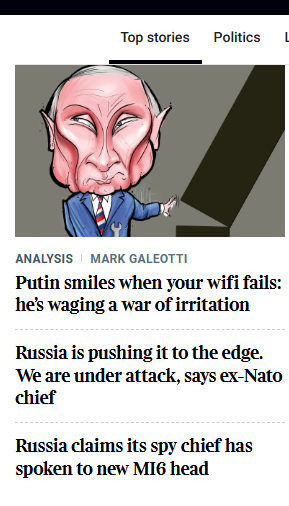
Adrian Blomfield of ‘The Telegraph’ searches for a Trump victory against ‘Putin The Terrible’?

Editor: Blomfield spies a Western Victory of a sort? Is Putin unable to render this attack moot? Is the Nuclear-Capable Oreshnik Hypersonic Missiles a possible way out for Putin?

stephenkmacksd.com/

Jan 08, 2026

How Trump humiliated Putin on the high seas

US president did not so much call Russia’s bluff as dismiss it outright

Adrian Blomfield Senior Foreign Correspondent

07 January 2026 7:43pm GMT

Ever since coming to power more than a quarter of a century ago, Vladimir Putin has yearned for Washington to treat him as the leader of a great power, an equal of the United States, as it did during the Cold War.

Instead, in the wintry waters of the North Atlantic, Mr Trump has treated Russia as a minnow, swatting aside its president in the most chastening way.

Moscow had staked its reputation and geopolitical credibility on protecting the rusting oil tanker boarded and seized by US forces south of Iceland on Wednesday.

It reflagged the vessel with Russian colours, added it to its official registry, issued formal diplomatic warnings to Washington and finally dispatched a submarine and other naval assets to shield it – all in vain.

In the process, Putin has once again demonstrated his inability to protect Russia’s clients and dependents.

He failed to save either Bashar al-Assad in Syria or Nicolás Maduro in Venezuela, despite extending patronage to both men.

Now he has shown he cannot even safeguard a leaky rust bucket on the high seas.

……

When Putin intervened in the 19-day pursuit of the Bella 1 across the Atlantic – an operation likened to the slow-speed chase of OJ Simpson’s Ford Bronco along California’s freeways 31 years ago – the gamble must initially have seemed a reasonable one.

For the past year, nothing appeared capable of shaking the foundations of Putin’s relationship with Donald Trump.

The Bella 1, as it was then known, formed part of the so-called shadow fleet of tankers used to move oil from Russia, Iran and Venezuela in defiance of sanctions imposed by the United States, Britain and other Western allies.

That fleet has been a vital lifeline for Moscow, allowing Russia to sell oil, prop up its economy, fund its war in Ukraine and conduct a hybrid campaign against Europe, using shadow-fleet vessels to conduct sabotage operations against undersea infrastructure and launch drones into European airspace.

Pressure on the Kremlin intensified last month when the US imposed a maritime embargo on sanctioned oil tankers operating in and out of Venezuela.

US forces subsequently intercepted and boarded two shadow-fleet vessels and then attempted to stop the Bella 1 – which had been under US sanctions for 18 months on suspicion of carrying cargo for Hezbollah – in the Caribbean on Dec 20 as it neared the Venezuelan coast.

Previously registered in Panama, Palau, Liberia and the Marshall Islands, the tanker was flying the Guyanese flag – fraudulently, according to US officials, who noted that it did not appear on Guyana’s shipping register.

The Russian, Indian and Ukrainian crew ignored orders to stop, turned the ship around and fled towards the Atlantic, repeatedly broadcasting distress signals to nearby vessels. The chase had begun.

As Christmas Day passed, the panicked crew hauled down the Guyanese colours, painted a Russian flag on the hull and appealed to Moscow, which they believed alone had the power to save them.

Under international maritime law, a vessel falsely flying a flag is regarded as stateless and may be boarded by the authorities of any state. A legitimately flagged ship, by contrast, enjoys protection from such interference.

On New Year’s Eve, Russia relented. It added the tanker – along with four others that had operated in Venezuelan waters – to its official shipping registry. The Bella 1, Moscow insisted, was no longer stateless. It was now a Russian vessel, sailing a Russian flag, registered to a Russian port. It was also given a new name: Marinera.

This, the Kremlin calculated, was a sanctuary of last resort – and surely sufficient. Personal ties between Trump and Putin aside, the United States might be expected to give up the pursuit, given that the vessel had turned back before reaching Venezuela, was not carrying oil and that boarding it risked breaching international law and triggering a diplomatic incident.

Yet as Bella 1 steamed towards what it hoped would be the safety of Russian waters, the Trump administration showed no sign of abandoning the chase.

Moscow doubled down, issuing a formal diplomatic reprimand demanding that Washington halt its pursuit. Then, in a final escalation, it dispatched a submarine and other naval assets to escort and protect the vessel.

The Russian president clearly hoped to deter the Americans with this show of force. Such tactics had worked before. In May last year, the Russian air force scrambled a fighter jet to prevent the Estonian navy from boarding the Jaguar, another shadow-fleet tanker, in the Baltic Sea.

But the United States is not Estonia, as Russia has now discovered. Trump did not so much call Russia’s bluff as dismiss it outright.

Backed by Britain, which provided naval and air force assets and authorised the use of its bases, the US seized the vessel, delivering the Kremlin a stinging rebuke.

Putin may have assumed that his warm personal relationship with Donald Trump would work in his favour. It did not. Indeed, the intervention may have further soured relations between Moscow and Washington, already strained after Putin claimed last month that Ukraine had targeted one of his residences with drones. Mr Trump initially expressed outrage on Putin’s behalf, but then – unusually – accepted a US intelligence assessment concluding that Russia had fabricated the claim.

The deception was not lost on the president.

At the same time, Mr Trump is likely to have been irritated by the Russian leader’s failure to heed a message his administration has been making with increasing force: South America is Washington’s backyard.

In early December, his administration published a new security strategy declaring that the region falls squarely within Washington’s sphere of influence under his so-called “Donroe Doctrine”, a muscular update of the 19th-century Monroe Doctrine asserting US primacy in the Western Hemisphere.

By reflagging a vessel attempting to breach the US blockade of Venezuela, Putin was directly challenging that doctrine – and Mr Trump did not like it one bit.

The Kremlin has seen potential upsides in the Donroe Doctrine. Russian officials hope the United States will become bogged down in South America, and there is scope for Moscow to exploit post regime-change instability in Venezuela by backing rival factions vying for power following Mr Maduro’s capture.

Beyond distracting Washington, such entanglement could also bolster Russia’s claim to dominance over Ukraine and other former Soviet states.

Yet even as Putin seeks advantage in Ukraine, he has watched Mr Trump deliver a serious blow to Russia’s global pretensions. The raid in Caracas demonstrated that the Russian air defences Mr Maduro so often boasted of were as ineffective as those that failed to protect Iran’s military facilities from Israeli and US strikes last year.

In what other Russian partners will see as a further sign of weakness, Putin has neither condemned Mr Maduro’s ousting nor commented on it at all – just as he was largely silent after the fall of Assad, despite Russia’s substantial military presence in Syria.

Painful though it will be, the Kremlin has little choice but to absorb its failure to defend the Bella 1.

Whether Mr Trump’s irritation with the Russian leader translates into a more sympathetic posture towards Ukraine remains to be seen. But one conclusion is unavoidable: in his latest display of raw power, the US president has laid bare Russian weakness before a watching world.
Editor: Putin could rescue the crew of this tanker, and render moot the Telgraph’s war mongering shill’s How Trump humiliated Putin on the high seas

US president did not so much call Russia’s bluff as dismiss it outright

Adrian BlomfieldSenior Foreign Correspondent

07 January 2026 7:43pm GMT

Ever since coming to power more than a quarter of a century ago, Vladimir Putin has yearned for Washington to treat him as the leader of a great power, an equal of the United States, as it did during the Cold War.

Instead, in the wintry waters of the North Atlantic, Mr Trump has treated Russia as a minnow, swatting aside its president in the most chastening way.

Moscow had staked its reputation and geopolitical credibility on protecting the rusting oil tanker boarded and seized by US forces south of Iceland on Wednesday.

It reflagged the vessel with Russian colours, added it to its official registry, issued formal diplomatic warnings to Washington and finally dispatched a submarine and other naval assets to shield it – all in vain.

In the process, Putin has once again demonstrated his inability to protect Russia’s clients and dependents.

He failed to save either Bashar al-Assad in Syria or Nicolás Maduro in Venezuela, despite extending patronage to both men.

Now he has shown he cannot even safeguard a leaky rust bucket on the high seas.

……

When Putin intervened in the 19-day pursuit of the Bella 1 across the Atlantic – an operation likened to the slow-speed chase of OJ Simpson’s Ford Bronco along California’s freeways 31 years ago – the gamble must initially have seemed a reasonable one.

For the past year, nothing appeared capable of shaking the foundations of Putin’s relationship with Donald Trump.

The Bella 1, as it was then known, formed part of the so-called shadow fleet of tankers used to move oil from Russia, Iran and Venezuela in defiance of sanctions imposed by the United States, Britain and other Western allies.

That fleet has been a vital lifeline for Moscow, allowing Russia to sell oil, prop up its economy, fund its war in Ukraine and conduct a hybrid campaign against Europe, using shadow-fleet vessels to conduct sabotage operations against undersea infrastructure and launch drones into European airspace.

Pressure on the Kremlin intensified last month when the US imposed a maritime embargo on sanctioned oil tankers operating in and out of Venezuela.

US forces subsequently intercepted and boarded two shadow-fleet vessels and then attempted to stop the Bella 1 – which had been under US sanctions for 18 months on suspicion of carrying cargo for Hezbollah – in the Caribbean on Dec 20 as it neared the Venezuelan coast.

Previously registered in Panama, Palau, Liberia and the Marshall Islands, the tanker was flying the Guyanese flag – fraudulently, according to US officials, who noted that it did not appear on Guyana’s shipping register.

The Russian, Indian and Ukrainian crew ignored orders to stop, turned the ship around and fled towards the Atlantic, repeatedly broadcasting distress signals to nearby vessels. The chase had begun.

As Christmas Day passed, the panicked crew hauled down the Guyanese colours, painted a Russian flag on the hull and appealed to Moscow, which they believed alone had the power to save them.

Under international maritime law, a vessel falsely flying a flag is regarded as stateless and may be boarded by the authorities of any state. A legitimately flagged ship, by contrast, enjoys protection from such interference.

On New Year’s Eve, Russia relented. It added the tanker – along with four others that had operated in Venezuelan waters – to its official shipping registry. The Bella 1, Moscow insisted, was no longer stateless. It was now a Russian vessel, sailing a Russian flag, registered to a Russian port. It was also given a new name: Marinera.

This, the Kremlin calculated, was a sanctuary of last resort – and surely sufficient. Personal ties between Trump and Putin aside, the United States might be expected to give up the pursuit, given that the vessel had turned back before reaching Venezuela, was not carrying oil and that boarding it risked breaching international law and triggering a diplomatic incident.

Yet as Bella 1 steamed towards what it hoped would be the safety of Russian waters, the Trump administration showed no sign of abandoning the chase.

Moscow doubled down, issuing a formal diplomatic reprimand demanding that Washington halt its pursuit. Then, in a final escalation, it dispatched a submarine and other naval assets to escort and protect the vessel.

The Russian president clearly hoped to deter the Americans with this show of force. Such tactics had worked before. In May last year, the Russian air force scrambled a fighter jet to prevent the Estonian navy from boarding the Jaguar, another shadow-fleet tanker, in the Baltic Sea.

But the United States is not Estonia, as Russia has now discovered. Trump did not so much call Russia’s bluff as dismiss it outright.

Backed by Britain, which provided naval and air force assets and authorised the use of its bases, the US seized the vessel, delivering the Kremlin a stinging rebuke.

Putin may have assumed that his warm personal relationship with Donald Trump would work in his favour. It did not. Indeed, the intervention may have further soured relations between Moscow and Washington, already strained after Putin claimed last month that Ukraine had targeted one of his residences with drones. Mr Trump initially expressed outrage on Putin’s behalf, but then – unusually – accepted a US intelligence assessment concluding that Russia had fabricated the claim.

The deception was not lost on the president.

At the same time, Mr Trump is likely to have been irritated by the Russian leader’s failure to heed a message his administration has been making with increasing force: South America is Washington’s backyard.

In early December, his administration published a new security strategy declaring that the region falls squarely within Washington’s sphere of influence under his so-called “Donroe Doctrine”, a muscular update of the 19th-century Monroe Doctrine asserting US primacy in the Western Hemisphere.

By reflagging a vessel attempting to breach the US blockade of Venezuela, Putin was directly challenging that doctrine – and Mr Trump did not like it one bit.

The Kremlin has seen potential upsides in the Donroe Doctrine. Russian officials hope the United States will become bogged down in South America, and there is scope for Moscow to exploit post regime-change instability in Venezuela by backing rival factions vying for power following Mr Maduro’s capture.

Beyond distracting Washington, such entanglement could also bolster Russia’s claim to dominance over Ukraine and other former Soviet states.

Yet even as Putin seeks advantage in Ukraine, he has watched Mr Trump deliver a serious blow to Russia’s global pretensions. The raid in Caracas demonstrated that the Russian air defences Mr Maduro so often boasted of were as ineffective as those that failed to protect Iran’s military facilities from Israeli and US strikes last year.

In what other Russian partners will see as a further sign of weakness, Putin has neither condemned Mr Maduro’s ousting nor commented on it at all – just as he was largely silent after the fall of Assad, despite Russia’s substantial military presence in Syria.

Whether Mr Trump’s irritation with the Russian leader translates into a more sympathetic posture towards Ukraine remains to be seen. But one conclusion is unavoidable: in his latest display of raw power, the US president has laid bare Russian weakness before a watching world.
https://www.telegraph.co.uk/authors/a/aa-ae/adrian-blomfield/

Editor : Mr. Adrian Blomfield’s 1240 word diatribe ends in the bit of whistling in the dark: But one conclusion is unavoidable: in his latest display of raw power, the US president has laid bare Russian weakness before a watching world.
Posted in Uncategorized | Leave a comment

The New York Times gives resident Professional War Monger Bret Stephens all the space he requires, to celebrate ‘The Demise Of The American Republic’ in its latest Trumpian iteration?

Newspaper Reader opines that Stephens is the natural sucessor to that British scoundrel Andrew Sullivan! Neither served in any Army, but both are acolytes Ernst Jünger ‘Storm of Steel’!

stephenkmacksd.com/

Jan 07, 2026

Editor: Here are the final paragraphs of Stephens political intervention. It’s all the space that ‘Stephens Chatter’ deserves!

For top-level hard-liners like Cabello and the defense minister, Vladimir Padrino López, the choice should be the one previously offered to Maduro: Club Med or Club Fed — exile in Turkey or turkey sandwiches in a New York prison. Maybe they’ll choose more wisely than their former boss.

For more pliable elements of the regime, a different choice: Go to free and fair elections, accept the inevitable defeat and become just another political party or else be banned from politics for life. For military officers and paramilitary leaders, accept an amnesty in exchange for a pledge of loyalty to the next government. Alternatively, face prosecution and, if indictable, extradition to the United States.

All this requires if not an immediate election, then the guarantee of one sooner rather than later. On Monday, Trump said there was “no way” an election could be held in the next month. OK, how about within six months? There needs to be a clear road map for that “judicious” transfer of power Trump spoke of when he announced Maduro’s capture.

Above all, there needs to be legitimacy. Trump’s capture of Maduro is being criticized as an invitation to Russia and China to behave similarly. This ought to be absurd: There is all the moral difference in the world between capturing an indicted dictator like Maduro and seeking to overthrow and conquer elected governments in Kyiv and Taipei. And with due respect to international law, it cannot become a shield behind which despots everywhere can do as they please to their own people.

Maduro’s capture was met with jubilation by exiled Venezuelans because for 25 years they and their families have had to endure one of the cruelest regimes anywhere and do so with precious little attention or sympathy from self-described progressives who otherwise claim to champion human rights and democracy. Trump now has a chance to prove he can be a better friend to freedom than his critics, assuming he doesn’t squander the moment, as he’s so wont to do.

It will take an election — free, fair and fairly soon.

Newspaper Reader.

Posted in Uncategorized | Leave a comment

Mark Zuckerberg meets DER SPIEGEL.

Newspaper Reader shares some of the wealth!

stephenkmacksd.com/

Jan 06, 2026

Zuckerberg has continually promised improvement. And afterward, he has always grown wealthier. More powerful. And his business has continually grown even more questionable.

In fact, as internal documents show, at the time of the questioning, 100,000 minors were being harassed daily on Meta’s platforms, and the company knew about it. In emails to company management, employees complained that there was much more that Zuckerberg could do and that more money could be invested. But the boss spent years ignoring such complaints.

Zuckerberg, indeed, is a man of two faces.

On the one hand, he plays the father of three who reads to his little daughters in the evening. A man who fights for good, through whose services the people were given a voice during the Arab Spring and dictators were toppled. An executive who admits mistakes and eliminates them. An owner who has transformed his company into a model of diversity, equality and liberalism – just to be on the right side of history.

On the other hand, he is a cold technocrat. The programmer with nerves of steel who simply “further developed” the idea for Facebook from his classmates. Who spies on his own users. Who largely abolished fact-checkers, thus provoking a flood of fake news.

Books, portraits and even a feature film examine these two Zuckerbergs. And the world has been puzzling for years over which version of this man will ultimately prevail: Jekyll or Hyde. The good-natured cuddly type in a hoodie or the ruthless, power-hungry mogul who subordinates everything to his own success.

Almost one year into Donald Trump’s second term, the answer seems clear. Trump’s MAGA takeover of America hasn’t just changed the U.S. It has also changed the Facebook boss. Nice Mark, it seems, is no longer needed in an America where selfishness and ruthlessness are considered the highest virtues. Nice Mark can go.

What’s interesting is how quickly Zuckerberg has shed that role. How smoothly he has adapted to the new power structures. It raises the question: Is the new, hard Mark the core of his character? One he has kept hidden for years for strategic reasons? Or is this transformation also just another about-face?

Newspaper Reader.

Posted in Uncategorized | Leave a comment

The perpetual political hysteria of Jonathan Turley, or The Sky Is Falling! …

Political Observer wonders how Zohran Mamdani’s won the election, even after Eric Adams was pardoned by Trump. Zohran Mamdani won the election by 200,000 votes! What does that mean?

stephenkmacksd.com/

Jan 06, 2026

Posted in Uncategorized | Leave a comment

There is no shortage of Neo-Faschists in America!

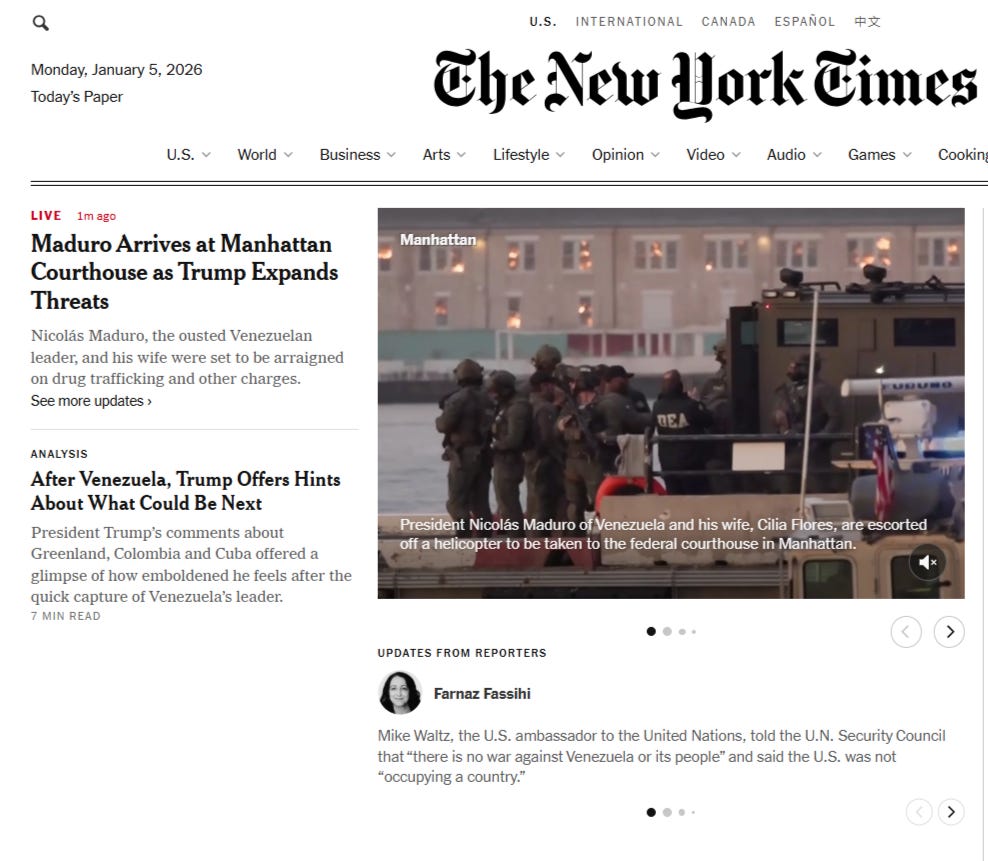
Old Socialist recommendes that the reader view @NYT this mourning:

stephenkmacksd.com/

Jan 05, 2026


Here is Fellow Traveler Quico Toro with the bad news!

Venezuela’s New President Is No Moderate

In fact, Delcy Rodríguez is a regime extremist.

Quico Toro

Jan 5

Here is One after another, Venezuelans lined up to share instances of her awfulness: her tireless whitewashing of the regime’s crimes, the international sanctions she was under, her leadership of the sham constitutional convention Maduro had used to void the opposition’s win in parliamentary elections in 2024, and especially the close links she’s reputed to have with SEBIN, the hated secret police behind Venezuela’s most notorious political prison and torture center.

To Venezuelans who had spent over a decade seeing in her one of Nicolás Maduro’s most ardent and uncompromising acolytes, calling her a “moderate” is an outrage. Here’s a woman who has held all of the most important offices of state—oil minister, minister of foreign affairs, president of the constituent assembly, vice president—and has never allowed any hint of sunlight to appear between her and Maduro.

Earlier today, Delcy Rodríguez became the new president of Venezuela.

Victimhood

Quico Toro is a contributing editor at Persuasion and the founder of Caracas Chronicles. Like eight million other Venezuelans, he was forced to flee Venezuela’s dictatorship.


Editor: The reader can only wonder at the absence of Historical Memory that afflicts Quico Toro, and his cadre of Neo-Cons: who pass themselves off as the victims, now the prisoner of the American Fachist’s Trump, Pete Hegseth, Marco Rubio!

Should the reader look to the rich history of Latin America from at the the rise of Fidel Castro, Che Guevara ,The Sandinistas, The Contras, etc.


Editor: Even William James, via Alexander Livingston, offers this: ‘Damn Great Empires! William James and the Politics of Pragmatism’

Old Socialist.

Posted in Uncategorized | Leave a comment

Zanny Minton Beddoes and her Cadre of Neo-Conservative Fellow Travelers on ‘The Decembrists’.

Political Cynic on a 2228 word History of the Decembrists as revelatory of what?

stephenkmacksd.com/

Dec 27, 2025

Christmas Specials | An uprising in St Petersburg

Two centuries ago, Russian revolutionaries tried to change the world

Bloodied and exiled, the Decembrists failed. But they made a start

https://www.economist.com/christmas-specials/2025/12/18/two-centuries-ago-russian-revolutionaries-tried-to-change-the-world

IT WAS A wintry night in St Petersburg and revolution was in the air. A piercing wind whipped off the frozen Neva river as, before dawn, the conspirators hurried to Senate Square, close to the Winter Palace. They drew up their troops beneath the stern stare of Peter the Great’s bronze statue; the gilded spire of the Admiralty pierced the inky sky. Before long the imperial cavalry would arrive, and the cannons, and the tsar. “We are going to die, brothers!” exulted one of the rebels. “Oh, how gloriously we are going to die!”

Though barely remembered in the West, that fateful day 200 years ago—December 26th 1825 in the modern calendar—was a hinge in time. Had the conspirators prevailed, their country’s history, and the world’s, might have been drastically different. As it was these men, known as the Decembrists, were transmuted into myth. As with many myths, interpretations of theirs vary. To Russia’s authorities, then and now, they were traitors. To admirers, they are champions of the flickering hope that another Russia is possible.


Revolutions are typically fomented by the uppity middle classes. This plot went right to the top. The Decembrists were the flower of Russia’s aristocracy: young men inspired by the American and French revolutions, the Enlightenment and Romantic nationalism. They were immersed in literature, modelling themselves on Roman heroes. Kondraty Ryleyev, a ringleader, railed in verse against “despotism’s heavy yoke”. Alexander Pushkin, the era’s bard, was a sympathiser. “Here is Caesar,” wrote Pushkin. “Where is Brutus?”

Crucially, they were military officers, mostly in the imperial guards, who had fought in the Napoleonic wars. As Sergei Muravyov-Apostol, another leader, put it: “We were the children of 1812.” That was when Napoleon invaded Russia; two years later Russian forces entered Paris. They returned flushed with the pride of liberators—and with visions of bringing citizenship and rights to a vast land blighted by arbitrary rule, in which a third of the population were serfs. Their revolt was, in part, an example of the blowback of war.

As Yuri Lotman, a historian, observed, the Decembrists represented a new psychological type. They were the first generation of Russian aristocrats to distinguish between service to the monarch and to society and the nation. They had earned their honour and dignity, they believed, not been granted them from above. Still, at first they hoped the tsar, Alexander I, would oversee reform of his downtrodden empire. But though he espoused liberal plans, even enacting a few on the empire’s fringes, he backtracked.

The Decembrists formed secret societies, based in St Petersburg, the imperial capital, and what is now Ukraine. Initially neither subversive nor altogether secret, they hardened into a conspiracy for a coup d’état.


Russian history was littered with coups, but the Decembrists’ aims were unique—even if they did not entirely agree on them. The most radical advocated a republic, others a constitutional monarchy. Still, they shared common goals. Having fought alongside conscripted serfs, all demanded their emancipation. They also wanted representative government, the rule of law and an end to caste-based privileges, including their own. Passionate patriots, they envisaged their country as a modern nation state. “All the nations of Europe are attaining laws and liberty,” declared a manifesto. “The Russian people deserve both.”


Blood on the snow

Autocracies are most vulnerable at moments of succession. Russia’s came sooner than the Decembrists expected—maybe too soon—when Alexander died suddenly. Since he was childless, his ostensible heir was his brother Constantine. But he had secretly renounced the throne, meaning another brother, Nicholas, would succeed. Because of the secrecy, however, imperial troops began swearing oaths to Constantine. So did Nicholas, lest he look like a usurper. Briefly, reported the Times of London, Russia had “two self-denying emperors, and no active ruler”.

This was an opening for the Decembrists, who set about agitating against Nicholas. Tipped off about the revolt, he instructed that a new oath of allegiance—to him—be sworn on December 26th. And so, on a frigid morning, the Decembrists led the troops who embraced their cause to Senate Square. Their plan was to seize the Winter Palace, arrest the tsar, install an interim government and convene an assembly. For a while they had the quiet, snow-covered square to themselves. Then forces loyal to Nicholas moved in.

In hindsight, the ensuing drama is doubly poignant. First, because many Decembrists didn’t expect to succeed. Rather they thought it was their duty to Russia—and each other—to make a stand. “There may be little prospect of success,” conceded Ryleyev, but “a beginning must be made.” They saw themselves as tragic actors on the stage of history, hoping for vindication by posterity rather than immediate victory.

Yet in a narrow sense, they might have won. The best chance for revolutionaries is often at the very start, when regimes are caught in confusion, and so it proved. Thousands of largely supportive civilians crowded around the square. The rebels could have seized the cannons that trundled across the cobbles. Above all, they might easily have killed Nicholas, who rode around imperiously, shooing away onlookers. Alexander Bulatov, a hero of 1812, stood nearby with two pistols, but found he couldn’t pull the trigger.


What if the Decembrists had won the day? The rebellion might have been swiftly quashed. Russia could have devolved into civil war, then slid back into despotism. Or, just conceivably, reform would have eased the discontent that led to the Bolshevik revolution of 1917. Communism might not have overrun Russia—in which case Nazism might not have risen in Germany…

So much for hypotheticals. In reality, the Decembrists were undone by haste and disorganisation. Their leader, Sergei Trubetskoy, didn’t show up. His courage is unlikely to have failed (he was a hero of the battle of Borodino); perhaps he foresaw that the amateurish plot would lead to a bloodbath and crackdown. Without orders, the mutineers shivered in their ranks in ten degrees of frost. Overall they numbered around 3,000. Nicholas’s much larger force encircled them.


It was one of those bleak winter days in St Petersburg when it never truly gets light. Both sides were loth to kill their compatriots; soldiers crossed themselves in the icy air. At length Nicholas ordered cavalry charges in a bid to disperse the rebels. The horses were repulsed, partly by stones and firewood hurled from the crowd. Several officials who interceded with the conspirators were shot. Bishops vainly beseeched them to retreat. “Our last minutes are close,” exhorted Ryleyev, “but these are the minutes of our freedom!”

“Give orders that this place should be swept by cannons,” Nicholas was advised, “or resign the throne!” Four artillery pieces were duly brought forward. No one moved. First came warning shots, at which the rebels shouted “hurrah!” Then grapeshot was loaded; it is said that the gunner refused to fire, so an officer did instead. As blood oozed across the snow, dazed insurgents tried to flee across the Neva. Some drowned when cannons smashed the ice. At least 1,271 people were killed, including many civilians.

By six o’clock it was over. The bullet-ridden Senate building was hastily replastered. Bloodstains were covered with fresh snow. Corpses were shoved into frozen canals. And the conspirators were rounded up.

Furious, Nicholas personally interviewed the leaders at the Winter Palace. He was surprised to see Bulatov among them; Bulatov said he was astonished to see Nicholas—because he had very recently meant to kill him. Offered a pardon, another Decembrist replied that it was precisely the tsar’s ability to override the law that provoked the revolt. The men were held in squalor, chained or isolated on Nicholas’s whim.

Interrogated at night, they were pressed to implicate themselves and each other in attempted regicide. In June 1826 scores were sentenced to decades of hard labour and exile in Siberia. Swords were broken over their heads in symbolic executions. Though capital punishment had been suspended in Russia for 50 years, five leaders were condemned to die.

It is never completely dark during the “white nights” of a St Petersburg summer. In the milky light of a July morning, the five were led to the gallows. Three of the ropes snapped. “Oh Lord, they can’t even hang people properly in Russia,” deadpanned Muravyov-Apostol after his tumble. New ropes were fetched.

The rest were clapped in irons and packed off to Siberia. The tsar instructed their wives to divorce them, but 11 women followed the men into exile, leaving behind their titles, fortunes and children. Arduous journeys led to dismal prisons and labour in mines. Kept in chains for over two years, the men told a jailer they had but one request: “not to insult or humiliate them”.


Their doomed revolution inspired both Tolstoy and Lenin

The Decembrist families suffered and survived together. When their penal servitude ended, some settled in Irkutsk, near beautiful Lake Baikal. You can—or could—visit two of their houses, the blue timberwork decorated with ornate window frames in the 19th-century Siberian style. They painted, made music, studied, taught and farmed. By the time Nicholas’s successor pardoned them in 1856, many had died.

Their story, however, does not end with their demise on a malfunctioning gallows or in the Siberian taiga. The struggle over their memory has been as fierce as the carnage on the square.

After the uprising, newspapers obediently described it as a riot by a handful of “madmen”. An official report of 1826 portrayed the Decembrists as traitors, bent on anarchy and the empire’s collapse.

But for generations of Russian writers they have been emblems of honour and self-sacrifice; the gallows became a martyr’s cross. Alexander Herzen, a liberal thinker, first formulated this version of their myth, seeing them as Roman heroes willing to die “to awaken a new life”. Leo Tolstoy planned to write a novel called “The Decembrists” (his protagonist was to be “an enthusiast, a mystic, a Christian”). As he plunged into their back story, it became “War and Peace”.

After 1917 the Decembrist myth was appropriated by both Bolsheviks and dissidents. Lenin inducted them into the pantheon of Soviet heroes, presenting his own rise to power as the climax of a revolutionary saga that began in 1825. Statues and streets were dedicated to them. This veneration gave cover to those who instead saw them as epitomes of selflessness.


The kgb sabotaged tributes to the uprising, an officer recalled. His name? Vladimir Putin

In 1967 a play about them by Leonid Zorin was staged in Moscow. At its heart was the moral dilemma of revolution: can it be right to shed blood for a higher goal? The Decembrists’ ideas resonated with the audience of Soviet intelligentsia (which included Alexander Solzhenitsyn). “We travelled half the world, liberating it from a tyrant,” the Trubetskoy character said, evoking the mood of Russian soldiers after the second world war as much as 1825. “And what have we found when we came back? Tyranny at home!”

After Soviet tanks extinguished the Prague Spring in 1968—and with it hopes for reform in Moscow—Alexander Galich dedicated a poem to the Decembrists. Distributed through samizdat, it asked: “Do you dare to come to the square?” Soon, in a landmark of the dissident movement, eight protesters walked onto Red Square bearing signs with slogans such as “For your freedom and ours!” Just as the Decembrists looked to Rome for models, the dissidents looked to the Decembrists, whose Romantic brilliance contrasted with the grey, unheroic Soviet world.

On the uprising’s 150th anniversary, the fight over their legacy spilled back onto St Petersburg’s streets. Artists and poets gathered on Senate Square. “For a moment of freedom,” one of their placards read, “I’m ready to give my life!” They were detained, the placard tossed, like the rebels’ corpses, into the frozen Neva. A KGB officer later recalled that, when dissidents planned commemorations for the Decembrists, the kgb put on rival events in the same place. “We’d show up with a brass band. We would lay our wreaths.” Foreign observers would “yawn a couple of times and go home”. The officer’s name was Vladimir Putin.

Even in Mr Putin’s nightmarish presidency, the Decembrists remain an inspiration for some and a moral threat to others. Mikhail Khodorkovsky, a one-time oligarch who spent a decade in a Siberian camp, invoked them at his show trial in 2005. Alexei Navalny inherited their civic nationalism and sense of mission, and finally their martyrdom. Conversely, in May 2025 the Decembrists’ case was relitigated at a Kremlin-sponsored conference in St Petersburg. The justice minister decried their “lack of honour”, arguing that their punishment was too lenient. The main lesson was that “the Russian state cannot afford to be weak.”

Were the Decembrists anything more than glorious failures? In the short term the regime they loathed grew more draconian. As often in Russia’s past, reckons Andrei Zorin, a historian (and the playwright’s son), the actions of “the purest and most noble people” inadvertently set back reform. Anti-Putin protests have likewise led to crackdowns and war.

From one point of view the men of 1825 were hopeless dreamers, too aloof or naive to see that Russia’s size and history mean it is doomed to eternal misrule. Or perhaps it is still too early to say. The Decembrists’ rebellion lasted only a few hours, but 200 years on, they remain a beacon of individual dignity in undignified times. A beginning must be made, and it was.


Editor: Reader thank you for your patience ! Here are the final papagraphs of this ‘Economist History’ as the Manufactured War in Ukraine seems to be reaching its toxic end-game? Before Volodymyr Zelenskyy and his retinue decamp?

Political Cynic.

Posted in Uncategorized | Leave a comment

The Economist attempts to rewrite Adam Smith!

Economist Reader almost longs for Micklethwait & Wooldridge…….

stephenkmacksd.com/

Dec 24, 2025

Headline : Adam Smith is misinterpreted and his influence overstated

Sub-headline: The most famous book in economics is less revolutionary than you think

The reader must grant that this Economist writer and her/his storied cast of characters is compelling?

Karl Marx, Darwin, Javier Milei,Margaret Thatcher, yet this paragraph might trouble that reader?

People will sagely nod at the mention of the anniversary; they will claim to have read it. Yet its reputation exceeds its contents. The book contains fewer genuinely novel ideas than many assume, and more weaknesses than its modern admirers acknowledge.

The Ecomomist writer offers this sketch of Smith’s life, in self-serving reductive terms, Smith seems to have led this writer to a dislike of a man of anothern time and place?

Kirkcaldy, a small town on Scotland’s east coast, is a nice place. But aside from a small alleyway, Adam Smith Close, the town has largely forgotten that Adam Smith lived there. The Adam Smith Heritage Centre is rarely open. The house in which he wrote the “Wealth of Nations” no longer exists.

Kirkcaldy’s lack of boastfulness about Smith is in keeping with the man’s character. Smith was shy, though he enjoyed drinking claret with friends. He never married. He had little time for pomp, quitting a scholarship at Oxford in 1746 because he thought the teaching was poor. He was also fantastically absent-minded. Lost in thought, he once wandered out of town in his dressing gown. He brewed a beverage of bread and butter and pronounced it the worst tea he had ever tasted.

He was nonetheless brilliant. By his early thirties he was the professor of moral philosophy at Glasgow University. Before long he decided that becoming an independent scholar would allow him to make a bigger impact. Following his great work’s publication in 1776, the reading public wanted more. But Smith never felt that he had completed a worthy successor. On his deathbed in 1790, he ordered his papers to be burned.

John Ruskin, a Victorian art critic, called him a “half-bred and half-witted Scotchman” who advised his readers to “hate the Lord thy God, damn His laws, and covet thy neighbour’s goods

How else to understand Smith’s second-most famous quotation?

“It is not from the benevolence of the butcher, the brewer, or the baker, that we expect our dinner, but from their regard to their own interest.”

This is an idea that Mr Milei, Ronald Reagan and Thatcher came to espouse. According to Smith’s most famous quotation:

“He intends only his own gain, and he is in this, as in many other cases, led by an invisible hand to promote an end which was no part of his intention.”

A cottage industry of academics, led by Amartya Sen, a Nobel prizewinning economist, has encouraged people to read Smith’s work more closely, however. Do so, and the caricature melts away. His first big work, the “Theory of Moral Sentiments” (1759), opened with a clear statement opposing greed-is-good:

“How selfish soever man may be supposed, there are evidently some principles in his nature, which interest him in the fortune of others…though he derives nothing from it except the pleasure of seeing it.”

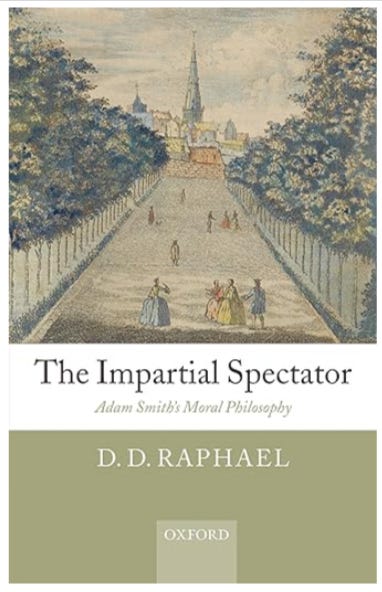
Reader on the question of ‘The Impartial Spectator’ see D.D. Raphael’s book:

Oxford University Press

August 28, 2009

Raphael’s discussion of the way Smith develops the idea of an impartial spectator to explain how we morally judge ourselves is as elegant as it is economical. His discussion spans several chapters, which include a critical appraisal of Smith’s theory of conscience and an examination of Smith’s account of moral rules and the virtues; but his chapter, “The Impartial Spectator,” is the central one. Here Raphael is especially careful to detail Smith’s revisions.

Raphael prefaces this discussion with a brief chapter on the role of the ‘spectator’ in Hutcheson’s and Hume’s moral theories. On his reading, Smith follows his predecessors in grounding moral judgments in the feelings of a spectator, attempting, as they did, to capture the disinterestedness of the moral sentiments of approval and disapproval. According to Raphael, Hutcheson’s and Hume’s idea of a spectator is that of a stranger — someone who is “indifferent in the sense of not being an interested party.” (34) All three philosophers aim to provide an empirical account of the moral sentiments.

Hutcheson was the first to insist that our approval of someone else’s actions can be disinterested, “uninfluenced by any thought of benefit to oneself.” (28) He claims that we possess a special moral sense, in addition to our other senses, that disposes us to feel approval or disapproval when we survey people’s character traits and actions. Hume’s contribution is that he saw the need to explain our capacity to approve and disapprove. He traces it to sympathy: we sympathize with the person herself and everyone with whom she interacts. We judge her character traits and actions expressive of them to be virtuous or vicious in terms of whether they are good or bad for everyone affected. Raphael thinks that the idea of an impartial spectator is present in Hume, although not the term.

On Raphael’s reading of Smith, he only needs the simpler idea of a spectator as “not being an interested party” to explain moral judgments we make about others. His originality and lasting contribution lie in his account of how we come to judge ourselves: how we acquire conscience, how it operates, and how it becomes authoritative.

There are two central features of Smith’s explanation of conscience, both of which were present at all stages in the development of his theory. One is that conscience is a social product, a “mirror of social feeling.” The other is that an agent is able to judge herself only by imagining what an impartial spectator would approve or disapprove of in her conduct.

Smith first stresses the impartiality of the reactions of spectators in his discussion of the virtue of self-command: when an agent tries to moderate his passions to the point where a spectator can sympathize. The virtue of self-command is essential to our being able to see ourselves as others do. Conscience originally springs from our “social experience” of being judged by others and being spectators who judge others. We have a natural desire to be loved and we dread blame. Because we love praise and hate blame, we learn to see our conduct through the eyes of others. We come to approve or disapprove of ourselves by imagining how spectators would judge us.

Raphael argues that Smith increasingly came to trust “imagination more and society less.” (38) One reason is that he was bothered by an objection that Sir Gilbert Elliott raised after TMS first appeared: if conscience is merely a reflection of actual spectators’ social attitudes, how would judgments of conscience differ from those of actual spectators?

However, even in the first edition, Smith’s spectator isn’t an actual bystander, but one we imagine. In the 2nd and 6th editions, Smith stresses even more that the spectator is a creation of imagination. Self-examination requires an ability to divide ourselves:

Whenever I endeavor to examine my own conduct … I divide myself as it were into two persons: and that I, the examiner and judge, represent a different character from that other I, the person whose conduct is examined into and judged of. The first is the spectator… The second is the agent… (TMS III. 1.6)

I become a judge of my own conduct by imagining what I would feel if I were a spectator of my own behavior. I then compare these feelings with the feelings that I as an agent actually have.

This leads to Smith’s famous idea of an internal, impartial spectator — “the man within.” Although conscience is initially a product of the approval and disapproval of others, Smith retains the traditional idea that “the voice of conscience represents the voice of God.” As a superior tribunal, it may conflict with the judgments of actual spectators. How does conscience gain its independence and become a higher authority?

Once we are capable of judging ourselves, we make a new distinction between being praised and being praiseworthy, being blamed and being blameworthy. We want not only praise, but to be praiseworthy; we dread not only blame, but to be blameworthy. Actual spectators may be partial and ill informed, but we are able to view ourselves without partiality or misunderstanding. I may gain the approval of others, for example, by pretending to be virtuous. But since I am able to judge what others would think of me, if they knew everything and were impartial, I realize that I do not merit praise. Not only may the judgments of the internal, impartial spectator differ from those of actual spectators, conscience comes to represent a higher tribunal. Smith eventually saw that being “flattered by the praise of society,” while ignoring the superior verdicts of conscience, is a sign of vanity.

At one point, Raphael remarks that a spectator theory is able to explain more easily third-person judgments, and also second-person judgments, but is “apt to be in difficulties with judgments made in the first person (about ‘me’ or ‘us’).” (31) But, on his view, what is original and enduring in Smith’s thought is his explanation of our capacity to judge ourselves from the point of view of an impartial spectator. He also notes that a spectator theory is “more comfortable with passing verdicts on what has been done in the past than with considering and deciding what should be done in the future.” (31) Does Raphael think that Smith is able to explain how we go from being a spectator of our own conduct to being a moral agent who tries to live up to her own ideals of conduct? In the moment of action, we may not be able to view ourselves impartially. But doesn’t the importance of the internal, impartial spectator lie in the fact that the spectator is the person to whom we, as agents, try to conform our conduct, thereby becoming worthy of love and praise? Raphael says that, according to Smith, an agent who attains a high degree of self-command can “identify himself with the imagined spectator to the extent of obliterating the natural feelings of self-regard.” (41)

Raphael maintains that Smith’s psychological and sociological explanation of conscience also shows that judgments of conscience possess a kind of authority or normativity. Does he think that Smith is able to show that they are authentically normative — answering a justificatory question about why we ought to approve as an impartial and well-informed conscience would? Or does he think that Smith is answering a question in “moral anthropology” — explaining why we are inclined to think that the judgments of conscience are normative?

Interestingly, Hume sketches a process that is similar in some ways to Smith’s account of conscience. According to Hume, sympathy ensures that we will catch the moral feelings other people have about us. Since we care deeply about what others think about us, our internalization of the praise and blame of others has the effect of making us see ourselves as others see us, valuing ourselves as others value us. Sympathy thus pressures us to survey ourselves as we appear to others. Hume says that sympathy may even go so far as to make us disapprove of our own vices, even though they benefit us.

Anyone interested in Adam Smith’s moral philosophy or in 17thand 18thcentury British moral philosophy will find Raphael’s The Impartial Spectator a stimulating book.


These paragraphs end this attack on Smith of the ‘The Theory of Moral Sentiments’ and its advocates like Amartya Sen and D.D. Raphael ! And almost adoration for ‘The Wealth of Nations’ framed with this wan cliche : ‘But there is no need for the best bottle in your cellar’ !

Second, Smith sometimes got economics wrong—not just in his support for the Navigation Acts. In the “Wealth of Nations” he argued for the “labour theory of value” (the idea that the amount of work that goes into a product determines its price, rather than how useful that product is). This theory distracted economists for decades and laid the groundwork for Marxism. Exploitation, in Marx’s view, arose from the difference between how much workers had laboured to create a good and what they were paid for producing it. Without Smith, there could have been no Marx.

Third, Smith introduced fewer core ideas of economics than you might think. He did not invent GDP (William Petty, in the 1660s, probably gets that accolade). He was not the first to recommend free trade. François Quesnay, a French economist, got there earlier. Nor was Smith the first to recognise the benefits of the division of labour. Plato beat him by 2,000 years.

Some argue that what makes the “Wealth of Nations” revolutionary is not individual ideas, but its method. Often using his favourite claret as an example, Smith treats the “economy” as a system with regularities. He did not use the term “equilibrium”, yet he clearly understood the interaction of supply and demand. When governments meddle, they distort the process. All interesting; yet these ideas were common in late 18th-century Europe.

Finally, what of his intellectual honesty? The rules about plagiarism were vague in Smith’s day. People often cited others obliquely, or assumed that the reader would already know who originated an idea. Smith, as it happens, was fiercely jealous of his insights, calling out rivals who he believed had stolen them, including Adam Ferguson, another Scottish philosopher, in 1767.

Which makes it funny, then, that the “Wealth of Nations” contains what Salim Rashid of the University of Illinois, Urbana-Champaign, delicately calls “unacknowledged borrowings”. Smith does not mention Ferguson’s analysis of the alienation of the worker under the division of labour. Or consider the pin factory. Did Smith personally observe it? Perhaps—he travelled a fair bit. Yet there is circumstantial evidence, including from the details of how the pins were made, that he “borrowed” the idea from the “Encyclopaedia”, a French work. Discussing the charge of plagiarism, John Maynard Keynes shrugged: “It seems unlikely that the question can ever be answered for certain.” So in 2026 raise a glass to the “Wealth of Nations”. But there is no need for the best bottle in your cellar. ■

Economist Reader.


The final paragraphs of this Economist Rewrite of Adam Smith

When the “Wealth of Nations” came out, everyone agreed it was a Very Important Book. But does it warrant calling Smith the “father of economics”? That may be going too far, for three reasons. Smith was a flowery writer; he made strange errors; and he is credited for ideas that were not his.

Take the book itself first. Full of long, winding sentences, it is not nearly as readable as Milton Friedman’s “Free to Choose” or Marx’s “Communist Manifesto”. Even in the 1770s people found it hard to digest, with a contemporary review noting that the work “may be sometimes thought diffuse”. Small wonder that even Smith scholars admit that they have not read the whole thing in one go.

Second, Smith sometimes got economics wrong—not just in his support for the Navigation Acts. In the “Wealth of Nations” he argued for the “labour theory of value” (the idea that the amount of work that goes into a product determines its price, rather than how useful that product is). This theory distracted economists for decades and laid the groundwork for Marxism. Exploitation, in Marx’s view, arose from the difference between how much workers had laboured to create a good and what they were paid for producing it. Without Smith, there could have been no Marx.

Third, Smith introduced fewer core ideas of economics than you might think. He did not invent GDP (William Petty, in the 1660s, probably gets that accolade). He was not the first to recommend free trade. François Quesnay, a French economist, got there earlier. Nor was Smith the first to recognise the benefits of the division of labour. Plato beat him by 2,000 years.

Some argue that what makes the “Wealth of Nations” revolutionary is not individual ideas, but its method. Often using his favourite claret as an example, Smith treats the “economy” as a system with regularities. He did not use the term “equilibrium”, yet he clearly understood the interaction of supply and demand. When governments meddle, they distort the process. All interesting; yet these ideas were common in late 18th-century Europe.

Finally, what of his intellectual honesty? The rules about plagiarism were vague in Smith’s day. People often cited others obliquely, or assumed that the reader would already know who originated an idea. Smith, as it happens, was fiercely jealous of his insights, calling out rivals who he believed had stolen them, including Adam Ferguson, another Scottish philosopher, in 1767.

Which makes it funny, then, that the “Wealth of Nations” contains what Salim Rashid of the University of Illinois, Urbana-Champaign, delicately calls “unacknowledged borrowings”. Smith does not mention Ferguson’s analysis of the alienation of the worker under the division of labour. Or consider the pin factory. Did Smith personally observe it? Perhaps—he travelled a fair bit. Yet there is circumstantial evidence, including from the details of how the pins were made, that he “borrowed” the idea from the “Encyclopaedia”, a French work. Discussing the charge of plagiarism, John Maynard Keynes shrugged: “It seems unlikely that the question can ever be answered for certain.” So in 2026 raise a glass to the “Wealth of Nations”. But there is no need for the best bottle in your cellar.

Economist Reader.

Posted in Uncategorized | Leave a comment

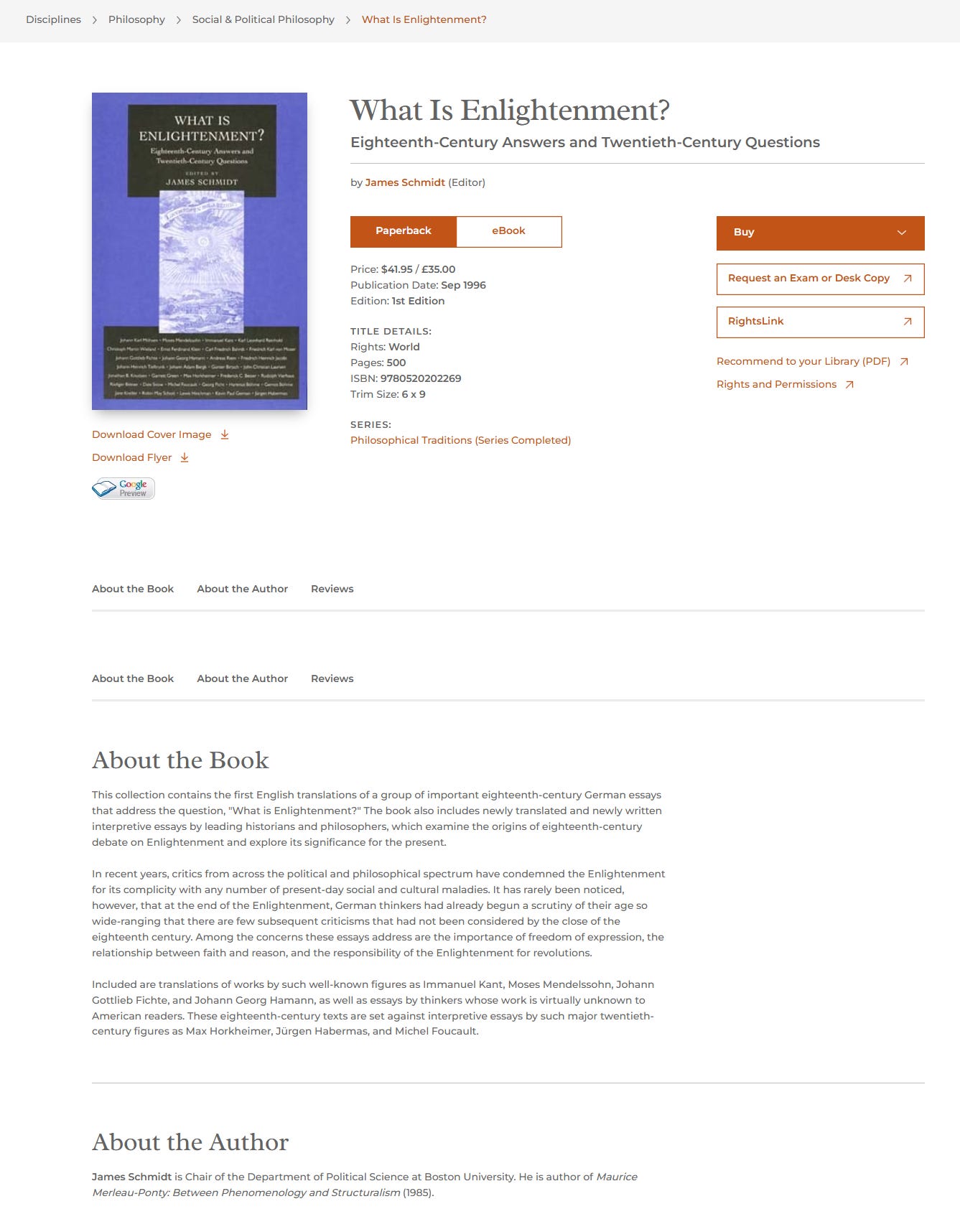
What Is Enlightenment? Eighteenth-Century Answers and Twentieth-Century Questions.

James Schmidt : https://www.ucpress.edu/books/what-is-enlightenment/paper

stephenkmacksd.com/

Dec 24, 2025

Posted in Uncategorized | Leave a comment

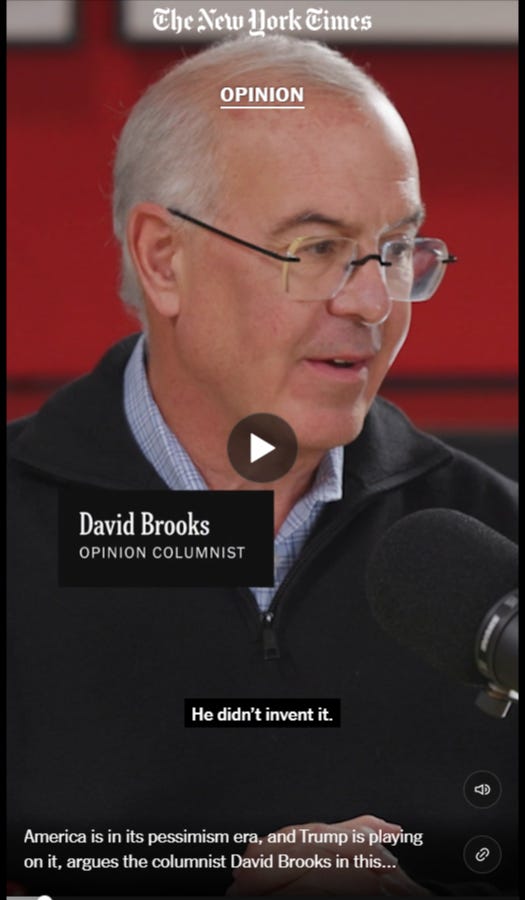
David Brooks trades in NYT puerile chatter, that appeals to an auidence that thinks that the cadre of Friedman, Brooks, Stephens, French, and Guests, represents a kind of Wisdom?

Political Observer .

stephenkmacksd.com/

Dec 22, 2025

The reader need only this of the selection of his books:

How to Know a Person (2023): Focuses on truly seeing and connecting with others.

The Second Mountain (2019): Explores the quest for a more meaningful, moral life.

The Road to Character (2015): Examines the importance of inner virtues.

The Social Animal (2011): Delves into love, character, and achievement.

Bobos in Paradise (2000): A classic look at the new upper class.

On Paradise Drive (2004): A humorous take on modern American life.

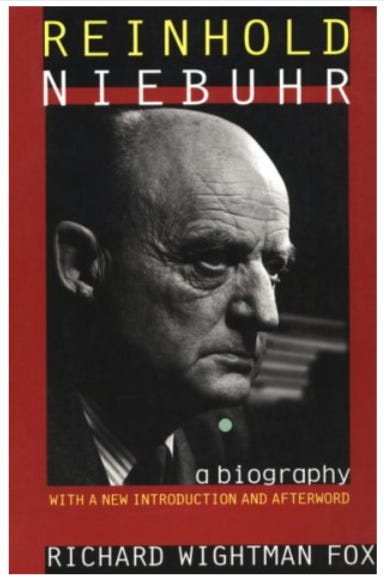
But reader Norman Vincent Peale isn’t the most apt comparison with Mr. Brooks’ public moralizing, think of Reinhold Niebuhr :

Posted in Uncategorized | Leave a comment

What The Sunday Times believes!? Sunday December 21 2025

https://www.thetimes.com/

stephenkmacksd.com/

Dec 21, 2025

Posted in Uncategorized | Leave a comment