Newspaper Reader on the reliability of The Cold War in all its iterations!
Jun 15, 2026
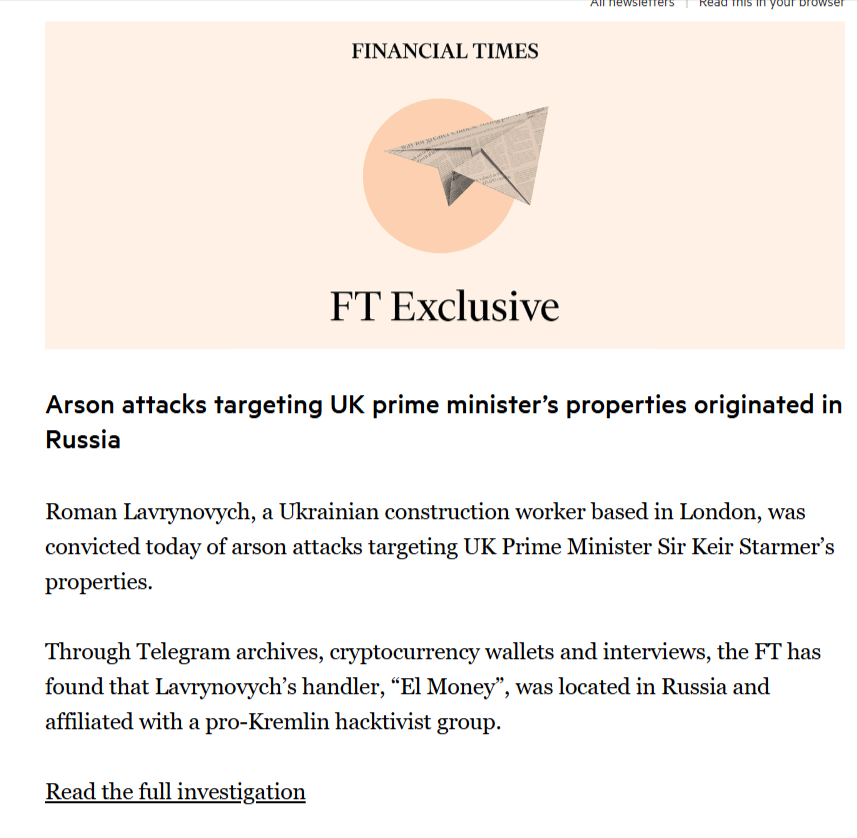
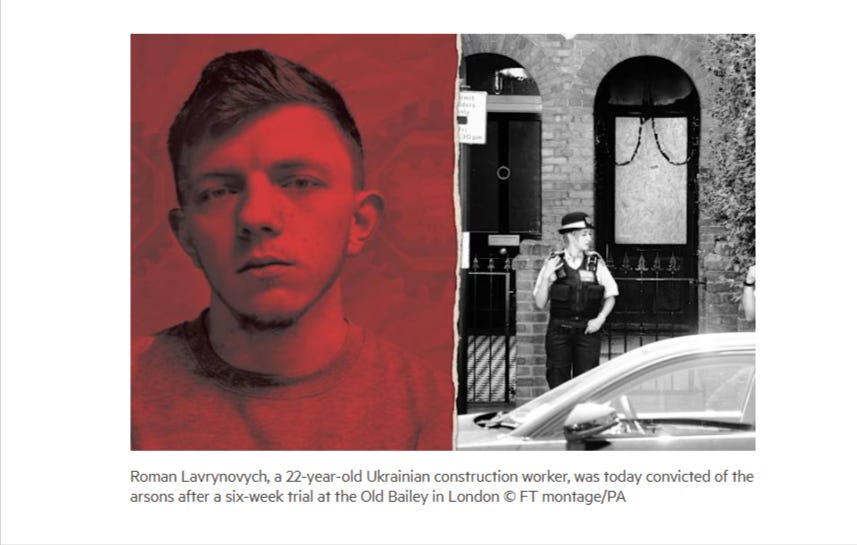
On the prima facie case against Stanislav Carpiuc, Petro Pochynok and Roman Lavrynovych.
Mystery ‘El Money’ figure offered to pay men to set fire to property linked to Starmer, court hears
Three defendants deny plotting arson attack on two homes and a car connected to prime minister in London last year
https://www.theguardian.com/uk-news/2026/apr/29/men-accused-arson-attacks-keir-starmer-london
…
He also said Telegram messages recovered by the police between Lavrynovych and El Money showed he had been recruited, instructed and promised with payment in cryptocurrency for the fires. Pochynok had been recruited by Carpiuc to help Lavrynovych with the first fire, the court heard, while Carpiuc’s role involved planning and receiving payment.
“The evidence demonstrated that there was here, no coincidence,” said Atkinson. “Rather, the vehicle and the two properties in question had been targeted, and the acts of arson at these locations had been planned and directed, with those involved promised payment for their participation.”
The court heard more than 320 messages dating back to September 2024 were recovered between Lavrynovych and El Money, who communicated in Russian in contrast to the Ukrainian used by the defendants.
Jurors were shown CCTV footage of Lavrynovych buying white spirit in south-east London two days before the Toyota was set on fire, the court heard. Each of the properties was allegedly set alight by Lavrynovych in the “dead of night, when the occupants of the addresses would inevitably have been asleep”, jurors were told.
“The prosecution’s case is that when he did so he must have intended to endanger – to risk – the lives of the people living inside those houses,” said Atkinson.
He added: “Why else would you set fire to the front door, blocking the residents’ escape?”
Editor: Should the reader here wonder about the instructions to Jurors, about the mysterious El Money, as pay master to these political actors! What might that mean? The reader might recall that British Police have arrested citizens for expressing political dissent to the Gauza Genocide by imprisonment!
Jurors were told it was “no part of your considerations” to decide who El Money was and “what reason he might have had” to coordinate the defendants’ actions. Atkinson also said the jury did not need to decide “what motivated” the defendants to carry out the arson attacks.
“It does not matter whether they knew that the property they were targeting was connected to the prime minister or whether that formed part of their motivation,” said Atkinson.
After the attacks, El Money had encouraged Lavrynovych to leave London, the court heard. “Look, you attacked the home of a very high-ranking person in Britain. I’ll send you money, you need to leave the city,” said the message read in court.
“If the police detain you, secretly write the word ‘geranium’ and I’ll send a lawyer to you, I’ll give you money for a week and a new phone. We won’t be in touch for a week.”
The trial is expected to continue until the end of May.
Newspaper Reader.
Editor: On the pressing question of History, and its manipulations by Political Opportunist, begin your exploration with this issue of Journal of Cold War Studies Volume 15, Issue 4 Fall 2013:
At The Financial Times: George F. Kennan revisionism?
Posted on February 17, 2022 by stephenkmacksd
Political Observer comments.
Mr. Kuper has missed this issue of the Journal of Cold War Studies Volume 15, Issue 4 Fall 2013:
https://direct.mit.edu/jcws/article/15/4/233/13418/Gaddis-s-Kennan-A-Different-Kennan
This issue takes a critical look at the Gaddis biography, as the preferred methodology for assessing the career of Kennan. Here is an excerpt of Anders Stephenson’s assessment:
…
Here lies the crux of the matter, and so of Gaddis’s ediªce as well. Everything turns on two issues. The ªrst is “the Soviet issue” itself. The divergence between Kennan and Lippmann on this matter in September 1947 hinges on the notion of “normality.” Difference is inscribed in the world, but in Kennan’s depiction as opposed to Lippmann’s the Soviet regime is and has always been abnormal, alien, and hostile, and now because of World War II was also dangerously placed: an abnormality piled on an abnormality, as it were. From the moment Kennan began seriously pondering the Soviet Union in the late 1920s and into the summer of 1948, he ultimately declined to recognize Moscow’s legitimacy as an international actor (he did not consider the Nazi regime, unpleasant and aggressive though it might be, equally beyond the pale until the war). The “Long Telegram” and the “X” article express this posture. Their speciªc accounts of the Soviet Union and its foreign relations are empirically wrong and strangely structured: wrong in denying that Moscow had ever made “deals” and compromises when in fact it had made a whole string of them, as Kennan well knew; strange in rooting Soviet policy wholly in domestic sources as though the outside world had no meaning except as a construction set forth to legitimate the regime at home. Astonishingly, the massive, near-death experience of the Soviet Union in World War II is almost entirely absent from the article. Suppose the United States had gone through a similar experience, the area between the Rockies and the industrial northeast had been essentially leveled by the Wehrmacht, 25 million had been killed, New York had been under siege for 900 days, and New Yorkers, the lucky ones, had been forced to eat rats while Washington was being bombarded. Can one imagine a persuasive postwar analysis of U.S. foreign policy that largely ignored such a sequence of events? I think not (and one can visualize the kind of security claims the U.S. government would have insisted on afterward). Yet, despite the antinomies and palpable errors of the “Long Telegram” and subsequent “X” article, they were received with a stupeªed sense of discovery, a discovery of “truth revealed.” Lippmann never fell into that trap, and Kennan himself, once confronted with the effects of the truth revealed, which is to say the Cold War, began to look for alternatives and ways to reconstitute some kind of diplomacy proper. The “normality” argument did not go away. It was famously resurrcted in 1967 by Arthur Schlesinger, Jr., in Foreign Affairs; and Gaddis reiterates it now again in celebrating the virtues of the Long Telegram. In fact, the Soviet Union proved remarkably orthodox in its devotion to power politics and classical European notions of international relations. What was really “wrong” with Iosif Stalin was, one might say, his abnormal “normality”—his hyper-realist reduction of all meaning to pure and ruthless interest. This was a man who had had The Prince translated for himself and then marked it up with care. Thus one might have chosen another basis for rejecting dealings with Moscow; for example, on ethical grounds: “this regime is a horrible dictatorship and, regardless of what we said and did during our wartime alliance, one must not accept such a regime qua regime.” This is a coherent position but notoriously difficult to maintain insofar as, typically, one has to distinguish this particular dictatorship by degree from others that are worth dealing with. Right-wing dictatorships aside, the ethical aspect as regards “Communism” was soon effectively discarded because of the need to support Josip Broz Tito’s regime in Yugoslavia. In treating this issue, Gaddis seems to favor the idea that “domestic” Communism was of no real (i.e., strategic) concern to the United States as long as it did not support Moscow and expansionism in foreign affairs. The effortless oscillation between quasi-realist pragmatism and Cold War ideology is in itself characteristic of the Cold War as actual geopolitics: “freedom, indivisible and sacred, will everywhere be defended by the Leader of the Free World, but it may be that we are not really capable of doing that so China (1948–49) will have to be written off, though we will not put it exactly like that and certainly not in public.”
…
https://direct.mit.edu/jcws/article/15/4/233/13418/Gaddis-s-Kennan-A-Different-Kennan
These two long paragraphs point to what Mr. Kuper uses, both of the Long Telegram and the Mr. X essay, as the rhetorical frame, that just alludes to Kennan’s change of mind about the Soviets. Mr. Stephenson ends his review of the Gaddis biography with these paragraphs:
Gaddis, on reºection, might well have agreed with this and gone on to take the other side of the argument. What he does is less interesting and indeed a bit tiresome. Having said that Kennan was essentially right in 1946– 1947, he faced the task of ªguring out what to do with half a century’s worth of withering Cold War critique, which in effect repudiated his erstwhile position. The predictable solution is a bracketing operation of another order:
Kennan the Early Prophet eventually proved right in the Age of Reagan when containment ªnally brought to maturity the Soviet regime’s “seeds of its own destruction,” a regime that had been so alien to Mother Russia. Meanwhile, Kennan the Late Prophet lost his way amid his emotions, his often charming eccentricities, and his ªxations on cultural degeneration in the West, all of which prevented him, tragically, from reconciling himself to the Truth of Reagan. Kennan’s half-century of critique, then, can be safely quarantined within a realm of egocentric peculiarity. The truth of the Cold War is duly preserved. I myself happen to think that Kennan was quite right in castigating Reagan as an egregiously irresponsible ªgure, a ªgure who, like Gaddis himself, seems to have been surprised that Soviet leaders actually believed there was danger afoot when the United States moved massively to resurrect the Cold War in the name of erasing the “Evil Empire” and so brought the world yet again, unnecessarily, to the brink of nuclear liquidation.
Political Observer
Adam Roberts at The Economist opines: ‘Why the West shouldn’t be afraid to confront Putin’!
Posted on September 21, 2024 by stephenkmacksd
Political Observer wonders what are Mr. Roberts’s qualifications to utter such an irresponsible, indeed bellicose pronouncement?
Editor: Here is the portion of Mr. Roberts essay devoted to Vladimir Putin and the American and EU War in Ukraine. Mr. Roberts come from an Economist Tradition that produced that Great Oxbridger Tag-Team of John Micklethwait and Adrian Wooldridge! That produced that classic apologetic for the War Mongering Bush The Younger: ‘The Right Nation: Conservative Power in America’ and his coterie of henchmen: Dick Cheney, Donald Rumsfeld and ‘Turd Blossom’ Karl Rove! As a regular reader of The Economist from the 1990’s, till they closed the comments section. When I attempted to read ‘Right Nation’ I experienced déjà vu, the already seen, as the literary/political style these two re-write men.
Hello from London,
Will conflict with Russia escalate? Vladimir Putin, again, wants to make you believe so. Joe Biden may be poised, at last, to say that Ukraine may use western-supplied weapons to hit military targets—such as airfields, logistics bases, or missile launchers—in Russian territory. That would be welcome, if overdue. Mr Putin, who booted out some British diplomats to show his anger on Friday, suggests this would be a step towards outright war between the West and Russia. His goal, of course, is to intimidate the West into inaction. But with bullies, caving into threats is a mistake. The West must dare to confront the aggressor. Ukraine, as the victim of aggression, has every right to fight back. Its allies should support it.
Russia continues to rain missiles, drones and artillery shells on Ukrainian cities and villages. Its forces are creeping towards making meaningful gains in the Donbas region of Ukraine. Across the country, Mr Putin’s goal is to destroy power supplies ahead of the winter, to further spread misery for ordinary people. Even as his forces commit war crimes, however, he has threatened Ukraine’s foreign supporters that they must not cross his red lines. At the same time, his forces continue to carry out sabotage and attempt assassinations in Europe, and to meddle in elections abroad, including in America.Mr Putin’s threats of escalation, therefore, must be seen for what they are. He is aggressive when he observes weakness in others, not when he is met by strength. Some in the West were previously fearful about supplying battle tanks to Ukraine, and then F-16 fighter jets. As on those occasions, the lesson to take is that standing by the government in Kyiv, helping Ukraine to fend off its aggressor, is the right way to act.
The Economist and their employee Adam Roberts attempt to re-heat The Old Cold War.
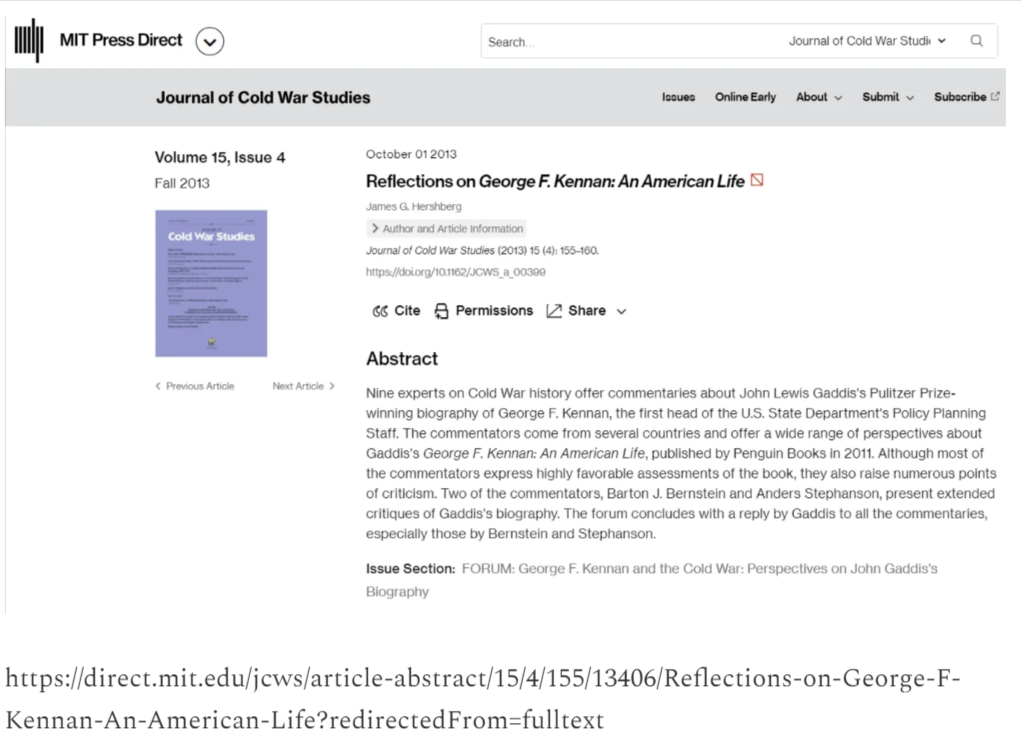
Reader begin your sturdy of that Cold War, with this issue of the Journal Of Cold War Studies Fall of 2013, that offers critiques of John Lewis Gaddis’s Pulitzer Prize-winning biography of George F. Kennan , with insightful critical evaluations by critics not sycophants!
Political Observer


