Is the utterly wayward, indeed bumptious Starmer, about to be caught in the quick-sand of of the unamed Peter Mandelson? The fact that Mandelson is not ever mentioned in political essay leades the …
Feb 16, 2026
Editor: Since the assent of Zanny Minton Beddoes, that old boys club that once consisted of Wooldridge & Micklethwait is gone.
Headline: How to oust a prime minister
Sub-headline: History offers useful lessons for those plotting to get rid of Sir Keir Starmer
https://www.economist.com/britain/2026/02/14/how-to-oust-a-prime-minister
Editor: The Oxbridgers that populate this ‘News Magazine’ bring with themselves that patina of an education, that reekes of the old school tie and carefully managed references, to their academic achievments! In the use of quotations, references, and a well execised self-belief ! The two well wrought paragraphs below offer?
It is haunting season in Westminster. As ever when the mood is mutinous, its denizens are on the lookout for a posse of phantom ministers, sometimes known as the men in grey suits. Rumour holds that in the coming months they may glide into Number 10 and tell Sir Keir Starmer that his time is up. If the past is a guide, though, this ghostly group will not materialise.
History offers lessons for Labour MPs still hoping to oust Sir Keir. They apply across parties and time, from the deferential era of yore to today, when British political leaders have the shelf-life of smartphone models. A big takeaway for plotters concerns those men (or women) in grey suits. It is no use waiting for some spectral figure to do the dirty work discreetly. You have to grip the axe, openly and together.
Editor: Look to this illustration that frames the above.
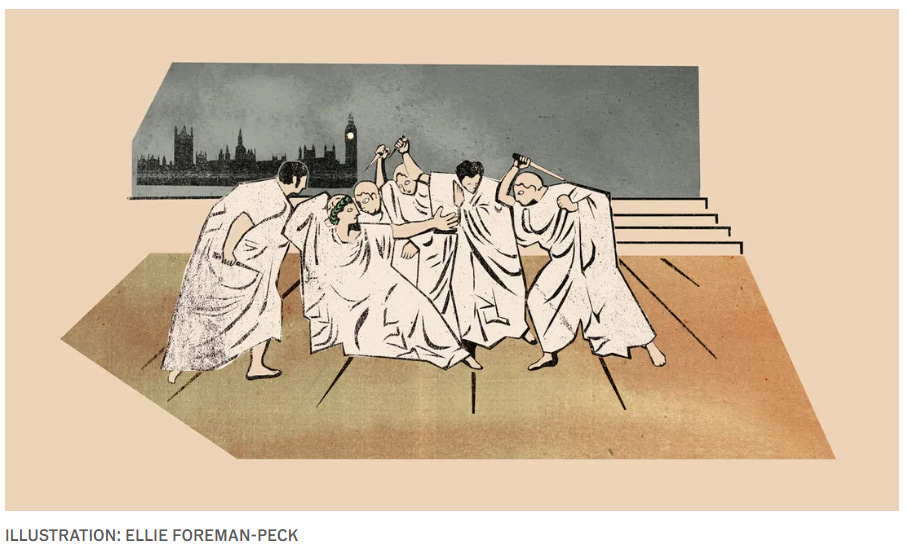
Reader compair the above illustartion to this from September 19th 2015
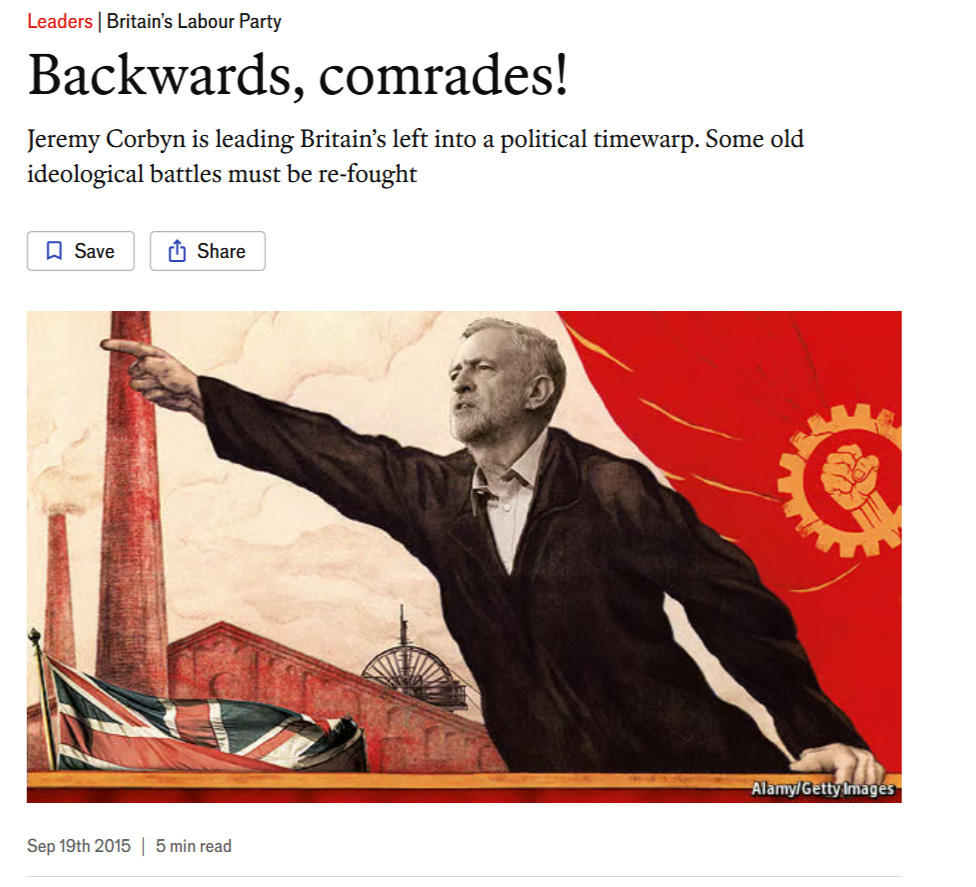
https://www.economist.com/leaders/2015/09/19/backwards-comrades
Editor : Compair and contrast the styles of these presentations- which is the more effective propagnda tool?
Editor: Below the Oxbridgers offer a political strategy:
The first lesson for mutineers is: pick the right moment. The wake of a chastening by-election—like that in Gorton and Denton on February 26th—could be propitious; more so a humbling for the ruling party in local or regional elections, such as those on May 7th. But plotters must have an eye on the wider chronology. Deposing a leader in the middle of a parliament invites pressure to hold a general election, which a party in the doldrums may lose. Wait much longer, and it can seem too late to change the public’s mind.
This “goldilocks problem”, as Philip Cowley of Queen Mary University of London, terms it, applies to the state of the nation too. It makes no sense to ditch a leader if everything is tickety-boo. But assailing one in an emergency may look self-indulgent (unless, like Liz Truss, she obviously caused it). “No time for a novice,” proclaimed Gordon Brown, the embattled Labour prime minister during the financial crisis of 2007-09—a gibe partly directed at pretenders on his own side. Today the jittery bond market discourages upheaval.
Time their ambush wisely, and insurgents enjoy natural advantages. For starters, prime ministers are distracted by the need to keep running the country: facing a leadership challenge in 1990, Margaret Thatcher flew off to a summit that marked the end of the cold war. Next, as both she and (in 2022) Boris Johnson learned, leaders can be too cocooned or aloof to grasp their peril. “They’re hard-headed enough to know that their colleagues would all kill them if they could,” says Sir Vernon Bogdanor of King’s College London. “But they tend to think they’re invulnerable, and that’s what gets them in the end.”
…
Editor: From The Econmist of Feb 11th 2026
…
Sir Keir is dead. Long live Sir Keir!
Britain is in the midst of a constitutional experiment. The prime minister does not command a majority; the majority commands him. Labour’s backbenchers—that mix of former trade-union officials, lobbyists and people who attend seminars on The Third Sector best labelled the “soft left”—now run the country. To govern is to choose and Labour mps have to pick who will be the face of this new government.
Herein lies the problem. Labour’s mps have proved incapable of taking any tricky decision voluntarily. They faint at modest reforms to welfare and wince at spending restraint. When it comes to the prime minister, external circumstances will, eventually, force a choice. Perhaps a mortifying by-election defeat to the Green Party in a Manchester suburb later this month will jolt them, or a May massacre in Scotland, Wales and London. Maybe the remorseless prospect of defeat in 2029 will foist action upon them. Until then, they can grumble, brief and watch videos of Mr Carns doing pull-ups while wondering what could be.
https://www.economist.com/britain/2026/02/11/the-alternatives-to-sir-keir
Editor: If only The Economist could offer a coherent critique of Starmer !
UK’s Top Civil Servant Quits in Fresh Upheaval for Starmer
The UK’s top civil servant quit his post after just 14 months, adding to the churn in Keir Starmer’s government that had already seen him lose two of his most senior aides this week.
Chris Wormald is standing down as cabinet secretary with immediate effect, the government said on Thursday in a statement that didn’t elaborate a reason for the resignation. The decision was reached “by mutual agreement” with the prime minister, it said.
Wormald’s departure underscores the instability in Starmer’s administration after his chief of staff, Morgan McSweeney, on Sunday, and his communications chief, Tim Allan, a day later. The now former cabinet secretary becomes the shortest-serving holder of the post since its inception 110 years ago.
Nevertheless, the move will likely be welcomed by those in the governing Labour Party who perceived Wormald — a veteran of the civil service — to have been a block on change, government officials told Bloomberg earlier this week.
When he appointed Wormald in 2024, Starmer demanded “the fundamental re-wiring of the British state.” The hire provoked some internal opposition because Wormald had worked in Whitehall for three decades and was not seen as someone who was likely to shake up the system.
…


 StephenKMackSD's Blog