Newspaper Reader.
Feb 17, 2026
Editor:
Civilization
by Roger Osborne
A New History of the Western World
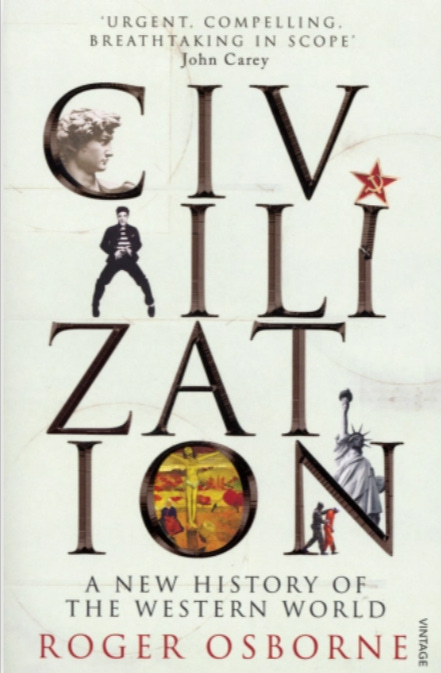
https://www.penguin.co.uk/books/362231/civilization-by-roger-osborne/9780099526063
Marco Rubio gave a speech Saturday to the Munich Security Conference in which he extolled an ideal that’s supposedly long out of fashion.
“We are part of one civilization: Western civilization,” the U.S. secretary of state told his largely European audience. “We are bound to one another by the deepest bonds that nations could share, forged by centuries of shared history, Christian faith, culture, heritage, language, ancestry and the sacrifices our forefathers made together for the common civilization to which we have fallen heir.”
The speech got, and deserved, a standing ovation.
…
What, exactly, is Western civilization? Americans younger than 50 might be excused for hardly knowing. A 2011 report from the National Association of Scholars found that not one of America’s top colleges and universities had a required survey course in Western civ and only 32 percent even offered it as an elective.
…
What many universities do offer (even more so now than when the N.A.S. issued its report) is what amounts to an education in anti-Western civ: the examination of all the ways in which Western civilization is, purportedly, an extended act of imperialism and colonialism, human exploitation and environmental despoliation, misogyny and white supremacy and phobias of every kind.
This pedagogy in civilizational self-loathing — some of it justified and overdue, much of it distorted by factual fudging and decontextualized historical judgments — has done three kinds of damage.
…
First, it helped spawn a generation of self-certain progressives, notably the pro-Hamas demonstrators on college campuses during the Gaza war, who only dimly seem to recognize that they are the very people they are being taught to hate. Who, after all, is more of a settler-colonialist — a Protestant, white, English-speaking undergrad in Los Angeles or a Jewish, Mizrahi, Hebrew-speaking one in Jerusalem? And does a typical Hamas militant despise a fervent Christian evangelical any more than he despises an anti-Zionist trans activist?
Second, it fueled a reactionary conservatism on both sides of the Atlantic. I have in mind people like Alexander Gauland, a founder of Germany’s fascist-leaning Alternative for Germany (AfD) party, who dismissed the Holocaust as a “just bird shit in more than 1,000 years of successful German history.” I’m also thinking of JD Vance, our cynical vice president, who last year met with an AfD leader after scolding an audience in Munich for refusing to respect free speech or accept the results of an election.
But the worst damage is to normal citizens in modern democracies who, unless they’ve sought it out for themselves, lack a clear idea of what the West stands for: It’s what Robert Maynard Hutchins called, in 1952, “The Great Conversation.”
…
Editor: Reader first aquainte yourself with Harry S. Ashmore’s biography of Robert Maynard Hutchens.
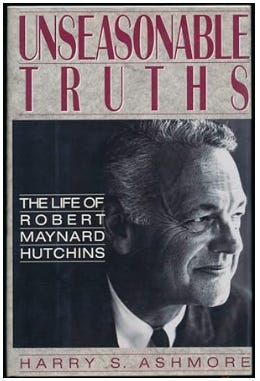
And the Robert Maynard Hutchins: American educator at Britannica Editors https://www.britannica.com/topic/University-of-Chicago
…
Hutchins was active in forming the Committee to Frame a World Constitution (1943–47), led the Commission on Freedom of the Press (1946), and vigorously defended academic freedom, opposing faculty loyalty oaths in the 1950s. After serving as associate director of the Ford Foundation (from 1951), he became president of the Fund for the Republic (1954) and in 1959 founded the Center for the Study of Democratic Institutions (Santa Barbara, California) as the fund’s main activity. The Center was an attempt to approach Hutchins’s ideal of “a community of scholars” discussing a wide range of issues—individual freedom, international order, ecological imperatives, the rights of minorities and of women, and the nature of the good life, among others.
From 1943 until his retirement in 1974, Hutchins was chairman of the Board of Editors of Encyclopædia Britannica and a director for Encyclopædia Britannica, Inc. He was editor in chief of the 54-volume Great Books of the Western World (1952) and coeditor, from 1961 to 1977, with Mortimer J. Adler, of an annual, The Great Ideas Today.
Hutchins’ views on education and public issues appeared in No Friendly Voice (1936), The Higher Learning in America (1936), Education for Freedom (1943), and others. Later books include The University of Utopia (1953), Some Observations on American Education (1956), and The Learning Society (1968).
Mr. Stephens attempt the shoehorn Hutchins whose ‘Center for the Study of Democratic Institutions’ was liberal, as Ashmore’s biography makes plan. I read Ashmore’s biography when it was published! Mr. Stephens’ wan attemp to lay claim to the Hutchins legacy is a execise in Straussian mendacity!
Newspaper Reader.


 StephenKMackSD's Blog