Political Observer marvels at ever bumptious Neo-Con Zanny Menton Beddoes, who has never fought in a War. Ernst Jünger’s Storm of Steel (1920) provides a fractured but usable model?
Nov 02, 2025
Editor: What can the reader make of this Economist call to arms?
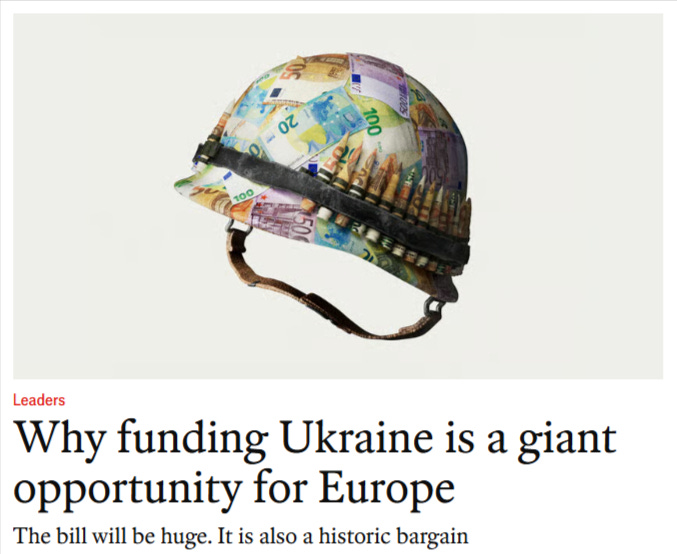
Editor: Its fitting that I’ll frame the text of this Economist political impertive, via a qutations from Ernst Jünger’s Storm of Steel (1920).
…
The villages we passed through as we marched to the front line had the appearance of lunatic asylums let loose. Whole companies were pushing walls down or sitting on the roofs of the houses throwing down the slates. Trees were felled, window-frames broken, and smoke and clouds of dust rose from heap after heap of rubbish. In short, an orgy of destruction was going on. The men were chasing round with incredible zeal, arrayed in the abandoned wardrobes of the population, in women’s dresses and with top hats on their heads. With positive genius they singled out the main beams
of the houses and, tying ropes round them, tugged with all their might, shouting out in time with their pulls, till the whole house collapsed. Others swung hammers and smashed whatever came in their way, from flowerpots on the window ledges to the glass-work of conservatories.
Every village up to the Siegfried line was a rubbish-heap. Every tree felled, every road mined, every well fouled, every water-course dammed, every cellar blown up or made into a death-trap with concealed bombs, all supplies or metal sent back, ail rails ripped up, all telephone wire rolled up, everything burnable burned. In short, the country over which the enemy were to advance had been turned into an utter desolation.
The moral justification of this has been much discussed. However, it seems to me that the gratified approval of arm-chair warriors and journalists is incomprehensible. When thousands of peaceful persons are robbed of their homes, the self-satisfaction of power may at least keep silence.
As for the necessity, I have of course, as a Prussian officer, no doubt whatever. War means the destruction of the enemy without scruple and by any means. War is the harshest of all trades, and the masters of it can only entertain humane feelings so long as they do no harm. It makes no difference that these operations which the situation demanded were not very pretty.
…
Editor: Beddoes and her minions have refined the call to battle, as a necessay imperative for Europe. The very thought of an Oxbridger, or its equiveilent, serving in any Army, offers a certain puerile potential? ‘Europe’ seems to have reached an Age of Fracture: Macrons wayward politics is the paradigm?
Wars are fought on the battlefield, but they are also trials of financial strength. In prolonged conflicts the ability and will to marshal resources and find new ways of raising cash are critical in determining who wins: sometimes they are the decisive factor. That truth is about to become all too real for Europe. Ukraine is facing a savage cash crunch. Unless something changes, it will run out of money at the end of February. This cliff edge is fast approaching, now that President Donald Trump has cut America’s financial support for Ukraine, hopes of a ceasefire fade and Russian drones smash Ukraine’s energy grid in an attempt to break its will.
Indebted, fractious Europe needs to find the money to keep Ukraine in the fight. But it would be a terrible mistake to see this cash call as merely a painful exercise in annual budgeting. Instead, it is a historic opportunity to shift the balance of power between Europe and Russia by exposing the Kremlin’s financial frailty and altering Vladimir Putin’s calculus about war and peace. It is also a chance to speed up Europe’s efforts to establish its military and financial independence from America. The bill for Ukraine is higher than most Europeans realise, but it is also a bargain.
After almost four years of war, the cost of fighting is huge. By the end of 2025, Ukraine’s military effort, defined as its defence budget plus foreign gifts of weapons and military grants, will have cost a total of roughly $360bn. This year the war effort will require $100bn-110bn, the highest sum yet, equivalent to about half of Ukraine’s GDP.
Two of the three sources of funding for Ukraine are now drying up. In February, after Mr Trump entered the White House, monthly American financial allocations to Ukraine stopped. Meanwhile, Ukraine has now borrowed as much as anyone will lend it. It has an official fiscal deficit of about a fifth of GDP; public debt has doubled as a share of GDP since before the war, to about 110%. Its ability to borrow from war-scarred households and firms at home is limited.
That leaves Europe. The prospect is exposing divisions inside the European Union. On October 23rd its leaders failed to agree on a loan to Ukraine that would be collateralised by $163bn of frozen Russian assets held in the EU’s main clearing house. Objections from Belgium, which hosts the clearing house, threaten to derail the plan. Northern countries fear that agreeing to more EU fundraising by issuing common bonds could undermine fiscal discipline across the currency bloc. France fears that fresh European funds will be spent on overpriced American weapons to please Mr Trump. Everyone worries that a blank cheque could worsen Ukraine’s corruption.
….
https://www.economist.com/leaders/2025/10/30/why-funding-ukraine-is-a-giant-opportunity-for-europe
Editor: The BBC provides the necessay reality check on the War Mongering of Beddoes, and her political cadre, in their comfortable home offices!
BBC
Headline: Key town faces ‘multi-thousand’ Russian force, top Ukraine commander admits
James Landale Diplomatic correspondent, in Kyiv
Ukraine’s top military commander has admitted his soldiers are facing “difficult conditions” defending Pokrovsk – a key eastern front-line town – against massed Russian forces.
Gen Oleksandr Syrskyi said Ukrainian troops were fending off a “multi-thousand enemy” force – but denied Russian claims that they were surrounded or blocked.
He confirmed that elite special forces had been deployed to protect key supply lines which, army sources said, were all under Russian fire.
The defence ministry in Moscow reported that Ukrainian troops were surrendering and 11 of their special forces had been killed after landing by helicopter – something denied by Kyiv.
Gen Syrskyi said in a social media post on Saturday that he was “back on the front” to personally hear the latest reports from military commanders on the ground in the eastern Donetsk region.
In a short video, Syrskyi is seen studying battlefield maps with other commanders, including the head of Ukraine’s military intelligence, Kyrylo Budanov.
It is unclear when or where the footage was recorded.
Ukrainian media earlier reported that Budanov was in the region to personally oversee the operation by the special forces.
The deployment of special forces suggests officials in Kyiv are determined to try to hold on to the town, which Russia has been trying to seize for more than a year.
Ukraine’s 7th Rapid Response Corps said on Saturday that Ukrainian troops “have improved [their] tactical position” in Pokrovsk – but the situation remained “difficult and dynamic”.
Late on Friday, Ukrainian President Volodymyr Zelensky stressed that the defence of Pokrovsk was a “priority”.
There have been growing reports of Russian advances around the strategic town to the west of the Russian-seized regional capital of Donetsk.
Images shared with news agencies late on Friday appear to show a Ukrainian Black Hawk helicopter deploying about 10 troops near Pokrovsk, although the location and date of the footage could not be verified.
Russia’s defence ministry said it had thwarted the deployment of Ukrainian military intelligence special forces north-west of the town, killing all 11 troops who landed by helicopter.
DeepState, a Ukrainian open-source monitoring group, estimates about half of Pokrovsk is a so-called “grey zone” where neither side is in full control.
A military source in Donetsk told the BBC that Ukrainian forces were not surrounded but their supply lines were under fire from Russian troops.
The US-based Institute for the Study of War said Ukrainian forces had “marginally advanced” during recent counter-attacks north of Pokrovsk, but that the town was “mainly a contested ‘grey zone’”.
Russia launched a full-scale invasion of Ukraine in February 2022, and currently controls about 20% of Ukrainian territory, including the Crimean peninsula Moscow annexed in 2014.
Moscow wants Kyiv to cede the Donetsk and neighbouring Luhansk regions – collectively known as the Donbas – as part of a peace deal, including the parts it currently does not control.
Pokrovsk is a key transport and supply hub whose capture could unlock Russian efforts to seize the rest of the region.
But Kyiv also believes its capture would help Russia in its efforts to persuade the US that its military campaign is succeeding – and, therefore, that the West should acquiesce to its demands.
Washington has grown increasingly frustrated with the Kremlin’s failure to move forward with peace negotiations – culminating in US President Donald Trump placing sanctions on two largest Russian oil producers and axing plans for a summit with President Vladimir Putin.
Zelensky has publicly agreed with Trump’s proposal for a ceasefire that would freeze the war along the current front lines.
Putin is refusing to do so, insisting on his maximalist pre-invasion demands that Kyiv and its Western allies see as a de facto capitulation of Ukraine.
Additional reporting by Jaroslav Lukiv
Editor: the final paragraphs of the Economist War Mongering chatter from a cadre of writers , who mold the work of stringers, that meets many levels of usable political winnoning, to meet political ends!
This newspaper supports the seizure of Russian assets, but they are $230bn short of what is needed. Given the size of the challenge Europe collectively faces, some sort of joint borrowing would be justified. Far from undermining the euro’s international status, for the EU to issue bonds collectively would create a bigger pool of common debt, deepening Europe’s single capital market and boosting the role of the euro as a reserve currency. A multi-year horizon for weapons procurement would help Europe sequence the build-up of its defence industry. In the short term Europe should have no qualms about buying the American weapons that Ukraine needs, including air-defence systems. Later spending should favour European defence firms as they develop their own systems, as well as Ukraine’s own cutting-edge defence-tech industries.
Bring it on
Grave problems lie ahead. Inducing despair in Mr Putin, a noble aim, might be complicated if Russia can tap China for funds. Decision-making between the EU and NATO, which includes Britain, Norway and Canada, needs to be nimbler. Safeguards against corruption are important, but must not erode Ukraine’s—and the Kremlin’s—certainty that, one way or another, the money is coming.
Europe should take heart and recognise its own strength. Its military budget is already four times larger than Russia’s; its economy is ten times larger. Far from shying away from a financial contest with the Kremlin, Europe should embrace it—and win the war.
Editor: The final paragraph of this of essay, places Europe in a position of power when compared to Russia. How might the Russia’s Oreshnik missile weigh in that balance of power?
Robert Greenall and Chris Partridge
BBC News
Russian missile reached speed of more than 8,000 miles per hour, Ukraine says
By Reuters
November 22, 20246:35 AM PSTUpdated November 22, 2024
KYIV, Nov 22 (Reuters) – The Russian missile that struck the Ukrainian city of Dnipro on Thursday reached a top speed of more than 13,000 kph (8,000 mph) and took about 15 minutes to reach its target from its launch, Ukraine said on Friday in its first public assessment of the new weapon.
Russian President Vladimir Putin said Moscow struck a Ukrainian military facility with a new intermediate-range, hypersonic ballistic missile known as “Oreshnik” as a warning to the West against supporting Ukraine’s war effort.
The attack took place with fighting in the war nearing the three-year mark and Ukraine firing longer-range missiles supplied by its Western allies at targets inside Russia.
“The flight time of this Russian missile from the moment of its launch in the Astrakhan region to its impact in the city of Dnipro was 15 minutes,” the military’s Main Directorate of Intelligence (HUR) said in a statement.
“The missile was equipped with six warheads: each equipped with six submunitions. The speed at the final part of the trajectory was over Mach 11.”
Mach is a measurement of supersonic speed. Mach 11 equals about 13,600 kph.
HUR added that the weapon was likely to be from the Kedr missile complex, which deputy head Vadym Skibitsky told Ukrainian media is related to the Oreshnik system and was first tested in June 2021.
Skibitsky said Russia could have at least 10 more such missiles to test before they enter mass production, news agency Ukrinform reported.
Kyiv initially suggested Russia had fired an intercontinental ballistic missile, but U.S. officials and NATO echoed Putin’s description of the weapon as an intermediate-range ballistic missile.
Ukraine’s foreign ministry on Thursday urged the international community to react swiftly to the strike.
NATO will hold an emergency meeting with Ukraine at the alliance’s headquarters in Brussels on Tuesday to discuss Moscow’s strike, a NATO source said on Friday.
Judy Dempsey offers this analysis/evaluation from May 21, 2024. Dempsey is an itergral part of the American National Security State Apparatus of Experts, based in Europe !
Headline: Europe’s Inability to Manage Instability
Sub-headline: Turbulent developments in Europe and beyond are eroding the premises upon which the EU was established. European governments must respond strategically to protect democracy.
by Judy Dempsey
Published on May 21, 2024
…
This economic shock was not new. The collapse of the Lehman Brothers bank in 2008 and the ensuring eurozone crisis triggered a deep lack of confidence in the EU’s perceived ability to provide continuous growth and prosperity.
On top of that, the war in Syria and Germany’s decision in 2015 to give refuge to nearly 1 million people fleeing the conflict also challenged the EU. The impact of globalization, wars, and migration sat uncomfortably with the EU’s founding premises.
What all the above means is that Europe needs to strategically acknowledge how such premises no longer apply.
First, the EU needs to move toward greater economic integration. This would entail agreeing a functioning banking union and a capital markets union. Both would strengthen the eurozone.
Second, since Europe, at least for now, is not going to be a defense player in the sense Macron proposed, it should strengthen its role in NATO, regardless of who enters the White House in January 2025. Deterrence, enhanced capabilities, and further enlargement need to be priorities.
Third, since EU member states cannot agree on treaty changes that would reduce the use of unanimity in decisionmaking—thus making EU foreign policy more cohesive and effective, coalitions of the willing could be an option. If this requires financing for special civilian missions, those countries that don’t want to join should contribute financially.
Finally, leaders need to speak out about why Europe’s democracy and values need to be defended. If that way of life didn’t matter, why are Ukrainians and Georgians waving EU flags?
Political Observer.


 StephenKMackSD's Blog