Newspaper Reader.
Nov 23, 2025
Editor: The ‘Thucydides’s trap’ first appeared as an esssay and then a book. In 2015 as an article, and again in 2017 in book form. But Lydia Polgreen in her political desperation to impress The New York Times reader: her first paragraphs almost sing?
In Washington, a decade of rancorous polarization just gave us the longest ever government shutdown. But one belief has endured on both sides of the aisle: that the world order, built and led by the United States, is under threat from China, which aims to usurp America’s rightful place atop it.
There’s a phrase that encapsulates the theory: the Thucydides trap, referring to the violent clash that comes when a rising power challenges the ruling hegemon. In Thucydides’ time, it was Athens that successfully challenged the pre-eminence of Sparta. But it is a pattern that has played out repeatedly through history, with the ambition and aggression of the challenger almost always ending in bloodshed.
…
In a startling reversal, it is America, not China, that seems determined to spring Thucydides’ trap. At the world’s summit, America is overthrowing America.
Editor: In mere moments Lydia Polgreen will be near full gallopp?
Editor: Here Graham Allison writes for The Financial Times of August 21,2012
Headline: Thucydides’s trap has been sprung in the Pacific
Sub-headline: China and America are the Athens and Sparta of today, says Graham Allison
Published Aug 21 2012
https://www.ft.com/content/5d695b5a-ead3-11e1-984b-00144feab49a
China’s increasingly aggressive posture towards the South China Sea and the Senkaku Islands in the East China Sea is less important in itself than as a sign of things to come. For six decades after the second world war, an American “Pax Pacifica” has provided the security and economic framework within which Asian countries have produced the most rapid economic growth in history. However, having emerged as a great power that will overtake the US in the next decade to become the largest economy in the world, it is not surprising that China will demand revisions to the rules established by others.
The defining question about global order in the decades ahead will be: can China and the US escape Thucydides’s trap? The historian’s metaphor reminds us of the dangers two parties face when a rising power rivals a ruling power – as Athens did in 5th century BC and Germany did at the end of the 19th century. Most such challenges have ended in war. Peaceful cases required huge adjustments in the attitudes and actions of the governments and the societies of both countries involved.
Classical Athens was the centre of civilisation. Philosophy, history, drama, architecture, democracy – all beyond anything previously imagined. This dramatic rise shocked Sparta, the established land power on the Peloponnese. Fear compelled its leaders to respond. Threat and counter-threat produced competition, then confrontation and finally conflict. At the end of 30 years of war, both states had been destroyed.
Thucydides wrote of these events: “It was the rise of Athens and the fear that this inspired in Sparta that made war inevitable.” Note the two crucial variables: rise and fear.
The rapid emergence of any new power disturbs the status quo. In the 21st century, as Harvard University’s Commission on American National Interests has observed about China, “a diva of such proportions cannot enter the stage without effect”.
Never has a nation moved so far, so fast, up the international rankings on all dimensions of power. In a generation, a state whose gross domestic product was smaller than Spain’s has become the second-largest economy in the world.
If we were betting on the basis of history, the answer to the question about Thucydides’s trap appears obvious. In 11 of 15 cases since 1500 where a rising power emerged to challenge a ruling power, war occurred. Think about Germany after unification as it overtook Britain as Europe’s largest economy. In 1914 and in 1939, its aggression and the UK’s response produced world wars.
…
To recognise powerful structural factors is not to argue that leaders are prisoners of the iron laws of history. It is rather to help us appreciate the magnitude of the challenge. If leaders in China and the US perform no better than their predecessors in classical Greece, or Europe at the beginning of the 20th century, historians of the 21st century will cite Thucydides in explaining the catastrophe that follows. The fact that war would be devastating for both nations is relevant but not decisive. Recall the first world war, in which all the combatants lost what they treasured most.
In light of the risks of such an outcome, leaders in both China and the US must begin talking to each other much more candidly about likely confrontations and flash points. Even more difficult and painful, both must begin making substantial adjustments to accommodate the irreducible requirements of the other.
Editor: Reader consider this from Matthew David Hamilton, Mark Fisher:
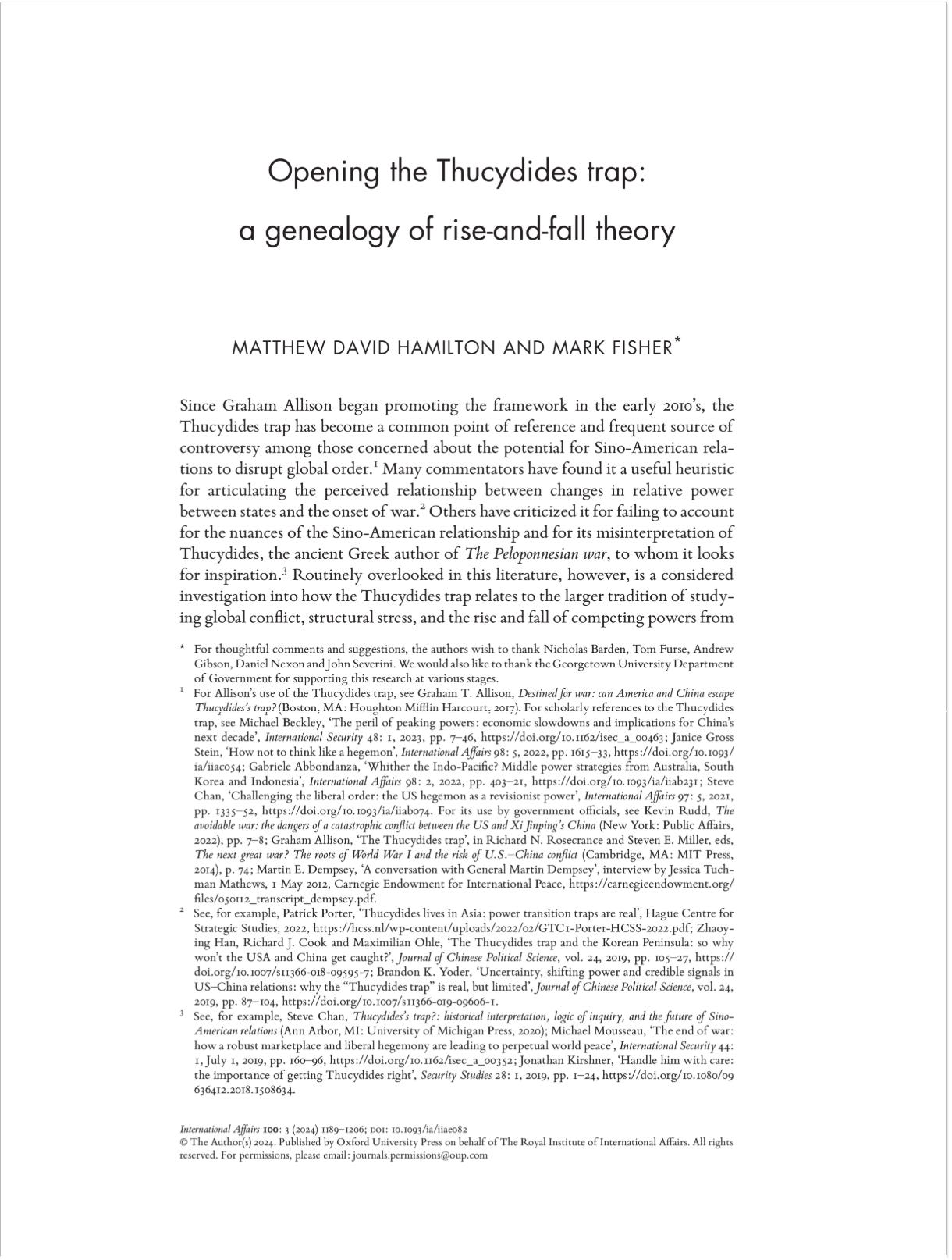
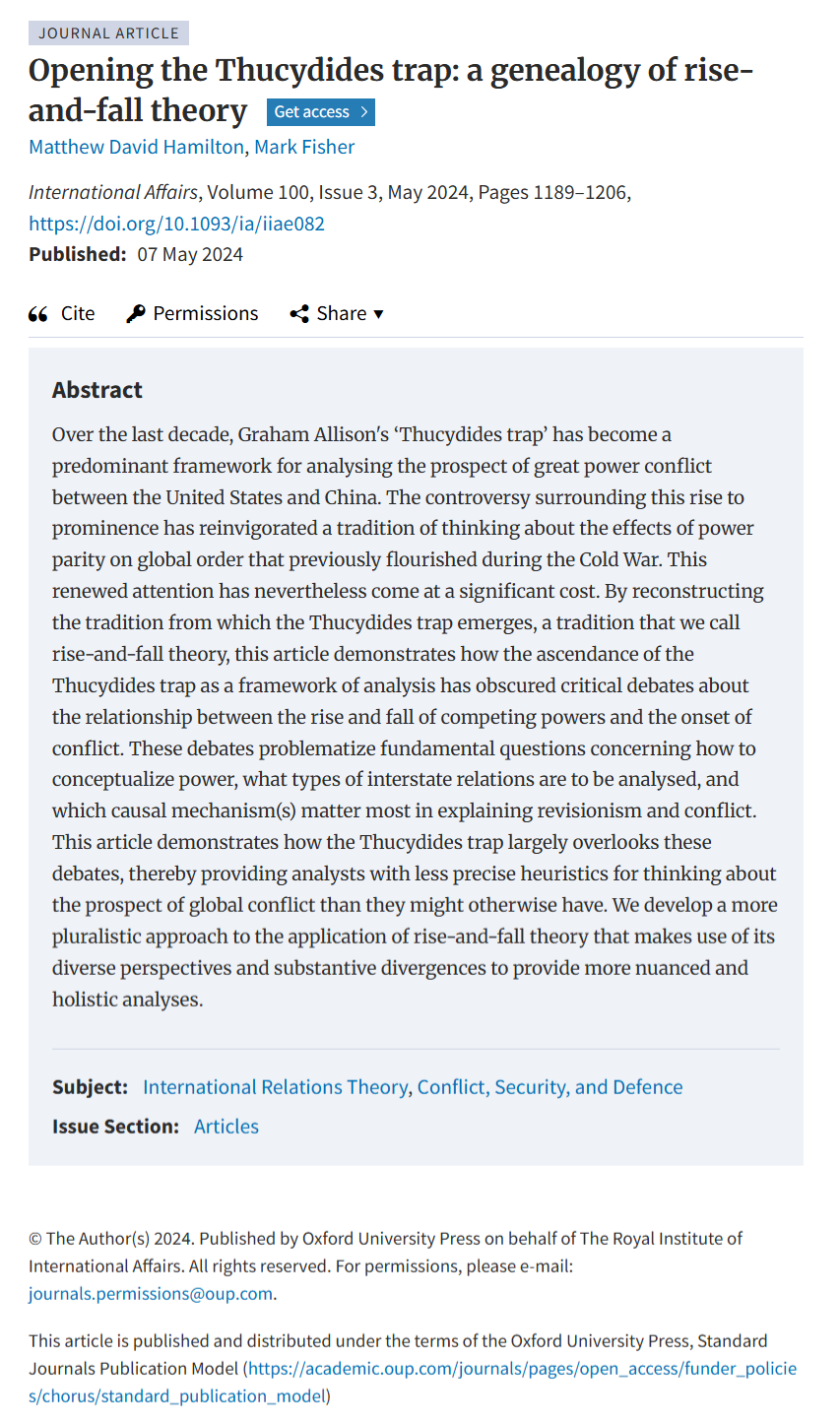
Again: Matthew David Hamilton, Mark Fisher:
https://academic.oup.com/ia/article-abstract/100/3/1189/7663889
Editor: A collection of telling quotes from Lydia Polgreen’ near political monstrosity!
Trump or no, the military adventurism of the past two decades has become an unmistakable sign of decline. “If we’re having to maintain primacy by invading this country that’s not posing a threat to us and launching a global campaign of antiterror, clearly, we’re on the decline,” Van Jackson, a progressive foreign policy scholar and an author of “The Rivalry Peril,” told me. “It has always been the case in these cycles of history that when the dominant power starts investing and playing this military role globally, you have rising powers who are stepping up, playing a more important economic role globally.”
History is littered with examples of the dangers of aggression for declining powers — Spain’s crusading military folly in the 16th century, the late Ottoman Empire’s embrace of ethnic nationalism, Britain’s vain attempt to cling to its unsustainable imperial position between the world wars. Each ended the same way: an astonishingly rapid loss of power and prestige on the global stage.
…
This leads to an irresistible irony. Far from beating back China, America under Trump may come to resemble it. The country is on its way: obsessed with regime stability and willing to use almost any means to keep its people under control; jealously guarding its near periphery while remaining largely uninterested in leading the world; and building a cult of personality around its autocratic leader in an atmosphere of ethnonationalist triumphalism.
Trump, despite his vituperative campaign rhetoric, has never really been a China hawk, even if some around him have led the charge for more aggressive policies to blunt China’s might. Indeed, he has often lavished praise on Xi Jinping, a man who has the kind of virtually limitless power Trump clearly craves. “President Xi is a great leader of a great country,” Trump cooed at their meeting in South Korea last month.
…
China is playing a much longer and more sophisticated game. Premier Li Qiang, Xi’s top emissary, will be in Johannesburg, accompanied by a vast retinue of officials, ready to talk with the world’s major economies about the problems and possibilities of the emerging multipolar order.
As its primacy fades, the United States now faces a choice: meet rising nations as respected partners in building a new, more equitable multipolar world or seek the costly, brittle power that comes from domination. Trump has chosen the latter; China, it seems, seeks the former. History tells us which path leads to peace and prosperity, and which is the road to ruin.
Newspaper Reader.


 StephenKMackSD's Blog