Newspaper Reader
Nov 27, 2025
In Abigail Green’s review of Mark Mazower’s ‘On Antisemitism A word in history’ of November 28, 2025 not one mention of The Gaza Genocide, should not surprise the reagular reader of the ‘Times Newspaper’ in its various iterations: Reader recall the attacks on Jeremy Corbyn, and The Economists that engaged in in like-mimded pictorial defamation:
Leaders | Britain’s Labour Party
Backwards, comrades!
Jeremy Corbyn is leading Britain’s left into a political timewarp. Some old ideological battles must be re-fought
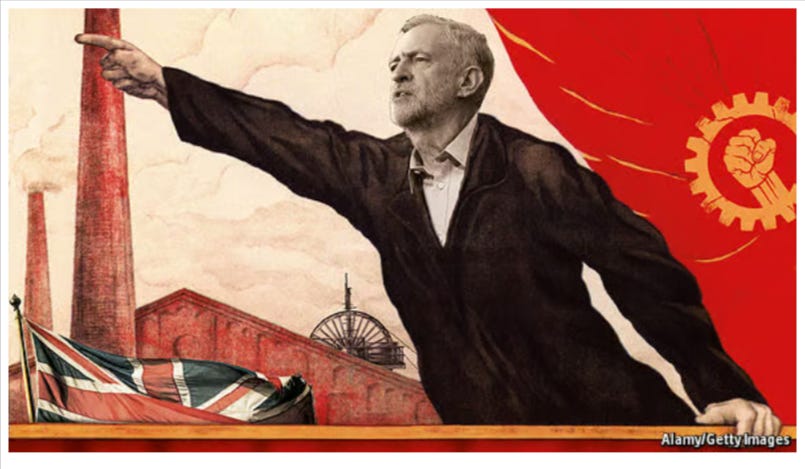
Sep 19th 2015|5 min read
Editor: Reader note the use of the IHRA as the cudgel of choice, while the Genocide In Gaza continues unabated!
…
Inevitably, Mazower’s account of this situation is not neutral. It was, he writes, increasingly clear to him “that the constant invocation of antisemitism [against those protesting for Palestinian rights] needed to be understood as a refusal to acknowledge other things … that is to say, the existence of a suffering Palestinian people and their desire for freedom”. I want to let that stand; it may well be true, just as it may be true that those concerned with the “weaponization” of antisemitism refuse to acknowledge the ways in which the Palestinian movement is acting as a conduit for antisemitism into “our” society, however just its core aspirations. After all, the IHRA and the Jerusalem Declaration both agree that anti-Zionism is sometimes a form of antisemitism.
To publish such a book at this particular juncture is inevitably to intervene in a highly charged political debate. On Antisemitism is, the back cover tells us, “a vitally important attempt to draw a line that must be drawn”. Unlike Mark Mazower, whose scholarship I admire, I have not chosen to intervene in that debate, preferring instead to review his book as a work of history, which is what it purports to be. Nevertheless, I want to conclude by querying the implicit “we” that runs through its entire enterprise. “What do we mean when we talk about antisemitism?”, it asks. To answer that question in today’s global world, “we” need to consider a broad range of agents and publics. The narrative provided here does centre Jewish voices, but it consistently privileges European, American and (in Israel) Ashkenazi players and perspectives over those of others.
Newspaper Reader.


 StephenKMackSD's Blog