Newspaper Reader comments.
Oct 04, 2025
Opinion Life & Arts
The war against the quite good
The bidding war for geniuses will antagonise those just below
Janan Ganesh
https://www.ft.com/content/0fc44c6b-277c-4472-a235-65f59a9195f3
Editor: Janan almost pulls out all the stops, for his latest, what to name it? Self-congratulaton in its future iteration? All in jest of a kind? His readers wallow in his impecable education University of Warwick, University College London, Harris Academy South Norwood education not quite an ‘Oxbrideger’ but in close proximity, like his relationship to his deathbed?
On my deathbed, as the burial site at Westminster Abbey is being prepared, and a weeping Nobel delegation bother me at my 12-bedroom Highgate estate with still another prize, I will spare one last thought for the species. What about people below the genius threshold? How is society to look after the merely very competent?
Editor: Under the rubric of ‘The Broken Masters of Capital’ which Ganesh laudes!
…
Peter Thiel made this point on The James Altucher Show while discussing his recently released book (Zero to One). At minute 11:35 of the podcast, he mentions how some of the more successful entrepreneurs in Silicon Valley share this common “dysfunction”:
“One of the strange things in Silicon Valley is that so many of these successful entrepreneurs suffer from a mild form of Asperger’s or something like that. And I always think of this as an incredible indictment of our society: What sort of society is it where, if you do not have Asperger’s, you will pick up on all these social cues that discourage you from pursuing creative original ideas.”
…
I ask because the world is in danger of over-rewarding an inspired few. The best AI researchers and engineers can name their price as companies vie to hoard talent. Sam Altman talks of “crazy intense comp for a very small number of people right now”. Something similar is going on in finance and law. There is no longer much squeamishness about admitting the uneven distribution of talent. Woke, with its flattening ethos, has ebbed, and unions are weak in the most advanced industries.
Editor: the final sentence of this paragraph reminds this reader of Ganesh of another time, of the evolution of his talent, with the adaptation of the feuilleton, no matter how etiolated as expressive tool!
At this point, the moral custom is to worry about people with the fewest marketable skills. But it is not as if the world was treating them well before. The real news is the fallen status of those just a notch or two down from the most sought-after. Will someone not speak up for the quite good?
Editor: The Reader has to wonder at Ganesh political/moral trajectory here?
A quite good job in journalism used to be sweet indeed. Even newspapers in secondary American cities would post staff to New Delhi and Rome. That life is still attainable at the very grandest titles but the Baltimore Sun, say, closed its last foreign bureau long ago.
Editor: In this paragraph Ganesh regales his readership with borrowed chatter!
A quite good artist used to do well. Before the invention of the gramophone, said the writer and advertising executive Rory Sutherland, “there was a decent living to be made as the fifth best operatic tenor in Denmark”. Once audiences were no longer confined to local music, these singers lost out to the best in the world market. In the Spotify era, when the marginal cost of streaming a song from another continent is zero, pray for them.
Editor: Ganesh regales the reader with : ‘a sort of Muskian impatience’ & ‘The difference between quite good and great trading is measurable. And so the worship of the very best becomes right (or at least righteous). This Reader just wonders at Ganesh’s flacid 105 words!
The quite good will always prosper in lines of work that are site-specific, and therefore somewhat screened from world competition. There are still loads of quite good restaurants. But in tech, multi-manager hedge funds and other disembodied sectors, which don’t just make the largest fortunes but also set wider cultural norms, a sort of Muskian impatience with the less-than-brilliant is part of the atmosphere. And not because these are colder people. The difference between quite good and great music is arbitrary. The difference between quite good and great trading is measurable. And so the worship of the very best becomes right (or at least righteous).
Editor: What a reader confronts here is a Ganesh, who self-presents in the guise of ‘dry liberal’ a term of wan political abuse?
The dry liberal in me isn’t so worried. If a luminous few make world-changing breakthroughs in their field, we might come to regard them as cheap at the price. If not, the auction for their talent should calm down over time.
Editor: Ganesh in this paragraph features: latent Tory, the most primitive Marxian, New England trader, George III’s taxes,….
It is the latent Tory, the worrier about social order, that does wince a bit. You’d have to be C to still believe that revolutions must always come from far below. In fact, it is the Weimar shopkeeper inflated out of their savings, the New England trader who felt George III’s taxes, who often rebels. That is, the person who sees their quite good status threatened. The person with enough education and confidence to assert themselves.
Editor: The once usual Ganesh political bravado is ebbing! The quotation of Tyler Cowan, of the utterly reactinaty Free Press, and its notorious cadre of Zionist Apologists alerts The Reader!
The 21st century equivalent would seem to be — what? — a smart if not quite dazzling graduate, snubbed by the top-end recruitment round and less and less able to fall back on the ever-scarcer graduate entry job. That is a lot of savvy people to upset. The economist Tyler Cowen wrote that Average Is Over. It would be a bigger threat to civic peace if even Far Above Average Is Over.
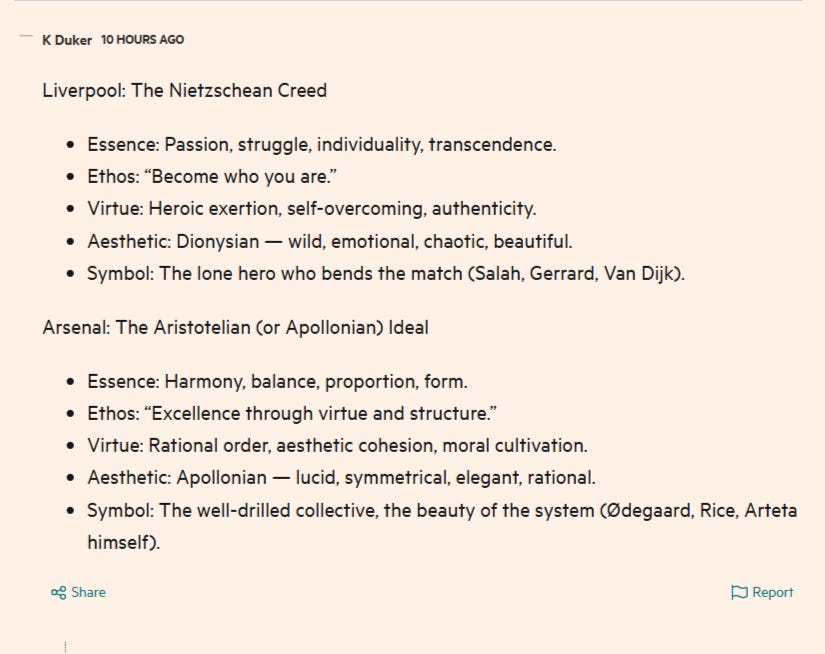
Editor: The Reader confronts the final paragraph framed by the Premier League vs. Arsenal framed by ‘ with Liverpool somewhat Nietzschean in their stress on the epic individual. What fun it will be to watch a wider social tension play out in miniature, without the disturbing stakes’ Reader this is seriocomic shit!
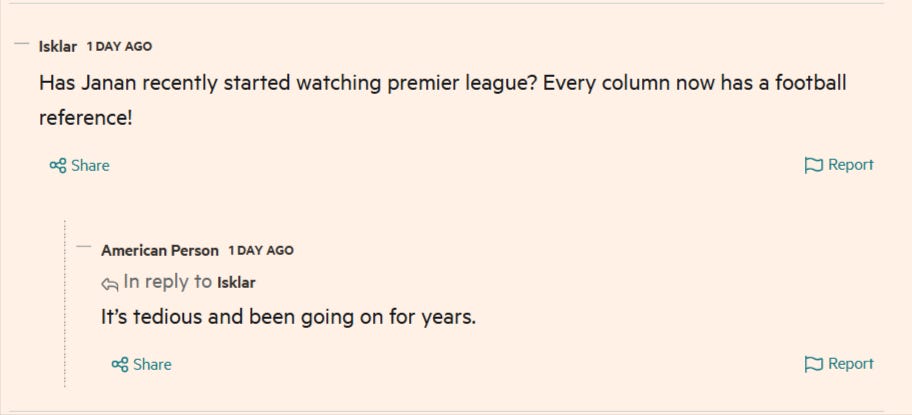
At this time of year, the Premier League season settles into some kind of pattern. What have we learnt? That Arsenal’s average player is probably better than Liverpool’s average player, but Liverpool’s elite few trump Arsenal’s elite few. This is a contest between not just two different recruitment strategies but almost two contrasting world views, with Liverpool somewhat Nietzschean in their stress on the epic individual. What fun it will be to watch a wider social tension play out in miniature, without the disturbing stakes.
https://www.ft.com/content/0fc44c6b-277c-4472-a235-65f59a9195f3
Newspaper Reader.
Editor: A well agued reply to Mr. Ganesh!
N.R.
Editor: Is this the precurser of Janan Ganesh ?
…
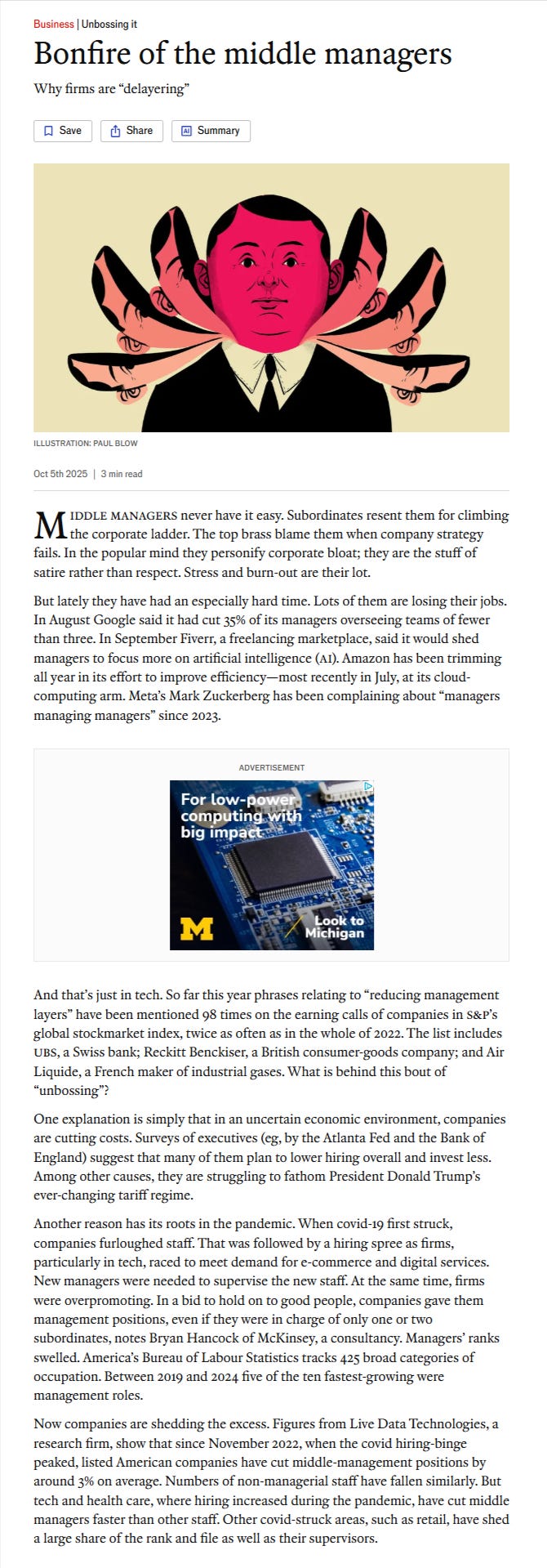
https://www.economist.com/business/2025/10/05/bonfire-of-the-middle-managers


 StephenKMackSD's Blog
Pingback: Old Socialist confronts Janan Ganesh, in his various iterations over time… | StephenKMackSD's Blog