American Reader.
Sep 09, 2025
Act 1:
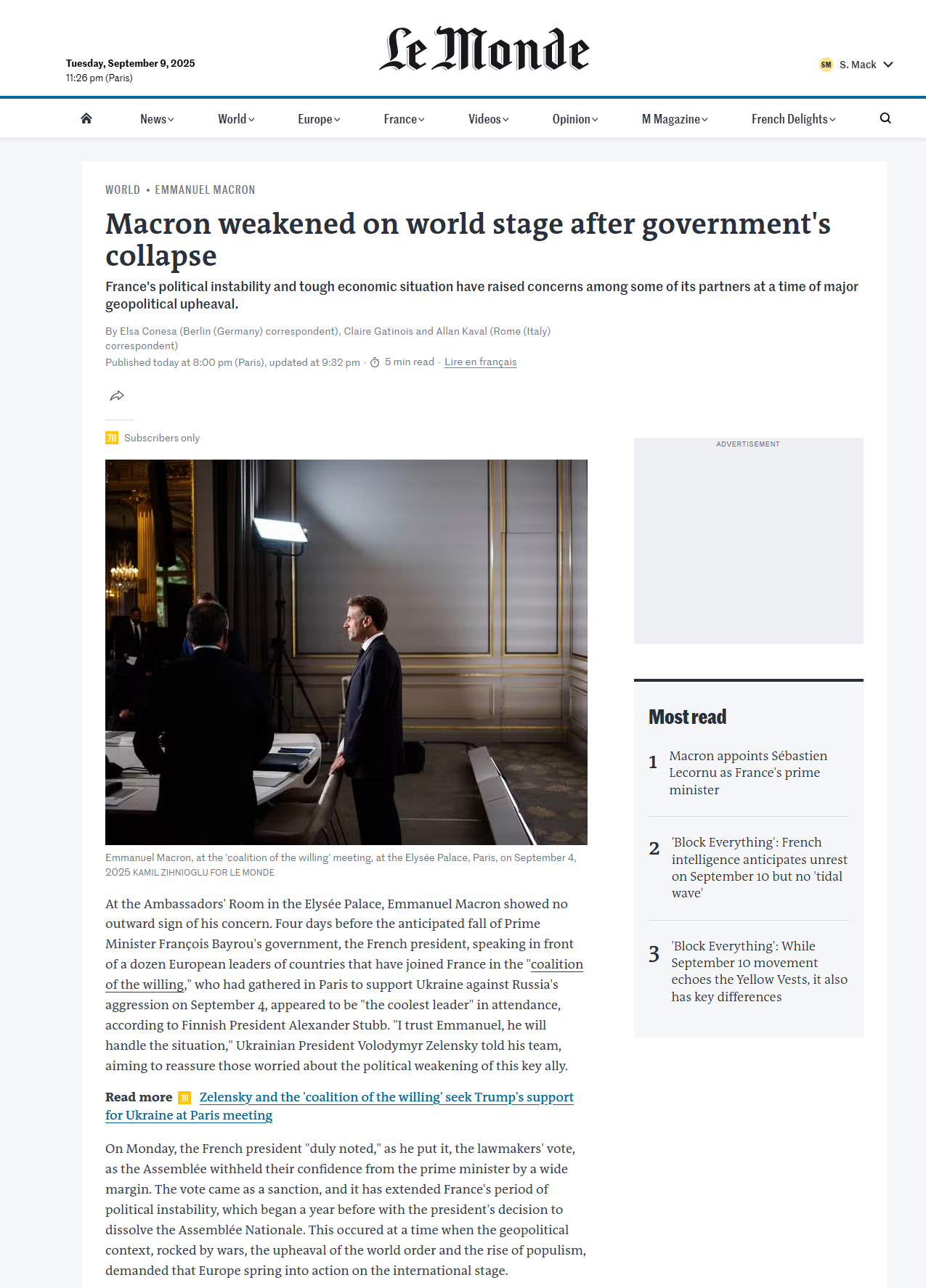
…
Once a star on the international stage, dubbed the “French Obama” in the US and “Wunderkind” in Germany, Macron is now described as one of the architects of the French decline: a phenomenon seen as a source of concern for some and of schadenfreude for others. The self-proclaimed reformer has “self-destructed,” summarized the magazine Der Spiegel on Friday, mocking the “grotesque discrepancy between words and deeds: So far, Paris has only granted Ukraine a total of €6 billion in military aid, less than countries like Denmark, the Netherlands or Sweden, which would never claim to play a role on the international scene. France is now a great power only in its president’s speeches.”
The incident also comes 15 days before the United Nations General Assembly, held in New York on September 22, at which the French president is due to recognize the State of Palestine. Macron hopes to revive the two-state solution, at a time when Israel is continuing its relentless bombing of the Gaza Strip. Meanwhile, Israeli officials have criticized Macron and seek to undermine his initiative, describing it as being led by a president who “doesn’t matter” anymore.
…
Act 2 :
Emmanuel Macron, a certain idea of power
By Raphaëlle Bacqué, Ariane Chemin and Ivanne Trippenbach
Published on December 18, 2024, at 7:01 pm (Paris), updated on December 20, 2024, at 6:27 pm
Investigation: ‘The Two Emmanuel Macrons’ (Part 1/4). The French president’s decision in June to dissolve the Assemblée Nationale provoked a major political crisis in France. Le Monde looks back in a series of articles at the leader’s puzzling evolution.
On November 16, 2016, a couple, she in sunglasses and leather pants, he in a slim-fitting black suit and thin matching tie, slipped incognito under the central gate and archways of the Basilica of Saint-Denis. Just after declaring his candidacy for the presidential election in the nearby Paris suburb of Bobigny, Emmanuel Macron, accompanied by his wife Brigitte, slipped away to secretly visit the tombs of the 43 kings of France. In the winter light filtering through the rose window of the south arm, the future president caressed the white marble of the recumbent sculpted figures.
For all those who take power, there’s an original scene. Saint-Denis is the crucible of France’s royal past, a key place in the national narrative. Other presidential candidates, lovers of history, had preceded Macron in drawing a piece of legitimacy from this magnetic pole of monarchical ambitions: François Mitterrand in the autumn of 1980; Jean-Luc Mélenchon, more quietly, in 2012.
On that day in November 2016, journalists and the embedded writer Philippe Besson, then busy writing his book Un personnage de roman (“A character from a novel”), missed Macron’s escapade. But on the way back, he confided to one of his early admirers, the journalist-blogger Bruno Roger-Petit, the meaning of his visit to Saint-Denis: Amid the “stones that speak,” he found himself “alone in his destiny.”
…
Editor: In the 3,522 words of the first part of their political essay, have Raphaëlle Bacqué, Ariane Chemin and Ivanne Trippenbach decided to rehabilitate Truman Capote’s non-fiction novel? Though their collective prose style seems mannered to an American Reader !
American Reader.


 StephenKMackSD's Blog