American Reader wonders at the political elasticity of ‘The Character of Bagehot’? Over time.
Aug 30, 2025
Editor: ‘The Bagehot’ of August 20, 2025:
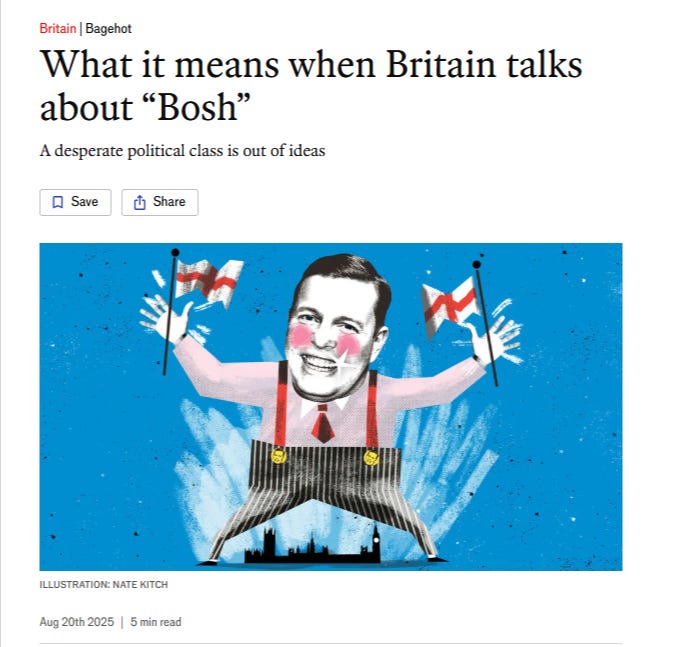
https://www.economist.com/britain/2025/08/20/what-it-means-when-britain-talks-about-bosh
The Reader might wonder about the books he published:
Lombard Street: A Description of the Money Market by Walter Bagehot
The English Constitution by Walter Bagehot
“Physics and Politics, or, Thoughts on the Application of the Principles of ‘Natural Selection’ and ‘Inheritance’ to Political Society”
Editor: Walter Bagehot could never be considered a satirist, yet in the hands of the present day Economist writer, Duncan Robinson mocks the Great Man!
https://www.economist.com/britain/2025/08/27/the-polycrisis-theory-of-brexit
Editor : Duncan Robinson in a ‘serious mood’, postulates ‘the polycrisis theory of brexit!’ in two short paragraphs
Parliament has lost interest, but Britons still devour books about Brexit. Those books tend to belong to one of two schools. One is the Great Man—or rather, inadequate boys—theory of history, exemplified by “All Out War”, by Tim Shipman. It argues that the divorce was propelled by the betrayals, blunders and petty feuds at the court of David Cameron, whose campaign was hopelessly focused on warning of economic disaster.
A second school takes the long view. In “Between The Waves”, a rich and incisive new history of British Euroscepticism to be published next month, Tom McTague begins the journey with Enoch Powell, a Tory imperialist, driving through the Algerian desert in 1943. From the very birth of the European project, he argues, the British dilemma between sovereignty outside the club or influence within it was acute. The break of 2016, if not inevitable, was foretold many times.
Editor: Duncan Robinson:
Robinson in the guise of Walter Bagehot, in his first two paragraphs fails to mention Bernard Connolly’s ‘The Rotten Heart of Europe’ in its 2012 edition:
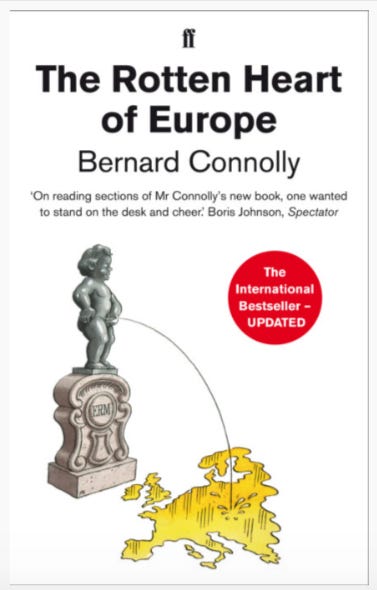
Bernard Connolly’s 400 page History is indictive of the inability of the Eurocratic clique, to let go of the tattered remaines of the legacy of Jean Monnet, and the Coal and Steel Cartel that metatisised into the Bankrupt E.U. of the current political moment! With Ukraine about to topple, and Ursula von der Leyen with her loyalists Macron, Starmer, Merz promising weapons not yet in production. What is the reader to think of Robinson as Bagehot, that offers the reader a maladroit, or just an imagined cordon sanitaire of a kind?
Editor: Just a sample of this collection of strung together Political Actors? Or just call it by another name, once favored by that long forgotten master of free association Sigmund Freud?
…
Revisit the continent that Lord Cameron, fresh from an election victory, toured in the summer of 2015 as he hawked his renegotiation plan.
…
Greece’s prime minister, Alexis Tsipras, called a referendum to defy the austere terms of a bail-out by his bankrupt country’s creditors. As cash machines ran dry, Grexit loomed—until, in an all-night summit,…
…
Parliament has lost interest, but Britons still devour books about Brexit. Those books tend to belong to one of two schools. One is the Great Man—or rather, inadequate boys—theory of history, exemplified by “All Out War”, by Tim Shipman. It argues that the divorce was propelled by the betrayals, blunders and petty feuds at the court of David Cameron, whose campaign was hopelessly focused on warning of economic disaster.
A second school takes the long view. In “Between The Waves”, a rich and incisive new history of British Euroscepticism to be published next month, Tom McTague begins the journey with Enoch Powell, a Tory imperialist, driving through the Algerian desert in 1943. From the very birth of the European project, he argues, the British dilemma between sovereignty outside the club or influence within it was acute. The break of 2016, if not inevitable, was foretold many times.
Both schools have merit, but Bagehot finds a third view compelling: Brexit was a matter of inept timing. Mr (now Lord) Cameron made the risky gambit of a referendum near-suicidal by asking Britons to pass judgment on the European Union after its most perilous year. Jean-Claude Juncker, then the European Commission’s president, called it the polycrisis: an era in which the prospect of Brexit combined with a euro-zone debt crisis, a migrant crisis and Islamist terrorism to threaten the foundations of Europe. With such a context, perhaps the only surprise is that Leave’s victory, with 52% of the vote, was so narrow. That crisis forms the backdrop to the last quarter of Mr McTague’s account. In the public debate, it has been largely forgotten.
Revisit the continent that Lord Cameron, fresh from an election victory, toured in the summer of 2015 as he hawked his renegotiation plan. In Brussels, the mood was leaden—like the eve of the first world war, as Donald Tusk, the Polish prime minister and an EU bigwig, later put it.
…
Greece’s prime minister, Alexis Tsipras, called a referendum to defy the austere terms of a bail-out by his bankrupt country’s creditors. As cash machines ran dry, Grexit loomed—until, in an all-night summit, Mr Tsipras cracked, “waterboarded” by his fellow leaders, as one diplomat put it. For the British left, the breaking of his Syriza party left a foul taste. “It’s time to reclaim the Eurosceptic cause,” wrote Owen Jones, a Guardian columnist.
….
Greece was also the entry point for many of the 1m migrants who arrived in Europe in 2015, often in dinghies over the Aegean. The largest group were Syrians displaced by war. “Wir schaffen das!” said Angela Merkel in August, declaring Germany up for the challenge.
…
The migrant crisis fused with another fear. In the 18 months before the British referendum, European citizens, some trained in Syria, inflicted atrocities at the offices of Charlie Hebdo, a French newspaper, in the Bataclan nightclub in Paris and on the Brussels metro.
….
But European leaders resented being asked to sort out the Conservative Party’s neuroses as they battled to save their project. At summit after summit, the British question fell to the bottom of the agenda, after the coffee and petits fours.
…
Brexit, it claimed, was the last lifeboat to preserve the status quo; staying in a crisis-riven bloc was the real danger. That was the meaning of “Take back control”. Or as the campaign’s less-well-remembered slogan put it: “Vote Leave is the safer option.”
…
The reality, that running against the EU as the euro burned was playing politics on easy mode, is awkward for everyone. The Great Man theory is more flattering than dumb luck.
…
The polycrisis marked the end of this innocent age. It put iron in the blood: the harshness meted out to Mr Tsipras would be visited on British ministers in the Brexit years. Brussels became a lot less about farm regulations and more about flexing geopolitical muscle: a Europe of events, not rules, as Luuk van Middelaar, a Dutch historian, puts it. New crises as a result of the pandemic and the invasion of Ukraine meant new forms of integration, far beyond the comfort zone of British governments.
….
Any attempt to reverse Brexit would need to embrace this new reality. Europe’s annus horribilis made Brexit unstoppable; the changes it brought may make rejoining unthinkable.
…
American Reader.


 StephenKMackSD's Blog