Political Observer: Can more than 650,000 voters, and counting, be wrong?
Aug 19, 2025
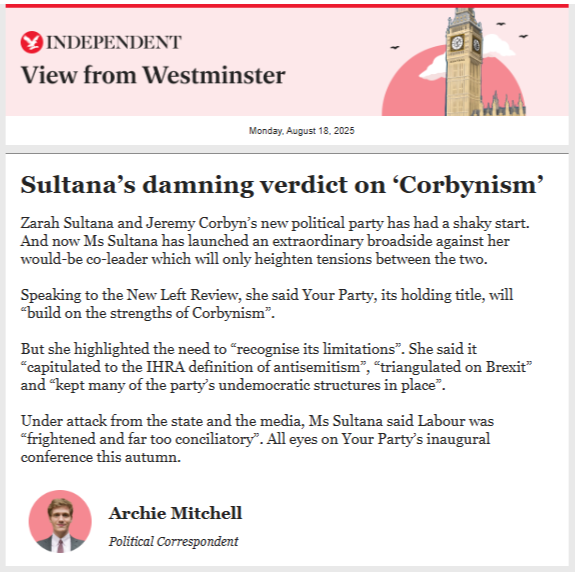
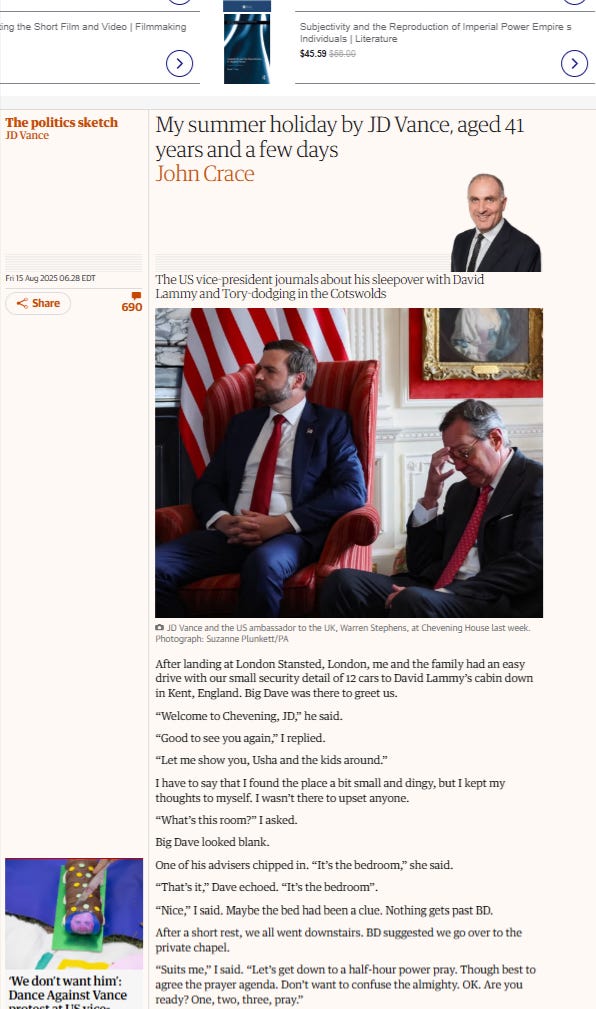
The Reader wonders at Mr. Mitchell’s what to name it? Perhaps Mr. Mitchell should read John Crace? or Andrew Murray?
Force of Opposition
C
06 August 2025 Politics
The number of people who have signed up for Britain’s new left-wing party has surpassed 650,000: a figure that dwarfs the membership of every other outfit in Westminster. Preparations are underway for its founding conference, likely to be held in November, where registrants will decide on its initial platform and develop some of its democratic structures. As part of the ongoing debate on such questions, Sidecar recently published an interview with James Schneider, the former communications director for Corbyn’s Labour, in which he set out his case for an organisation that would avoid the electoralist pitfalls of the 2010s by basing itself mostly outside Westminster and striving to construct different forms of popular power.
For our next instalment in the series, we turn to Andrew Murray. Born in 1958, Murray joined the Morning Star as a lobby journalist at the age of nineteen. He moved sidelong into the labour movement in the 1980s, playing a key role in the foundation of Unite, one of the country’s largest unions, and later serving as its Chief of Staff. During the 2000s he was appointed to the executive committee of the Communist Party of Britain and co-founded the Stop the War Coalition, set up to oppose the invasions of Iraq and Afghanistan. An early supporter of Corbyn’s leadership, Murray was seconded from Unite to assist with its 2017 general election campaign, before joining the team as a Special Political Adviser. He is also the author of numerous books on UK politics: a devastating indictment of railway privatisation, Off the Rails (2002); an account of the structural processes that produced the Corbyn project, The Fall and Rise of the British Left (2019); and an analysis of the political lessons to be drawn from that experience, Is Socialism Possible in Britain? (2022).
Murray spoke to Oliver Eagleton about the politics of the nascent party, its priorities at this early stage, the discussions about its leadership, and the attitude it should cultivate towards social movements and working-class institutions.
…
OE: How can the party provide that kind of political expression?
AM: Well, that is the main question. Debates about the organisation’s structure (federal, coalitional, central) or even its leadership (sole, joint, collective) are secondary to its political positioning. The new party needs to be absolutely, clearly anti-capitalist and anti-imperialist. It needs to see itself as creating the space for a transition to socialism. Parts of its political profile can perhaps be assumed: certainly its position on Gaza and its opposition to austerity. But it needs to go further, in my view, by generalising outward from these two urgent issues and offering a systemic alternative.
This is, broadly speaking, what the party’s supporters want. It is also what millions of people across the country are craving, including many of those who are gravitating towards Reform. In the present political landscape you have a crumbling centrism identified with Starmer and with Rishi Sunak before him, which takes a managerial approach to the colossal problems that have accumulated since 2008, and then you have a right-wing pseudo-opposition which the FT’s Martin Wolf rightly describes as ‘plutocratic populism’, which engages in all sorts of demagoguery, including posing as pro-worker, when in fact it is the project of millionaire Thatcherites. With this as the current polarisation, the left has a unique opportunity to redraw the lines of division: placing the centre and the hard right on one side, and itself on the other. The issues that it can use to do so are clear: opposition to austerity, opposition to medieval levels of social inequality, and opposition to war. Our slogan in the Stop the War Coalition is ‘Welfare not Warfare’. The government’s might as well be ‘Make the Poor Pay For War’. It is right now embarking on a major military build-up while slashing social spending – and it is doing so in lockstep with the pluto-populists, who don’t even pretend to have the same non-interventionist inclinations as Trump’s national-populists in the US.
So, undoubtedly, there is a political space to be occupied. Corbyn’s leadership filled it from 2015 to 2019, but it was tethered to the Labour Party, which already had an entrenched position in the British status quo that many of its parliamentarians and staffers were determined to defend. The new party is in a very different situation. It will be unencumbered by these problems; it will be a novel and galvanising force. But at the same time it will not have the strength that comes from being a part of the political fabric for 120 years, nor the historic roots and power bases which, although they have massively atrophied for the Labour Party, have not disappeared entirely.
…
https://newleftreview.org/sidecar/posts/force-of-opposition
Political Observer.


 StephenKMackSD's Blog