Political Cynic offers a Sampler!
Aug 17, 2025
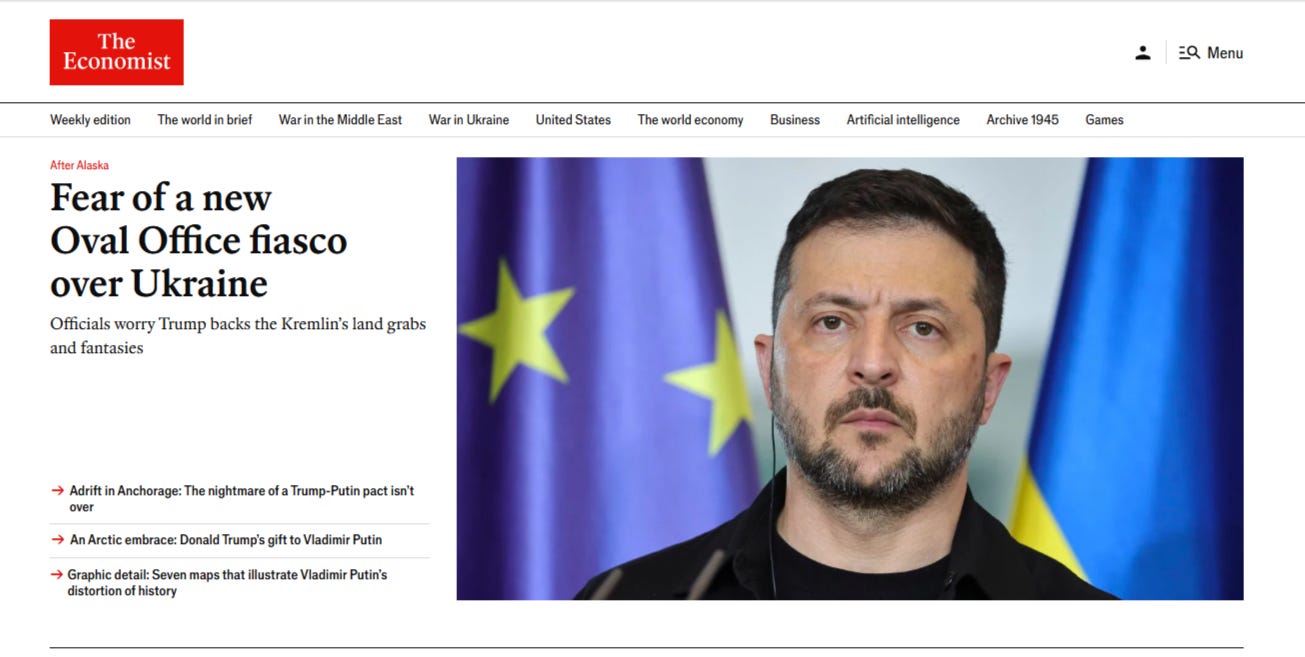
Political Cynic offers a Sampler:
Fear of a new Oval Office fiasco over Ukraine.
…
Throughout July secret contacts between Ukraine and Russia had brought the two countries closer to an understanding of how the war could be frozen. But subsequent talks between Mr Putin and Steve Witkoff, a confidant of Mr Trump from his real-estate days, created a series of impossible new territorial demands on Ukraine. At the summit on Friday Mr Putin once again demanded that Ukraine retreat from the parts of Luhansk and Donetsk provinces that it still holds, which together represent the most fortified sections of the front line. This would put Mr Putin in a far stronger position to attack again in the future, should he choose to do so. In return, the Russian president offered to give back tiny chunks of occupied territory in Sumy and Kharkiv provinces, and to freeze the current lines in Zaporizhia and Kherson.
Years of war have strained the Ukrainian people, and Russia continues to press its advantage in metal and men on the front lines. Unsurprisingly, opinion polls show a clear switch to pragmatism on concessions for peace. A majority of those asked are now in favour of acknowledging de facto occupation of the areas Russia already holds in exchange for genuine security guarantees from the West. But there are nonetheless consistent and overwhelming majorities against making any further territorial concessions to Russia. According to Anton Hrushetskyi, executive director of the Kyiv International Institute of Sociology, less than one in five would be prepared to accept the kind of land swap Mr Trump is said to be favouring.
A Ukrainian intelligence officer says the Americans are being “unbelievably aggressive” in pushing Ukraine to forfeit more land. The Russian interest is clear enough, he says. “They want to maximise the package they will get in return—from sanctions relief, to the return of seized assets, to the re-opening of energy markets.” What, he says, is far less clear is why the Trump administration was pushing so forcefully to promote Russia’s interests.
Despite the obvious headwinds, Mr Trump appears committed to his quick-fix peace. The Economist understands a three-way meeting between Mr Trump, Mr Putin and Mr Zelensky could come as early as the end of next week. Before that, on Monday, the Ukrainian leader is scheduled to arrive in Washington for his first visit since his humiliation in February. European leaders will join him in a show of support. But some of the ingredients appear ominously similar to his previous visit. Channelling the logic of Mr Putin, Mr Trump is already preparing to blame Ukraine if his plans blow up, Ukrainians fear. “Make a deal,” he advised Mr Zelensky, via Fox News. “Russia is a very big power. [You] are not.” ■
https://www.economist.com/europe/2025/08/17/fear-of-a-new-oval-office-fiasco-over-ukraine
The nightmare of a Trump-Putin pact isn’t over
…
This is where Europe has a key role. After the Alaska summit Mr Trump spoke with European leaders and Mr Zelensky for one hour in a call, during which they emphasised that Ukraine must decide on territory and must get weapons supplies and security guarantees. In a statement the European leaders declared that “We will continue to strengthen sanctions and wider economic measures to put pressure on Russia’s war economy until there is a just and lasting peace. Ukraine can count on our unwavering solidarity as we work towards a peace that safeguards Ukraine’s and Europe’s vital security interests.” There is evidence that Mr Trump listens to Sir Keir Starmer, Friedrich Merz, Emmanuel Macron and Alexander Stubb, so their interventions over the next few days will carry some weight in steering him away from trying to impose a bad deal on Ukraine. There is little support in Congress or among the American public for a full rehabilitation of Russia.
Europe would carry a lot more weight if it were doing and spending more. Mr Trump and his vice-president, J.D. Vance, both think, with some justification, that supporting Ukraine should be primarily a European responsibility. For a long time that was not the case and only in recent months has Europe’s cumulative military aid through procurement deals finally exceeded that of America, according to the Kiel Institute, a think-tank. Europe can do more by providing funds for buying weapons from America, building up its own munitions and helping Ukraine to complete the build-out of its own military-industrial complex. This is essential in any scenario. It would also signal that if Mr Zelensky and Europe ultimately reject a deal that Mr Trump and Mr Putin agree on, and America then abandons its support entirely, Ukraine is still capable of fighting on.
After Anchorage Mr Trump suggested that he wanted not a transitory ceasefire, but a final peace that would “hold up”. In fact, deal or no deal in the coming days, the conflict will continue. For Mr Putin, the war has become an instrument of political control at home, providing a pretext for the repression that keeps him in power, despite the heavy costs in lives and to Russia’s economy and increasingly rickety financial system. As well as expanding Russian territory, he hopes to divide the Western alliance and weaken Europe. The danger is that Mr Trump is blind to, or even untroubled by, the Kremlin’s agenda. The talks on Monday could produce a breakthrough. But Europe and Ukraine must prepare for the worst and make clear that they are ready for that challenge. ■
https://www.economist.com/leaders/2025/08/16/the-nightmare-of-a-trump-putin-pact-isnt-over
Donald Trump’s gift to Vladimir Putin
…
The honours for Mr Putin were in sharp contrast to the public humiliation that Mr Trump and his advisers inflicted on Mr Zelensky during his visit to the White House earlier this year. Since then relations with Ukraine have improved, but Mr Trump has often been quick to blame it for being invaded; and he has proved strangely indulgent with Mr Putin. Mr Trump told Fox you have to “weave and bob” to reach deals, but his constant shuffling in the run-up to the summit suggests indecision and frustration with a Russian leader who will not respond to his entreaties.
The Alaskan venue was rife with symbolism: the proximity of Russia and America across the Bering Strait, the sale of Alaska by Tsarist Russia to the United States in 1867; and the American lend-lease agreements that armed the Soviet Union to help it resist Nazi Germany (an important supply route ran through Alaska). Mr Putin recalled all this and recounted how, on the red carpet, he had greeted Mr Trump with “Good afternoon, dear neighbour.”
It surely makes sense for big nuclear powers, even geopolitical rivals, to talk to each other. Whether they need to roll out the honours at home for no gain is more doubtful. The only sop to Mr Trump came when the Russian leader said he was “sincerely interested in putting an end” to the war, and agreed that it would not have happened had Mr Trump been president in 2022.
Yet Mr Putin insisted that “we need to eliminate all the primary causes of that conflict”. Given that he thinks the primary cause is Ukraine’s independence and sovereignty, and its right to join European institutions including NATO, his formula is a recipe for continuing the war. Mr Trump did nothing to disabuse him. The Russian president left with a smile, and even tried a little English in public: “Next time in Moscow”, he told his host. To which Mr Trump replied, “I’ll get a little heat on that one, but I could see it possibly happening.”
https://www.economist.com/europe/2025/08/16/donald-trumps-gift-to-vladimir-putin
A short history of Russia and Ukraine
Editor: Here is the final salvos of the Economist, as the perverors of a ‘History Made To Measure’! I offer a condesation, without the maps!
IN JULY 2021 Vladimir Putin published an essay with arguments he would later use to justify Russia’s invasion of Ukraine.
…
There is truth in Mr Putin’s claim that Ukraine and Russia are close kin, as the following maps demonstrate.
…
For Mr Putin the origin of Russian-Ukrainian identity is Kyivan Rus, a confederation of princedoms that lasted from the late 9th to the mid-13th century (see map 1).
…
In the mid-11th century, however, Kyivan Rus began to fragment into semi-autonomous principalities (see map 2). These included Galicia-Volhynia, which covered parts of modern Ukraine and B.
…
When the Mongol empire and its successors began to decline in the 14th century, rival polities rose to fill the vacuum.
…
In 1648 the Cossacks, settlers on the steppe who amalgamated into disciplined military units, led an uprising against the commonwealth.
…
Early Cossack warriors practised a limited form of democracy, a contrast to Muscovy’s autocratic regime.
…
But the Cossack state had a hard time. In 1654, threatened by the Poles as well as the Ottomans to the south, Cossack leaders pledged allegiance to the tsar of Muscovy.
…
By the end of the 17th century the Hetmanate’s territory had split into two: Muscovy took control of the east bank of the Dnieper river, the Polish-Lithuanian Commonwealth seized the west.
…
In the late 18th century the Russian empire broke up the Polish-Lithuanian Commonwealth, with help from Austria and Prussia.
…
On the eve of the first world war the Russian empire stretched from the Sea of Japan to the Baltic (see map 4).
…
In 1917, weakened by the war, Russia experienced two revolutions. The first overthrew the Romanov dynasty. The second was the seizure of power by Vladimir Lenin and his Bolsheviks.
…
Ukraine’s territory expanded during the Soviet period. Under the Soviet Union’s non-aggression pact with Nazi Germany, signed in 1939, the two countries carved up eastern Europe.
…
But Ukraine also experienced great suffering. In the 1930s Josef Stalin’s policy of forced collectivisation of agriculture led to a famine, known in Ukraine as the Holodomor, which killed millions of people.
…
In the 1980s Mikhail Gorbachev, the last Soviet leader, set out to reform the Soviet Union through openness and reform—glasnost and perestroika.
…
Ukraine suddenly became home to the world’s third-largest nuclear arsenal. In 1994 it agreed to denuclearise in exchange for security assurances from America, Britain and the Russian Federation.
…
In 2004-05 the “Orange revolution” highlighted Ukraine’s democratic ambitions. Thousands protested against a rigged presidential election that gave victory to a pro-Russian candidate.
…
Editor: the final paragraphs of this History Made To Measure , that is about the self -willed forgetting, of the various roles toxic political actors, played in the Political Coup against Viktor Yanukovych: Victoria Nuland, Geoffrey R. Pyatt, the Foundation for Defense of Democracies, and the toxic political meddler George Soros, and of course the subrosa political actor Barack Obama. Not forgetting Historian Timothy Snyder who benefited from the largess of Robert Silvers of The New York Review Of Books!
His response to the Maidan marked Russia’s first military incursions into independent Ukraine. In 2014 the Kremlin illegally annexed Crimea and sent troops into the Donbas, a predominantly Russian-speaking region in eastern Ukraine (see map 7). Russia’s separatist proxies—led by the Russian intelligence officers— declared “people’s republics” in Donetsk and Luhansk. By December 2021, just before Russia’s full-scale invasion in February 2022, the conflict had killed more than 14,000 people. The war continues.■
Correction (January 30th) The borders in maps 3 and 4 have been updated since this story was published. The chronology of the founding of the Ukrainian People’s Republic in 1917 has also been clarified.
https://www.economist.com/graphic-detail/2024/01/29/a-short-history-of-russia-and-ukraine
Political Cynic.


 StephenKMackSD's Blog