Old Socialist on the very elastic political standards of Jonathan Freedland & Fellow Travelers!
Jul 13, 2025
Headline: We’re becoming inured to Trump’s outbursts – but when he goes quiet, we need to be worried
Sub-headline: Across the US, without soundbites or stunts, the president is building a police state and eroding democracy
https://www.theguardian.com/commentisfree/2025/jul/11/donald-trump-us-police-state-democracy
Editor: The first three paragraphs from Freedland’s diatribe:
In the global attention economy, one titan looms over all others. Donald Trump can command the gaze of the world at a click of those famously short fingers. When he stages a spectacular made-for-TV moment – say, that Oval Office showdown with Volodymyr Zelenskyy – the entire planet sits up and takes notice.
But that dominance has a curious side-effect. When Trump does something awful and eye-catching, nations tremble and markets move. But when he does something awful but unflashy, it scarcely registers. So long as there’s no jaw-dropping video, no expletive-ridden soundbite, no gimmick or stunt, it can slip by as if it hadn’t happened. Especially now that our senses are dulled through over-stimulation. These days it requires ever more shocking behaviour by the US president to prompt a reaction; we are becoming inured to him. Yet the danger he poses is as sharp as ever.
Consider the events of just the last week or so, few of them stark enough to lead global news bulletins, yet each one another step towards the erosion of democracy in and by the world’s most powerful country.
…
https://www.theguardian.com/commentisfree/2025/jul/11/donald-trump-us-police-state-democracy
Editor: This Reader can’t quite forget Friedman’s attack on Jeremy Corbyn of Wed 1 May 2019! Columnist Daniel Finkelstein does the the heavy lifiting, while Freedland maitaines safety in distance!
Headline: Jeremy Corbyn is either blind to antisemitism – or he just doesn’t care
Sub-headline: Labour’s leader may claim he didn’t see the racism in JA Hobson’s book. But can the party indulge that delusion?
https://www.theguardian.com/commentisfree/2019/may/01/jeremy-corbyn-blind-antisemitism-hobson
…
On the contrary, the bit Corbyn praised as “correct and prescient” was, in his words, “Hobson’s railing against the commercial interests that fuel the role of the popular press,” which appears squarely in the section where Hobson’s target is “this little group of financial kings”, these “cosmopolitan” men who he had already identified as Jews. (The chapter, incidentally, is called “Economic Parasites of Imperialism,” with “parasites” an image recurrent in anti-Jewish propaganda.) This is not a mere aside by Hobson that might accidentally be overlooked in a skim-read by a busy politician. There are pages and pages of it.
No one is arguing that Corbyn was obliged to denounce the whole book. He could simply have nodded to the problem with a tiny caveat: something like, “Despite some passages that read uncomfortably to the modern ear …” But there is nothing like that. He might have made the move Finkelstein himself made when writing recently about Churchill, in a column headlined: “Winston Churchill was a racist but still a great man”. Corbyn could have said something similar about Hobson or his book. But he didn’t do that either. A Labour spokesman has said that: “Jeremy completely rejects the antisemitic elements of [Hobson’s] analysis.” But if that’s true, why did he not say so when he wrote about it?
Perhaps the Labour leader’s explanation will be the same one he offered for his defence of a mural depicting hook-nosed, Jewish bankers playing Monopoly on the backs of the poor: that he simply did not see the racism. But in the Hobson text, it’s there in black and white. It would be very hard to miss, especially if you’re a “lifelong anti-racist” as Corbyn always insists he is. But perhaps that will be what he’ll say: that he couldn’t see the racism even when it stared him in the face. Because the only other explanation available is that he didn’t object to this part of Hobson’s analysis – as he did to other parts, describing one element of the book as “strange” – because he didn’t see anything wrong with it.
We all know that it’s painful to admit flaws in those we admire. Corbyn should have done it about Hobson, but did not. Now that task falls to Labour MPs, members, supporters and voters. The Labour leader may tell himself that he is the victim here, a serially unlucky anti-racist who means well, but keeps overlooking racism against Jews even when it’s right in front of him, whether on the platforms he shares or the books he praises. Now the rest of the Labour family have to decide how much longer they are willing to indulge that delusion.
…
Editor: Friedland in his concluding paragraphs argues: ‘No one is arguing that Corbyn was obliged to denounce the whole book’. It’s a throwaway line, that refies the statement!
https://www.theguardian.com/news/2019/nov/19/corrections-and-clarifications
On 8 November, the politics live blog republished a tweet by the Guardian columnist Jonathan Freedland that wrongly stated that a shortlisted Labour parliamentary candidate, Councillor Majid Mahmood, had been fined over antisemitic comments made on Facebook. In fact, Mr Freedland confused individuals, both solicitors with the same name, and we are happy to confirm that Councillor Majid, who sits for Labour on Birmingham city council, has not been so fined. We apologise to Councillor Majid for the error and any damage that it has caused him.
Headline: Review: Dangerous Hero: Corbyn’s Ruthless Plot for Power by Tom Bower — portrait of a monomaniac
Sub-headline: If Jeremy Corbyn became prime minister, he would easily be the most dangerous, most indolent and least intelligent holder of the office in history
Review by
Sunday February 24 2019, 12.01am GMT, The Sunday Times
his is one of the most depressing books I have ever read. It is a forensically detailed portrait of a man with no inner life, a monomaniac suffused with an overwhelming sense of his own righteousness, a private schoolboy who failed one A-level and got two Es in the others, a polytechnic dropout whose first wife never knew him to read a book.
It is the story of a man who does not appear to have gone to the cinema or listened to music, takes no interest in art or fashion and refused to visit Vienna’s magnificent Schönbrunn Palace because it was “royal”. It tells how he bitterly opposed the Anglo-Irish Agreement, deeply regretted the fall of the Berlin Wall and praised the men who attacked New York on September 11, 2001, for showing an “enormous amount of skill”. In some parallel universe, this man would currently be living in well-deserved obscurity. In reality, Jeremy Corbyn is the leader of Her Majesty’s opposition and the bookmakers’ favourite to become our next prime minister.
For the veteran biographer Tom Bower, whose previous subjects include Mohamed al-Fayed, Richard Branson, Simon Cowell, Tony Blair and Prince Charles, Corbyn is the easiest target imaginable. The details of his life are well known. Born in 1949, the son of a skilled engineer and a maths teacher, he was brought up in a large 17th-century farmhouse in Shropshire called Yew Tree Manor. At school he was a loner and an underachiever, so lazy that his headmaster told him: “You’ll never make anything of your life.”
…
Editor: The above is pure agitprop! Yet The Economist manages to even surpass the Friedland Jeremy Corbyn political hysterics!
Leaders | Britain’s Labour Party
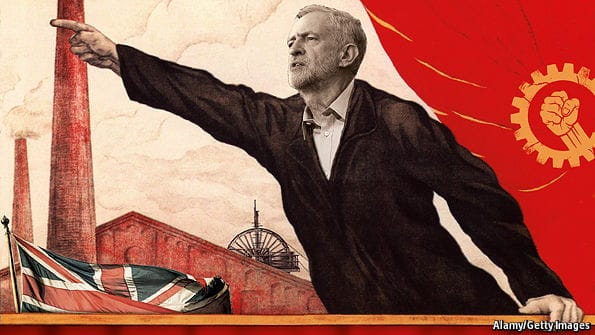
Backwards, comrades!
Jeremy Corbyn is leading Britain’s left into a political timewarp. Some old ideological battles must be re-fought
Sep 19th 2015|5 min read
BEFORE he had finished belting out his first celebratory rendition of “The Red Flag”, a hymn to class struggle, some of Jeremy Corbyn’s colleagues in Labour’s shadow cabinet had already handed in their resignations. A 66-year-old socialist, Mr Corbyn has spent 32 years as one of the hardest of hardline left-wingers in the House of Commons and a serial rebel on the Labour backbenches. On September 12th he flattened three moderate rivals (see article) to become leader of Britain’s main opposition party. Labour MPs are stunned—and perhaps none more so than Mr Corbyn himself.
Two views are emerging of Labour’s new leader. The more sympathetic is that, whatever you think of his ideology, Mr Corbyn will at least enrich Britain by injecting fresh ideas into a stale debate. Voters who previously felt uninspired by the say-anything, spin-everything candidates who dominate modern politics have been energised by Mr Corbyn’s willingness to speak his mind and condemn the sterile compromises of the centre left. The other is that Mr Corbyn does not matter because he is unelectable and he cannot last. His significance will be to usher in a second successive Conservative government in the election of 2020—and perhaps a third in 2025.
Both these views are complacent and wrong. Mr Corbyn’s election is bad for the Labour Party and bad for Britain, too.
Cowards flinch and traitors sneer
Start with the ideas. In recent decades the left has had the better of the social arguments—on gay rights, say, or the role of women and the status of the church—but the right has won most of the economic ones. Just as the Tory party has become more socially liberal, so, under Neil Kinnock and then Tony Blair, Labour dropped its old commitment to public ownership and accepted that markets had a role in providing public services. Mr Blair’s government put monetary policy in the hands of an independent Bank of England and embraced the free movement of people and goods within Europe.
The argument today has moved on—to the growing inequality that is a side-effect of new technology and globalisation; to the nature of employment, pensions and benefits in an Uberising labour market of self-employed workers (see article); and to the need for efficient government and welfare systems. Fresh thinking on all this would be welcome—indeed it should be natural territory for the progressive left. But Mr Corbyn is stuck in the past. His “new politics” has nothing to offer but the exhausted, hollow formulas which his predecessors abandoned for the very good reason that they failed.
Only in the timewarp of Mr Corbyn’s hard-left fraternity could a programme of renationalisation and enhanced trade-union activism be the solution to inequality. If just spending more money were the secret of world-class public services, Britain, which cut almost 1m public-sector jobs in the previous parliament, would have been a cauldron of discontent. In fact voters’ satisfaction with public services rose. If you could create macroeconomic stability by bringing the Bank of England back under the government’s thumb, then Britain would not have spent the post-war decades lurching from politically engineered booms to post-election busts.
Time and again, Mr Corbyn spots a genuine problem only to respond with a flawed policy. He is right that Britain sorely lacks housing. But rent controls would only exacerbate the shortage. The previous Conservative/Liberal Democrat coalition government should indeed have been less austere. It could have boosted demand by spending more on infrastructure. But Mr Corbyn’s notion of “people’s QE”—getting the Bank of England to print money to pay for projects—threatens to become an incontinent fiscal stimulus by the backdoor (rather than serve as an unorthodox form of monetary policy when interest rates are at zero). There is no denying that young people have been harmed by Tory policies that favour the old. But scrapping university-tuition fees would be regressive and counterproductive. For proof, consider that in England more poor students go to university than when higher education was free, whereas in Scotland, whose devolved government has abolished tuition fees, universities are facing a funding crisis and attract no more poor students than they did.
To see where Mr Corbyn’s heart lies, you have only to look at the company he has kept. He admires the late Hugo Chávez for his legacy in Venezuela. No matter that chavismo has wrecked the economy and hollowed out democracy. He indulges Vladimir Putin’s authoritarian kleptocracy in Russia and blames NATO for provoking its invasion of Ukraine. He entertains Hamas, which has repeatedly used violence against Israel and admires Syriza, the radical left party that has governed Greece with almost unmatched incompetence. Yet he is stridently anti-American, anti-Israel and anti-NATO and quietly anti-European Union (apparently, it’s a free-market conspiracy—see article). He even scolded China’s Communist Party for its free-market excesses.
To argue that Mr Corbyn’s ideas will improve the quality of political discourse in Britain just because they are different is about as wise as Mr Corbyn’s refusal this week to sing the national anthem at a service to commemorate the Battle of Britain. Policies this flawed will crowd out debate, not enrich it.
The Corbyn of history
Perhaps that doesn’t matter. Mr Corbyn had no expectation of winning the leadership, and for a man who has never had to compromise, the drudgery of party management, media appearances and relentless scrutiny must be a hardship. Even if he is not pushed, he may not choose to stay for long.
Yet the leader of the opposition is one Tory meltdown away from power. Even if Mr Corbyn fails ever to become prime minister, as is likely, he will still leave his mark on the Labour Party. The populism and discontent that brought him the leadership will not just subside. The loathing of Westminster that he represents and the fantasies that he spins will make the task for the next centrist Labour leader all the harder. There is nothing to celebrate about Mr Corbyn’s elevation. For Britain, it is a grave misfortune.
Old Socialist


 StephenKMackSD's Blog