Political Observer explores these questions.

Jun 03, 2025
Headline: Javier Milei’s chainsaw economics in Argentina could lead the way
Sub-headline: If the model can be successfully applied across even just some of the underperforming countries in South America, the economic bounty could be enormous.
Editor: Read the first gushing paragraphs of her opininon column;
You’ll no doubt have noticed the growing buzz around Europe, thanks to a brighter economic outlook, Germany’s decision to scrap its debt brake, and some tactical shifts away from the US. But there’s another region that’s been quietly catching investors’ attention: Latin America.
I believe the region could emerge as the unexpected economic winner of the next few years, and perhaps beyond.
Regular readers will be familiar with Argentina’s eccentric, chainsaw-wielding president, Javier Milei, who was my economic hero of 2024. Since becoming president in 2023, Milei has slashed burdensome red tape and bureaucracy, and rolled back unsustainable and unproductive spending, while implementing supply side reforms.
The result has been an astonishing turnaround in Argentina’s economic fortunes. “Hyper-inflation” reduced to a mere 2.2 per cent as of February, with projected GDP growth of 5.5 per cent in the next year. It’s no surprise, then, that Argentina-focused exchange traded funds saw record inflows in 2024, and emerging market debt funds have been hoovering up corporate and government bonds.
But Milei is far from done. With inflation now under control, last week he scrapped reporting and tax rules aimed at unlocking a potential $200 billion injection in the domestic economy, consisting of the unofficial US dollar savings of ordinary Argentines. Previously, attempts to part with this cash were fraught with risk and would have seen individuals and businesses fall foul of strict protectionist currency controls. Now, individuals will be free to spend their dollars at will.
…
Editor: here is a Buenos Aires Herald report on Argetine Poverty from February 18, 2024:
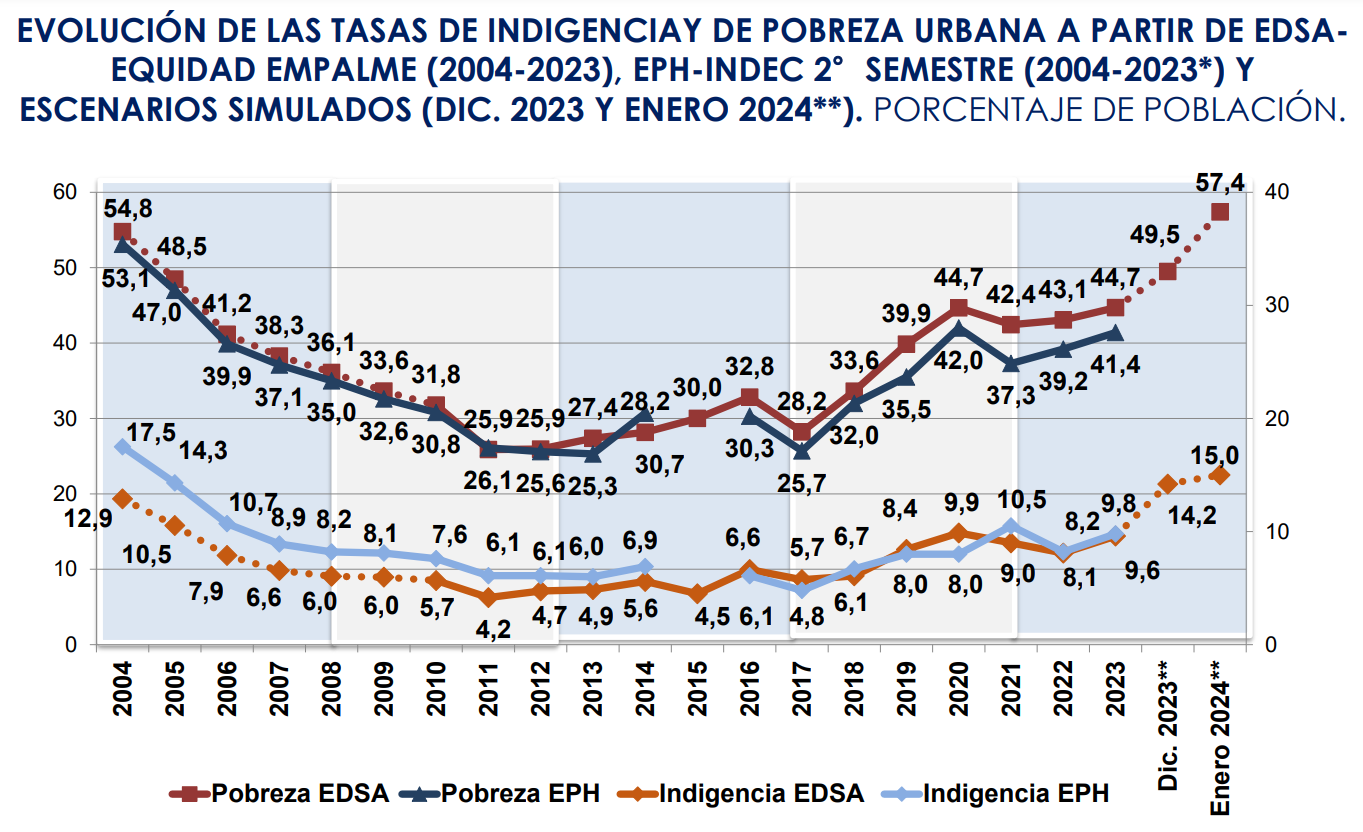
Argentina’s poverty rate reached 57.4% in January according to a new report by the Argentine Catholic University’s respected Social Debt Observatory. It’s the highest poverty number since 2004, when the observatory began publishing reports, amid widespread economic deregulation and price hikes.
“Our perspective is that this will keep getting worse in February,” the observatory’s Director Agustín Salvia told the Herald. “The crisis is about to explode in systemic terms.”
According to the report, which analyzed the inflationary effects of the 54% Argentine peso devaluation in December, poverty rose from 44.7% in the third quarter of 2023 to 49.5% in December, then 57.4% in January.
Salvia said there is “a generalized impoverishment of Argentine society” as a result of “a decrease in real salaries” as well as “a high risk of losing jobs” and the devaluation of the peso. “Households can’t compensate the effects of inflation on the food basket with working more hours, like they did in 2023.”
“The working class and middle class who don’t receive any welfare suffered the biggest increase [in poverty levels],” the report said.
The observatory also found that 15% of Argentines are destitute — the highest level since 2005. Destitution numbers had been 9.6% in the third quarter of 2023 and 14.2% in December, and went up even more in January “due to the increase in the cost of the basic food basket.”
The National Institute for Statistics and Census (INDEC by its Spanish acronym) considers a family “destitute” when their monthly income is less than the basic food basket. A family is considered to be in poverty if they earn less than the basic food basket plus services, known as the total basic basket.
You may also be interested in: Argentina starts 2024 with a 20.6% monthly inflation rate
“The December 2023 devaluation led to a strong price increase at a general level, and therefore, [an increase of] the basic food basket and the total basic basket,” the document stated.
The report added that while the government increased pensions and social plans in an attempt to absorb the effects of the record-high inflation “the poverty and destitution levels significantly rose.”
Argentina’s monthly inflation rate reached 25.5% in December 2023, the highest since February 1991, according to the National Institute for Statistics and Census (INDEC, for its Spanish acronym). In January, it went down to 20.6%, marking a 254.4% year-on-year inflation.
Within the past two months, gasoline prices more than doubled, private healthcare medicine applied 80% increases, and bus and train fares rose by 251% and 169% respectively. More tariff and price jumps are expected in the upcoming months.
Meanwhile, discussions to increase Argentina’s minimum wage and unemployment benefits fell through on Thursday while social movements protested outside the Labor Ministry. The minimum wage, which defines who receives certain social benefits, currently sits at AR$156,000 a month while the total basic basket for a single adult reached AR$193,000 in January, according to INDEC’s latest report.
Editor: Here is a report from May 19, 2025 in the Buenos Aires Herald, about Milei and Money!
Headline: Cash savings, tax evasion, bank robbery: Milei confirms no-questions-asked dollar plan
Sub-Headline: The president said he doesn’t care ‘in the slightest’ how Argentines got their dollars
President Javier Milei said that he “does not care in the slightest” how Argentines got their dollars during a television interview on Monday, during which he appeared to encourage tax evasion and play down the risk of courting organized crime.
It comes as his administration prepares a measure to allow the population to spend dollars without justifying where the funds came from, which experts say would facilitate money laundering, tax evasion, and other crimes.
Asked about such risks, Milei responded that economic issues should be separated from legal and security issues.
The move was announced by Economy Minister Luis Caputo in early May, but has yet to be made official.
“Under the mattress, Argentines have… estimates range between US$200 billion and US$400 billion,” Milei said during an interview on América 24 TV channel. “That means between 33% and 66% of the GDP. That implies an injection of funds into the economy that could generate a huge acceleration of the growth rate.”
According to the INDEC statistical bureau, Argentines held US$256 billion in cash and deposits outside the nation’s financial system in the last quarter of 2024.
He said Argentines who save dollars outside the financial system have done so to “avoid the tax that is inflation,” which he described as “devastating.”
Tax evaders are ‘heroes’
Asked about dollars stemming from tax evasion, the president said that “taxes are robbery,” later adding: “people who tried to protect themselves from thieving politicians are heroes, not criminals.”
He went on to argue that organized crime such as drug trafficking should be combated by the Security Ministry and the Defense Ministry, without involving the economy. “You do not use the economy to fight crime,” he said.
For the measure to work, he said, “the key is that nobody asks where you got your dollars. What’s more, I don’t care where you got your dollars. I don’t care in the slightest. That’s to say, economic issues are fixed in the economy. Issues of other kinds are fixed in the legal and judicial sphere. You have to understand that: they shouldn’t be mixed.”
After the plans were announced, María Eugenia Marano, a lawyer focusing on economic crimes, told the Herald that allowing the population to use dollars with no questions asked facilitated bringing laundered money back into the financial system.
Bank robbery
When journalist Antonio Laje asked whether that would mean bank robbers attempting to pay in US$500,000 would be asked no questions, Milei compared the situation to giving a sick person the wrong medicine, before stating: “Again, with the robbery, you shouldn’t mix the problem of crime with the issue of the economy.”
Under current law, such transactions can be reported to the financial authorities as suspicious. That legislation, Milei said, “is horrific.”
“You have to be able to use dollars with ease. Nobody should be asking for explanations for anything.”
Milei said the measure, which he has described as a form of “endogenous dollarization,” would be similar to a tax amnesty, but without paying taxes.
Milei said that the government had not yet passed the measure because it was addressing legal issues. He refused to give a launch date, stating instead that it would be passed once it was “technically impeccable.”
Political Observer.


 StephenKMackSD's Blog