Political Observer comments!

May 11, 2025
Editor: Usually I look to The Sunday Times and my favorite Thatcherite Political Romantic Robert Colvile:
Headline: Ed Miliband’s wind plan has left him hostage to suppliers
Sub-headline: The idea that we could shift the grid from gas to wind within a single parliament, while saving money, was always hugely ambitious
https://www.thetimes.com/comment/columnists/article/ed-miliband-wind-plan-orsted-npsb0kthw
Editor: Mr. Colvile’s intervetion, with the help of his staff of underlings is filled with doubt and apprehension!
Ed Miliband might not look like a revolutionary. But he has embarked upon the most radical, ambitious and — to its critics — foolhardy project that this government is pursuing. Namely, to transform the entire basis of the UK energy network, at historic speed.
For decades, the UK powered itself by coal, and then by gas. Miliband wants to move us, as rapidly as possible, to a system dominated by wind — and, in particular, offshore wind, which will become by far our largest source of power.
This is far more ambitious than the coal-to-gas transition, for three reasons. First, we can’t use as much of the existing infrastructure. So we need a huge amount of new cabling, not least off the coasts.
Second, we also need to hugely increase the amount of power, because we are simultaneously trying to electrify both transport and home heating. Third, we need back-up provision for when the wind doesn’t blow.
In short, for Miliband’s plan to work, an awful lot of things need to go right. But last week something went badly wrong. The Danish energy company Orsted announced that it would not be building a 2.4GW wind farm off the coast of Hornsea in Yorkshire, despite having planning permission in place and a price agreed.
To understand why this is such a problem, it helps to understand how the renewables revolution has been funded.
…
Editor: Yet what caught my eye: ( Colevial pales with time, and the reader’s patience longs for a change of pace, from his usual ‘Techo-Chatter’: note too that those ‘Ubiquitous Gamers’ have now commedeared the notion of ‘Palate Cleanser’ from the world of Connoisseurship!
Headline: Should we blame the US for the Cold War?
Sub-headline: The Russian-born historian Vladislav Zubok makes the provocative case that western leaders exaggerated the threat from cautious and conservative Soviet leaders
Dominic Sandbrook
Editor: I should have read this whole review. Yet Mr. Sandbrook’ quotes extensively from General John Hackett’s book of 1978: ‘The Third World War’. Mr. Sandbrook knows his Times readership!
The Third World War broke like a storm over the fields of central Europe. Moving with ruthless speed, the communist forces smashed through West Germany’s defences and advanced on the Rhine, while Soviet commandos landed in Norway and Turkey. Then the pendulum swung as Nato troops mounted a heroic stand near the German town of Krefeld, while American sailors and pilots began to wrest back control of the seas and the skies.
As the Warsaw Pact’s armies stalled and began to retreat, the hard men in the Kremlin faced an awful decision. With a conventional victory out of reach, perhaps only the ultimate weapon would stave off the spectre of defeat and force their opponents to come to terms. So it was that on August 20, 1985, the masters of the Soviet Union realised the dream of a generation of British town planners. They dropped a nuclear bomb on Birmingham.
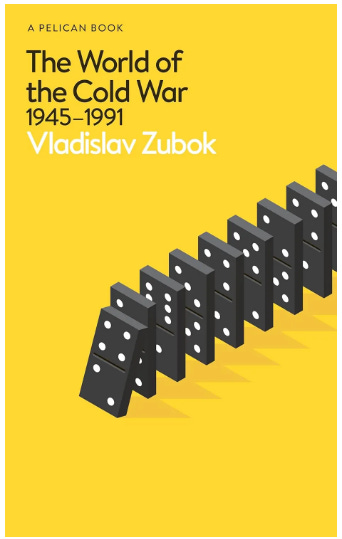
An illutration of book ‘The World of the Cold War, 1945-1991’ by Vladislav Zubok iterupts the narrative flow. Excerpts of General John Hackett’s ‘The Third World War’ provides the two opening paragraphs of Sandbrook’s maladriot essay.
Editor: Mr. Sandbrook on Vladislav Zubok:
Yes, the Russian historian Vladislav Zubok says in his readable short account of the Cold War. In crises like the Cuban missile standoff of 1962, he writes, “humanity was extraordinarily lucky”. With different leadership the world might have faced nuclear Armageddon. Thank goodness, then, that we have such impressive leaders today.
Why are there are so few gripping histories of the Cold War? One explanation is the subject is just so vast, but the fact remains that many standard accounts, such as the one by the American historian John Lewis Gaddis, are sensationally boring. This book is much better: brisk, spiky and unafraid to make provocative judgments.
Born and educated in Moscow with a close knowledge of Soviet sources, Zubok doesn’t blame Stalin for the Cold War. Although he is clear-eyed about the dictator’s atrocities, he thinks he was more cautious and pragmatic than we appreciate and he places the lion’s share of responsibility for the ideological conflict with the US.
Editor: Sandbrook begins his anaysis of Vladislav Zubok’s History: selectice quotaton is the only viable defence against Mr. Sandbrook proferred self-asaurance.
With different leadership the world might have faced nuclear Armageddon. Thank goodness, then, that we have such impressive leaders today.
…that many standard accounts, such as the one by the American historian John Lewis Gaddis, are sensationally boring. This book is much better: brisk, spiky and unafraid to make provocative judgments.
Although he is clear-eyed about the dictator’s atrocities, he thinks he was more cautious and pragmatic than we appreciate and he places the lion’s share of responsibility for the ideological conflict with the US.
Editor: With just 804 words left in this essay, in self-defence, The Reader need only consult Sandbrook’s in his final tortured paragraph, that presents Putin as ‘smoulders with so much resentment’
The Reader need only listen to Putin address, his Victory Day Speech see that Sandbrook is a ‘Cold Warrior’!
We know how that story played out, and for anybody trying to understand why Vladimir Putin smoulders with so much resentment — and why, sad to say, tens of millions of Russians support him — this book is an excellent place to start.
Political Observer.


 StephenKMackSD's Blog