Political Observer offers a selection from three sourses!
The Fourteenth Amendment directly overruled Dred Scott by declaring that all persons born in the US were citizens.
John Yoo.
https://www.civitasinstitute.org/research/birthright-citizenship-is-american-citizenship.
…
& Wong Kim Ark is not just an artifact that history has long passed by. The modern Supreme Court, in dicta, has reaffirmed it. In Plyler v. Doe (1982), a 5-4 majority observed that the Fourteenth Amendment’s Equal Protection Clause forbade states from excluding the children of illegal aliens from public schools. The Justices unanimously agreed, however, that “no plausible distinction for the 14th Amendment’s ‘jurisdiction’ can be drawn between resident aliens whose entry into the United States was lawful and resident aliens whose entry was unlawful.” Critics of birthright citizenship today can certainly argue that the Court erred in Plyler, just as they can argue that the Court erred in Wong Kim Ark. But they must show that the weight of historical evidence of the original understanding of the Fourteenth Amendment justifies reversing 140 years of unbroken judicial interpretation. They cannot because the traditional sources of legal meaning run exactly the other way.
The Fourteenth Amendment recognized the traditional American norm of birthright citizenship. No Supreme Court, Congress, or President has acted to the contrary. As head of the executive branch, Trump has the authority to order the agencies to pursue a different interpretation. He can use his discretion to prompt a test case that will swiftly reach the Supreme Court, which will almost certainly affirm Wong Kim Ark. It is hard to see a conservative, originalist Supreme Court rejecting the traditional American understanding of citizenship held from the time of the Founding, through Reconstruction, to today. But while destabilizing settled constitutional meaning, Trump may suffer severe political costs without doing anything to solve the problems of immigration and the southern border.
John Yoo: The Man Who Would Make the President King
The Trump presidency has been a stress test for maximalist theories of presidential power.
Gene Healy | 9.24.2020 12:40 PM
…
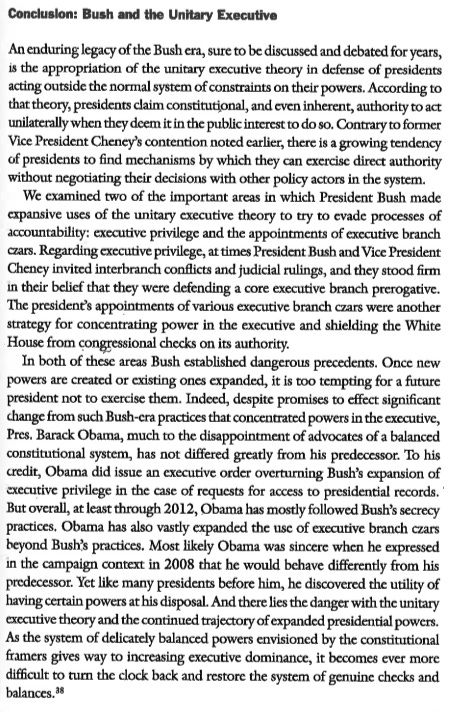
The Trump presidency has been a stress test for maximalist theories of presidential power. Even the narrower versions of unitary executive theory, which hold that the president has an indefeasible right to direct and remove executive branch officers, present vast opportunities for mischief. With those powers, a crooked president can cover up corruption by barking “You’re fired!” to inspectors general who might expose it, or direct federal prosecutors to protect his cronies and screw his enemies. Trump’s efforts in this direction so far have been unsubtle, to say the least, but they reveal how much rests on a bed of unenforceable “norms.” Alexander Hamilton’s argument for “energy in the executive” in Federalist 70 took as a given that we’d have a president vulnerable to “the restraints of public opinion,” not one for whom, as has been said of Trump, “shamelessness is a superpower.”
Yoo’s hardly blind to Trump’s character flaws. He admits his hero Hamilton erred badly in predicting that the office would be filled by “characters preeminent for ability and virtue.” Instead, the 20th century drift toward “quasi-plebiscitary” selection favors the sort of figures Hamilton feared: men with “talents for low intrigue and the little arts of popularity”—a description, Yoo concedes, that “could not have anticipated Donald Trump’s public life in more accurate terms.” But if we’re increasingly likely to get people we can’t trust, might it have been unwise to concentrate so much power in the presidency in the first place?
Hamilton also argued that energy in the executive would provide “steady administration of the laws.” This is, perhaps, another area where the $10 Founding Father could’ve been a lot smarter. The last three presidents have assumed an extraordinary amount of unilateral power to make the laws, as with Trump’s recent decision to conjure up $400 a week in supplemental employment benefits with the stroke of a pen.
Under Yoo’s tutelage, Trump appears poised to take pen-and-phone governance still further. The president is “privately considering a controversial strategy to act without legal authority to enact new federal policies,” Axios reported in July, in a scheme “heavily influenced by John Yoo, the lawyer who wrote the Bush administration’s justification for waterboarding after 9/11.”
The gambit centers on the Supreme Court’s recent decision, in DHS v. Regents of the University of California, blocking Trump’s reversal of Obama’s Deferred Action for Childhood Arrivals (DACA) program, itself an arguably illegal use of executive power. The ruling, Yoo lamented in National Review, “makes it easy for presidents to violate the law”—and hard for their successors to undo those violations. In a matter of days, though, Yoo decided Regents was really a blueprint for action and began urging Trump to “weaponize the DACA decision” to enact his own agenda.
One problem with forging new weapons is that you can’t keep them out of the hands of future presidents, some of whom are sure to combine Trump’s shamelessness with actual competence.
Oh, well: The upside is that Yoo’s new theory of executive empowerment scored him an audience with the president. After his Oval Office visit in July, Yoo reported that Trump is “really on top of things,” and, despite what you hear, not all “Nixonian in the bunker and paranoid and dark.” So we’ve got that going for us.
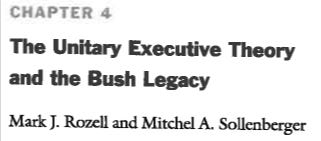
Political Observer ( With apologies to Mark J. Rozell & Mitchel A. Sollenberger !)


 StephenKMackSD's Blog