Newspaper Reader.

Feb 14, 2025
Editor: For those of ‘us’ with a long memory, who can forget Jonathan Freedland’s act of Defamation against Jeremy Corbyn.
Headline:Jeremy Corbyn is either blind to antisemitism – or he just doesn’t care
Sub-headline Labour’s leader may claim he didn’t see the racism in JA Hobson’s book. But can the party indulge that delusion?
https://www.theguardian.com/commentisfree/2019/may/01/jeremy-corbyn-blind-antisemitism-hobson
I’m trying to imagine the left’s reaction if it emerged that a leading politician had once lavished praise on a century-old book that not only trotted out racist stereotypes about, say, black people and their supposed characteristics, but whose central thesis rested on an ancient, hostile assumption about that group. Would good, progressive folk be rushing to defend that politician by saying the author of the book in question had also written lots of important, non-offensive things, and that other people had quoted that author too, so this was a fuss about nothing – or would they be appalled and even sickened that a contemporary politician could praise such a text without so much as mentioning the racism within it?
It turns out that the answer is: it depends which side the politician is on, and also perhaps which ethnic minority is involved. If the politician is the current leader of the Labour party and the minority involved are Jews, well, then it seems the usual progressive reflexes don’t always kick in.
In today’s Times, the columnist Daniel Finkelstein has dug out a 2011 reissue of JA Hobson’s 1902 work, Imperialism: A Study. The foreword was written by Jeremy Corbyn in 2011. Across eight pages, the then Labour backbencher lavishes praise on the book. His very first sentence describes it as a “great tome”. Among other things, he calls it “very powerful,” “brilliant”, as well as “correct and prescient”. The trouble is, Hobson was not just an accomplished analyst of international politics – for the Manchester Guardian, as it happens – but an egregious anti-Jewish racist.
….
Editor: don’t miss the final paragraph
We all know that it’s painful to admit flaws in those we admire. Corbyn should have done it about Hobson, but did not. Now that task falls to Labour MPs, members, supporters and voters. The Labour leader may tell himself that he is the victim here, a serially unlucky anti-racist who means well, but keeps overlooking racism against Jews even when it’s right in front of him, whether on the platforms he shares or the books he praises. Now the rest of the Labour family have to decide how much longer they are willing to indulge that delusion.
Editor: Don’t forget The Economist contribution to the Defamation of Corbyn ?
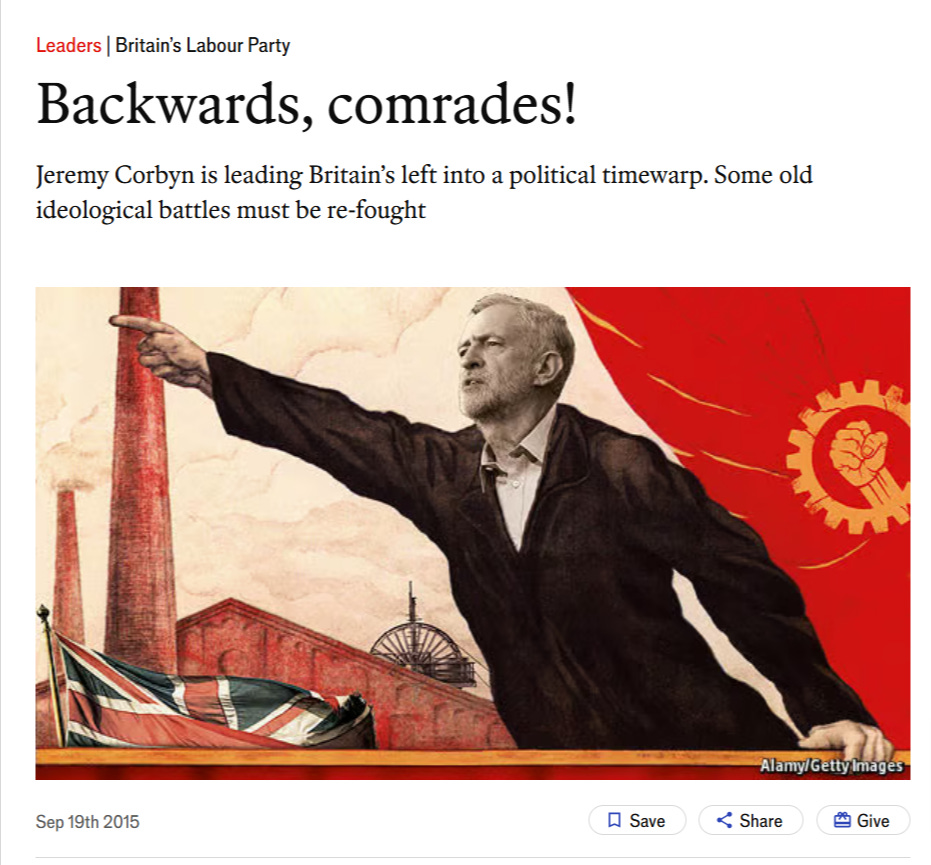
BEFORE he had finished belting out his first celebratory rendition of “The Red Flag”, a hymn to class struggle, some of Jeremy Corbyn’s colleagues in Labour’s shadow cabinet had already handed in their resignations. A 66-year-old socialist, Mr Corbyn has spent 32 years as one of the hardest of hardline left-wingers in the House of Commons and a serial rebel on the Labour backbenches. On September 12th he flattened three moderate rivals (see article) to become leader of Britain’s main opposition party. Labour MPs are stunned—and perhaps none more so than Mr Corbyn himself.
Two views are emerging of Labour’s new leader. The more sympathetic is that, whatever you think of his ideology, Mr Corbyn will at least enrich Britain by injecting fresh ideas into a stale debate. Voters who previously felt uninspired by the say-anything, spin-everything candidates who dominate modern politics have been energised by Mr Corbyn’s willingness to speak his mind and condemn the sterile compromises of the centre left. The other is that Mr Corbyn does not matter because he is unelectable and he cannot last. His significance will be to usher in a second successive Conservative government in the election of 2020—and perhaps a third in 2025.
Both these views are complacent and wrong. Mr Corbyn’s election is bad for the Labour Party and bad for Britain, too.
Cowards flinch and traitors sneer
Start with the ideas. In recent decades the left has had the better of the social arguments—on gay rights, say, or the role of women and the status of the church—but the right has won most of the economic ones. Just as the Tory party has become more socially liberal, so, under Neil Kinnock and then Tony Blair, Labour dropped its old commitment to public ownership and accepted that markets had a role in providing public services. Mr Blair’s government put monetary policy in the hands of an independent Bank of England and embraced the free movement of people and goods within Europe.
The argument today has moved on—to the growing inequality that is a side-effect of new technology and globalisation; to the nature of employment, pensions and benefits in an Uberising labour market of self-employed workers (see article); and to the need for efficient government and welfare systems. Fresh thinking on all this would be welcome—indeed it should be natural territory for the progressive left. But Mr Corbyn is stuck in the past. His “new politics” has nothing to offer but the exhausted, hollow formulas which his predecessors abandoned for the very good reason that they failed.
…
https://www.economist.com/leaders/2015/09/19/backwards-comrades
In his latest political/moral iteration Freedland plumbs the depths of the Zionist Psyche, while avoiding the Genocide, that is the actual Watershed of Theodor Herzl’s European Zionism. Not to willfully forget that Freedland is a Tribalits to his marrow! Reader brace your-self for the turged melodrama!
In Israel, dread and rage haunt the streets. Netanyahu is exploiting that
When I visited Israel this week, it seemed time had stood still since 7 October. I saw pain and grief, but little sign of hope
https://www.theguardian.com/commentisfree/2025/feb/14/israel-benjamin-netanyahu-7-october
…
Journalists cannot enter Gaza, but I was in Israel this week and saw for myself at least the latter half of the equation. When I reported from there a few weeks after the 7 October attacks, I was struck by how time seemed suspended, how frozen the country was in the terror of that day, when at least 1,200 Israelis, mostly civilians, were killed and more than 250 taken hostage. That remains true today. For Israelis, it’s still 7 October.
What has kept so many of them stuck is the wait for the hostages’ return. It might be the Tel Aviv skyscraper lit up with the number of days of captivity – it will be 500 on Monday – and the message “All of us are waiting for you”, or the stickers and posters of their faces plastered on street corners and bus shelters. Either way, anxiety for their plight hangs heavy in the air.
It gained a new urgency after the release last Saturday of three male hostages, each one visibly emaciated. The sight immediately struck a nerve that lies close to the surface of Israeli society: I heard the three referred to as Muselmänner, the name Auschwitz prisoners gave to the walking skeletons among them.
Editor: I will offer a selection of the Melodrama, as narrated by Freedland:
…
That has left the hostage families in the no man’s land between hope and dread: hope that their father or son will come out, dread at the state they’ll be in.
…
“It’s like an open wound that you cannot treat until this is over.” She cannot move on till he is back, and in that she is like much of her country.
But beyond dread, there is rage.
…
What Sharabi did not know, but his captors surely did, was that his wife and daughters were murdered on 7 October.
…
Israeli media rarely show the devastation Israeli bombardment has wreaked on the strip; most Israelis don’t see what the rest of the world sees. They know that thousands have been killed, but they put the blame squarely on Hamas, which surely knew what it was unleashing on 7 October.
…
He wants the war to resume, and for cynical reasons: because if the war continues, his far-right coalition members stay onboard, keeping him in the prime minister’s chair and out of jail. (His trial on corruption charges is ongoing.)
…
…Netanyahu would embark on a “very aggressive”, two-month operation that would, Harel writes, culminate in “the forced expulsion of Palestinians”.
…
This week, I met Yair Golan, the new leader of what was the Israeli Labor party, now rebadged as the Democrats. A former general, Golan is hailed as one of the heroes of 7 October.
…
Equally important is to provide an alternative to Hamas.” Only when “a young Palestinian” can see the path to a better future that does not involve violence will Hamas be truly defeated.
…
And much of the Israeli public struggles to see through the anger, pain and grief that descended on 7 October and which has barely lifted.
Those who want change have to hope that Netanyahu has erred by tying himself to an erratic, if not unstable, US president abroad and to extremist allies at home, and that is too combustible a mixture to last. I badly want that to be right. But I also know there’s a reason why hope has always been the Middle East’s scarcest commodity.
Newspaper Reader.


 StephenKMackSD's Blog