Political Observer.

Dec 22, 2024
Headline: It seems everyone but Justin Trudeau knows it’s time for him to go. Why is it so hard to quit?
Sub-headline: The prime minister is in the fight for his political life. But deciding to back out is harder than it may seem.
This reader must first recognise Mark Colley exceptional reporting on Justin Trudeau! He quotes :
“It was very hard,” said Kathleen Wynne of her experience in the 2018 Ontario election, when as premier she suffered a stunning loss that reduced her Liberal party to seven seats before she resigned as party leader. “The whole thing was brutal because it did feel like, as the leader, I was letting people down and that’s a horrible feeling.”
….
Knowing when to quit is part of the dilemma.
There are signs. According to Raymond Blake, a professor at the University of Regina who specializes in 20th century Canadian politics, two of the biggest are public and party discontent. A lapse of judgment is another. Failure to meet expectations, too.
But even with the signs, it can be hard to quit. History is littered with examples of those who have hung on past their expiration date.
“It’s really, really tough for anyone who’s at the top of their game to give it up,” Blake said. “Walking away is tough.”
…
Psychologically speaking, our careers become deeply ingrained in who we are, according to Marie-Hélène Budworth, the director of York University’s school of human resource management who has a PhD in organizational behaviour. At a dinner party, the answer to the question “Who are you?” is often occupation.
Quitting leaves the quitter searching for a new answer.
“It can be a real struggle to make the decision to leave it behind,” Budworth said, “because you’re leaving part of your identity.”
This dilemma, of course, is only exaggerated for a role as public-facing as the prime minister of Canada.
Budworth also suggests social circle could play a role in Trudeau’s decision. Often, the people around us agree with our views. It can create the notion of a false consensus — that most people are on my side because this small group is.
And there’s also the public consequences of quitting.
“We live in a world where quitting is often seen as failure,” Budworth explained. “Someone who quits couldn’t hack it. They couldn’t make it work.”
It doesn’t help people aren’t good at remembering accomplishments, Budworth said. Instead, our nature is to simply remember how something ends. Thus, leaving in a cloud of controversy “does leave a lasting scar,” Blake said.
It impacts legacy. Rehabilitating public opinion is a natural process for any public leader once they’ve left office. Trudeau’s legacy will be damaged if he leaves now, but it will suffer even more if he sticks around and is crushed in the next election, Blake predicted.
…
Compare this above selection from Mark Colley insightful reporting, though he does miss the the disturbing fact of Freedlands Ukranian connection as reported in his own newspaper :
The controversy over Chrystia Freeland and the red Ukrainian scarf, explained
Deputy Prime Minister Chrystia Freeland has been caught in a controversy over a red and black scarf.
March 2, 2022
Editor : Matthew Kaminski at Politico:
Headline: Trudeau’s Top Lieutenant Resigns With a Bang
Sub-headline: Chrystia Freeland is a serious woman. She spent a decade at the right hand of an unserious man, Justin Trudeau. Her resignation on Monday was shocking in its bluntness — and in its impact on politics north of the border.
https://www.politico.com/news/magazine/2024/12/17/canada-trudeau-freeland-resignation-00194785
What a crazy month for geopolitical bingo. Who had a successful Syrian revolution on their card? Or martial law in South Korea? Or, a world-class-worthy-of-Shakespeare political drama in Ottawa?
The day up north began with a resignation letter from Canadian Deputy Prime Minister and Finance Minister Chrystia Freeland. Before anyone dares to suppress a yawn — and I am well aware that New York Times columnist Flora Lewis’s “Worthwhile Canadian Initiative” won the New Republic’s prize in 1986 for most boring headline ever written — this was no ordinary letter. Chrystia Freeland is no ordinary politician.
Freeland is, first of all, a journalist. She can write. She has also, going back to 2013 when Justin Trudeau recruited her from the ink-stained world, been steadfastly loyal to him. In her various cabinet posts after Trudeau and the Liberals won power two years later, Freeland kept the rapier always sheathed. In words spoken and written, she was measured. A team player, always. Old friends from the Financial Times, her professional home for many years (where for three years in the mid-1990s she was my boss), were amazed/annoyed by how disciplined she was when they had to cover her. Chrystia was no Boris, as in former British Prime Minister Johnson, another hack-turned-pol, who was desperate to charm and entertain his old pals in the trade. Then Monday came her letter, published on X.
…
As for the letter itself, you don’t have to know anything about Canadian politics to appreciate the sight of a rhetorical rapier plunged straight in in the bright light of day. You tried to demote me, she writes, so I quit. She didn’t need to say it but it was noticed that Trudeau did the same to other prominent women in his cabinet, and Freeland wasn’t going to let him do it to her. She was building up her steam. “You and I have found ourselves at odds,” she writes. I see President-elect Donald Trump’s “aggressive economic nationalism,” in the form of tariffs, as “a grave challenge,” she writes. You, Dear Justin, are into “costly political gimmicks” — the details here are boring but basically involve fiscal giveaways over the holidays — “which we can ill afford.” You are unserious, she implies. Then she lays out what it “means” to be “serious.” To act in “good faith and humility,” to face “the threat” from Trump, to be a nation “strong, smart and united.” You, Pretty Boy, are not able to lead this kind of Canada. I am. I’ll be running for my seat in the next election, she writes. And as everyone can read between the lines, I’ll be running to lead the party.
…
Editor: Matthew Kaminski wallows in it! It’s almost like reading Puck! He then expolores on it periphery Freedland Ukraine connection in its carfully scrubbed version:
On the world stage, Freeland was a particularly prominent voice on behalf of Ukraine, the birthplace of her mother Halyna, where both of them worked in the early days of its independence. She was taken very seriously in G7 finance and foreign policy councils, even though Freeland was speaking on behalf of a country that — unwilling to spend on defense, falling well short of the NATO minimum guidelines of 2 percent of GDP — was itself not taken seriously.
Editor: Here is the un-laundered version
Headline: Chrystia Freeland’s ties to Ukrainian nationalists reveal a double standard
Sub-headline: The deputy prime minister was photographed with a scarf associated with the Ukrainian far-right at a demonstration in Toronto
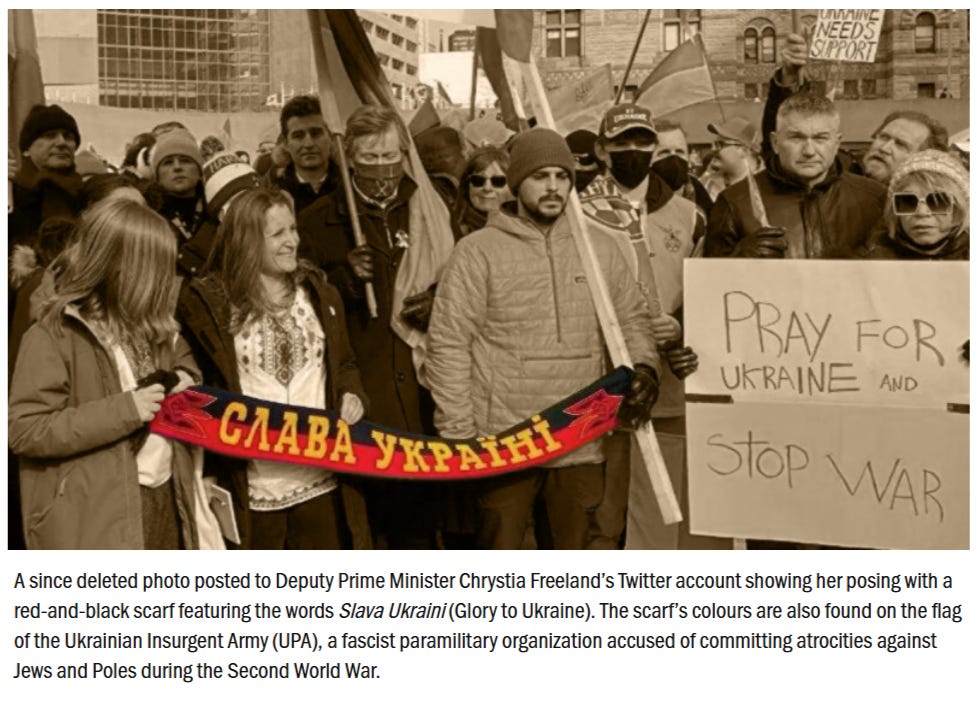
Canadian Deputy Prime Minister Chrystia Freeland spoke at a rally against Russia’s invasion of Ukraine on February 27, in which she was photographed holding up a scarf associated with a Ukrainian paramilitary organization that massacred thousands of Jews and Poles during the Second World War.
Freeland, who has made her Ukrainian heritage a major focus of her political brand, tweeted out the photo of her holding up a black and red scarf that had “Slava Ukraini,” or “Glory to Ukraine” written on it, with the relatively innocuous caption, “We stand united. We stand with Ukraine.”
The scarf’s colour scheme, as well as the slogan on it, were adopted by the Ukrainian Insurgent Army (UPA), an offshoot of the more radical wing of the Organization of Ukrainian Nationalists led by Stepan Bandera.
The UPA collaborated with the Nazis to ethnically cleanse Volhynia and Eastern Galicia of Poles and Jews in an attempt to establish an ethnically-pure Ukrainian state, which culminated in the murder of 100,000 Poles by 1943, according to historian Terry Martin.
“Red and black are the colours of the Bandera Wing of the Organization of Ukrainian Nationalists. The flag symbolizes blood and soil, and was adopted by that organization in 1941, along with an explicitly totalitarian program. The black-and-red banner is a symbol intimately connected with the most radical Ukrainian right-wing tradition,” Per Anders Rudling, a historian of nationalism, explained to the Toronto Star.
Natalia Khanenko-Friesen, director of the Canadian Institute of Ukrainian Studies, confirmed to the National Post that the colours represent blood and soil, but reassures the reader that it’s not the fascist kind. “Blood as life, as blossom, and not as blood lost in battles,” she declared. Freeland deleted the tweet and then posted an image of her at the rally without the scarf. But as many pointed out, the replacement photo still has a UPA flag in the distant background—a testament to the prominence of UPA symbology at the rally.
At Passage, Davide Mastracci notes UPA flags were also seen at Ukraine solidarity rallies in Montreal, Winnipeg, Vancouver, Prince George, BC, Edmonton and London, Ontario.
While Toronto Mayor John Tory rushed to condemn the use of swastikas by fringe cranks at a pro-Palestine rally in Toronto last year, he stood right behind Freeland while she held up the UPA scarf at the pro-Ukraine protest.
…
Editor: It is easy to see that Freedland’s letter come at an auspisious momet , as Joe Biden leaves office and Trump assumes office in America. The Ukraine War is reaching its denouement with a fated Russian victory? A politically weakned Trudeau and Freedland acting as an unofficial voice for Ukraine offers…
Political Observer


 StephenKMackSD's Blog