Political Cynic on the redoutable Robby Soave ,who opines to those viewers ‘as if’ he were a latter day Walter Lippmann or George F. Will ?

Dec 18, 2024
Robby Soave is just another self-promoter who renders opinions -this cadre of would-be ‘political technocrats’ chokes the corporate internet, with rendered opinions on the issues of the day, with a manufactured solemnity as if he were- his model is more akin to the dispeptic chatter and ‘personal style’ of George F. Will :
Editor: New York Times review
UP FROM INDIVIDUALISM
By Michael J. Sandel July 17, 1983
…
Mr. Will does not offer a detailed solution to the predicament he describes. His purpose is less to promote particular programs than to change the character and tone of the debate. His political vision here might best be described as communitarian conservatism. He favors a welfare state that embodies an ethic of common provision, a military draft that expresses a deepened citizenship, a market economy restrained by considerations of the public good and restrictions on abortion, pornography and sexual permissiveness in hopes of elevating society’s moral sensibilities.
Like all communitarian ethics, Mr. Will’s invites the objection that to mix politics and morality, for whatever good ends, is to consort with totalitarian possibilities. Mr. Will replies, plausibly enough, that the greater vulnerability lies in atomized, dislocated societies, not in stable communities with a lively sense of common purposes and shared traditions.
Still, ”Statecraft as Soulcraft” leaves a lurking worry. Missing from it is any clear commitment to democracy. For example, the American institution most powerfully equipped for democratic soulcraft, the public school, finds scant support from Mr. Will, who for all his praise of the public estate, would subsidize private schools through tuition tax credits. And despite his assurance that soulcraft is ”the citizenry working on itself,” he also asserts that ”the basic political right is to good government, not self-government.”
If the aim of politics is, as Mr. Will says, ”a warm citizenship, approximating friendship, based on a sense of shared values and a shared fate,” democracy would seem an essential, not merely an incidential ingredient. Liberals and democrats would do well to take up the challenge Mr. Will puts to his fellow conservatives – to argue for a vision of the good society, unembarrassed by the thought that it has nothing to do with politics.
Editor : Reader aquaint herself/himself with this essay on Lippmann via this NYT essay by Ronald Steel July 21, 1985
Headline: THE BIOGRAPHER AS DETECTIVE: WHAT WALTER LIPPMANN PREFERED TO FORGET
…
If I never grew really close to Walter Lippmann, I nonetheless came to respect him enormously for his intelligence, his integrity and his decency. He was a man who, in his 80’s, could still be outraged by folly, and who, despite all the public idiocies he had witnessed, did not become cynical. Even when I grew exasperated with him for a judgment made or an action taken, I could not forget that he never stopped trying to make men listen to reason or believing that they could be made better.
I had hoped that he would not ask to see the drafts of my book. And he did not, except once, just a few months before he died. Surprisingly, he was not interested in what I thought of his opinions of the great political issues he had been involved in, or of the monumental egos he had observed. The only thing he cared to see was what I had written about his time at Harvard. He wanted, in those last days, to evoke the moments of his own spring – when William James came knocking on his door to introduce himself to the Yard’s brightest sophomore, when the fearsome Santayana invited him to dinner and made him blush with terrible gossip of the philosophy faculty, when he himself hovered between the pre-Raphaelite estheticism of the Circolo Italiano and the earnest moral endeavor of the Socialist Club. B Y the time he died in 1974 Lippmann had, I think, long since made his peace with himself and was willing to let others make their judgments as they would. He did not seem particularly concerned with posterity. He had done the best he could, and beyond that no one could ask more.
What he taught me is that one can be a part of one’s time without surrendering to it, that even accomplishments such as his are three parts hard work to one part genius, and that the greatest pitfall is not worldly fame but ceasing to care about making a difference. He was very much like his youthful hero, H. G. Wells, of whom he once wrote, he ”seemed to win by a constant renewal of effort in which he refused to sink either into placid acceptance of the world, or into self-contained satisfaction with his vision.” That was the Walter Lippmann I came most to admire, a man who made a very long journey -one of endless discoveries.
…
”The Biographer as Detective,” an essay by Ronald Steel in the July 21 Book Review, was not properly credited. It was adapted from a lecture in a series on the art and craft of American biography, held at the New York Public Library and sponsored by the Book-of-the-Month Club.
A correction was made on
Aug. 4, 1985
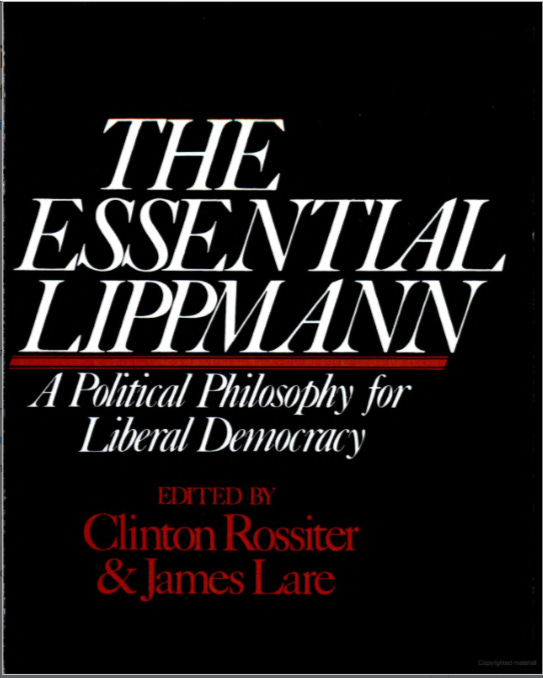
Editor: I read this book over many years,
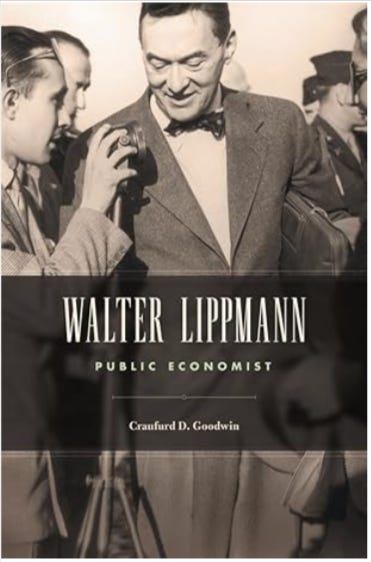
Editor : I am currently reading : ‘Walter Lippmann: Public Economist’ Hardcover – October 20, 2014 by Craufurd D. Goodwin: I can only manage 5 or 6 pages at time, though it is engagingly written and argued !
Editor: The ‘as if’ of the commentators like Mr. Soave, and his cadre: what to name them? Is that the Neo-Liberal Age is Past: instead what is alive and present is its natural sucessor, even its twin political manifestations: ‘The Rebellion Against The Elites’, across ‘The Mythical West’ that Soave and his cohort seek to render inocouious. Fritz Stern offers a telling History from 1974.

https://www.ucpress.edu/books/the-politics-of-cultural-despair/paper


 StephenKMackSD's Blog