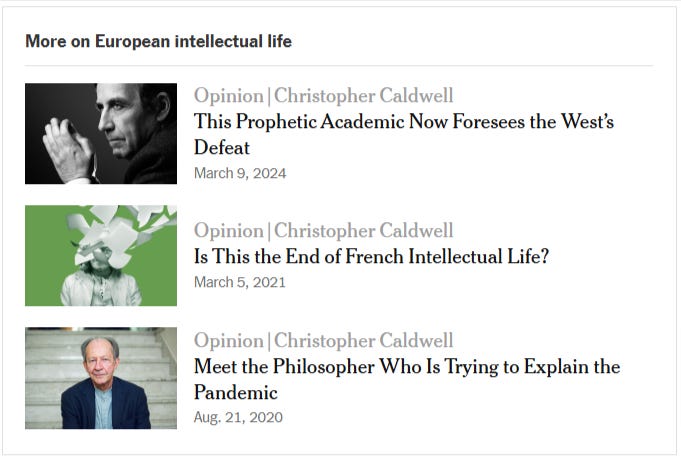
In his latest essay in The New York Times Mr. Caldwell expresses an enthisasm for Wolfgang Streeck:
Headline: This Maverick Thinker Is the Karl Marx of Our Time
Nov. 28, 2024
Editor: A brief selection from the first part of Mr. Caldwell’s 1595 word essay:
…
As Mr. Streeck sees it, a series of (mostly American) attempts to calm the economy after the ’70s produced the system we now call neoliberalism. “Neoliberalism,” he argues, “was, above all, a political-economic project to end the inflation state and free capital from its imprisonment in the postwar settlement.” This project has never really been reconsidered, even as one administration’s fix turns into the next generation’s crisis.
At each stage of neoliberalism’s evolution, Mr. Streeck stresses, key decisions have been made by technocrats, experts and other actors relatively insulated from democratic accountability. When the crash came in 2008, central bankers stepped in to take over the economy, devising quantitative easing and other novel methods of generating liquidity. During the Covid emergency of 2020 and 2021, Western countries turned into full-blown expertocracies, bypassing democracy outright. A minuscule class of administrators issued mandates on every aspect of national life — masks, vaccinations, travel, education, church openings — and incurred debt at levels that even the most profligate Reaganite would have considered surreal.
Mr. Streeck has a clear vision of something paradoxical about the neoliberal project: For the global economy to be “free,” it must be constrained. What the proponents of neoliberalism mean by a free market is a deregulated market. But getting to deregulation is trickier than it looks because in free societies, regulations are the result of people’s sovereign right to make their own rules. The more democratic the world’s societies are, the more idiosyncratic they will be, and the more their economic rules will diverge. But that is exactly what businesses cannot tolerate — at least not under globalization. Money and goods must be able to move frictionlessly and efficiently across borders. This requires a uniform set of laws. Somehow, democracy is going to have to give way.
A uniform set of laws also requires a single international norm. Which norm? That’s another problem, as Mr. Streeck sees it: The global regime we have is a reliable copy of the American one. This brings order and efficiency but also tilts the playing field in favor of American corporations, banks and investors.
Perhaps that is what blighted the West’s relations with Russia, where the transition to global capitalism “was tightly controlled by American government agencies, foundations and N.G.O.s,” Mr. Streeck says, and the oligarchs who emerged to run the government in the 1990s were “received with open arms by American corporations and, not least, the London real estate market.” To an Indian or a Chinese person, “free markets” established on these terms might carry the threat of imperial highhandedness and lost self-determination.
…
Editor: as infromative as this is, what might The Reader make of Mr. Calwell’s Reflections on the Revolution in Europe: Immigration, Islam, and the West by Christopher Caldwell , Doubleday, 422 pp., $30.00
Reviewed by Malise Ruthven in the December 17, 2009 issue of the New York Review of Books:
Powell, who died in 1998, has been castigated as a racist and condemned, not to say vilified, by the liberal left; but as Christopher Caldwell argues in his provocatively titled book, Reflections on the Revolution in Europe: Immigration, Islam, and the West, his demographic predictions have proved remarkably accurate. In one of his speeches Powell shocked his audience by predicting that Britain’s nonwhite population of barely a million would reach 4.5 million by 2002; according to the Office of National Statistics, the size of Britain’s “ethnic minority” population actually reached 4.6 million in 2001. His predictions for the ethnic composition of major cities such as Wolverhampton, Birmingham, and Inner London were similarly on target. Britain’s Commission for Racial Equality predicts that by 2011 the population of Leicester will be 50 percent nonwhite, making it the first major British city without a white majority.
This pattern is being replicated in cities throughout Western Europe. According to Caldwell, Europe is now a “continent of migrants” with more than 10 percent of its people living outside their countries of birth. The figure includes both non-European immigrants and citizens of countries belonging to the enlarged European Union who are permitted to move freely within its territory. But it also includes a substantial body of immigrants—namely Muslims—whom Caldwell regards as posing “the most acute problems” on account of their religion (an issue never mentioned by Powell in his speeches).
The statistics are highly variable since many countries do not register the religion of their citizens. However, it is generally assumed that there are now upward of 13 million Muslims, and possibly as many as 20 million (Caldwell’s preferred figure), living in the European Union. The largest concentrations are in France with more than 5 million, Germany with around 3 million, Britain with 1.6 million, Spain with a million, and the Netherlands and Bulgaria with just under a million. Overall, the proportion of Muslims now residing in the European Union (including the indigenous Bulgarian Muslims) remains at 5 percent, a proportion twice that of the “nearly seven million American Muslims” mentioned by President Barack Obama in his Cairo University speech last June.
Individual cities, however, have much higher concentrations. Karoly Lorant, a Hungarian economist who wrote a paper on the subject for the European Parliament, calculates that Muslims already make up 25 percent of the population in Marseilles and Rotterdam, 20 percent in Malmö, 15 percent in Brussels and Birmingham, and 10 percent in London, Paris, and Copenhagen. If the French national figure of around 5 million were proportionately reproduced in the US, it would make for 24 million American Muslims. Moreover, given that immigrant Muslims have a higher birthrate than indigenous white Europeans or other immigrant groups such as Eastern Europeans or African-Caribbeans, that population seems set to increase, regardless of tighter controls on immigration now being imposed by governments. The US National Intelligence Council expects that by 2025 the Muslim population of Europe will have doubled.
…
Editor: This Caldwell opinion piece appeared in The Financial Times of September 23, 2011 is demostrative of his politics
Opinion Christopher Caldwell
Headline: The president just does not get the American centre
Sub-headline: Barack Obama is a typical American – the more he says, the less you know him
Editor: Mr. Caldwell is here billed as : The writer is a senior editor at The Weekly Standard. A selection from the Weekley Standard version of Caldwell
…
Populism will work a charm on this electorate, but it is a note that Mr Obama is strangely unable to sound.
…
Mr Obama is being sensible when he suggests (eventually) capping upper earners’ tax deductions for mortgage interest and charitable giving.
…
But Mr Obama repeats the mistake he made in this summer’s debt ceiling debate – he offers few specifics as to how any of this would work fiscally.
…
It makes the allegation of class warfare easier to sustain.
…
Populism is a many-splendoured political disposition.
…
Having never shown much interest in the opinions of the working class, he now finds it hard to claim their allegiance.
…
Mr Obama offered it to them, in the form of his avowal there was no red (or Republican) America and no blue (or Democratic) America.
…
Editor: the reader might look to salient fact that Simpson-Bowles was about Austerity, and that Obama’s call was ‘lets put this all behind us’!
He spent the summer calling for a bipartisan “grand bargain” mixing tax rises and entitlement cuts when there was one already on the table – the so-called Simpson-Bowles plan.
…
Editor: Obama was a Neo-Liberal, like the Clintons, so Caldwell is here correct!
The centrist voters who put the president in office feel he has abused their trust. It is possible that no collection of programmes and plans, no matter how sensible, will now suffice to restore his standing.
Mr. Caldwell has now become the official Intellectual Court Historian of The New York Times ?
Rootless cosmopolitan,down at heels intellectual;would be writer.
'Polemic is a discourse of conflict, whose effect depends on a delicate balance between the requirements of truth and the enticements of anger, the duty to argue and the zest to inflame. Its rhetoric allows, even enforces, a certain figurative licence. Like epitaphs in Johnson’s adage, it is not under oath.'
https://www.lrb.co.uk/v15/n20/perry-anderson/diary



 StephenKMackSD's Blog