Political Cynic shares that News, in miniature… featuring Gillian Tett as almost a Keynesian? from January 16 2024.

Nov 29, 2024

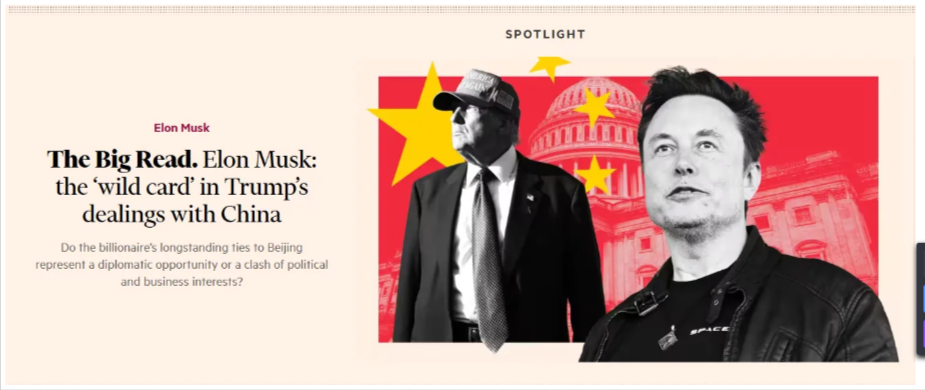


Not to forget the redoubtable Gillian Tett!
Or her January 16, 2024 essay:
Globalisation
Gillian Tett: Look back to judge chances of a global future
Maybe it’s time to dust off John Maynard Keynes’s warning about taking borderless prosperity for granted
https://www.ft.com/content/4f397d45-3ca6-44fe-9c12-153f64d4e3dd
Editor: A selection from her essay is telling:
…
Thus “the projects and politics of militarism and imperialism, of racial and cultural rivalries, of monopolies, restrictions, and exclusion were little more than the amusements of his daily newspaper.” In plain English: people had taken globalisation so completely for granted that they rarely gave it much thought — and assumed that the free movement of people, money and objects would continue indefinitely. War had seemed like a relic of the past.
Fast forward a century, and it is tempting to laugh or cry at this state of affairs. After all, during the 1914-18 conflict, such sunny complacency had been shattered by massive economic destruction, the closure of borders, disruptions in trade and a fractured capital market.
Globalisation had gone into reverse. Further, the war was followed by the 1929 economic crash, depression and protectionism in the 1930s and, then, another world war. Although globalisation resumed in the middle of the 20th century, it was not until the century’s end that the world returned to the type of globalisation that Keynes observed — ie, a world where it seemed so normal to move goods, capital and ideas around that most observers assumed this would continue indefinitely, and deepen. The only big difference between 2013 and 1913 was that, in the modern era, no one expects to travel “without passport or other formality” across borders. Today, there are inevitably bureaucratic controls.
The chilling question we face is whether we are about to see a replay of Keynes’s tale — namely, an era when globalisation suddenly goes into reverse, as geopolitical conflict rears its head again. So far, the answer is “not entirely”. For, while the political rhetoric in many countries has become lamentably populist, protectionist and nationalist, globalisation is far from dead.
…
And when, in October in Marrakech, the IMF held its annual general meeting, its World Economic Outlook included a depressing new feature: a section calculating what might happen if the world slides into a new “Cold War” of two rival geopolitical economic blocs that do not trade with each other.
To (gu)estimate that, the IMF used a model based on the political grouping that emerged at the UN during 2022’s Ukraine vote: namely pro-western and anti-western blocs. It calculated that, if a true cold war emerges, it would cut future global GDP by up to 7 per cent due to lower trade, finance and information flows. Other economists put the figure even higher.
The IMF stresses that such a scenario is theoretical and hopes — by showing policymakers, and voters, the folly of letting globalisation wither — to ensure it never occurs. Yet, the fact it published this “abstract” exercise shows how the world has changed: a decade ago, in 2013, the idea globalisation might go into reverse was as alien as it was in 1913.
Perhaps, then, it is time to republish The Economic Consequences of the Peace — or transmit its message out on the globalised internet.
Political Cynic
Editor: Further thought on the issues raised by Tett:
Where might the Globalist Agenda stand: given the Genocide in Gaza, and the expanding reach of the Zionist Faschist State’s into Lebanon, Syria and in all likeyhood into Iran: the closing of the The Strait of Hormuz that woud presiptate world wide oil crisis!
And the American Proxy War in Ukraine, and the real possability of Nuclear War with Russia: all these speculations about possibilities might lead the reader of Tett’s essay to – how deft must be the political foot work of the Globalist’s be, to confront the above collection of possible/probables toxins?


 StephenKMackSD's Blog