Political Cynic tries to measure the political temperature of this Oxbridger Clique!
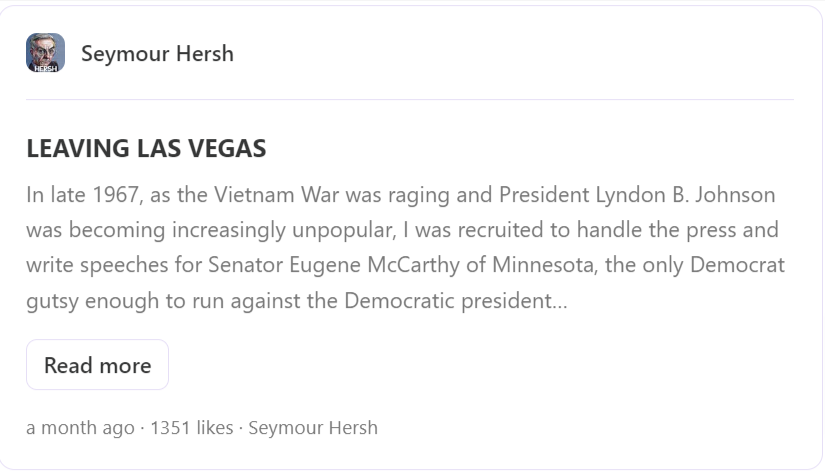
A bit of shopworn Political Melodrama begins this essay, without a mention of the behind the scenes maneuvering/blackmail that resulted in Biden’s withdrawal from the contest. The last paragraphs of Seymour Hersh’s reportage are revelatory:
……………………………………………………
…
A key factor in the decision to force Biden out of office by invoking the 25th Amendment was a series of increasingly negative polls on the president’s standing against Trump that had been commissioned by the funders, the official said. “The downward slope was increasing.” Polling would also be important for the vice president, I was told, and it was agreed that if the polls did not continue to show her gaining traction, other options would be considered, including an open convention. I was unable to learn if Harris was aware of such considerations or whether she intends to abide by them.
The official, who has decades of experience in fundraising, told me that Obama emerged as the strongman throughout the negotiations. “He had an agenda and he wanted to seek it through to the end, and he wanted to have control over who would be elected.”
A few days after we talked, with Harris getting off to a solid start, Obama and his wife announced their endorsement of Harris and told her, over the phone in a staged TV event, that they would do all they could to campaign for her and to support her.
But she had better perform.
…………………………………………………………….
The above too politically radioactive, for The Economist’s Oxbridger Clique, well connected to apparatus of the British National Security. The Reader might picture the Editor Zanny Minton Beddoes on the phone to MI6?
Editor: The Political Melodrama Begins, in its politically truncated form:
A few weeks ago the Democratic convention looked as if it would be a wake. Instead it has been a love-in. Delegates’ ebullience has been spiced with relief that their nominee has saved the party from almost-certain defeat.
Kamala Harris has accomplished this less because of who she is than who she is not. For a start she is not Joe Biden, who showed in a valedictory speech in Chicago that age has turned him into a scold. And neither is she Donald Trump. Now that President Biden is out of the race, the Republican nominee is the old man on the ballot, and he drives voters away with his petty insults and his dark obsessions.
However, Ms Harris needs more. Our forecast model has the race tied. In a bid to make her someone people actually want to vote for, the convention was all about her character and her life-story. Americans now know she worked at McDonald’s and that every year she teases her husband by playing the rambling voicemail he left asking her for a first date.
Unfortunately, how that would translate into a Harris presidency remains disconcertingly vague. She has reasons for building her campaign around personality: policy can be a liability, Mr Trump is no wonk and, with him as an opponent, character matters. Yet, worryingly, her tactics may also signal something more fundamental.
This part of the final quoted paragraph ‘a Harris presidency remains disconcertingly vague” is the very key to Harris’ political viability? Yet Musk and his Cadre of Billionaires are already …

Editor: Elon Musk is already scolding Harris for her Capital Gaines Tax ‘promise’ or ‘backs’ the Biden’s Tax Plans. Neo-Liberals adapt from political moment to political moment!
Editor: The Economist diagnoses Harris manifold political weaknesses:
Politically, Ms Harris is still an unknown quantity—and she is partly responsible for keeping it that way. In the Biden administration she was overshadowed, as vice-presidents usually are. She became the nominee without being tested in a primary. Since Mr Biden’s withdrawal, she has not given interviews and she has taken few questions from reporters. Her policy platform was mostly inherited from her boss, and it is even sparser than Mr Trump’s. When she takes positions—such as vowing to deal with corporate price-gouging—they may not be expressions of her political beliefs so much as campaign manoeuvres designed to placate voters worried about the cost of living.
Editor: Presenting the obvious as ‘insightful’, demonstrates trading in well worn cliches. It does not qualify as reportage!
Editor: More of the same… the briefing … : Repetition in longer form does not demonstrate insightful analysis, but ranks as self-reifying propaganda!
Our briefing this week sets out to make sense of all this—and Ms Harris’s record in the Senate and as a politician in California. She is not one of those whose career reveals a set of deep convictions or an inner core of beliefs. Instead, like Mr Biden, she positions herself slightly to the left of centre of her party and adjusts as it evolves. Worse than him, her policies on the economy and in foreign affairs seem to be unanchored.
Editor: some selective quotation of this essay might be a way to clear the way for The Reader to assert her critical faculties?
…
Pragmatism has its virtues in a politician.
…
Pragmatism also means that Ms Harris is open to other people’s ideas.
…
But when pragmatism signals a lack of thought-through principles, it can spell danger.
…
Likewise, without strong fundamental beliefs and a set of guiding priorities, a president can easily be blown off-course by events.
…
Her overriding task is to defeat Mr Trump, and it is a vital one in which guile and cunning are permitted
…
But there are reasons to press Ms Harris for more. One is that to do so could soon be in her political interest. Should personality lose its power to propel her campaign forward, policy could be one way to revive it.
…
If it is the first time she tries to unspool a single thread running through her life, her principles and her policies, she is unlikely to do her best.
…
Editor: The final paragraph of this essay resorts to practiced political cliche, not a surprise, given this publication’s history of platitudinous, in fact, obsequious political conformity!
The other, more important reason to press Ms Harris is that being a politician is about more than campaigning. Governing matters, too. And, for a party that wants to strengthen democracy, governing is better if its winning mandate contains a programme. You can be desperate for Ms Harris to defeat Mr Trump and still wonder how good she will be in office. As the vice-president in a one-term administration, she might be tempted to govern with victory in 2028 as a focus. Unless she is clearer about what she wants to do with power, her term will be dominated by campaigning—with all its vices.
Political Cynic


 StephenKMackSD's Blog