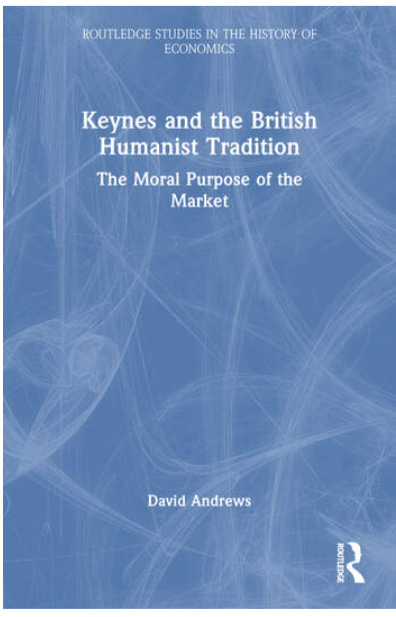
Well-connected in academia, business and government, John Maynard Keynes was one of the most influential economic theorists of the twentieth century. It appears that his theories will be just as important for the twenty-first. As Keynes himself explained, his ideas throughout his life were influenced by the moral philosophy he learned as an undergraduate. Nevertheless, the meaning and significance for Keynes of this early philosophy have remained largely unexplored.
Keynes and the British Humanist Tradition offers an interpretation of Keynes’s early philosophy and its implications for his later thought. It approaches that philosophy from the perspective of the nineteenth century intellectual context out of which it emerged. The book argues that roots of Keynes’s early beliefs are to be found in the traditions of the Apostles, the very famous secret society to which he and most of his teachers belonged. The principles of Keynes’s philosophy can be seen in such writers as John Stuart Mill and Henry Sidgwick, but the underlying ideas have been obscured by changing fashions in philosophy and thus require excavation and reconstruction.
This book will be of interest to students and researchers in the history of economics, in particular the thought of John Maynard Keynes, especially his ethics, politics and economics.
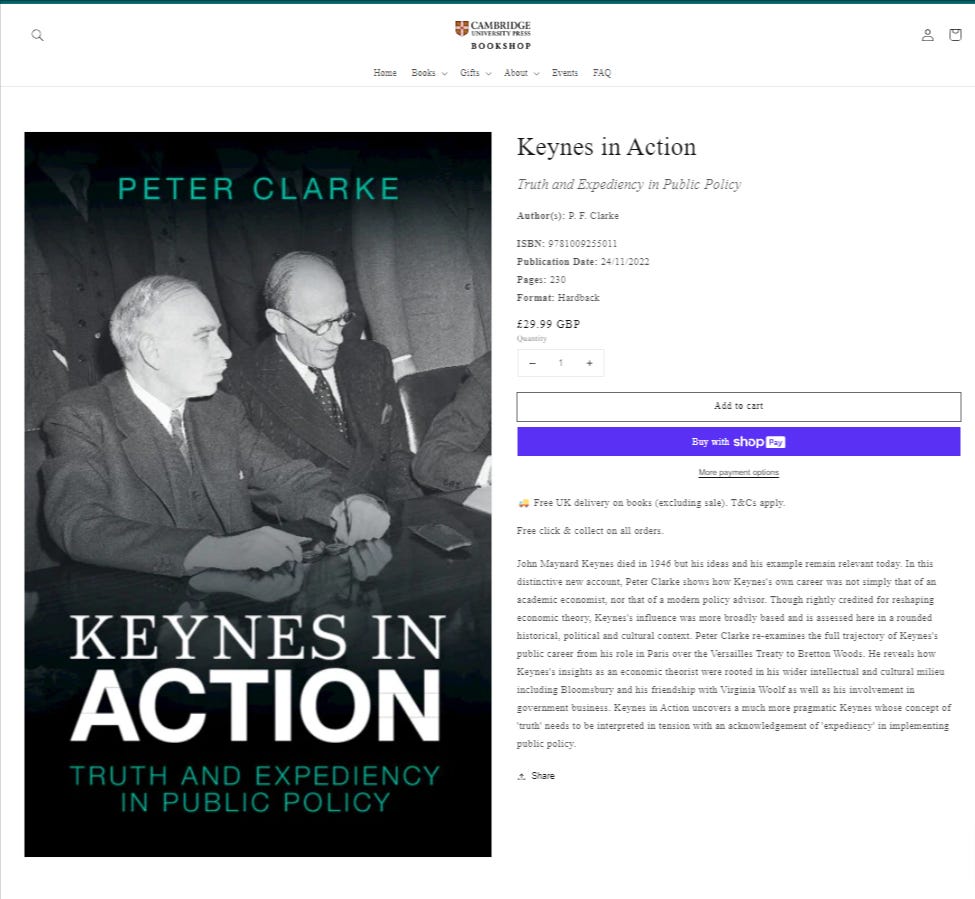
John Maynard Keynes died in 1946 but his ideas and his example remain relevant today. In this distinctive new account, Peter Clarke shows how Keynes’s own career was not simply that of an academic economist, nor that of a modern policy advisor. Though rightly credited for reshaping economic theory, Keynes’s influence was more broadly based and is assessed here in a rounded historical, political and cultural context. Peter Clarke re-examines the full trajectory of Keynes’s public career from his role in Paris over the Versailles Treaty to Bretton Woods. He reveals how Keynes’s insights as an economic theorist were rooted in his wider intellectual and cultural milieu including Bloomsbury and his friendship with Virginia Woolf as well as his involvement in government business. Keynes in Action uncovers a much more pragmatic Keynes whose concept of ‘truth’ needs to be interpreted in tension with an acknowledgement of ‘expediency’ in implementing public policy.
Rootless cosmopolitan,down at heels intellectual;would be writer.
'Polemic is a discourse of conflict, whose effect depends on a delicate balance between the requirements of truth and the enticements of anger, the duty to argue and the zest to inflame. Its rhetoric allows, even enforces, a certain figurative licence. Like epitaphs in Johnson’s adage, it is not under oath.'
https://www.lrb.co.uk/v15/n20/perry-anderson/diary


 StephenKMackSD's Blog