A Newspaper Reader focuses on one of the many political actors, in this Friedman Political Melodrama!
…………………………………………………………………………………………………………………………………………..
My brief collection of evocative fragments from this ‘essay’:
There are many ways to explain the two biggest conflicts in the world today–while the two battlefronts may look very different- a titanic geopolitical struggle between two opposing networks of nations and nonstate actors- post-post-Cold War- the relatively stable Pax Americana/globalization era-the fall of the Berlin Wall in 1989-this is no ordinary geopolitical moment-
A collection of Friedman’s provisional rhetorical actors:
…
Resistance Network
…
Inclusion Network
…
Resisters
….
Includers
…
Further on in this Rhetorical Juggernaut The Reader encounters Chrystia Freeland:
…
At a breakfast with NATO leaders devoted to the Ukraine issue at Davos this year, Canada’s deputy prime minister, Chrystia Freeland, noted that it is we, the West, who should be thanking the Ukrainians, not forcing them to beg us for more weapons.
She also eloquently formulated the stakes: “What Putin wants is to transform the world order” that evolved since World War II and the post-Cold War — where “the competition between nations was about who can be richer and who can help their people prosper the most. … Putin hates that world because he loses in that world — his system is a loser in a peaceful, global, wealth-enhancing paradigm. And so what he wants is to move us back to dog-eat-dog, to a 19th-century, great power competition, because he thinks he can, if not win, be more effective there. … Let’s not think that this is a Ukrainian problem; this is a problem for us all.”
She is exactly right.
…
Chrystia Freeland has a problem with the truth, and Friedman as a ‘reporter’ is compromised!
Headline: Chrystia Freeland’s granddad was indeed a Nazi collaborator – so much for Russian disinformation
The news conference on Monday by Foreign Affairs Minister Chrystia Freeland was interesting not for the announcement that Canada was extending its training mission to Ukraine but for the questions and answers about the minister’s grandfather.
There have been a number of articles circulating about Freeland’s Ukrainian grandfather Michael Chomiak and his ties to the Nazis.
Some of those articles have appeared on pro-Russian websites. Freeland, who strongly supports Ukraine and is a major critic of Russia’s seizure of the Crimea, suggested to journalists that the articles about her grandfather were part of a Russian disinformation campaign. (The Russian government sees Freeland as virulently anti-Russian and has placed her on their travel ban).
“American officials have publicly said, and even Angela Merkel has publicly said, that there were efforts on the Russian side to destabilize Western democracies, and I think it shouldn’t come as a surprise if these same efforts were used against Canada,” Freeland told reporters after they raised questions about the articles about her grandfather.
The Globe and Mail also reported that an official in Freeland’s office denied the minister’s grandfather was a Nazi collaborator.
In addition, the claims were dismissed outright by those in the Canadian-Ukrainian community. “It is the continued Russian modus operandi that they have,” Paul Grod, president of the Canadian Ukrainian Congress told the Globe and Mail. “Fake news, disinformation and targeting different individuals. It is just so outlandish when you hear some of these allegations – whether they are directed at minister Freeland or others.”
Well it actually isn’t so outlandish. Michael Chomiak was a Nazi collaborator.
What are the sources for the information that Freeland’s grandfather worked for the Nazis?
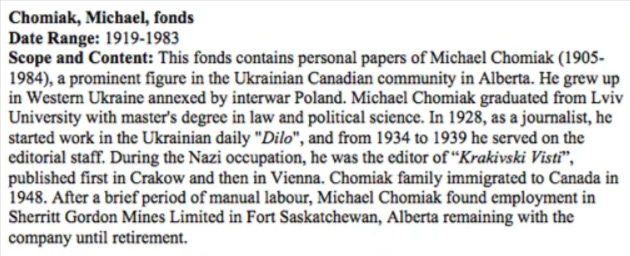
For starters, The Ukraine Archival Records held by the Province of Alberta. It has a whole file on Chomiak, including his own details about his days editing the newspaper Krakivski Visti. Chomiak noted he edited the paper first in Crakow (Cracow), Poland and then in Vienna. The reason he edited the paper in Vienna was because he had to flee with his Nazis colleagues as the Russians advanced into Poland. (The Russians tended to execute collaborators well as SS members).
See archive entry below:
So what was the Krakivski Visti? It, like a number of publications, had been seized by the Nazis from their Jewish owners and then operated as propaganda outlets.
Here is what the Los Angeles Holocaust Museum has to say about Krakivski Visti and a similar newspaper, Lvivski Visti, both publications associated with the Nazi regime.
“The editorial boards carried out a policy of soliciting Ukrainian support for the German cause,” the Holocaust Museum noted. “It was typical, within these publications, to not to give any accounts of the German genocidal policy, and largely, the editions resorted to silencing the mass killing of Jews in Galicia. Ukrainian newspapers presented the Jewish Question in light of the official Nazi propaganda, corollary to the Jewish world conspiracy.”
…
Now cut & paste, bricolage are tools of the writer, yet when used in tandem with outworn political cliche, attached to the practice of ersatz thought, equals what Friedman practices. Note that in this essay and his practice, as a New York Times Public Intellectual, Friedman treats word count as being equal to seriousness!
A Newspaper Reader


 StephenKMackSD's Blog