How very convenient that Simon Kuper is both an employee of The Financial Times and and a contributor to Volta!
Simon Kuper
is a British writer. After studying History and German at Oxford and attending Harvard University as a Kennedy Scholar, he began writing about sports “from an anthropological perspective” and joined the Financial Times in 1994. His column today is called “Opening Shot” and is a fixture of the FT’s Weekend Edition.
Da Empoli understands power, partly because he once wielded some, as adviser for years to Matteo Renzi, who from 2014 to 2016 was Italy’s would-be modernising prime minister. That’s why his novel has become a guide — devoured by many western politicians — to the mindset of the Kremlin. The book covers Russian power since the 1990s, a subject that da Empoli had been obsessively researching since first visiting Moscow in 2010.
Surveying the diners in Jack’s, he remarks: “In Russia, power is a big beast. In Switzerland power is a kitten, and it’s been domesticated. Through history, it’s been diluted, distributed, at local level and through referendums. Swiss politicians are boring. That’s quite a good thing. The more spectacular a political system, the worse it is, in many ways.”
We’ve eaten together before — we know one another from Paris, where we both live, and in 2016 the progressive think-tank he ran, Volta, published some of my essays as an Italian ebook. After da Empoli switched from writing in Italian to French, I enjoyed his essayistic political books. I then watched him become a star. His novel appeared in April 2022, weeks after Russia’s full-scale invasion of Ukraine. He says: “I never thought it would sell more than 3,000 copies. And when the war broke out, I thought it would be wiped out completely.” It has sold about 650,000 copies in France alone.
…
Should this sentence surprise The Reader? It reeks of Hollywood kitsch!
I then watched him become a star. His novel appeared in April 2022, weeks after Russia’s full-scale invasion of Ukraine
The Reader can further her reading of this Anti-Putin Propaganda and Mr. Giuliano da Empoli story of his political/literary evolution.
…
Renzi was not Vladimir Putin, but da Empoli believes some aspects of power are universal. “I think the difference between leader and adviser is that the leader is 100 per cent into his action. There’s no distance between what he does and thinks and who he is. It’s so intense, you need to mobilise so many resources, that the only way is if you’re in it 100 per cent. The adviser keeps a distance, which allows him to be more lucid, and maybe keep giving good advice. This suits certain personalities. It suits me perfectly.”
The job would inform his literary depiction of the Kremlin’s “wizard”, Putin’s imagined consigliere Vadim Baranov. Putin, da Empoli explains, exercises a “premodern” type of power that baffles western European politicians. “He operates with codes that maybe some of our ancestors would have understood better than we do. But Putin’s practically never been on the internet. He’s not on social media. Baranov provides the postmodern theatrics that are also important in Putin’s power.”
…
My analysis is not complete! What I seek to comment upon is the reception of Giuliano da Empoli’s fiction, in two highfalutin journals, of respectable bourgeois political opinion. Can @TheEconomist be next? Or will the perpetually exhumed Bagehot comment from the perspective of 1843?
The New Statesman of January 15, 2024
Headline: The Wizard of the Kremlin takes us inside the mind of Putin’s spin-master
Sub-headline: Giuliano da Empoli’s fictionalized portrait of Vladislav Surkov dramatises the birth of the post-truth world.
David Sexton’s ‘review’ lacks Kuper’s melodramatic enthusiasm, if that is the right descriptor. Mr. Sexton’s paragraph about the fictional set-up -The Reader can evaluate this for what it is , Anti-Putin propaganda, refracted through a ‘character’ modeled on Vladislav Surkov .
…
The fictional set-up is creaky but effective. An unnamed narrator is in Moscow to study Yevgeny Zamyatin, the author of the pioneering dystopian novel We (1924). He spots that a Twitter account he follows, attributed to the now retired “Wizard of the Kremlin”, has cited the writer, and promptly responds by completing the quote. The following evening, a Mercedes whisks him to Baranov’s elegant house, where the Wizard, for no particular reason (“you’ve come all this way”), launches into the full story of his life, over glasses of whisky, through the night. The pretence of the fireside chat is soon dropped, however; the yarn incorporates much extended explanatory dialogue, supposedly recalled verbatim. The one apparently wholly fictional component of the story is Baranov’s grand amour, the beautiful and demanding Ksenia, whom he hooks up with while a penniless theatre student, but loses to his nerdy but super-rich friend Mikhail (Khodorkovsky). Ksenia is, I fear, a cipher for the spirit of Russia, “a tigress”, “a strange and cruel nymph”.
….
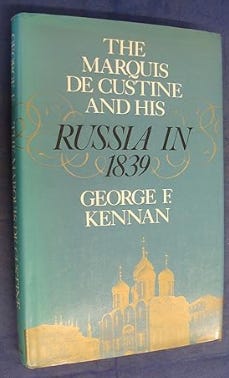
The Wizard of the Kremlin is a fast, easy read, smartly translated by Willard Wood, which efficiently dramatises great sweeps of Russia’s recent political history. Its success in France can be attributed both to the country’s special relationship with Russia and to its flattering embrace of a familiar literary perspective on Russia and its tsars. Baranov repeatedly quotes from the French aristocrat Astolphe de Custine’s scathing Letters from Russia (1839). Baranov says that his revered grandfather told him that Custine, that “son of a bitch” who said the whole country was a prison, remains the best interpreter of Russia. Robin Buss’s Penguin Classics translation of the letters is a treat.
George F. Kennan offers this:
While the War In Ukraine continues, financed by the EU, America and a collection of malign political actors; the Genocide in Gaza resisted militarily by the Houlis alone, and South Africa, in the International Court of Justice: there can be no doubt that ‘The West’ is not just in a ‘Decline’ as once diagnosed by Oswald Spengler, but a total surrender to War Criminal Benjamin Netanyahu’s Crimes against Humanity. Giuliano da Empoli’s fiction provides a necessary ‘bad actor’, on the World Stage, as a Second -Front that respectable Liberals/Neo-Liberals/Neo-Conservatives can focus their Moral Awareness, about a clear and present danger. While Trump wins handily, a political creature birthed by the New Democrats, The Republicans, The Neo-Conservatives!
Rootless cosmopolitan,down at heels intellectual;would be writer.
'Polemic is a discourse of conflict, whose effect depends on a delicate balance between the requirements of truth and the enticements of anger, the duty to argue and the zest to inflame. Its rhetoric allows, even enforces, a certain figurative licence. Like epitaphs in Johnson’s adage, it is not under oath.'
https://www.lrb.co.uk/v15/n20/perry-anderson/diary


 StephenKMackSD's Blog