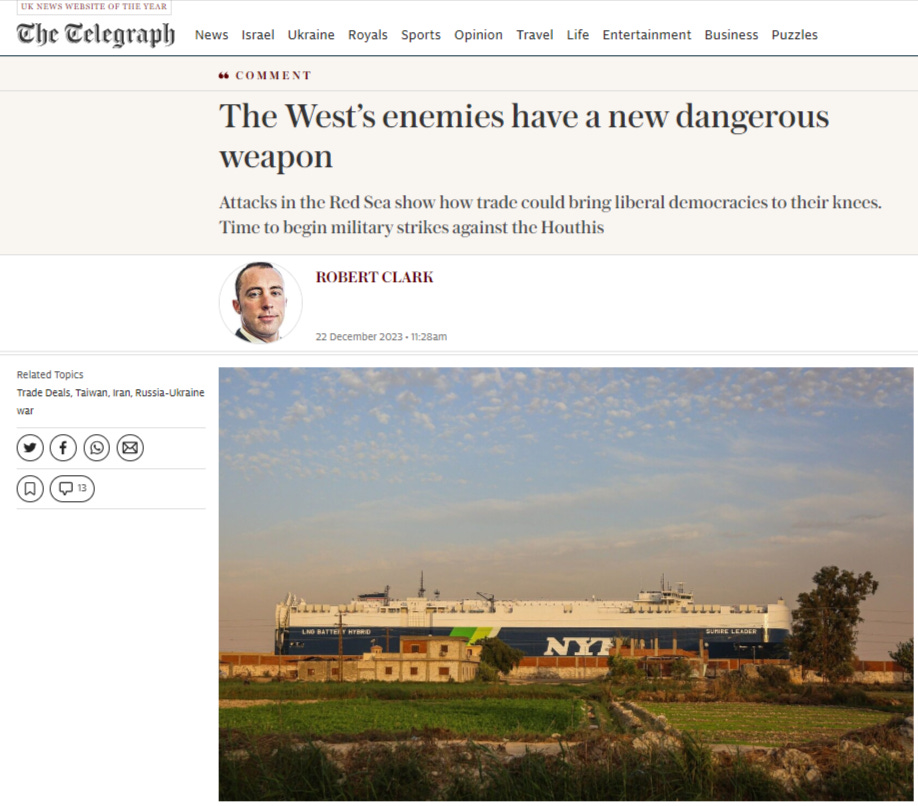
Note the framing of the Telegraph report: ‘The West’s enemies’ ! This newspaper seems to be moored in the political territory once occupied by The Economist?
The last paragraphs from this ‘news story’ are instructive of an attitude of bellicosity!
…
We can already see this played out in the Red Sea, as Iranian-funded terrorist group the Yemini Houthis are closing international shipping lanes after a relatively successful campaign of hostage-taking and firing cruise missiles over a few short weeks.
This campaign – from a non-state actor and terrorist organisation – has resulted in British Petroleum, one of the world’s largest businesses, declaring that it will be avoiding the Red Sea shipping lanes, crucial for exporting oil and gas from the Middle East to the markets of Europe and North America.
This disruption to supply chains will likely lead to a run on the petrol price at the pumps in Britain over the Christmas period, while long-term significant costs will be incurred to ease flow and supply – again the brunt of which will be passed on at the pump.
Weaponising trade cannot continue. We cannot let military and economic deterrence fail at a time when authoritarian regimes seek to damage our national interests in this way. It may not be war that brings down the current global order, but rather repeated shocks to global commerce and supply chains, should we choose to not do anything about it. A good place to start is military strikes against the Houthis.
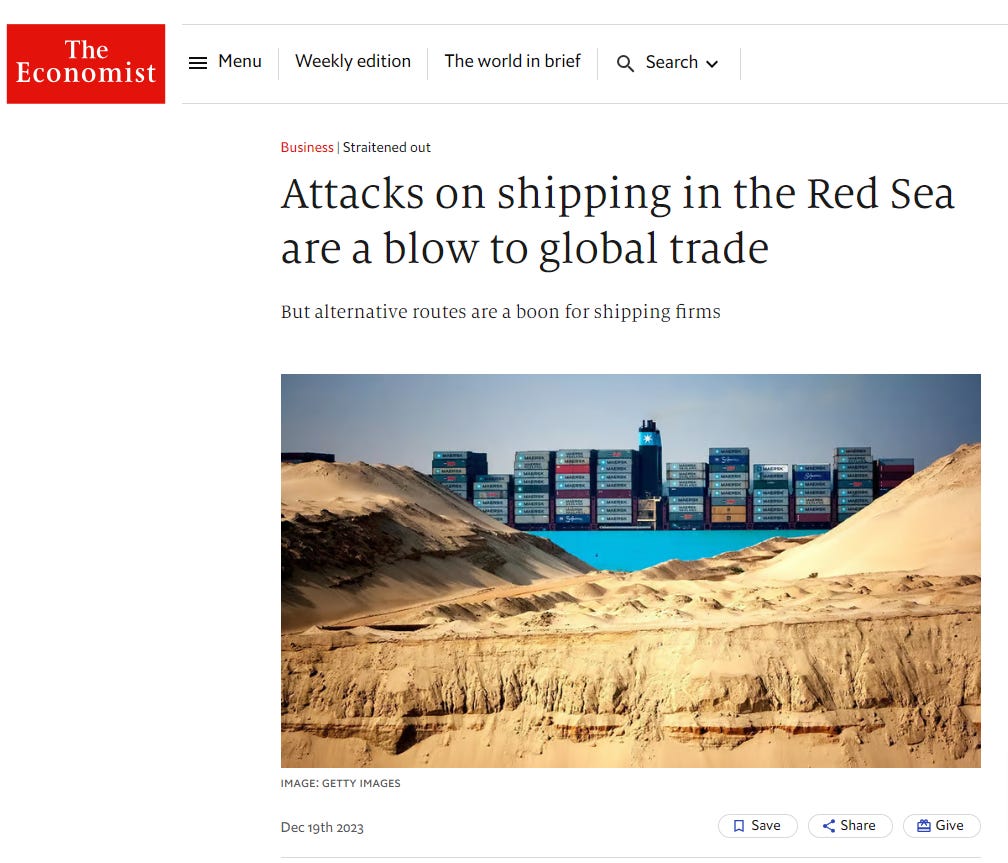
The Economist framing is sedate, even by Economist standards.
The tone of the article is sedate, even measured, as compared to the Telegraph’s bellicosity! The final paragraphs of The Economist’s news story:
…
Still, this Suez crisis will not “put a cork in global trade”, says Lars Jensen of Vespucci Maritime, a consultancy. The reason for the cautious optimism has to do with shipping’s remorseless cyclicality. In contrast to the Ever Given fiasco, supply chains are not currently under immense strain. Back then cuts to capacity coupled with a surge in spending by locked-down consumers had sent shipping rates surging to astronomical levels. A global index from Drewry, another consultancy, hit over $10,000 per standard container. On some routes, spot rates surpassed $20,000. That helped push shipping firms’ combined net profits in 2022 to $215bn, according to the John McCown Container Report, an industry compendium, compared with a cumulative loss of $8.5bn in 2016-19.
The shipping firms’ usual response to such price signals is to order new vessels. Those are starting to arrive. Though demand has remained flat over the past year or two, the global fleet’s capacity will swell by 9% this year and another 11% in 2024, according to ing, a bank. Already, the industry’s profits may have plunged by 80% in 2023. With capacity to spare, running longer routes should not cause the disruption seen at the height of covid-19. By mid-December Drewry’s index was becalmed at $1,500 or so (see chart). Rates could double as a result of the Red Sea turmoil, reckons Peter Sand at Xeneta, a freight-data firm. But they will probably stay well below their pandemic peaks—and so will shipping companies’ profits.
Rootless cosmopolitan,down at heels intellectual;would be writer.
'Polemic is a discourse of conflict, whose effect depends on a delicate balance between the requirements of truth and the enticements of anger, the duty to argue and the zest to inflame. Its rhetoric allows, even enforces, a certain figurative licence. Like epitaphs in Johnson’s adage, it is not under oath.'
https://www.lrb.co.uk/v15/n20/perry-anderson/diary


 StephenKMackSD's Blog