Carlos Lozada’s essay from 2017, wakes ‘us’ from our a-historical stupor? Premature Anti-Fascist wonders!
Former President Donald J. Trump said undocumented immigrants were “poisoning the blood of our country” in a recent interview, language with echoes of white supremacy and the racial hatreds of Adolf Hitler.
Trump simply echoes Samuel P. Huntington.
Carlos Lozada’s essay from 2017 provides answers:
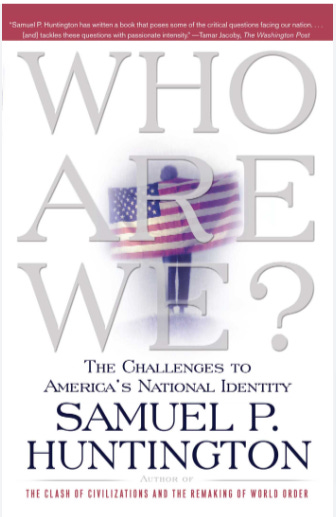
Samuel Huntington, a prophet for the Trump era.
The writings of the late Harvard political scientist anticipate America’s political and intellectual battles — and point to the country we may become.
Sometimes a prophet can be right about what will come, yet torn about whether it should.
President Trump’s recent speech in Warsaw, in which he urged Europeans and Americans to defend Western civilization against violent extremists and barbarian hordes, inevitably evoked Samuel P. Huntington’s “clash of civilizations” — the notion that superpower rivalry would give way to battles among Western universalism, Islamic militance and Chinese assertiveness. In a book expanded from his famous 1993 essay, Huntington described civilizations as the broadest and most crucial level of identity, encompassing religion, values, culture and history. Rather than “which side are you on?” he wrote, the overriding question in the post-Cold War world would be “who are you?”
So when the president calls on the nations of the West to “summon the courage and the will to defend our civilization,” when he insists that we accept only migrants who “share our values and love our people,” and when he urges the transatlantic alliance to “never forget who we are” and cling to the “bonds of history, culture and memory,” I imagine Huntington, who passed away in late 2008 after a long career teaching at Harvard University, nodding from beyond.
It would be a nod of vindication, perhaps, but mainly one of grim recognition. Trump’s civilizational rhetoric is just one reason Huntington resonates today, and it’s not even the most interesting one. Huntington’s work, spanning the mid-20th century through the early 21st, reads as a long argument over America’s meaning and purpose, one that explains the tensions of the Trump era as well as anything can. Huntington both chronicles and anticipates America’s fights over its founding premises, fights that Trump’s ascent has aggravated. Huntington foresees — and, frankly, stokes — the rise of white nativism in response to Hispanic immigration. He captures the dissonance between working classes and elites, between nationalism and cosmopolitanism, that played out in the 2016 campaign. And he warns how populist demagogues appeal to alienated masses and then break faith with them.
This is Trump’s presidency, but even more so, it is Huntington’s America. Trump may believe himself a practical man, exempt from any intellectual influence, but he is the slave of a defunct political scientist.
Huntington’s books speak to one another across the decades; you find the origins of one in the unanswered questions of another. But they also reveal deep contradictions. More than a clash of civilizations, a clash of Huntingtons is evident. One Huntington regards Americans as an exceptional people united not by blood but by creed. Another disowns that idea in favor of an America that finds its essence in faith, language, culture and borders. One Huntington views new groups and identities entering the political arena as a revitalization of American democracy. Another considers such identities pernicious, anti-American.
These works embody the intellectual and political challenges for the United States in, and beyond, the Trump years. In Huntington’s writings, idealistic visions of America mingle with its basest impulses, and eloquent defenses of U.S. values betray a fear of the pluralism at the nation’s core. Which vision wins out will determine what country we become.
Rootless cosmopolitan,down at heels intellectual;would be writer.
'Polemic is a discourse of conflict, whose effect depends on a delicate balance between the requirements of truth and the enticements of anger, the duty to argue and the zest to inflame. Its rhetoric allows, even enforces, a certain figurative licence. Like epitaphs in Johnson’s adage, it is not under oath.'
https://www.lrb.co.uk/v15/n20/perry-anderson/diary


 StephenKMackSD's Blog