Political Observer wonders at this political intervention.
Recall the ascent and reign of Janan Ganesh, of another time? Those apt quotations from an obscure L.A. restaurant critic ? Or even a quote from American Silver-Fork gargoyle Tom Wolfe? In his latest essay he resorts to a map, from that 19th Century Antique, The Economist. This is his framing device for a convoluted apologetic for the Tory leaders: Cameron, May, Johnson, Truss, Sunak as not ‘hard right’. Should a report on the malign incompetence, of these political actors be forth coming? Certainly not from Mr. Ganesh, whose desperate search leads to a critique of ‘hard right’ , ‘Populist-governed’, ‘Rassemblement National’, ‘Alternative for Germany’.
‘Europe Since 1989’ offers an invaluable history of Europe, and the long term political toxin of Neo-Liberalism.
…
Philipp Ther—a firsthand witness to many of the transformations, from Czechoslovakia during the Velvet Revolution to postcommunist Poland and Ukraine—offers a sweeping narrative filled with vivid details and memorable stories. He describes how liberalization, deregulation, and privatization had catastrophic effects on former Soviet Bloc countries. He refutes the idea that this economic “shock therapy” was the basis of later growth, arguing that human capital and the “transformation from below” determined economic success or failure. Most important, he shows how the capitalist West’s effort to reshape Eastern Europe in its own likeness ended up reshaping Western Europe as well, in part by accelerating the pace and scope of neoliberal reforms in the West, particularly in reunified Germany. Finally, bringing the story up to the present, Ther compares events in Eastern and Southern Europe leading up to and following the 2008–9 global financial crisis.
…
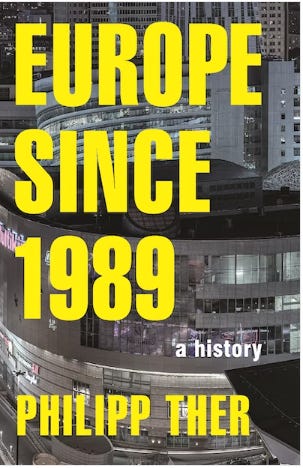
See Chapter 4 : Getting on the Neo-Liberal Bandwagon, and Chapter 5: Second -Wave Neo-Liberalism, for the toxic legacy of Neo-Liberalism, in the former satellites of the Soviet Union.
The opening of the Ganesh’s essay:
I am looking at a map of Europe from a recent edition of The Economist. Each country is rendered in a shade of red according to its level of public support for the hard right: the higher, the darker. Populist-governed Italy is Ferrari-red. So are Poland and Hungary. France, where the Rassemblement National might win the next presidential election, and Germany, where the Alternative for Germany is polling second, are a sort of trout-fillet colour. Spain, Portugal and most of Scandinavia are one shade lighter.
Britain? Barely as pink as this newspaper. Only Ireland, Iceland, Lithuania and Malta (combined population 9mn) are paler still. If we define the hard right as a force outside, and more extreme than, a nation’s traditional centre-right party, then Britain hasn’t got a hard right to reckon with. One MP out of the 650 represents a movement of that description, and he is a Conservative defector who has never won election under his new banner. In the local elections of 2022 and 2023, extremists got almost nowhere. Make fun of the UK’s unbuilt train lines. Despair of its featherweight politicians. Just give the country its due as Europe’s haven of moderation.
…
A selection of Ganeshisms:
…
But conflating it with Viktor Orbán, or Giorgia Meloni, is whataboutery at its sour and desperate worst. Which hard-right party in Europe would fill three of the great offices of state with non-white descendants of immigrants?
…
It shouldn’t be a liberal taboo to say that Britain outdoes the continent at some things, including, for now, the containment of extremists. Or to ask how the country has done it.
…
Those in the UK who campaign for proportional representation should view contemporary Europe as a warning, not a template.
…
We could go into the yet deeper past to explain the failure of the UK’s hard right. The nation has for centuries had a relatively weak church. (French, Italian and Polish populists are often tied up with a certain kind of Catholicism.) Then there is the capacious nature of Britishness itself. Because of the creation in 1707 of that single state, from the kingdoms of England and Scotland, the country had early exposure to the idea that nationhood needn’t be grounded on common ethnic stock. Throw in sheer geographic distance from the “east”, and Britain is unpromising soil for a faith-and-flag, Russia-smitten, Orbán-style movement.
…
Well, the spread of plausible outcomes at the next UK election is a centre-right government or a centre-left one. It shouldn’t feel as transgressive as it does to say that Europe’s other democracies should be so lucky.
As a measure of the misrule/ incompetence of the reign of the Tories: Here is an issue that would never occur to Janan Ganesh!
Headline: One in seven Britons faced hunger in 2022, says food bank charity
By James Davey
June 27, 20235:48 PM PDT Updated 3 months ago
- Summary
- Companies
- 11.3 mln Britons faced hunger in 2022
- 3 mln food parcels provided by Trussell Trust in 2022/23 year
- Ineffective social security system blamed
LONDON, June 28 (Reuters) – One in seven people in the United Kingdom faced hunger last year because they did not have enough money, according to a report published on Wednesday by food bank charity the Trussell Trust.
It said this equates to 11.3 million people, more than double the population of Scotland, and blamed a dysfunctional social security system, as well as a cost of living crisis that is showing little sign of easing.
Britain is the world’s sixth-biggest economy but its citizens have been pressured for more than a year by high inflation which has outstripped pay growth for almost all workers.
Government forecasters estimate UK households are in the midst of the biggest two-year squeeze in living standards since comparable records started in the 1950s.
The Trussell Trust’s network of 1,300 food bank centres across the UK provided a record 3 million food parcels in the year to March, up 37% and more than double the amount provided five years ago.
“This consistent upward trajectory exposes that it is weaknesses in the social security system that are driving food bank need, rather than just the pandemic or cost of living crisis,” it said.
The charity said that 7% of the UK population was supported by charitable food support, including food banks, yet 71% of people facing hunger had not yet accessed any form of charitable food support.
It also noted that one in five people forced to turn to food banks in its network are in a working household and called on the UK government to ensure the benefits system covers essential costs.
Political Observer


 StephenKMackSD's Blog
Pingback: Old Socialist confronts Janan Ganesh, in his various iterations over time… | StephenKMackSD's Blog