Headline: Whether it’s 2030 or 2035, if we don’t have enough electricity we’ll never get to net zero
…
As recent events have made abundantly clear, our modern economy runs on energy. The net zero agenda involves three simultaneous, enormous transformations in how that works. First, a massive increase in the amount of electricity we use, both in absolute terms and as a proportion of our energy mix. Second, a massive increase in the amount of it generated by nuclear and/or renewables. Third, a massive decentralisation of the National Grid, to accommodate numerous tiny power sources and storage media (solar panels, car batteries, etc) rather than a few big power stations.
…
But that’s only the start of the obstacles. We need to create the right investment incentives, at a time when everyone in the world is competing for green projects — which is putting a corresponding crimp on supply chains.
Note that Colvile stays close to the Globalist Agenda, of ‘Western De-Industrialization’ as the future: rather than a Re-Industrialization, as the antidote to the utterly botched ‘Supply-Chain’ once the cornerstone, of the Neo-Liberal Mythology during the Covid Epidemic? Consider also the political consequences of Cameron, May, Johnson, Truss, Sunak: this New York Times report of by Emma Bubola reporting from London of Jan. 25, 2023 provides an answer.
Headline: In U.K. Cost-of-Living Crisis, Some Workers Struggle to Feed Children
Sub-headline: As inflation hits the pockets of families who already had little to spare, food banks say they are getting much busier and seeing more people with jobs.
As the cost of grocery shopping and heating homes have hit records in recent months, the signs of distress are everywhere. The BBC has published dozens of online recipes costing less than a pound, or about $1.23, per portion. Some schools have turned down their heaters. And many communities have opened “warm spaces” — heated public rooms for people with cold homes.
But in Britain, one of the world’s richest countries, among the most shocking signs of the cost-of-living crisis is that a growing number of workers are struggling to feed their children.
…
Employment growth has left Britain with fewer out-of-work households, but many of those who found work still did not reach a decent standard of living, which left them vulnerable when inflation hit a 41-year high a few months ago, and wages failed to keep up.
Austerity measures under a decade of Conservative-led governments have also eaten away at the benefits paid to many low-income families, including working households. Since 2016, Britain has had one of the highest minimum wages in the world for most workers, benefiting some of the lowest earners. But many of them still cannot find enough hours of work, and the income of low earners has grown more slowly in Britain than in some other Western countries including Germany and France.
…
To Colevile The Hungry Masses lacks the journalistic appeal of Policy?
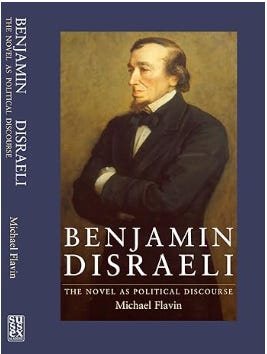
Michael Flavin offers in his ‘Benjamin Disraeli : The Novels as Political Discourse’ :
some insights into an alterative view of Colevile’s addiction to high-flown Neo-Liberal Policy Chatter. Can Disraeli’s novel Sybil offer substance, as opposed to Colevile’s self-serving commentary?
Sybil
Page 97
Morley’s contributions contributions to this first conversations could have come from Disraeli himself, or from the heroes of his many novels: ‘it is a community of purpose that constitutes society…. In the great cities men are brought together by the desire for gain. They are not in a state of cooperation, but of isolation , as to making fortunes; and for all the rest they are careful of neighbors’ (pp. 75-6). Morley argues for the alienating effects of industrialization and the morally corrosive nature of the blind pursuit of profit. When Morley replies to Egremont’s observation that ‘we live in strange times’, stating , ‘when the infant begins to walk, it also thinks that it lives in strange times, (p. 76) the reader could be forgiven for thinking of Sidonia. Morley’s address concludes with the most well- known passage in the whole of Disraeli’s fiction.
‘Well, society may be in its infancy, ‘ said Egremont, slightly smiling; ‘but say what you like , our Queen reigns over the greatest nation that ever existed.’
‘Which nation?’ asked an young stranger, ‘for she reigns over two,’
The stranger paused; Egremont was silent for but looked inquiringly.
‘Yes’ resumed the young stranger after a moment’s interval. ‘Two nations : between whom there is no intercourse and no sympathy; who are dwellers in different zones , or inhabitants of different planets; who are formed by a different breeding , are fed by a different food, are ordered by different manners, and are not governed by the same laws’
‘You speak of ______’ said Egremont, hesitatingly.
‘The RICH AND The POOR’ , (pp 76-7)
The formula , attributed generally to Disraeli (but has been shown , originally constructed in essence by Carlyle), caught on: ‘the “two nations” became a household word, perhaps the most famous of all Disraeli’s inventions’ according to Blake. Furthermore, Disraeli utilized the image again in a speech in Lady Londonderry’s grounds in 1848, using an architectural metonym to convey the same principal; ‘the palace is not safe when a cottage is not happy’,
Moreover, Disraeli’s dualistic formulation had (according to to Kathleen Tillotson) a considerable influence throughout the novel genre : ‘ this then came more and more to occupy novelists in the forties.
Most novel-readers belonged to the other nation; the novelists were scouts who had crossed the frontier or penetrated the iron curtain and brought back their reports. In this sense , prior to the exotic geographical journey described in Tancred, Disraeli had undertaken a similarly thrilling journey in Sybil , bringing to his middle and upper-class readers an insight into the strange and dangerous world which threatened to destroy their sense of stability, ‘Two Nations ‘ implied antagonism , suggesting that society was in a perilous condition.
Rootless cosmopolitan,down at heels intellectual;would be writer.
'Polemic is a discourse of conflict, whose effect depends on a delicate balance between the requirements of truth and the enticements of anger, the duty to argue and the zest to inflame. Its rhetoric allows, even enforces, a certain figurative licence. Like epitaphs in Johnson’s adage, it is not under oath.'
https://www.lrb.co.uk/v15/n20/perry-anderson/diary


 StephenKMackSD's Blog