Political Observer comments on Preston’s self-willed ignorance.
The Players: Andrew Preston, William Bullitt, Sigmund Freud, Woodrow Wilson, Patrick Weil, Zachary Jonathan Jacobson, Richard Nixon.
Andrew Preston’s review begins here:
Shortly after the US election of 2016 a group of psychiatrists denounced Donald Trump as a psychologically unbalanced sociopath – cruel, narcissistic, paranoid, prone to delusions of grandeur – and thus a danger to the world. But in doing so they had to wrestle with two contradictory principles of their profession: a psychiatrist shouldn’t offer diagnoses for people they have never met, let alone treated, a principle also known, thanks to an earlier American political episode, as the Goldwater rule; yet a psychiatrist also has a duty, not only moral but legal, to warn if someone’s mental illness poses a danger to others. This seemed compelling in Trump’s case, but in publicly offering a diagnosis, their decision to prioritize the second principle over the first generated fierce debate over whether a president’s state of mind was fair game.
Most observers agreed it was. During the Trump era sensational revelations of a psychologically unstable president made Michael Wolff’s Fire and Fury one of the fastest-selling books in publishing history. As Nancy Pelosi put it, “You understand that this is not a person of sound mind”. In response, Trump’s self-diagnosis will long be remembered: he wasn’t just “smart, but genius … and a very stable genius at that!”
Presidential sanity is not a new concern, and politicians have long been subject to psychological analysis. The Goldwater rule emerged after a large number of psychiatrists claimed that Senator Barry Goldwater, campaigning for the White House in 1964, was mentally unfit for the presidency. After his election loss to Lyndon B. Johnson – himself a curious psychological study – Goldwater successfully sued for defamation and the American Psychiatric Association issued its cautionary guideline. But that hasn’t stopped a cottage industry about it from arising.
Should The Reader look askance at the title of Patrick Weil’s book under review?
The Madman In The White House: Sigmund Freud, Ambassador Bullitt and the lost psychobiography of Woodrow Wilson
The ‘psychobiography’ was published in 1966, a ‘redacted version’: this from the publisher of Weil’s book, Harvard University Press. I’ve placed in bold font the last paragraph.
After two years of collaboration, Bullitt and Freud signed off on a manuscript in April 1932. But the book was not published until 1966, nearly thirty years after Freud’s death and only months before Bullitt’s. The published edition was heavily redacted, and by the time it was released, the mystique of psychoanalysis had waned in popular culture and Wilson’s legacy was unassailable. The psychological study was panned by critics, and Freud’s descendants denied his involvement in the project.
For nearly a century, the mysterious, original Bullitt and Freud manuscript remained hidden from the public. Then in 2014, while browsing the archives of Yale University, Weil happened upon the text. Based on his reading of the 1932 manuscript, Weil examines the significance of Bullitt and Freud’s findings and offers a major reassessment of the notorious psychobiography. The result is a powerful warning about the influence a single unbalanced personality can have on the course of history.
This Andrew Preston paragraph, pronounces that ‘essentially every biographer is a psychohistorian’.
Historians and biographers, whose only methodological guardrail is the availability of primary sources, have no such qualms. Judging a personality, and its disorders, is inherent to the practice of biography. At the extreme end is the genre of psychohistory, which blends historical method with psychoanalytical theory, but essentially every biographer is a psychohistorian.
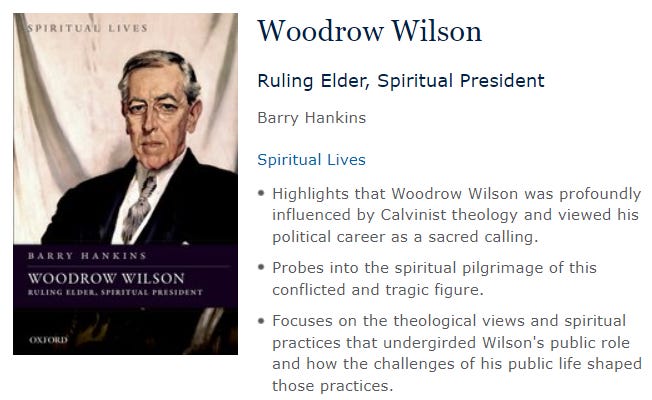
Patrick Weil’s The Madman in the White House, a detailed study of Woodrow Wilson and his statecraft, falls into this category. Wilson reluctantly brought the US into the First World War and, during the Paris Peace Conference, attempted to create a new world order, known as Wilsonianism, along liberal internationalist lines. By ensuring the attainment of its other principles – the promotion of democracy, self-determination, collective security – the League of Nations was Wilsonianism’s bedrock. This was always going to be a tough sell in America, but Wilson refused to compromise on the League’s basic design. His unstoppable force met the immovable objections of the Republican Party, led by Henry Cabot Lodge, and, though Wilson was a strong president, Republicans controlled the Senate. Lodge prevailed, and the standoff meant that the US never ratified the Treaty of Versailles or joined the League. Wilson predicted that the consequence would be another world war.
Psychohistory and the Psychohistorian had passed from the scene decades ago. Prof. Preston’s ignorance, of this second half of Robert Coles 1973 essay, seems inexcusable given his credentials!
No doubt somewhere there is a historian prepared to insist that any psychoanalyst who wants to write about history take a full graduate course and spend a few years doing “proper” historical research. But some scholars have to some degree combined the two disciplines—the historian Bruce Mazlish, for example, or the political scientist E. Victor Wolfenstein. Both men have psychoanalytic knowledge—of an order Dr. Eissler would doubtless find acceptable—as well as training in their professions.
Professor Mazlish has been an especially active proponent of what he and others (Robert Jay Lifton, Joel Kovel, John Demos) call “psychohistory.” Each of these men has his own particular way of working with historical materials from a psychological (more precisely, psychoanalytic) point of view. They share a common interest in drawing upon several disciplines in the hope of seeing human experience more broadly, and escaping the rigidities and biases inherent in any particular psychoanalytic formulation. Robert Wallerstein has perhaps made the best case for such activity:
…
Yet as one goes through Mazlish’s In Search of Nixon: A Psychohistorical Inquiry or Wolfenstein’s The Revolutionary Personality: Lenin, Trotsky, Gandhi, it seems clear that both scholars have as many dangers to avoid as opportunities to grasp. In both books we are warned that psychoanalytic “reductionism” is offensive and perhaps a thing of the past. Nevertheless, Nixon is called “oral” and “anal” at various points, as are Lenin, Trotsky, and Gandhi. Ambivalences are discussed, problems with mothers and fathers described at length.
In the case of Mazlish’s book an interesting dialectic of sorts takes place. First the President is described or typed. (“Orality is an important element in Nixon’s character.”) Then the reader is informed that such a description merely makes Richard Nixon a human being. If he has used a “genital metaphor and an anal one,” then “others frequently use similar metaphors.” After we have read two-thirds of his book, in which words or phrases like “passivity,” “death anxiety,” and “survivor guilt” are pervasive, Mazlish makes this statement: “What we have been discussing up to now may be thought of as the psychological banalities of Nixon’s character.” One wonders, at this point, why the author has bothered to write this book at all, especially since the rest of the book offers nothing else about the President’s “character,” only an extensive justification of the value of “psychohistory” as “science.”
Zachary Jonathan Jacobson writes ‘On Nixon’s Madness: An emotional history’ … The Reader might ask herself, what is an ‘emotional history’, or might it be? Could it be a kind of modern day reductionism of Psychoanalysis/Psychohistory? Andrew Preston seems, at the least, duly impressed : ‘brilliant, insightful, beautifully written book’.
If historians ranked the maddest of the modern presidents, it’s certain Wilson wouldn’t top the list. That honour would more likely go to Zachary Jonathan Jacobson’s subject, Richard Nixon. But in this brilliant, insightful, beautifully written book, Jacobson takes a different approach from Weil’s. Rather than diagnosing Nixon’s pathologies, he uses the infamous “madman theory” as a point of entry into one of the most consequential presidencies in history.
Andrew Preston’s praise of Zachary Jonathan Jacobson ‘emotional history’ reads like maladroit Anti-Trump propaganda, with Nixon acting the part as the ‘bizarre personality, along with his clumsy attempts to manipulate reality so that it would conform to an image he not only wanted to project, but needed to believe’.
Nixon has been written about more extensively than most presidents, so the audacious originality of On Nixon’s Madness is a truly impressive feat. Jacobson’s account examines Nixon’s bizarre personality, along with his clumsy attempts to manipulate reality so that it would conform to an image he not only wanted to project, but needed to believe. As Jacobson observes: “It was as if Nixon had never quite mastered the role of Richard Nixon”. He was “ill-calibrated”. The results – including the prolonging of the war (the madman theory turned out to be a strategic dud) and the Watergate crisis – destroyed Nixon and destabilized an increasingly divided nation.
Most presidents have displayed strange or antisocial behaviour. Perhaps that’s because they’ve all to some extent been mentally ill: who other than a narcissist would even want the job? Others may have had the sense not to say it out loud, but Trump wasn’t the only president to believe “I alone can fix it”. Maybe Wilson and Nixon were indeed mad. But if so, they probably all were.
My comment is a sketch, at best, but it might just enable The Reader to navigate Prof. Preston essay, via some sources that transcended the imperatives of propaganda.
Rootless cosmopolitan,down at heels intellectual;would be writer.
'Polemic is a discourse of conflict, whose effect depends on a delicate balance between the requirements of truth and the enticements of anger, the duty to argue and the zest to inflame. Its rhetoric allows, even enforces, a certain figurative licence. Like epitaphs in Johnson’s adage, it is not under oath.'
https://www.lrb.co.uk/v15/n20/perry-anderson/diary


 StephenKMackSD's Blog