Capitalism’s failure to lift living standards, impose the rule of law and tame flourishing corruption and nepotism have given way to fond memories of the times when the jobless rate was zero, food was cheap and social safety was high.
“(The bad) things have been forgotten,” said Rumen Petkov, 42, a former guard now clerk at the only prison still functioning on the Persin island.
“The nostalgia is palpable, particularly among the elderly,” he said, in front of the crumbling buildings of another old jail opened on the site after the camp was shut in 1959. The communists imprisoned dozens of ethnic Turks here in the 1980s when they refused to change their names to Bulgarian.
Some young people in the impoverished town of Belene, linked to the island with a pontoon bridge, also reminisce: “We lived better in the past,” said Anelia Beeva, 31.
“We went on holidays to the coast and the mountains, there were plenty of clothes, shoes, food. And now the biggest chunk of our incomes is spent on food. People with university degrees are unemployed and many go abroad.”
In Russia, several Soviet-themed restaurants have opened in Moscow in recent years: some hold nostalgia nights where young people dress up as pioneers — the Soviet answer to the boy scouts and girl guides — and dance to communist classics.
Soviet Champagne and Red October Chocolates remain favourites for birthday celebrations. “USSR” T-shirts and baseball caps can be seen across the country in summer.
While there is scant real desire for old regimes to be restored, analysts say apathy is a vital outcome.
“The big damage of the nostalgia…is that it dries out the energy for meaningful change,” wrote Bulgarian sociologist Vladimir Shopov in the online portal BG History.
The year 1989 brought the fall of the Berlin Wall and the collapse of communism in Eastern Europe. It was also the year that the economic theories of Reagan, Thatcher, and the Chicago School achieved global dominance. And it was these neoliberal ideas that largely determined the course of the political, economic, and social changes that transformed Europe—both east and west—over the next quarter century
Philipp Ther—a firsthand witness to many of the transformations, from Czechoslovakia during the Velvet Revolution to postcommunist Poland and Ukraine—offers a sweeping narrative filled with vivid details and memorable stories. He describes how liberalization, deregulation, and privatization had catastrophic effects on former Soviet Bloc countries. He refutes the idea that this economic “shock therapy” was the basis of later growth, arguing that human capital and the “transformation from below” determined economic success or failure. Most important, he shows how the capitalist West’s effort to reshape Eastern Europe in its own likeness ended up reshaping Western Europe as well, in part by accelerating the pace and scope of neoliberal reforms in the West, particularly in reunified Germany. Finally, bringing the story up to the present, Ther compares events in Eastern and Southern Europe leading up to and following the 2008–9 global financial crisis.
…
Goldberg ends her ‘essay’ with
One silver lining to Brexit is that it offers a cautionary tale for the rest of Europe. After Britain voted to leave the E.U. in 2016, there’s been fear, among some who care about the European project, that France or Italy could be next. But as The Guardian reported, as of January, support for leaving the E.U. has declined in every member state for which data is available. As governments across the continent move rightward, the E.U. itself is moving in a more conservative direction, but it’s not coming apart.
“I don’t think you’re going to see other countries in the E.U. leaving the E.U. if for no other reason than because they’ve seen the impact on us,” said Khan. But there’s a larger lesson, one most Western countries seemingly have to continually relearn. Right-wing nationalist projects begin with loud, flamboyant swagger. They tend to end unspeakably.
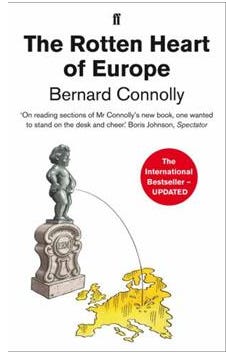
If The Reader consults François Duchêne’s hagiography of ‘Jean Monnet: The First Statesman of Interdependence’ reviewed here..
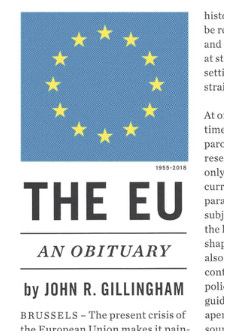
No one can seriously doubt the existence of a crisis in the affairs of the European Union. As the implications of the treaties on which it is based, including the Maastricht timetable for economic and monetary union, become ever more widely appreciated, and as the ordinary citizen in most member countries begins to participate in the debate over the future of the Union and its institutions (a debate hitherto largely confined to the United Kingdom), the glow of the European ideal begins to fade and the demand for precise definitions as to what it is all for becomes louder. We are all Euroskeptics now.
The only country seemingly unaware of this change in public attitudes is the United States of America. Washington continues to act on the assumption that a “United States of Europe” is the continent’s inevitable destiny, and American ambassadors continue to proclaim in London, and no doubt elsewhere, that nothing must be allowed to frustrate this “manifest destiny,” even at the expense of the solidarity of the English-speaking and Atlantic worlds.
Ever since I began studying this process nearly forty years ago, I have been puzzled by the uncritical acceptance in the United States of the view that only with common institutions exercising sovereign power could Europe flourish economically, and play a proper role in its own defense. For while it is understandable that the United States should welcome the apparent decision of the countries of Western and Southern Europe to end their age old strife–did not Americans twice have to intervene to redress the balance?–the assumption that, without the institutions of Brussels, Luxembourg, and Strasbourg, these countries would once again be preparing for armed conflict is on the face of it wholly implausible.
…
Should The Reader look to the continuing Rebellion’s in France, or the Revolt of the Dutch Farmers against the EU, as indicative of the fracture of Monnet’s ‘vision’? Or might The Reader be blunt: Michelle Goldberg is out of her depth, yet fully congruent with current ‘political wisdom’. Yetthe fracturing of a Utopian Capitalist Collectivism, in sum The EU , tinctured in an etiolated Neo-Liberalism, is under attack by The Populist Menace?
Rootless cosmopolitan,down at heels intellectual;would be writer.
'Polemic is a discourse of conflict, whose effect depends on a delicate balance between the requirements of truth and the enticements of anger, the duty to argue and the zest to inflame. Its rhetoric allows, even enforces, a certain figurative licence. Like epitaphs in Johnson’s adage, it is not under oath.'
https://www.lrb.co.uk/v15/n20/perry-anderson/diary


 StephenKMackSD's Blog