‘One of the great turning points in 20th-century American history was the Supreme Court’s 1954 Brown v. Board of Education decision, which overturned on constitutional grounds the 19th-century Plessy v. Ferguson case that had upheld legal segregation. This decision was the starting point for the civil rights movement, which, over the following decade, succeeded in dismantling the formal barriers to racial equality and guaranteed the rights of African Americans and other minorities. The courts had cut their teeth earlier over union organizing rights; new social rules based on those rights provided a model for subsequent social movements in the late 20th century, from environmental protection to women’s rights to consumer safety to gay marriage.
So familiar is this heroic narrative to Americans that they seldom realize how peculiar it is. The primary mover in the Brown case was the National Association for the Advancement of Colored People (NAACP), a private voluntary association. The initiative had to come from private groups, of course, because state governments in the South were controlled by pro-segregation forces. The NAACP pressed the case on appeal all the way to the Supreme Court. What was arguably one of the most important changes in American public policy thus came about not because Congress, as the representative of the American people, voted for it but because private individuals litigated through the court system to change the rules. Later developments, like the Civil Rights and Voting Rights Acts, were the result of congressional action, but even in these cases enforcement was carried out by courts at the behest of private parties.’
The genesis for Conservatism’s Myth of Usurpation of The Old Order , here presented in the abstruse rhetorical frame of ‘Institutional Decay’: the end of Segregation in public education, and it’s corollary of oppression, Jim Crow, proceeds from the unanimous Brown v Board. The Civil Rights movement in it’s most militant phase grew out of this landmark decision. It is the beginning of the politics of the present, the genesis of The Federalist Society, and the judicial careers of Rehnquist,Scalia, Thomas, Alito inextricably linked to Neo-Confederate/Originalism as legal cover, the Nixon Southern Strategy, and of the contemporary blight of Republican Nihilism. The proof is the legal restrictions placed on voting in 26 states controlled by Republican governors and legislatures ,since the election of President Obama. And the legal obscenity of the Robert’s majority decision in Shelby County v. Holder. It’s overarching but utterly disingenuous rhetorical/legal claim: ‘things have changed’. Read Justice Ginsburg’s devastating polemical dissent, it is based not on bogus claims, but on the presentation of empirical evidence.
‘No other liberal democracy proceeds in this fashion. All European countries have gone through similar changes to the legal status of racial and ethnic minorities, and women and gays in the second half of the 20th century. But in Britain, France or Germany, the same results have been achieved through a national justice ministry acting on behalf of a parliamentary majority. The legislative rule changes might well have been driven by public pressure, but they would have been carried out by the government itself, not by private parties acting in conjunction with the judiciary.’
That somehow the Racial Violence and institutional racism legal Segregation was could have been ended by the legislatures of the deep South and the North is pure Conservative lie, no other name for it! There was no political will to enact such a change. The growth of Federal power was a rational legal response to segregationist intransigence. See President Eisenhower’s telegram to Governor Faubus dated September 5, 1957:
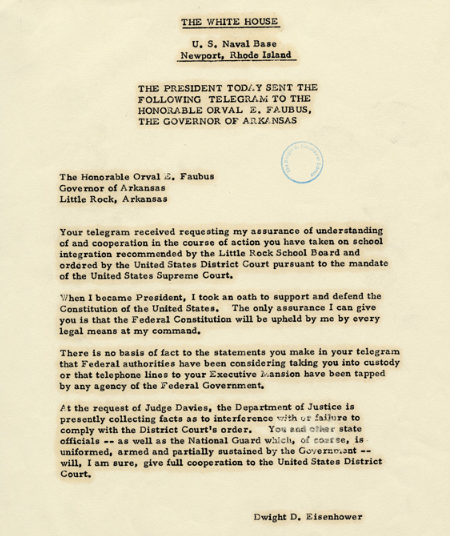
President Eisenhower’s letter may prove Mr. Fukuyama’s claims to be true, according to his presented arguments, as unconvincing as they may be. Yet the cult of the Law was once a cornerstone of ‘Conservatism’, or perhaps it was law based on an entrenched, indeed institutionalized ,racial hierarchy. In this portion of Mr. Fukuyama’s essay, an unconvincing attempt to re-frame Brown as a product of ‘institutional decay’, rather that of a civic/legal/institutional vibrancy, takes it’s place as a politically complicated set of arguments: a highly intellectualized and rationalized propaganda.
Political Observer


 StephenKMackSD's Blog
Pingback: Nicholas Xenos describes the Straussian Method, and I provide some examples of it’s application | StephenKMackSD's Blog
Reblogged this on StephenKMackSD's Blog.