It would be easy to be dazzled by the way Israeli, American and other allied militaries shot down virtually every Iranian drone, cruise missile and ballistic missile launched at Israel on Saturday and conclude that Iran had made its point — retaliating for Israel’s allegedly killing a top Iranian commander operating against Israel from Syria — and now we can call it a day.
That would be a dangerous misreading of what just happened and a huge geopolitical mistake by the West and the world at large.
There now needs to be a massive, sustained, global initiative to isolate Iran — not only to deter it from trying such an adventure again but also to give reason to Israel not to automatically retaliate militarily. That would be a grievous error, too. Iran has a regional network, and Israel needs a regional alliance, along with the U.S., to deter it over the long run.
So there must be major diplomatic and economic consequences for Iran, with countries like China finally stepping up: When Tehran fired all those drones and missiles, it could not know that virtually all of them would be intercepted. Some were shot down over Jerusalem. A missile could have hit al-Aqsa Mosque, one of Islam’s holiest shrines. (You can see pictures online of Iranian rockets being intercepted in the skies right over the mosque.) Another could have hit the Israeli Parliament or a high-rise apartment house, causing massive casualties.
…
No one should think Iran is just a paper tiger. Tehran can still unleash thousands of shorter-range rockets against Israel through Hezbollah — and because some of these rockets have precision guidance, they could do significant damage to Israel’s infrastructure. Iran has bigger missiles in its arsenal, as well.
Still, what happened Saturday is ultimately a significant boost for what I call the Inclusion Network in the Middle East (more open, connected countries like Jordan, Saudi Arabia, Bahrain, the United Arab Emirates, Egypt and Israel and the NATO allies) and a real setback for the Resistance Network (the closed and autocratic systems represented by Iran, Hamas, Hezbollah, the Houthis and Iran’s Shiite militias in Iraq) and Russia. The sound within Iran and the Resistance Network on Sunday morning is that sound you hear from your car’s GPS after a wrong turn: “Recalculating, recalculating, recalculating.”
Mr. Friedman is writer given to Zionist Apologetics/Propaganda, and the manufacture of puerile Catch-Phrases: ‘The Inclusion Network’ & ‘The Resistance Network’ a reductivist pastiche of actual thought!
Bret Stephens offers this:
After several days during which Supreme Leader Ali Khamenei repeatedly vowed that “the evil Zionist regime” would be punished for its April 1 attack on Iran’s embassy complex in Damascus that killed seven Iranian military advisers, including three top commanders, the Islamic Republic struck. More than 300 drones and missiles launched from Iranian soil took aim at Israel on Saturday. Nearly all of them were intercepted, mainly by Israeli or American defenses, with a report of just one Israeli casualty, a girl from a Bedouin community wounded by shrapnel.
Will that be the end of it?
It’s no secret that Israel and Iran have fought a shadow war for decades. The weekend attack is notable for two reasons: its directness and its ineffectuality. Iranian military commanders undoubtedly understood that most of their slow-moving drones, about 170 in all, would be shot down before reaching their targets. They were a diversion. Those commanders were probably more surprised that their 30 cruise missiles and 120 ballistic missiles also did negligible damage.
That should drive home a clear lesson to Iran’s leaders: They are no technological match for the Jewish state, especially when the United States is lending a hand. If Israel decides to respond to the attack with direct strikes on Iran — perhaps against oil installations, nuclear sites or military infrastructure — it isn’t likely to miss its targets.
The reader/viewer might look to an actual expert Scott Ritter, being interviewed by George Galloway, that explores the questions raised by the Iranian attack on Israel?
Mr Stephens is a notorious Zionist partisan/apologist. Ritter an expert in Warfare. Stephens is a New York Times opinion writer. Expertise vs. Opinion?
The final two paragraphs of The Stephens Melodrama. The Neo-Conservative wallows in war mongering brio, without the actual experience of battle, that Ernst Jünger’s ‘Storm of Steele’ offers the reader!
Nor is it to say that Israel doesn’t deserve President Biden’s full support if it chooses to retaliate for Saturday’s attack. The Ayatollah Khamenei surely noted the friction between Israel and the West over Gaza when he ordered the strike; daylight between Israel and the United States is often an invitation to mischief by the common enemies of both. The president has political reasons to avoid another full-scale regional war in an election year. But the best way to avert such a war is to leave Tehran with no illusions that it could separate Israel from the United States by starting one.
The key decisions of the past half-century that have driven the Middle East to the place it is in today have a common origin: Iran’s Islamic Revolution of 1979, which brought to power a theocratic despotism intent on sowing fanaticism, brutalizing its own people, destroying Israel and causing misery across the region for the sake of its ideological aims. Saturday’s missile attack is the latest example of a long and ugly record. But as Israelis decide how to react, they wouldserve their interests best by recalling the useful adage that revenge is a dish best served cold.
A sampler of this ‘Mulligan Stew’ that Ganesh prepares for his readers is helpful:
…
Jonathan Haidt’s The Anxious Generation, smartphone panic exists, smartphone panic exists,
so insulated from life-and-death issues that sad teenagers are what pass for news
it is a parable for the west, where life can be too good for our own good.
Where did the “woke” movement take hold?
the 2008 financial crash and the 2020 pandemic.
If woke is the howl of the dispossessed,
Problems of success are harder to fix because,
answer to the culture war is, after all, “induce an economic depression”.
the most effective answer to low birth rates is “undo modernity”.
Parents no longer need to have three children to ensure that one survives.
hey needn’t even have one as a source of income support in old age. State pensions have seen to that.
From something precious (the Enlightenment), something bleak (demographic decline).
the baby bust, No, that is populism,
the last time that electing a demagogue led to total societal ruin
the last crash starts to take risks with its balance sheet.
economist Hyman Minsky said of financial crises, that stability breeds instability,
The challenge is to persuade western intellectuals of this.
It is a hopeless account of the past decade.
The Brexit campaign won most of England’s affluent home counties.
it liberates people to be cavalier with their vote,
Faced with problems of failure — disease, illiteracy, mass unemployment — western elites are supremely capable.
(What if all the jobs disappear?)
(What will people do with all that leisure?)
Modernity — a world in which most people live in cities, have freedom from clerics and communicate across great distances at low cost — came along about five minutes ago in the history of civilisation.
The story isn’t phone-induced stress or even low birth rates. The story is that we haven’t experienced much worse.
Mr. Ganesh riffs on the themes of the Neo-Cons, who drown The Reader in chatter, that begats confusion and exploitable in-attention, or just utter despair: think of a novice attempting to read Hagel or Heidegger, without preliminary research!
It’s always a revelation, of a kind, to read Mr. GaneshHistory Made to Measure that places the 14 year Tory Rule as preferable, to the New Labour of ‘Corbyn Slayer’, and Labour Friends of Israel apologist Kier Starmer, as somehow not a bad copy of the Tories? After all Mrs. Thatcher proclaimed Tony Blair , the actual Leader of New Labour, as her greatest accomplishment!
The rhetorical prestidigitations, of the Ganesh of remembrance, is now long gone. These almost gems deserve to be quoted, apart for the the rest of the rhetorical dross:
…
For all Starmer’s underrated toughness, this is still a party that twice offered Jeremy Corbyn as prime minister.
…
If not — if progressives, with their Marxian weakness for narrative, have read a big dialectical shift into the messiness of real life — expect a very unpopular Labour government, very soon
…
Yet The Reader confronts this dubious declaration about ‘middle age’ as the end point of Mr. Ganesh’s endorsement of Tory incompetence, wedded to its mendacity!
Among the consolations of middle age is seeing things from one’s prime years come around again. After the financial crash in 2008, Labour was confident that the hour of the state had arrived. It entertained talk of a post-liberal world. It elected leaders in that image. It hasn’t governed since.
Political Cynic
Reader recall this essay from 2019?
Jeremy Corbyn’s Labour cannot be trusted to govern
This week’s conference showcased a divided and paranoid party
Jeremy Corbyn, a leader who fails to inspire the confidence of many of his own MPs, is behind many of the problems. His attitude to foreign affairs and a visceral anti-American stance are a threat to national security. Whether it is the EU or Nato, he has made clear his mistrust of and opposition to organisations involving Britain’s closest allies that have underpinned peace and prosperity in Europe for decades.
Yet much of the party remains in thrall to Mr Corbyn. Many delegates feared his refusal to embrace a Remain stance could cost the party dearly in a coming election. Even so, Corbyn loyalists treated a vote on Mr Corbyn’s Brexit policy as an issue of confidence in the leader, urging delegates to back him to avoid a defeat that could be exploited by a hostile media and a disloyal parliamentary party.
Devoted Corbynites support an approach to the economy that sees a powerful interventionist state as the solution to every problem. The party this week escalated its attacks on the foundations of British prosperity. Not only does Mr Corbyn see the free market economy as a conspiracy to exploit workers, he has singled out two sectors in which the UK excels — finance and life sciences — for special attention. In addition to his existing plans for the City of London, he announced new plans for compulsory licenses for pharma patents for a new state-owned generic drugmaker. Such policies could have a chilling effect on Britain’s status as a research and development hub.
…
Here is political hysteric Jonathan Freedland in The New York Review of Books, of November 2020, reciting the crimes of Jeremy Corbyn:
To Labour’s Anti-Semitism Saga, a Bitter Denouement
Jeremy Corbyn’s suspension after defying a report’s damning conclusions about his leadership was the last twist in a shameful chapter of the party’s history.
…
Corbyn didn’t see it that way. Thirty-five minutes after publication, before Starmer had even delivered Labour’s official response to the report, Corbyn issued his own statement on Facebook making it clear that he did not accept all of the EHRC’s findings; indeed, he believed that the problem of anti-Semitism in the Labour Party had been “dramatically overstated.” That clashed with Starmer’s insistence that anyone who sought to minimize Labour’s anti-Semitism problem belonged “nowhere near the Labour Party.” (Indeed, I’m reliably informed that Corbyn knew in advance that this was precisely where Starmer would draw the line, but he chose to cross it anyway.) By lunchtime that day, Labour officials had suspended Corbyn’s party membership. He remains a member of Parliament, but will no longer count as part of the Labour group in the House of Commons. Considering that Corbyn was the leader of the Labour Party as recently as April, it’s a remarkably swift fall.
…
Al Jazeera provides the antidote to both The Financial Times and Freedland’s defamation of Corbyn!
The Labour Files – Episode 1 – The Purge I Al Jazeera Investigations
Newspaper Reader engages is some revelatory Political Archelogy.
Mr. Sunstein latest political intervention on behalf of another Academic/Technocrat should not surprise. Daniel Kahneman represents the virtue of seeking ‘a consensus’ of a kind, with his critics in an Academic World, consonant with the adversarial, is presented as a virtue?
I’ll offer a selection of Sunstein’s 1093 word argument.
Our all-American belief that money really does buy happiness is roughly correct for about 85 percent of us. We know this thanks to the latest and perhaps final work of Daniel Kahneman, the Nobel Prize winner who insisted on the value of working with those with whom we disagree.
Professor Kahneman, who died last week at the age of 90, is best known for his pathbreaking explorations of human judgment and decision making and of how people deviate from perfect rationality. He should also be remembered for a living and working philosophy that has never been more relevant: his enthusiasm for collaborating with his intellectual adversaries. This enthusiasm was deeply personal. He experienced real joy working with others to discover the truth, even if he learned that he was wrong (something that often delighted him).
Back to that finding, published last year, that for a strong majority of us, more is better when it comes to money. In 2010, Professor Kahneman and the Princeton economist Angus Deaton (also a Nobel Prize winner) published a highly influential essay that found that, on average, higher-income groups show higher levels of happiness — but only to a point. Beyond a threshold at or below $90,000, Professor Kahneman and Professor Deaton found, there is no further progress in average happiness as income increases.
Sunstein offers this as an object lesson of the ‘Kahneman Methodology’:
Eleven years later, Matthew Killingsworth, a senior fellow at the Wharton School of the University of Pennsylvania, found exactly the opposite: People with higher income reported higher levels of average happiness. Period. The more money people have, the happier they are likely to be.
What gives? You could imagine some furious exchange in which Professor Kahneman and Professor Deaton made sharp objections to Dr. Killingsworth’s paper, to which Dr. Killingsworth answered equally sharply, leaving readers confused and exhausted.
Professor Kahneman saw such a dynamic as “angry science,” which he described as a “nasty world of critiques, replies and rejoinders” and “as a contest, where the aim is to embarrass.” As Professor Kahneman put it, those who live in that nasty world offer “a summary caricature of the target position, refute the weakest argument in that caricature and declare the total destruction of the adversary’s position.” In his account, angry science is “a demeaning experience.” That dynamic might sound familiar, particularly in our politics.
Instead, Professor Kahneman favored an alternative that he termed “adversarial collaboration.” When people who disagree work together to test a hypothesis, they are involved in a common endeavor. They are trying not to win but to figure out what’s true. They might even become friends.
Jeremy Waldron in The New York Review of Books offered a review of October 9, 2014 of two books by Cass Sunstein:
I’ve made some choices for The Reader, that she may not agree with, so feel free to comment! But Waldron seems to be right on target in his criticisms of these books!
…
Employers sometimes try to educate people to make better choices, offering them retirement-planning seminars, for example. But the lessons of these seminars are soon forgotten: “Employees often leave educational seminars excited about saving more but then fail to follow through on their plans.” And so Sunstein and Thaler suggested a different strategy. Instead of teaching people to overcome their inertia, we might take advantage of their inertia to solve the problem. Suppose we arrange things so that enrollment at some appropriate level of contribution is the default position—the position that obtains if the employee does nothing. Something has to be the default position; why not make it the position that accrues most to the employee’s benefit, “using inertia to increase savings rather than prevent savings”?
Resetting the default position this way is what Thaler and Sunstein call a “nudge.” It exploits the structure of the choice to encourage a more desirable option. The decision is not taken entirely out of the employee’s hands. She can still change it and revert to a strategy of no contributions or diminished contributions to her retirement funds. But in that case she has to make an effort; this is where she has to overcome her inertia.
Nudging is an attractive strategy. People are faced with choices all the time, from products to pensions, from vacations to voting, from requests for charity to ordering meals in a restaurant, and many of these choices have to be made quickly or life would be overwhelming. For most cases the sensible thing is not to agonize but to use a rule of thumb—a heuristic is the technical term—to make the decision quickly. “If it ain’t broke don’t fix it,” “Choose a round number,” “Always order the special,” and “Vote the party line” are all heuristics. But the ones people use are good for some decisions and not others, and they have evolved over a series of past situations that may or may not resemble the important choices people currently face.
Here begins Waldron’s critical analysis:
Nudging is about the self-conscious design of choice architecture. Put a certain choice architecture together with a certain heuristic and you will get a certain outcome. That’s the basic equation. So, if you want a person to reach a desirable outcome and you can’t change the heuristic she’s following, then you have to meddle with the choice architecture, setting up one that when matched with the given heuristic delivers the desirable outcome. That’s what we do when we nudge.
All of this sounds like a marketer’s dream, and I will say something about its abusive possibilities later. But Sunstein and Thaler have in mind that governments might do this in a way that promotes the interests of their citizens. Governments might also encourage businesses and employers to use it in the interests of their customers and employees. The result would be a sort of soft paternalism: paternalism without the constraint; a nudge rather than a shove; doing for people what they would do for themselves if they had more time or greater ability to pick out the better choice
…
Mr. Waldron ends his review here:
…
There’s a sense underlying such thinking that my capacities for thought and for figuring things out are not really being taken seriously for what they are: a part of my self. What matters above all for the use of these nudges is appropriate behavior, and the authorities should try to elicit it by whatever informational nudge is effective. We manipulate things so that we get what would be the rational response to true information by presenting information that strictly speaking is not relevant to the decision.
I am not attributing informational nudging to Sunstein. But it helps us see that any nudging can have a slightly demeaning or manipulative character. Would the concern be mitigated if we insisted that nudgees must always be told what’s going on? Perhaps. As long as all the facts are in principle available, as long as it is possible to find out what the nudger’s strategies are, maybe there is less of an affront to self-respect. Sunstein says he is committed to transparency, but he does acknowledge that some nudges have to operate “behind the back” of the chooser.
It may seem a bit much to saddle Cass Sunstein with all this. The objections about dignity and manipulation that I’ve been considering can sound hysterical. It is perfectly reasonable for him to ask: “Is there anything insulting or demeaning about automatic enrollment in savings and health care plans, accompanied by unconstrained opt-out rights?” The strategies he advocates, when used wisely and well, seem like a sensible advance in public regulation, particularly when we consider them nudge by nudge.
Still, it is another matter whether we should be so happy with what I have called “nudge-world.” In that world almost every decision is manipulated in this way. Choice architects nudge almost everything I choose and do, and this is complemented by the independent activity of marketers and salesmen, who nudge away furiously for their own benefit. I’m not sure I want to live in nudge-world, though—as a notoriously poor chooser—I appreciate the good-hearted and intelligent efforts of choice architects such as Sunstein to make my autonomous life a little bit better. I wish, though, that I could be made a better chooser rather than having someone on high take advantage (even for my own benefit) of my current thoughtlessness and my shabby intuitions.
Here is Sunstein’s reply to Waldron’s critical analysis and Waldron’s reply:
I am most grateful to Jeremy Waldron for his generous and clear-headed review of my books Why Nudge? The Politics of Libertarian Paternalism and Conspiracy Theories and Other Dangerous Ideas [NYR, October 9]. Waldron worries that nudging poses a risk to autonomy and dignity, but it is important to see that nudges are meant to promote both of those values. Disclosure of relevant information (about the terms of a school loan or a mortgage, for example) is hardly a threat to human dignity. When people are asked what they would like to choose, their autonomy is enhanced, not undermined. (Active choosing is a prime nudge.) A GPS certainly nudges, but it does not compromise what Waldron favors, which is “a steadfast commitment to self-respect.” Waldron is right to worry about the risk of manipulation, but the whole idea of nudging is designed to preserve freedom of choice, and in that sense both autonomy and dignity.
Cass R. Sunstein Robert Walmsley University Professor Harvard University Cambridge, Massachusetts
Jeremy Waldron replies:
I appreciate this clarification. Many nudges simply involve an improvement of the decision-making environment and of the information available to choosers. Professor Sunstein is right that there can be no objection to that. But in his book, the term “nudge” also comprises attempts to manipulate people behind their backs, using their own defective decision-making to privilege outcomes that we think they ought to value. I think both of us should be concerned about that and about a world in which that more sinister sense of nudging becomes a widespread instrument of public policy.
The Reader might think to herself, that Sunstein has ‘evolved’ in light of his praise of for the ‘Kahneman Methodology’?
Final thought: ‘Conspiracy Theories’ is/was a mask to hide the role that The American National Security State played in the assassination John Kennedy. The test of fealty to this lie, was professing a belief that only ‘crackpots’ believed in these ‘theories’. Arlen Spector was its apologist till the end!
Political Cynic on a revelatory portion of Jonathan Guyer’s political encyclical.
…
In a Box With Biden
Unless President Biden is willing to kick down the sides of the box—checking his own assumptions about Israel, facing down the realities of the electorate, turning to new advisers with a broader perspective, and seeing the Middle East as it is—he will remain constrained.
Many policies to ensure human rights and accountability are already enshrined in law. They are lying in wait, unused. “If we’re going to keep arming Israel then there’s not that much to talk about,” Yager told me.
On most topics in any presidential administration, credit or blame can be broadly distributed. But in this case, the pro-Israel directives are coming from the president himself, with his instincts from another era. “Biden has a multi-decade career where he has proudly stood with Israel at every turn,” Zaha Hassan of the Carnegie Endowment for International Peace told me. “The idea that now, in his later years, he is going to want to distract from that legacy is unlikely.”
The most powerful foreign-policy officials in the Biden administration are negotiating with Israel about getting more flour into Gaza, tweaking rhetoric in press conferences, urging their boss to adjust small policies on the margin, like holding Israeli settlers to account, while failing to make the bigger adjustments needed to deal with the gravity of the crisis at hand. The story is not really one of foreign policy, but of the ideology and psychology of President Biden.
Mr. Ganesh as boulevardier loves to tease his readership! The first two paragraphs of Ganesh’ s essay are an evocative crowd scene:
Not enough is said about the other Donald T. Having led Poland between 2007 and 2014, Donald Tusk can take some credit as his nation approaches western European standards of living. Now in his second stint, Ukraine has no more vociferous friend in the world. Talk of Poland as the eventual heir to Britain — a pro-market, pro-American and martial voice in the EU — seems rash. It has around half the population and less diplomatic clout. But Tusk’s ease in those institutions as a former Brussels grandee narrows the gap.
Whatever Europe lacks as it tries to become a hard power, it isn’t leadership. Even aside from Tusk, Ursula von der Leyen has been a strong wartime president of the European Commission. With the zeal of a convert, Emmanuel Macron now sees the Kremlin is implacable. Rishi Sunak and Sir Keir Starmer are so as one on Ukraine that the subject never arises in British politics. As an Italian populist, Giorgia Meloni could be a Russia apologist. She isn’t. Even Olaf Scholz, the alleged ditherer, has seen Germany become easily Europe’s largest donor of military aid to Ukraine on his watch.
Then Ganesh actually begins his essay, after his baroque crowd scene, amounts to this:
The high politics aren’t perfect. There are always grounds for a tired metaphor about the Franco-German engine sputtering and so on. But these schisms add up to a rounding error next to the real problem, which is, I’m afraid, us.
Their are no ‘high politics’ except the one imagined by Ganesh. Who is the ‘us’ that he offers? Another 266 words and The Reader thinks she has arrived, with this sentence :
“Leaders must lead, not follow,” you will say, but that is always a dreamy view of politics.
The next paragraphs offers this:
This is the most overused word in politics. The extent to which the public are ever “led” against their preferences is overstated by romantics.
The penultimate paragraph this:
There is good news to be had. Europe is well-led (compare its main figures with America’s).
The final paragraph offers this:
The bad news is that leaders can only ever do so much against public sentiment. Scholz’s “historic turning point” took place in chancelleries. We don’t know if it took place in households. I can’t shake from my mind a quote attributed to another European leader, in another era, in another context. “We all know what to do. But we don’t know how to get re-elected once we have done it.”
Early in the Gaza conflict, a TikTok video of John Kirby went viral. In the first frames, the White House spokesman is composed as he describes civilian casualties in Gaza as part of the “brutal, ugly” reality of war.
For the Biden administration’s critics, that video summed up America’s double standards.
The threat of a famine in Gaza is currently making global headlines every day.
Like Gaza, Sudan borders Egypt. But the Sudanese conflict — and last week’s warning — has been largely ignored by the wider world.
Efforts to free the Israeli hostages held in Gaza have become a centrepiece of international diplomacy.
Go a little further back and the world’s capacity to ignore mass killing and suffering — particularly in Africa — is stark.
The slogan “Black Lives Matter” that began in the US was resonating globally in 2020.
Here after the bourgeoise political chatter gideon.rachman@ft.com arrives at his point:
What is it that causes some tragedies and conflicts to command the world’s attention and others to pass almost unnoticed?
The answer seems to be something that can be called identity geopolitics. A conflict is much more likely to spark international concern and outrage if large numbers of people identify with those who are fighting or suffering. Europeans look at fleeing Ukrainians and imagine their own cities under bombardment. Many Muslims and Jews identify with the warring sides in Gaza.
‘Identity Politics’ can only be defined as a politics that is dismissed out of hand, as prima facie without merit, by its critics, who set an imaginary standard as a singularity? In sum a politics that is out of step with the Technocratic Babblers/ Political Conformists. Rachman simply widens it’s parameters into ‘identity geopolitics’. Six more dazzling paragraphs of Rachman’s political/moral acrobatics and The Reader arrives here:
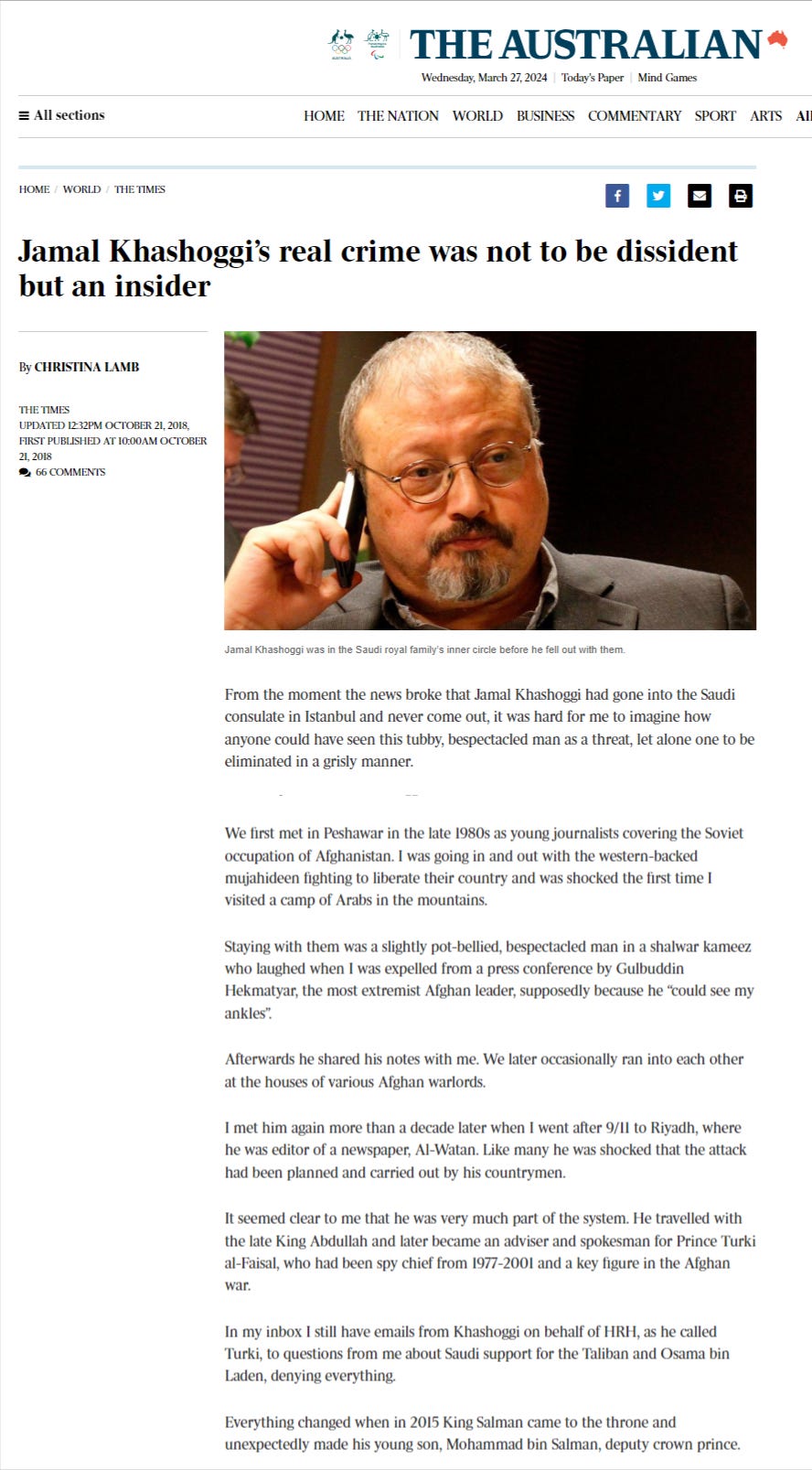
The issue that caused a real crisis in US-Saudi relations was the murder of a single prominent journalist, Jamal Khashoggi. His horrific story had the power to move emotions and shift international politics — unlike the deaths of thousands of other victims, who were destined to remain anonymous.
World politics still seems to live by the infamous phrase, often attributed to Stalin: “A single death is a tragedy, a million deaths is a statistic.”
This report from The Australian of 2024 paints Khashoggi as an ‘Insider’ rather that as a ‘Dissident’ :
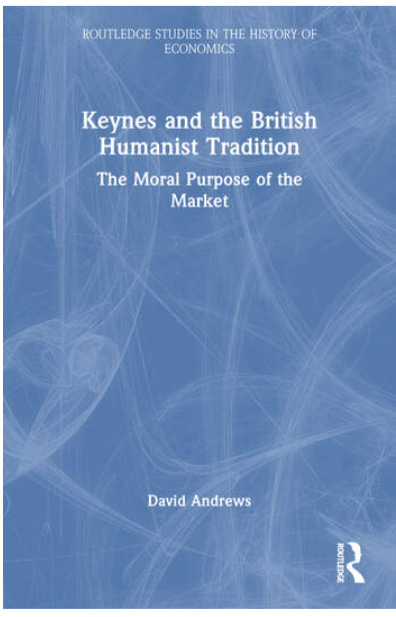
Well-connected in academia, business and government, John Maynard Keynes was one of the most influential economic theorists of the twentieth century. It appears that his theories will be just as important for the twenty-first. As Keynes himself explained, his ideas throughout his life were influenced by the moral philosophy he learned as an undergraduate. Nevertheless, the meaning and significance for Keynes of this early philosophy have remained largely unexplored.
Keynes and the British Humanist Tradition offers an interpretation of Keynes’s early philosophy and its implications for his later thought. It approaches that philosophy from the perspective of the nineteenth century intellectual context out of which it emerged. The book argues that roots of Keynes’s early beliefs are to be found in the traditions of the Apostles, the very famous secret society to which he and most of his teachers belonged. The principles of Keynes’s philosophy can be seen in such writers as John Stuart Mill and Henry Sidgwick, but the underlying ideas have been obscured by changing fashions in philosophy and thus require excavation and reconstruction.
This book will be of interest to students and researchers in the history of economics, in particular the thought of John Maynard Keynes, especially his ethics, politics and economics.
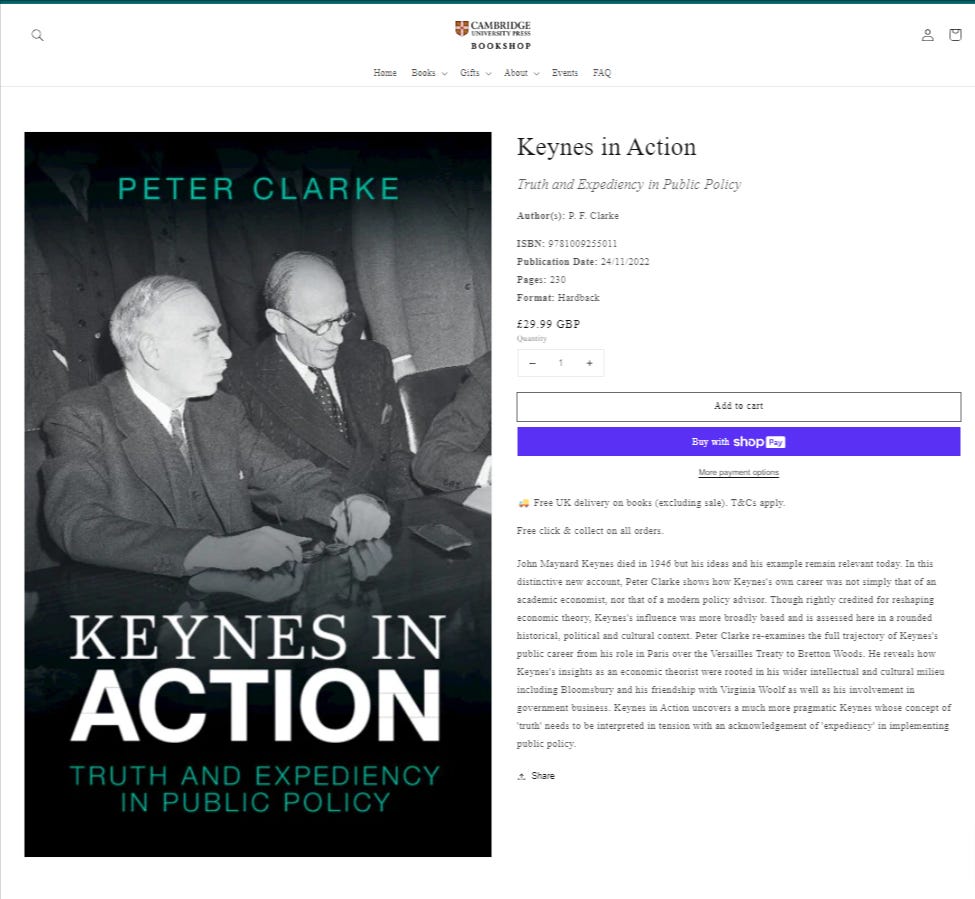
John Maynard Keynes died in 1946 but his ideas and his example remain relevant today. In this distinctive new account, Peter Clarke shows how Keynes’s own career was not simply that of an academic economist, nor that of a modern policy advisor. Though rightly credited for reshaping economic theory, Keynes’s influence was more broadly based and is assessed here in a rounded historical, political and cultural context. Peter Clarke re-examines the full trajectory of Keynes’s public career from his role in Paris over the Versailles Treaty to Bretton Woods. He reveals how Keynes’s insights as an economic theorist were rooted in his wider intellectual and cultural milieu including Bloomsbury and his friendship with Virginia Woolf as well as his involvement in government business. Keynes in Action uncovers a much more pragmatic Keynes whose concept of ‘truth’ needs to be interpreted in tension with an acknowledgement of ‘expediency’ in implementing public policy.
What consequences might flow from Friday’s terrorist attack on Crocus City Hall in Moscow? Even—or especially—for an autocrat who just won a sham election, there is a risk of looking weak or wrong-footed after such a horrific event. Vladimir Putin, a spy by training, tends to stay out of the public eye when confronted by unexpected crises. Last year, for example, he was nowhere to be seen as Yevgeny Prigozhin, the leader of the Wagner mercenary group, led a column of fighters towards Moscow. The Russian president took his revenge later.
This time, as our new article explains, Mr Putin hopes to pin the blame for the Moscow attack on his foes in Ukraine. I suspect he will struggle to do so. An affiliate of Islamic State claimed responsibility for the attack, and it bore the group’s hallmarks. Russia has suffered from Islamist attacks on civilian targets before. Indeed, just a few weeks ago American intelligence warned of an imminent assault by such actors in Russia. Mr Putin dismissed their claims as blackmail.
Nonetheless, Mr Putin will surely try to take advantage of the uncertainty. He might, for example, say that the terrorist threat requires more resources to be given to the security services. Perhaps he will try to mobilise another wave of conscripts to fill the ranks of his army ahead of an anticipated spring offensive for his needless war in Ukraine. Large numbers of young Russian conscripts are slaughtered there each week. Last month we published a grim article assessing how many Russian soldiers have been killed in Ukraine since the invasion two years ago.
Beyond Russia, we have published a new article on the American election: not the presidential race, but the contest for control of Congress. Republicans are within a whisker of losing control of the House of Representatives, just as Democrats may be forced to give up their grip on the Senate. After November, both chambers could see a change of control.
Last week I promised a slightly less fiendish set of questions for our weekly history quiz, Dateline. I believe we have delivered, but let me know how you get on with the new batch.
Spare a thought for the disjointed opposition in India as the election campaign gets under way in the world’s biggest democracy. Late last week the chief minister of Delhi, Arvind Kejriwal, was arrested. I’m not one for conspiracy theories, but it’s a bad look when opposition politicians are dragged off to jail and the bank accounts of their parties frozen, whereas figures in the ruling coalition are left alone. I knew Mr Kejriwal a bit, when I was a correspondent in Delhi a decade or so ago. His newish political party is finding ways to win over voters beyond the capital. Perhaps he is seen as a threat.
Here in Britain I expect to see more stories in the coming days about the royal family, after the Princess of Wales said she was being treated for cancer. Almost every family, including my own, knows how cancer can upend lives. This should be a moment for discussing how to reduce its prevalence and promote better treatment for everyone.
Finally, we have a new story on the boom in equities. The strength of America’s stockmarkets is remarkable, but some analysts are beginning to brace for a crash. Should investors hunting for value look further afield?
Our inbox is crammed with your responses from last week on Israel and Gaza. Thank you for your comments—we read them all and enjoy most of them. This week I’d like you to tell me how you expect Mr Putin to respond to the Moscow terror attack—and what, if anything, it might mean for the war in Ukraine. You can reach us at economisttoday@economist.com.
Mr. Brook’s 3,248 word apologetic for Israel, and its American sponsor does not include the word Genocide. Neo-Conservatives as followers of Leo Strauss, engage in the habit of drowning the reader in words and paragraphs, steeped in verbosity , that seek to obfuscate meaning, from what rhetoric is meant to accomplish, informing the reader, in sum presenting viable arguments.
A sampling of the ‘actors’ in Mr. Brooks’ political melodrama:
the Democratic Party, the war in Gaza, Israel has the right to defend itself, defeat Hamas, The vast numbers of dead and starving children are gut wrenching, it’s hard not to see it all as indiscriminate, If the current Israeli military approach is inhumane, what’s the alternative?, use to defeat Hamas without a civilian blood bath, I’ve been talking with security and urban warfare experts, The thorniest reality that comes up,
Hamas’s strategy is pure evil, but it is based on an understanding of how the events on the ground will play out in the political world.
So we’re back to the original question: Is there a way to defeat Hamas with far fewer civilian deaths?
Another alternative strategy is targeted assassinations.
Furthermore, Hamas’s fighters are hard to find, even the most notorious leaders.
The political costs of this kind of strategy might be even worse than the political costs of the current effort.
A third alternative is a counterinsurgency strategy, of the kind that the United States used during the surge in Iraq.
A fourth alternative is that Israel should just stop.
The national security adviser, Jake Sullivan, has argued that Israel can destroy Hamas in Gaza without a large invasion but “by other means”…
Benny Gantz, reportedly told U.S. officials, “Finishing the war without demilitarizing Rafah is like sending in firefighters to put out 80 percent of a fire.”
…
Reader just 1109 words left of this not very carefully managed Zionist apologetics! Aided by the recycled comments of his selection of Technocrats/Experts!
The concluding paragraphs that features David Petraeus as one of his featured political/moral actors with a quote ‘“Over time, hearts and minds still matter.” Call it what it is a maladroit non sequitur, and or just an inept attempt to express etiolated profundity!
For her book “How Terrorism Ends,” the Carnegie Mellon scholar Audrey Kurth Cronin looked at about 460 terrorist groups to investigate how they were defeated. Trying to beat them with military force alone rarely works. The root causes have to be addressed. As the retired general David Petraeus reminded his audience recently at the New Orleans Book Festival, “Over time, hearts and minds still matter.”
Israel also has to offer the world a vision for Gaza’s recovery, and it has to do it right now. Ross argues that after the war is over, the core logic of the peace has to be demilitarization in exchange for reconstruction. In an essay in Foreign Affairs, he sketches out a comprehensive rebuilding effort, bringing in nations and agencies from all over the world, so Gaza doesn’t become a failed state or remain under Hamas control.
Is any of this realistic given the vicious enmity now ripping through the region? Well, many peace breakthroughs of the past decades happened after one side suffered a crushing defeat. Egypt established ties with Israel after it was thoroughly defeated in the Yom Kippur War. When Israel attacked Hezbollah in southern Lebanon in 2006, the world was outraged. But after the fighting stopped, some Lebanese concluded that Hezbollah had dragged them into a bloody, unnecessary conflict. The Hezbollah leader, Hassan Nasrallah, was forced to acknowledge his error, saying he didn’t know Israel would react so violently. The Lebanese border stabilized. Israel’s over-the-top responses have sometimes served as effective deterrents and prevented further bloodshed.
Israel and the Palestinians have both just suffered shattering defeats. Maybe in the next few years they will do some difficult rethinking, and a new vision of the future will come into view. But that can happen only after Hamas is fully defeated as a military and governing force.

 StephenKMackSD's Blog